Quick answer
Drive the truck at a steady speed near 50 mph on a smooth road. If the whine from the rear appears at constant speed, gets slightly louder or softer as you feather the throttle, and fades as you move away from that speed, your truck may match the pattern Toyota describes in two service bulletins. Toyota says the cause is rear differential vibration transferring through the chassis and body. The differential itself is not condemned by either bulletin.
The factory remedy works on the path the vibration travels. It adds a pad inside each C-pillar, a frame dynamic damper and a new cushion stopper at each No. 3 cab mount, and, on 2016 to 2018 trucks with the wheelbase the bulletin calls long, new rear leaf spring assemblies. Both bulletins were written as warranty repairs under the 36 month, 36,000 mile Basic Warranty, which has expired for every truck covered. In 2026 this is a do-it-yourself or pay-the-shop job, and the parts are small damping pieces.
Do the diagnosis in the next section first. A whine that grows steadily with road speed, changes when you weave the truck side to side, or comes with play at the pinion flange or metal in the fluid is a different problem. Fitting TSB damping parts to a worn bearing will only make a failing part quieter for a while.
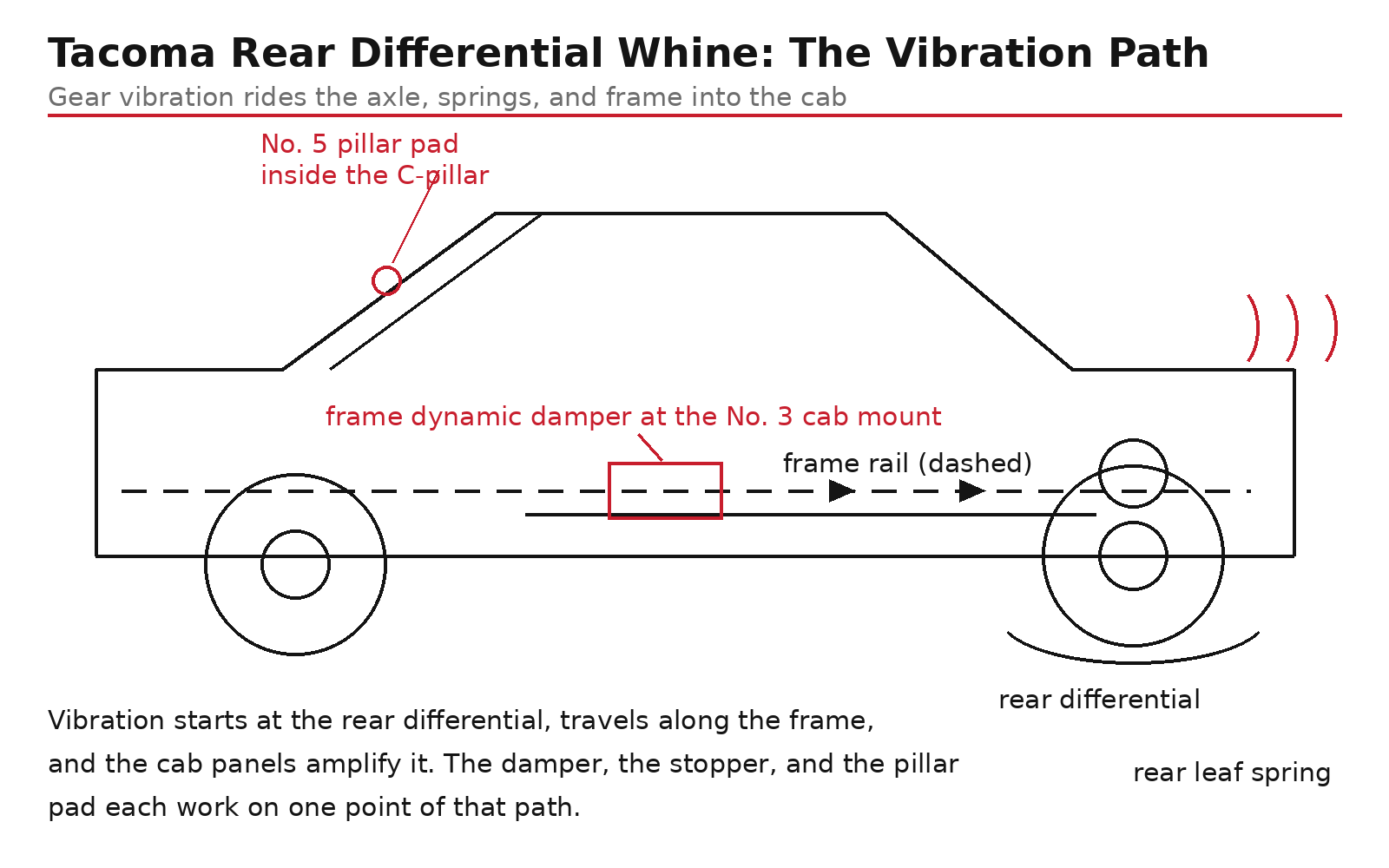
Tacoma Rear Differential Whine Vibration Path
Which trucks the bulletins cover
Toyota split this fix across two bulletins, and the split matters when you order parts.
| Bulletin | Trucks covered | Parts in the remedy |
|---|---|---|
| T-SB-0013-18, February 6, 2018, Rev1 August 8, 2018 | 2016 to 2018 Tacoma Double Cab 4WD with the BD22 rear differential, built before the production change effective VINs listed in Rev1 | Pillar pads, frame dynamic dampers, cab mount cushion stoppers, plus new rear leaf spring assemblies on the wheelbase the bulletin calls long (127.4 in) |
| T-SB-0045-23, July 21, 2023 | 2019 to 2023 Tacoma Double Cab | Pillar pads, frame dynamic dampers, and cab mount cushion stoppers only |
Two limits deserve emphasis. First, both bulletins are Double Cab only. An Access Cab truck with a 50 mph whine does not match either bulletin, whatever the noise sounds like. Second, the 2018 bulletin names the BD22 rear differential and 4WD, while the 2023 bulletin lists Double Cab trucks without naming a drivetrain or a differential code. Do not carry the earlier limit into the later bulletin, and do not carry either bulletin into other models.
Watch the revision level when you look this bulletin up. The original February 2018 issue of T-SB-0013-18 covers only 2016 and 2017 trucks. Rev1, dated August 8, 2018, adds the 2018 model year and limits the bulletin to vehicles produced before a set of production change effective VINs, listed by plant in the revision. A 2018 owner who finds only the original issue will wrongly conclude the truck is not covered. Check the revision notice on the first page.
GX and 4Runner owners should stop here. A GX470, GX460, or 4Runner rear differential can whine, and the diagnosis section below still helps you sort a resonance from a worn bearing. The Tacoma pillar pads, frame dampers, and stoppers do not fit those trucks, and Toyota has published no equivalent damping bulletin for them in the sources used for this guide.
The sound, in owner words and in Toyota words
Toyota describes a whine type noise from the rear of the vehicle while driving around 50 mph at constant speed, slight acceleration, or slight deceleration. Owners in the long-running Tacoma World poll thread on this noise describe the same event as a howl that shows up when feathering the throttle, loud enough on some trucks to be heard over the radio.
Complaints filed with NHTSA on the 2019 model year, before the 2023 bulletin existed, match the pattern. One owner reported a very loud whine from the rear differential, most notable between 50 and 60 mph, and noted the problem had been documented on previous model years. Another reported the rear differential howling while cruising at 40 to 50 mph and sometimes during deceleration.
Separate the resonance from a real failure
Work through these checks before you buy parts. They cost nothing but a drive and a fluid check.
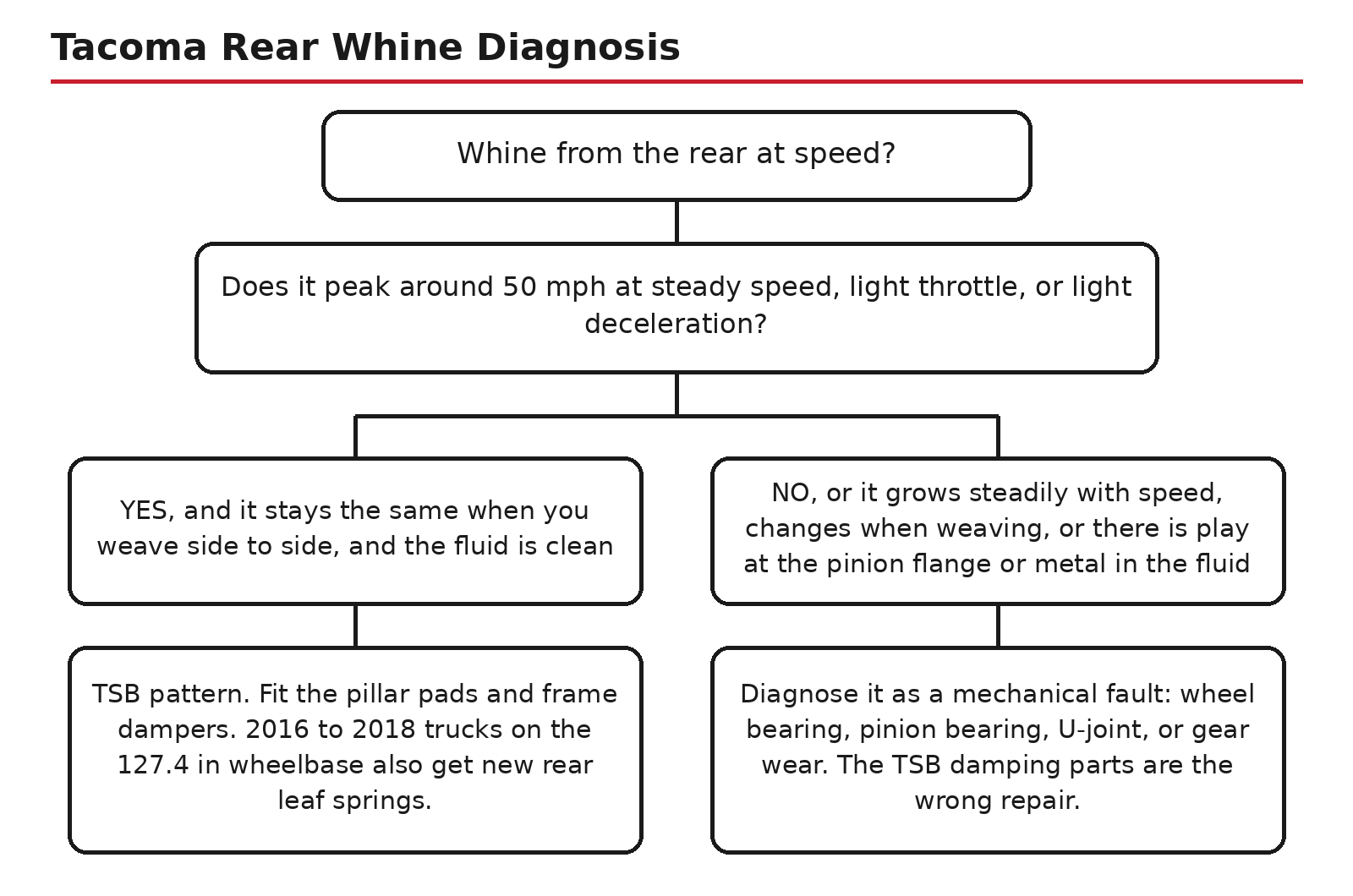
Tacoma Rear Whine Diagnosis Flowchart
The weave test. At the speed where the noise is loudest, on an empty road, steer gently left and right so the truck’s weight shifts from side to side. A failing wheel bearing usually changes pitch or volume as its load changes. The TSB resonance tracks speed and light throttle, and it stays much the same through the weave.
The throttle test. Hold the noisy speed, then lift off the throttle completely, then roll back in lightly. The TSB whine lives in that narrow band of constant speed, slight acceleration, and slight deceleration. A pinion bearing or gear contact problem also changes with load, so use this test together with the others. Experienced owners and technicians on IH8MUD tie a whine that appears under acceleration and disappears on coast to pinion bearing preload and tooth contact position, which calls for diagnosis inside the differential.
The fluid check. Pull the rear differential fill plug and look at the fluid on the drain plug magnet if you drain it. Clean fluid at the right level supports the resonance theory. Glitter, chunks, or a low level point to wear inside the housing. A truck that has been run low on fluid can whine for mechanical reasons that no damper will fix. If you drain and refill during this check, the Tacoma rear differential takes 75W-85 GL-5 gear oil, and a quart bottle fluid pump makes the refill cleaner than a squeeze bottle.
The pinion flange check. With the truck safely supported, grip the driveshaft at the rear pinion flange and try to move it up, down, and side to side. Movement at the flange means bearing or preload trouble inside the differential. Have that diagnosed before you spend anything on damping parts.
| Test result | Most likely meaning | Next step |
|---|---|---|
| Whine peaks near 50 mph, steady through the weave, clean fluid, no flange play | TSB resonance pattern | Fit the damping parts for your bulletin |
| Whine changes pitch or volume when weaving | Wheel bearing loading and unloading | Diagnose the rear wheel bearings |
| Whine only under hard acceleration or only on coast, with flange play or dirty fluid | Pinion bearing preload or gear wear | Differential diagnosis by a gear shop |
| Squeak or chirp that follows driveshaft speed, worse in reverse | U-joint wear | Inspect the driveshaft U-joints |
What the TSB parts do
The ring and pinion gears generate a vibration at one frequency band. On the covered trucks that vibration travels through the axle housing, the leaf springs, and the frame, then into the cab, where the body panels act like a sounding board. Toyota’s parts attack three points on that path.
The No. 5 pillar pad mounts at the bottom of each C-pillar, behind the rear cab trim. It keeps the pillar from amplifying the vibration into the cabin.
The frame dynamic damper bolts at each No. 3 cab mount, together with a new cab mounting cushion stopper. A dynamic damper is a tuned weight that absorbs vibration at the frequency it was designed for. Fitting it at the cab mount works on the vibration at the point where the frame hands it to the cab.
The leaf spring replacement in the early bulletin changes the first link in the path. Only one wheelbase gets it, and Toyota’s naming is easy to misread. The bulletin calls the 127.4 in wheelbase long, and the 140.6 in wheelbase super long, and it specifies spring replacement for the long wheelbase while stating that replacement is not required for the super long wheelbase. The 2023 bulletin drops the springs entirely, which suggests Toyota later judged the pads and dampers sufficient for the 2019 to 2023 trucks. That last point is an inference from the two documents, stated here so you can weigh it. Toyota does not state it in either bulletin.
Parts list
Order by your bulletin, and confirm every number against your VIN before paying. Part numbers change, and the 2016 to 2018 stopper and spring numbers vary by grade and configuration.
| Part | Part number | Quantity | Which trucks | Source |
|---|---|---|---|---|
| Damper, frame dynamic | 51229-04010 | 2 | Both bulletins | Genuine Toyota, eBay |
| Pad, pillar, No. 5 | 62555-04070 | 2 | Both bulletins | Toyota Parts |
| Stopper, cab mounting cushion | 52216-04010 | 2 | 2019 to 2023, per T-SB-0045-23 | Toyota Parts |
| Stopper, cab mounting cushion | 52216-04010 standard; 52216-04020 and 52216-04040 variants by configuration | 2 | 2016 to 2018, confirm by VIN | Toyota Parts |
| Spring assembly, rear, left and right | Varies by wheelbase, transmission, and grade | 1 pair | 2016 to 2018, 127.4 in wheelbase only, confirm by VIN | Toyota Parts |
Tools: a trim panel removal tool kit for the cab trim, a 3/8-inch torque wrench covering 5 to 45 ft·lbf that can be set to the 9, 31, and 33 ft·lbf specs in this job, and a mechanic’s stethoscope if you want a second opinion from the axle housing during the diagnosis drive.
Fitting the pillar pads
Budget an hour for the pad and damper work together. Toyota’s warranty time for the pad and damper operation in the 2023 bulletin is 1.0 hour, and that is a fair planning figure for a first attempt at home.
- Fold down the rear seat and seat back to make room to work.
- Remove the left and right luggage compartment side trays, the rear door scuff plates, the rear door weatherstrips, and the quarter trim lower panels. A plastic trim tool keeps the clips intact.
- Remove the rear seat outer belt assembly on each side. Tape each belt so it cannot retract into its reel while it is unbolted. A retracted belt with the anchor unbolted is a miserable problem to undo.
- Fit one No. 5 pillar pad at the bottom of each C-pillar, in the position shown in the bulletin figures.
- Reinstall the belt assemblies and all trim in the reverse order.
- Torque the seat belt bolts to the bulletin figures. Bolt A takes 9 ft·lbf (12.5 N·m). Bolt B takes 31 ft·lbf (42 N·m). Seat belt anchors are safety hardware. Do not guess these by feel.
A Home Mechanic note on step 3: if you are not comfortable unbolting seat belt anchors, this is the step to hand to a shop. The rest of the job is trim and one cab mount nut per side.
Fitting the frame dynamic dampers
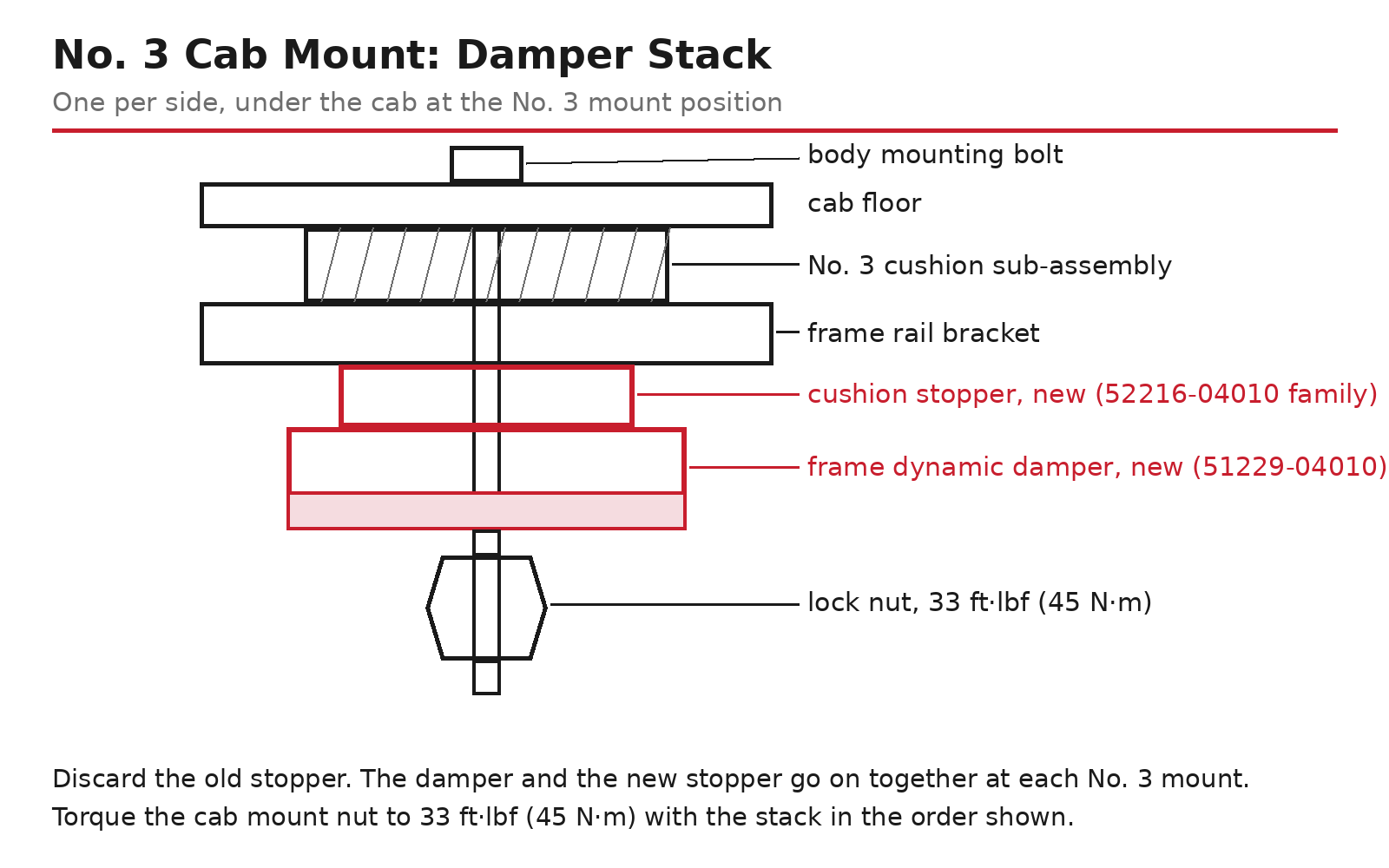
No. 3 Cab Mount Stack With Frame Dynamic Damper
- Find the No. 3 cab mount on each side of the truck. The bulletin figure shows the mount, its nut, and the cushion stopper stack.
- Remove the No. 3 cab mount nut. It takes a 17 mm socket. Discard the old cab mounting cushion stopper on each side.
- Fit the new cab mounting cushion stopper and the new frame dynamic damper to each cab mount, in the stack order shown in the diagram above: body mounting bolt, No. 3 cushion sub-assembly, cushion stopper, frame dynamic damper, lock nut.
- Retighten the cab mount nut to 33 ft·lbf (45 N·m).
- Warm the truck up and test drive it through the speed range where the whine lived. Confirm the noise is gone or reduced before you call the job done.
Rust changes this job. Cab mount hardware on a truck that has lived in salt can fight hard, and a snapped cab mount bolt turns a one hour job into a weekend. Soak both nuts in penetrating oil the day before. The frame rust guide on this site covers how to judge whether the surrounding metal is sound enough to work on.
The 2016 to 2018 leaf spring step
Double Cab 4WD trucks on the 127.4 in wheelbase, which the bulletin calls the long wheelbase, also get new left and right rear spring assemblies under T-SB-0013-18. Trucks on the 140.6 in super long wheelbase skip this step, which runs against the natural assumption that the longest trucks get the most parts, so check the wheelbase line in the bulletin for your truck. Bed length nicknames are unreliable for this step. Every 2019 to 2023 truck also skips this step.
Spring replacement is a bigger job than the pads and dampers. The truck goes on stands, the axle is supported, the U-bolts and spring eye bolts come out, and the new assemblies go in following the rear leaf spring removal and installation procedure for the 2016, 2017, or 2018 Tacoma. Torque the spring hardware to the values below, which cover the 2016 to 2018 trucks in this section. The four U-bolt nuts at each spring seat take 52 ft·lbf (70 N·m). The front spring eye bolt, the rear spring eye bolt, and the shackle upper bolt each take 89 ft·lbf (120 N·m), tightened at the end of the job with the truck back on the ground and the suspension bounced to settle. The shock absorber lower bolt takes 43 ft·lbf (58 N·m), the parking brake cable bracket bolt takes 9 ft·lbf (13 N·m), and the rear wheels go back on at 83 ft·lbf (113 N·m). Fit new U-bolts during the job, which is standard practice on leaf spring work.
What owners report after the fix
Set your expectations before you spend money. The Tacoma World poll thread on this noise runs to dozens of pages, and the outcomes in it are mixed.
Some owners had differentials replaced under warranty before the damping bulletins were widely applied, and the replacement howled again right away. That result matches the bulletin’s theory: if the cab and frame are amplifying a normal gear vibration, a new differential can sing the same song. One owner in the thread reported the opposite sequence. His replacement differential howled, and the howl ended after new rear leaf springs were fitted, which he and his mechanic attributed to driveline angle and the spring link in the vibration path.
Other owners were told the noise was normal, or were offered extended warranty coverage instead of a repair. A transfer case replacement on one truck in the thread did not fix its whine at all.
Read together, the owner record supports the bulletin order of operations. Confirm the pattern, fit the cheap damping parts first, and treat a differential replacement as the last resort for a truck whose fluid, flange play, and bearing checks all come back clean. Owners who expected the dampers to make the truck silent were sometimes disappointed. Owners who expected the whine to drop to a background level closer to ordinary road noise report better results. No verified decibel measurement was found in the sources for this guide.
Home Mechanic alternatives owners have tried
These are owner-reported attempts from forum discussion, not verified fixes. They are listed so you can judge them with open eyes.
| Approach | What it involves | Owner-reported result |
|---|---|---|
| TSB damping parts, fitted at home | Pads, dampers, and stoppers from the parts table | The factory approach. Mixed reports, from gone to quieter to little change |
| Sound deadening in the rear cab | Butyl mat and foam on the rear cab wall, floor, and C-pillars while the trim is already off for the pads | Reported to lower how noticeable the whine is in the cabin. It reduces the sound inside the cabin, and the vibration itself is unchanged |
| Damper only install | Fitting just the two frame dynamic dampers and skipping the interior trim work | Less trim work. Reported results vary, and the bulletin treats pads and dampers as one operation |
| Heavier rear differential gear oil | Draining and refilling with a heavier grade than stock, such as running 75W-85 GL-5 at full spec or stepping up a grade | Owners report little to no change in the 50 mph whine once the oil is warm. It is cheap, and it doubles as the fluid check in the diagnosis section |
| Replacement third member or regear | A professionally set up carrier or new gears | Reported to end the whine on trucks where the noise was gear setup after all. Run the full diagnosis first. This is the expensive end of the scale |
If you do the pillar pad job, the rear cab trim is already off. That is the one cheap moment to add sound deadening to the rear wall and pillars, whether or not you believe it will help.
What this job should cost you
The pads, dampers, and stoppers are small parts, and every one of them is linked in the parts table so you can see the current price before you order. The labor benchmark is the 1.0 hour warranty operation for the pad and damper work. A dealer quoting you a full differential replacement as the first step for a clean-fluid, no-play truck is quoting the most expensive item on the menu before trying the factory’s own damping procedure. Ask which bulletin they checked, and ask for the result of the fluid and flange checks in writing.
FAQ
Does the TSB replace my rear differential? No. Neither T-SB-0013-18 nor T-SB-0045-23 replaces or opens the differential. Both bulletins fit damping parts to the cab and frame, and the 2018 bulletin adds rear leaf springs on long-wheelbase trucks.
My truck is a 2018. Am I covered? Yes, if it is a Double Cab 4WD with the BD22 rear differential and it was produced before the production change effective VINs listed in the bulletin. The original February 2018 issue of T-SB-0013-18 stopped at 2017, but Rev1, dated August 8, 2018, added the 2018 model year. Make sure the copy you or your dealer are reading carries the Rev1 notice.
My Access Cab whines at 50 mph. Do the TSB parts fit? Both bulletins are Double Cab only, so there is no factory damping procedure for your truck in these documents. Run the diagnosis section. An Access Cab whine is more likely to be a bearing, a U-joint, or gear wear than the Double Cab resonance.
Will the whine damage the differential if I ignore it? On a truck that matches the TSB pattern, with clean fluid and no pinion flange play, Toyota treats the noise as vibration transfer, and the bulletins describe no internal damage. A whine with dirty fluid, low fluid, or flange play is a different case and can get worse. The checks decide which truck you have.
Can I fit just the frame dampers and skip the pillar pads? You can, and some owners have. The bulletins specify pads and dampers together as one operation, so a damper-only install is a partial version of the factory fix with results that owners report as variable.
Does this apply to my GX470 or 4Runner? No. The parts and the bulletins are Tacoma Double Cab specific. Those trucks need their own noise diagnosis, starting with the same fluid, flange, and weave checks.
Related guides
- GX frame rust: how to check for it, treat it, and prevent it, for judging frame and cab mount metal before you put a wrench on rusted hardware
- GX front drivetrain noise diagnosis, for sorting bearing, joint, and gear noises on the GX side of the garage
Sources
- Toyota T-SB-0013-18, Whine Noise From Rear of Vehicle, February 6, 2018, on OEMDTC, and Rev1, August 8, 2018
- Toyota T-SB-0045-23, Whine Noise from Rear of Vehicle, July 21, 2023, NHTSA-hosted PDF
- Tacoma World, 3rd Gen Poll: Rear End Noise howling when feathering throttle
- CarProblemZoo, Differential Unit Problems of the 2019 Toyota Tacoma
- IH8MUD, Rear Diff – Pinion Oil Seal
Leave a Reply