The 20 minute underbody inspection every GX buyer should do, what the rust you find actually means, and the treatment options that really work: wire wheel and converter, Fluid Film, Woolwax, or a shop spray.
Who This Guide Is For
This guide is for two people. The buyer, who is looking at a GX that lived in the rust belt and needs to know whether the frame is a weekend project or a deal breaker. And the owner, who has a clean or lightly rusted truck and wants a prevention routine that keeps the frame alive for another decade. It covers how to inspect the frame, what the rust you find actually means, when to walk away, and which treatments are worth the money.
Why GX Frames Rust
A GX frame is painted steel, and painted steel rusts wherever three things meet: bare metal, water, and oxygen. Road salt accelerates the whole process. GX frames have a few design features that concentrate the problem.
Boxed sections trap water. Parts of the frame are closed tubes. Water and salt spray get in through holes and seams, then sit there with almost no airflow. Rust that starts inside a boxed rail is invisible until it breaks through the outside.
Overlaps trap water. Where two layers of metal overlap with a small gap, capillary action pulls water in and holds it there. One GX470 owner who cut into his rusted frame found the worst damage in the double layer overlap near the front cab mount, inside the rail next to the catalytic converter. The outside looked acceptable. The inside was falling apart. 9
The passenger side gets it first. Owners across IH8MUD consistently report the passenger frame rail rots before the driver side. The commonly cited reason is the air conditioning condensate drain, which discharges onto or near the frame on the passenger side and keeps it wet. Not everyone agrees on the cause, but the passenger side bias is reported often enough to check that side first. 13
Salt pools where you cannot see it. A Michigan owner notes that salt pools on top of the frame rail near the passenger door and eats away at the frame from the top down. You will not see this standing next to the truck. You have to reach up and feel, or look down from the engine bay with a light. 10
None of this is unique to the GX. The same failure pattern killed enough Tacoma and 4Runner frames to spawn recalls and a class action discussion that GX470 owners tried to join. 9 The GX shares the family DNA. Treat the frame like it needs the same attention.
Parts and tools
For the inspection, you need very little:
- A bright flashlight or headlamp. A phone light works in a pinch.
- A flat screwdriver or a metal pick. This is your rust severity gauge. Anything that probes and scrapes will do.
- A telescoping inspection mirror or a cheap borescope. Shadetree alternative: your phone camera on a selfie stick, shooting blind into the frame holes and reviewing the photos after.
- A floor jack and jack stands, or a set of drive on ramps. Never get under a truck supported only by a jack. Shadetree alternative: inspect at a seller meetup by turning the wheels full lock and lying on a flattened cardboard box. You can see most of the front rail and lower control arms that way. The rear crossmember still needs you to slide under, so bring the cardboard.
- Gloves. Rust flakes and undercoating are miserable on bare hands.
For treatment, after you own the truck:
- Pressure washer or a strong hose nozzle.
- Wire wheel on a drill, wire cup on an angle grinder, or a needle scaler. Shadetree alternative: a stiff hand wire brush. It is slower and your forearm will hate you, but it works on small areas.
- Phosphoric acid rust converter, the kind that turns rust black.
- A rust encapsulator like POR-15 for the scaled areas you wire wheeled.
- Your oil coating of choice: Fluid Film aerosol cans for small jobs, or a gallon kit plus an undercoating spray gun with a frame rail wand for a full truck. A 6 gallon pancake compressor at about 90 PSI runs the gun fine. 7
- Safety glasses and a respirator or dust mask. Wire brushing rust throws metal dust. The converter fumes are not pleasant either.
- Tarps or cardboard for the driveway. Oil undercoating drips.
No torque specs are involved in this guide. If the inspection turns up parts that need replacement (lower control arms, body mount hardware), those fasteners get their torque values from the factory manual procedures in the relevant guide, not from here.
The 20 Minute Inspection Walkaround
Do this on every GX you are serious about buying. Ask the seller to leave the truck cold and parked on pavement, not grass. Grass hides drips and wet frames dry slower.
- Start with the paperwork. Ask where the truck has lived. A GX that spent ten years in Michigan or Maryland is a different truck than one that spent ten years in Arizona, even with the same mileage. Owners in the rust belt treat undercoating as routine maintenance. Southern owners often have never thought about it.
- Walk around with the flashlight first. Look at the visible frame rails from the side. Surface rust on the outside of the rail is normal on a northern truck. What you are screening for at this stage is flaking, holes, and anything that looks soft or swollen.
- Check the radiator core support behind the front bumper. Owners evaluating rusty trucks flag this as one of the first structural pieces to go soft. If the core support is compromised, the rest of the front end is usually worse. 1
- Turn the wheels full lock and look at the passenger frame rail behind the front tire, where the rail dips down. This is the AC drip zone. Look inside the rail through any factory holes with the borescope or the mirror. Rust from the inside out starts here. 8
- Reach up and feel the top of the frame rail near the passenger door. Salt pools here. If your glove comes back with flakes instead of dust, note it. 10
- Check the double layer overlap near the front cab mount, inside of the rail by the catalytic converter. Shine the light through the square holes in the rail. You are looking for heavy scaling inside a rail that looks fine outside. 9
- Look at the lower control arms, especially the cam bolt area. In the rust belt these bolts seize into the bushings, which turns a future alignment or bushing job into a cut it out and replace it job. Note it for negotiation even if the arm itself is solid. 14
- Slide under the rear. Check the rear crossmember behind the rear axle. It collects gunk and road debris and rusts out from the top. Poke it with the screwdriver. 11 Then check the rear panhard bar, the rear links, and the spring mounts the same way. 12
- Check the body mount brackets. These are the brackets that bolt the body to the frame. If they are crumbling, the body is separating from the frame at that point. This is structural. 1
- Drop your eyes to the spare tire carrier and its hardware. It is the least important spot on the list, but a rusted carrier tells you the owner never washed the underside. 6
Probe everything with the screwdriver. The probe is the whole test. Surface rust wipes off or scrapes off and the metal underneath is smooth and hard. Scale lifts off in flakes and leaves pits, but the pick does not push through. Perforation means the pick sinks in or finds a hole. Do not be shy with the probe. A seller with a clean frame will not mind, and a seller who minds is telling you something.
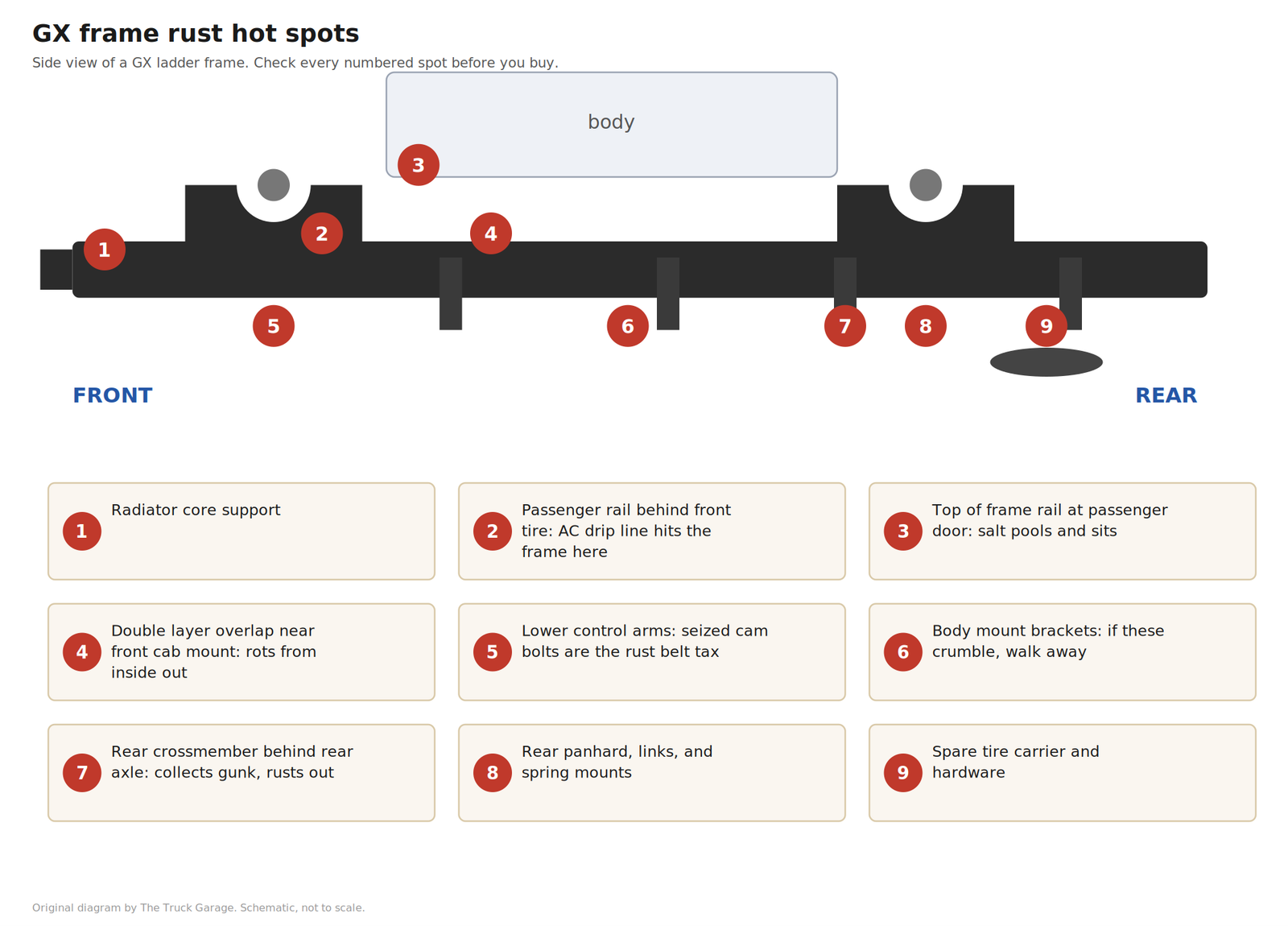
Rust Hot Spots on Every GX
The diagram above maps the nine spots GX owners name most often, in the order to check them on a GX470, GX460, or GX550:
- Radiator core support. Thin metal, first to go soft in the salt belt.
- Passenger rail behind the front tire. The AC drip zone. Rots from the inside out.
- Top of the frame rail at the passenger door. Salt pools and sits.
- Double layer overlap near the front cab mount. Capillary action holds water between the layers.
- Lower control arms. The arms survive, but the cam bolts seize.
- Body mount brackets. Structural. Crumbling brackets are a walk away sign.
- Rear crossmember behind the rear axle. Collects gunk on top and rusts through.
- Rear panhard, links, and spring mounts. Check every one with the probe.
- Spare tire carrier and hardware. Least critical, most honest about maintenance history.
Check all nine on every truck regardless of generation. The GX470, GX460, and GX550 all use a ladder frame with boxed sections, so the failure pattern carries across. On a GX550 the truck is still young enough that you are mostly confirming the factory coating is intact, but the inspection habit starts now.
What You Found: The Severity Scale
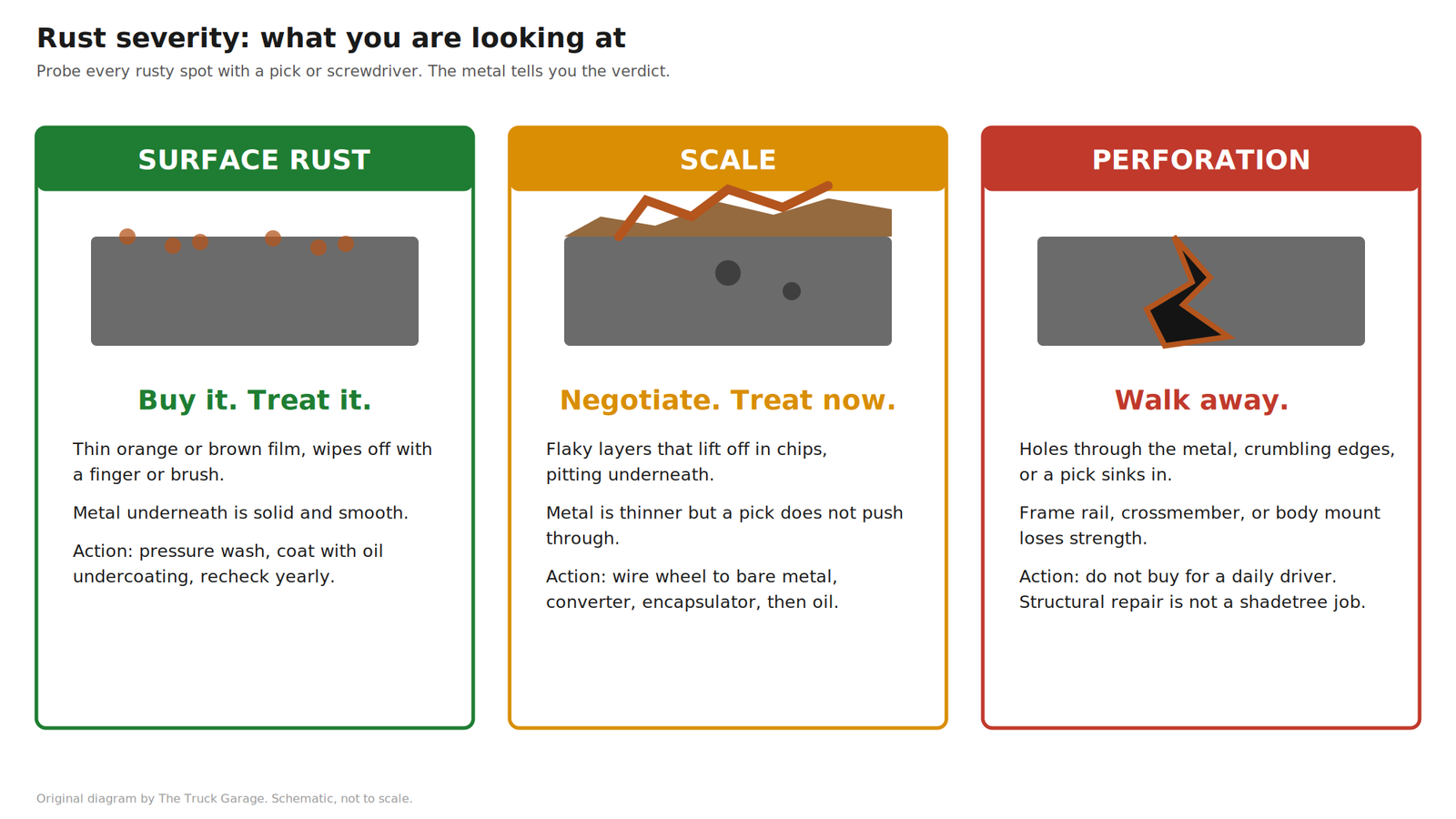
There are three kinds of frame rust, and they demand three different responses.
Surface rust: buy it, treat it. Thin orange or brown film. Wipes off with a finger. The metal underneath is smooth and solid when you scrape it. This is cosmetic. Almost every northern GX has some. Budget a weekend for pressure washing and an oil coating, and recheck it once a year.
Scale: negotiate, treat now. Flaky layers that lift off in chips. Pitting underneath, but the pick does not push through the metal. The frame is thinner than it was, but it is still a frame. This is where negotiation lives. The truck is still buyable, but it needs a real treatment weekend: wire wheel to bare metal, rust converter, encapsulator, then an oil coating on top. Plan for that work in your offer.
Perforation: walk away. Holes through the metal. Crumbling edges. The pick sinks in. On a frame rail, a crossmember, or a body mount bracket, this is structural damage. Frame repair is welding and fabrication work, not a shadetree weekend. For a daily driver or an overland build, walk away. The only exception is a parts truck priced like a parts truck.
The key judgment is location plus severity. Scale on a skid plate bolt tab is an annoyance. Scale on the frame rail at the double layer overlap is a structural question. Perforation anywhere on the frame is the end of the conversation.
Should You Avoid Rust Belt GXs?
Short answer: no, but buy with your eyes open and your screwdriver out.
The GX market reality is that a huge share of clean, well maintained GX470s and GX460s lived in the salt belt. Refusing to look at any of them cuts out most of the inventory, including many trucks whose owners treated the frame every fall. A rust belt GX with a documented undercoating history can be a better truck than a southern GX that was neglected in other ways. Condition beats zip code.
That said, a rust belt truck costs you something even when the frame is solid. Plan on broken fasteners. Owners warn that skid plate bolts, exhaust hardware, and control arm cam bolts snap or seize on trucks that lived in salt, and you will be drilling, cutting, or heating hardware that would come right off a southern truck. 814 That is the real rust belt tax. It is measured in hours and swear words, not just metal.
The decision flow:
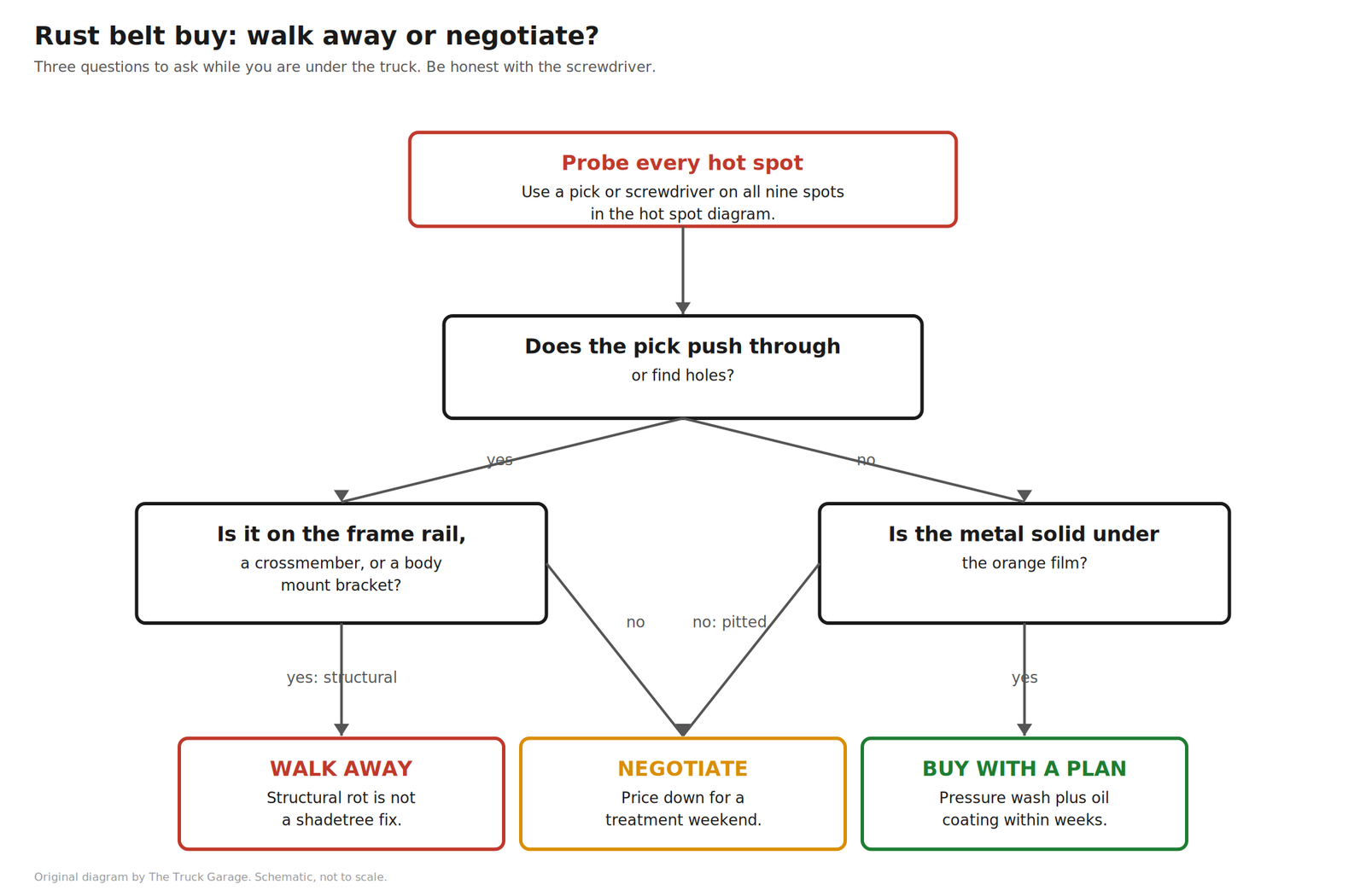
Probe every numbered spot from the hot spot diagram. If the pick pushes through or finds holes in a frame rail, a crossmember, or a body mount bracket, walk away. If you find scale on non structural parts like brackets, skid plate tabs, or the spare carrier, negotiate the price down to cover a treatment weekend. If it is surface rust on solid metal, buy with a plan: pressure wash and oil coat the frame within weeks of getting it home, before the next winter.
Two buying tips from owners who have done this many times. First, put a borescope inside the frame rails. The outside can look fine while the inside is scaling, especially at the double layer sections. One look inside the rail through a factory hole tells you more than ten minutes of staring at the outside. 8 Second, check the passenger side twice. It rots first. 13
This same inspection belongs in The Ultimate GX Buying Guide checklist, alongside the timing belt sticker, the air suspension check, and the coolant leak check. Frame condition is the one item on that list that can total the truck.
Treatment Options
Once you own the truck, you have two philosophies: hard coatings and oil coatings. They solve different problems.
Wire wheel plus converter plus encapsulator. This is the restoration approach for scale. Pressure wash the frame, wire wheel or needle scale the rust down to mostly bare metal, brush on phosphoric acid rust converter (it turns the remaining rust black and inert), then coat with a rust encapsulator like POR-15. One 4Runner owner in Maine does exactly this on the welds, then oil coats over the top. 15 It is the most work and the best result on scaled metal. It is also the only approach that makes sense if you want the frame to look good.
Oil coatings: Fluid Film, Woolwax, or a shop spray. This is the maintenance approach. Lanolin based oil that never fully dries, creeps into seams, and starves rust of oxygen and water. It does not remove rust. It arrests it and prevents new rust. Both Fluid Film and Woolwax are lanolin based and solvent free, and both can be applied over existing rust to stop it progressing. 2
The practical differences, from owner reports and comparison writeups:
Fluid Film is thinner. It creeps deeper into seams, cracks, and spot welds, which is exactly where GX frames rust from the inside out. It comes in aerosol cans at auto parts stores, so it is the easiest DIY option. Downsides: it stays tacky and collects dirt, it drips in warm weather, it has a strong lanolin smell that lingers, and in harsh climates owners report needing to reapply as often as twice a year. 34
Woolwax is thicker. It drips less, stays put better on exposed areas like wheel wells, and lasts longer, with owners and installers reporting annual reapplication and some stretching it to every 2 to 3 years. 5 It smells less because the lanolin odor is neutralized. Downsides: the thickness means it creeps less into tight seams, and it usually needs a spray gun rather than a rattle can, so the DIY setup costs more up front. 3 PB Blaster Surface Shield is a comparable undercoating alternative on Amazon.
Shop sprays like NHOU are the pay someone option. Purpose built rust inhibitors applied by a shop, usually needing annual reapplication at a higher cost than DIY oil. The advantage is coverage: a good shop gets inside the rails and crossmembers with wands, which is the part most DIY jobs skip. 4
The owner consensus hybrid: soak the truck with Fluid Film first, since the thin oil penetrates seams and the inside of the rails, then brush or spray Woolwax over the outside of the frame for the thicker lasting coat. One 4Runner owner runs exactly this combo: Fluid Film inside and out including the underbody and brake lines, then a brushed Woolwax coat on the frame exterior with extra attention on the high rust areas. 6
Two warnings before you start. First, oil coatings and paint do not mix. If you think you will ever want to wire wheel and paint the frame properly, do the paint work first. Once lanolin soaks into scaly rust, getting the surface clean enough for paint takes serious degreasing. 6 Second, drop the skid plates and the spare tire before you spray. The areas you cannot reach are the areas that rust. The Maine owner routine specifically calls this out, plus a heavy coat under the foam strip under the radiator. 15
| Approach | Effort | Best for | Reapply |
| Wire wheel, converter, encapsulator | Full weekend, messy | Scaled metal you want to restore | Touch up as needed, then oil coat |
| Fluid Film DIY | Half day | Seams, inside rails, budget jobs | Yearly, sometimes twice in harsh climates 4 |
| Woolwax DIY | Half day plus gun setup | Exposed frame, wheel wells | Yearly, some go 2 to 3 years 5 |
| Shop spray (NHOU type) | Drop off the truck | Full coverage including inside rails | Yearly 4 |
Prices move around too much to quote exactly here. Expect a DIY oil job to cost well under a hundred dollars in product, and a shop treatment to run in the high hundreds to low thousands depending on prep work. 16
The Annual Prevention Routine
If your frame is solid, keep it that way. This is the routine owners in the salt belt actually follow.
Fall, before the first salt. This is the main event. Pressure wash the entire underside, including inside the frame rails through the factory holes, and let it dry. Touch up any chipped encapsulator. Then apply your oil coating: inside the rails with the wand, the crossmembers, the body mounts, the control arms, the brake and fuel line clips, and the spare tire carrier area. Drop the skids and the spare so you can reach everything. 615
Winter. Leave it alone. Do not spray off the underside all winter if you can avoid it. Woolwax specifically advises letting the coating sit, and owners report the dirt that accumulates on the coating actually helps it stay put. 15 If you must wash road salt off, use a gentle rinse, not a pressure washer aimed at the frame.
Spring. Now pressure wash the underside thoroughly to get the winter salt and grime off. Inspect every hot spot from the diagram while it is clean. This is when you catch new scale early. Apply a light touch up coat on any bare areas.
Summer. Check the AC drip line area on the passenger rail while you are under there for other work. If you run the air conditioning hard all summer, that rail stays damp. A quick shot of Fluid Film there takes thirty seconds.
That is the whole program. Wash in spring, coat in fall, inspect twice a year, and leave it alone in winter. Owners who do this keep frames alive for decades in the salt belt. Owners who skip it end up asking forums whether their frame is too far gone.
FAQ
How do I check for frame rust on a GX?
Get under the truck with a flashlight and a screwdriver. Check the nine hot spots in the diagram above: radiator core support, passenger rail behind the front tire, top of the rail at the passenger door, the double layer overlap by the front cab mount, lower control arms, body mount brackets, rear crossmember, rear suspension mounts, and the spare tire carrier. Probe every rusty spot with the screwdriver. Solid metal under surface rust is fine. Flaking scale needs treatment. Holes or soft metal mean walk away.
Should I avoid rust belt GXs?
Not automatically. Many well maintained northern GXs have treated frames and are better trucks than neglected southern ones. But budget for the rust belt tax: seized and broken fasteners on every job, and a frame that needs yearly undercoating for the rest of its life. Inspect with a borescope inside the rails, check the passenger side twice, and walk away from perforation on any structural part.
Fluid Film, Woolwax, or what?
Both are lanolin based oils that stop rust from progressing. Fluid Film is thinner, creeps deeper into seams, and comes in easy DIY spray cans, but it drips, smells, and needs reapplying more often. Woolwax is thicker, lasts longer, and smells less, but needs a spray gun and creeps less into tight spots. Many owners use both: Fluid Film first for penetration, Woolwax over the top for durability. For scaled metal, wire wheel plus rust converter plus encapsulator first, then oil over it.
Can I stop frame rust that has already started?
Surface rust and light scale, yes. Clean it, convert it, seal it, and keep it oiled, and it stops progressing. Perforation, no. Once the metal has holes, no coating restores the strength. That is a welding job or a different truck.
How often do I need to reapply undercoating?
At least once a year, in the fall before road salt season. Fluid Film may need a midwinter touch up in harsh climates. Woolwax often stretches to a full year or more. Check the high wear areas like wheel wells every spring.
Does undercoating void any warranty?
On a GX470 or GX460 this is a non issue; those trucks are long out of factory corrosion warranty. On a newer GX550, check with the dealer before applying anything, since aftermarket coatings can complicate a corrosion claim. This is general advice, not legal advice.
Sources
- IH8MUD forum, “Is this too much rust?” (GX460 frame evaluation, Maryland truck): https://forum.ih8mud.com/threads/is-this-too-much-rust.1308248/
- IH8MUD forum, “On the hunt and looking for advice on a frame”: https://forum.ih8mud.com/threads/on-the-hunt-and-looking-for-advice-on-a-frame.1353464/
- IH8MUD forum, “New 2003 Lexus GX470 Owner…” (Grand Rapids salt pooling note): https://forum.ih8mud.com/threads/new-2003-lexus-gx470-owner.1259222/
- IH8MUD forum, “Rusty GX Frame? Class Action Started for 4th Gen 4runner Owners, GX470 Owners may be added”, page 3 (double layer overlap, inside out rust): https://forum.ih8mud.com/threads/rusty-gx-frame-class-action-started-for-4th-gen-4runner-owners-gx470-owners-may-be-added.1261810/page-3
- IH8MUD forum, “Lower Control Arms” (seized cam bolts): https://forum.ih8mud.com/threads/lower-control-arms.1330584/
- IH8MUD forum, “Undercarriage evaluation for rust evaluation video” (rear panhard and link check): https://forum.ih8mud.com/threads/undercarriage-evaluation-for-rust-evaluation-video.1278244/
- 4Runners.com, “Fluid Film after a couple years OK? Anyone against doing it?” (hybrid Fluid Film plus Woolwax routine): https://www.4runners.com/threads/fluid-film-after-a-couple-years-ok-anyone-against-doing-it.27647/
- 4Runners.com, “Woolwax over Fluid Film, but not there yet?” (Maine owner routine, spray gun kit, winter wash advice): https://www.4runners.com/threads/woolwax-over-fluid-film-but-not-there-yet.31337/
- Tundras.com, “Undercoating”, page 2 (installer quote on Fluid Film vs Woolwax reapplication intervals): https://www.tundras.com/threads/undercoating.122798/page-2
- Ultragloss, “NHOU vs Fluid Film vs Woolwax vs Food Grade Oil vs Motor Oil: Which Undercoating Reigns Supreme”: https://ultragloss.biz/blog/nhou-vs-fluid-film-vs-woolwax-vs-food-grade-oil-vs-motor-oil-which-undercoating-reigns-supreme
- VehicleFreak, “Woolwax Vs Fluid Film Undercoating: Which Is Better?”: https://vehiclefreak.com/woolwax-vs-fluid-film-undercoating-which-is-better/
- OZK Customs, “Rust Inspection Guide for Vans and Trucks” (general inspection method): https://www.ozkcustoms.com/recreational-vans/rust-inspection
Footnotes
- IH8MUD frame evaluation thread: the radiator core support, body mount bracket, and frame welds called out as compromised on a rusty truck. https://forum.ih8mud.com/threads/on-the-hunt-and-looking-for-advice-on-a-frame.1353464/
- VehicleFreak comparison: both Woolwax and Fluid Film are lanolin based, solvent free, non drying, can be applied over existing rust, and migrate after application. https://vehiclefreak.com/woolwax-vs-fluid-film-undercoating-which-is-better/
- VehicleFreak comparison: Fluid Film has a strong lingering lanolin odor while Woolwax is neutralized; Woolwax is thicker and harder to wash off, Fluid Film is easier to spray and migrates faster. https://vehiclefreak.com/woolwax-vs-fluid-film-undercoating-which-is-better/
- Ultragloss undercoating comparison: Fluid Film cons include staying tacky and often needing two applications per year in harsh climates; Woolwax pros include longer lasting protection up to a year; NHOU requires annual reapplication. https://ultragloss.biz/blog/nhou-vs-fluid-film-vs-woolwax-vs-food-grade-oil-vs-motor-oil-which-undercoating-reigns-supreme
- Tundras.com undercoating thread: an installer reports recommending Woolwax reapplication every 2 to 3 years versus 1 to 2 years for Fluid Film, noting Woolwax does not creep as well into inside cavities. https://www.tundras.com/threads/undercoating.122798/page-2
- 4Runners.com Fluid Film thread: owner-recommended hybrid routine of a Fluid Film soakdown first (thinner, penetrates) followed by a brushed Woolwax coat on the frame exterior; notes that oil coatings make later paint prep much harder. https://www.4runners.com/threads/fluid-film-after-a-couple-years-ok-anyone-against-doing-it.27647/
- 4Runners.com Woolwax thread: owner runs the Woolwax spray gun kit with wands off a 6 gallon pancake compressor at about 90 PSI. https://www.4runners.com/threads/woolwax-over-fluid-film-but-not-there-yet.31337/
- IH8MUD “Is this too much rust?”: owner advises inspecting inside the frame everywhere with a light or inspection camera, focusing on the passenger rail behind the front tire where the AC drip line discharges onto the frame, plus the rear crossmember; recommends Fluid Film or Woolwax inside and out; warns small bolts will break when wrenching on a rust belt truck. https://forum.ih8mud.com/threads/is-this-too-much-rust.1308248/
- IH8MUD rusty frame class action thread, page 3: owner describes the double layer overlap near the front cab mount rusting from the inside out like Tacoma frames, with water held by capillary action in the small gap between layers. https://forum.ih8mud.com/threads/rusty-gx-frame-class-action-started-for-4th-gen-4runner-owners-gx470-owners-may-be-added.1261810/page-3
- IH8MUD new GX470 owner thread: Michigan owner advised to check on top of the frame rail near the passenger side door, where salt pools and eats the frame. https://forum.ih8mud.com/threads/new-2003-lexus-gx470-owner.1259222/
- IH8MUD “Is this too much rust?”: the rear frame crossmember behind the rear axle noted as collecting gunk and rusting out. https://forum.ih8mud.com/threads/is-this-too-much-rust.1308248/
- IH8MUD undercarriage evaluation thread: owner advises checking the rear panhard, links, and spring mounts, plus wire brushing and paint followed by Fluid Film to stop further rusting. https://forum.ih8mud.com/threads/undercarriage-evaluation-for-rust-evaluation-video.1278244/
- IH8MUD rusty frame class action thread, page 3: owner reports the passenger side universally develops issues before the driver side across Tacoma, 4Runner, and GX trucks, hypothesized to be AC drain water on the frame; notes other owners dispute the hypothesis. https://forum.ih8mud.com/threads/rusty-gx-frame-class-action-started-for-4th-gen-4runner-owners-gx470-owners-may-be-added.1261810/page-3
- IH8MUD lower control arms thread: owner reports factory cam bolts seize and must be cut out; multiple owners confirm replacement difficulty is far worse in rust belt climates. https://forum.ih8mud.com/threads/lower-control-arms.1330584/
- 4Runners.com Woolwax thread: Maine owner treats frame welds with POR-15 then Woolwaxes the truck, drops skid plates and spare tire for access, sprays under the radiator foam strip, avoids washing the underside in winter, power washes in spring with a light recoat, and does the thorough application before winter. https://www.4runners.com/threads/woolwax-over-fluid-film-but-not-there-yet.31337/
- Price ranges are approximate and unverified: one video description claims shops charge 800 to 2,000 dollars plus for rust treatment and about 12 dollars per Fluid Film aerosol can at retail. Treat as rough figures, not quotes. https://www.youtube.com/watch?v=RpdgRZwrRrc
Leave a Reply