Do you actually have X-REAS?
This guide starts with a correction, because a common search brings GX owners here by mistake. No GX470 trim ever came with X-REAS, Sport included. The GX470 Sport package’s special suspension was KDSS, a hydraulic sway-bar system, and some GX470 trims used AVS electronically adjustable dampers instead. The GX460 skipped X-REAS too, pairing AVS with rear air suspension on the higher trims. The GX470 factory service manual documents KDSS throughout and never mentions X-REAS at all, and the 2005 Lexus GX brochure lists the Sport Package contents with no X-REAS in sight.
The trucks that actually got X-REAS are 4Runners:
| Vehicle | X-REAS availability |
|---|---|
| 4th-gen 4Runner, 2003-2009 | Sport and Limited trims |
| 5th-gen 4Runner, 2010-2024 | Limited, Nightshade, TRD Sport |
| 6th-gen 4Runner, 2025+ | Not offered |
| GX470 (2003-2009), all trims | Never offered. Sport got KDSS |
| GX460 (2010-2023), all trims | Never offered. Used AVS plus rear air |
| GX550 (2024+) | Not offered |
You can identify X-REAS in about 30 seconds. Crawl under the truck and look at the shocks. Each X-REAS shock has a short rubber hydraulic line running from the shock body to a hard-line fitting on the frame rail. Regular shocks have no lines at all.

What X-REAS is and how it works
X-REAS stands for Cross Relative Absorber System. Toyota built it to give a tall body-on-frame SUV flatter cornering without ruining the ride. The system is fully mechanical, with no computer, no sensors, and no wires.
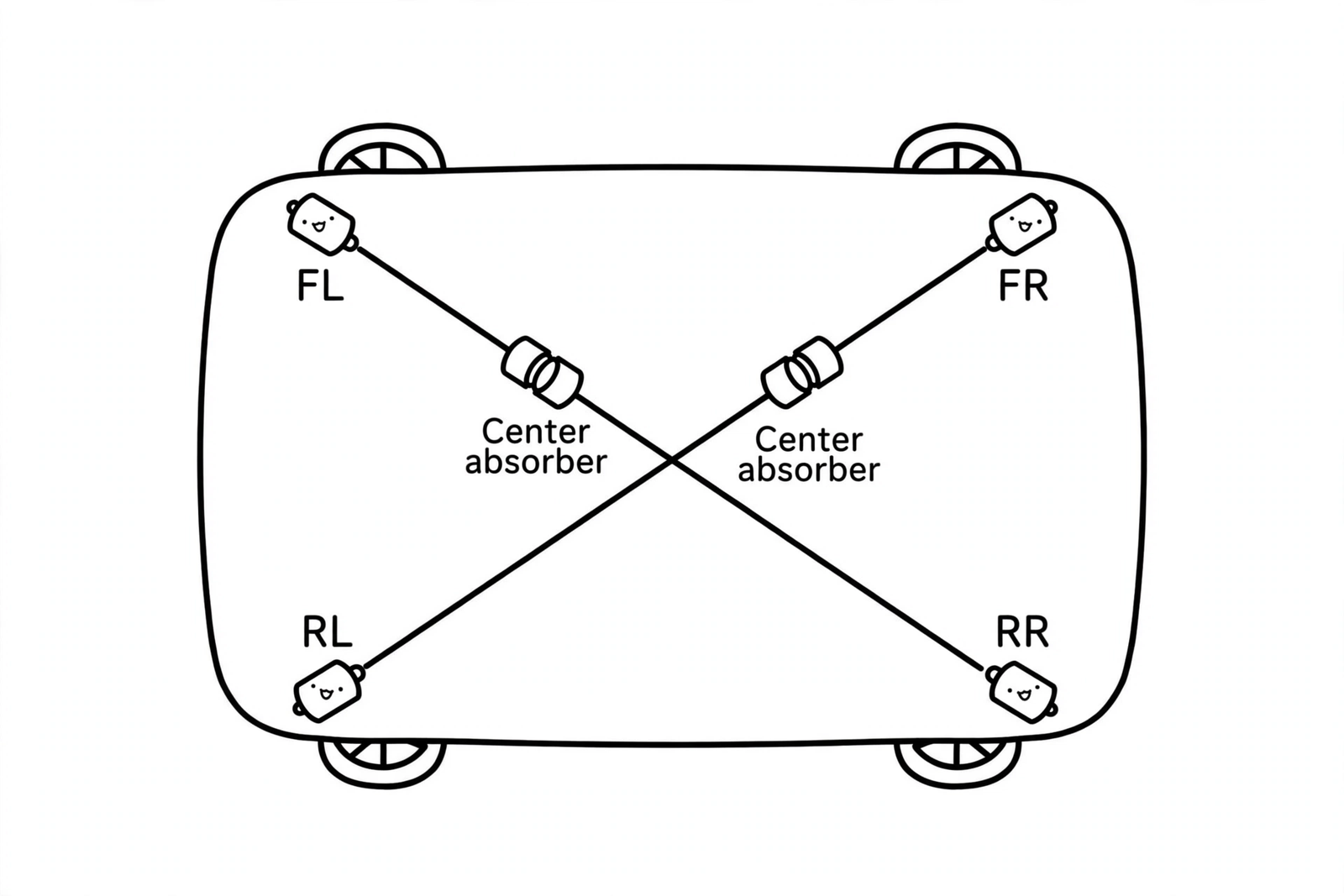
Each shock connects to its diagonal partner through hydraulic tubes. The front-left shock links to the rear-right, and the front-right links to the rear-left. A center control absorber sits in the middle of each circuit. Inside that absorber, a free piston separates the oil from a high-pressure gas chamber, and a valve meters the oil flow between the two sides.
When the two shocks in a circuit move in opposite directions, as they do in body roll and brake dive, oil has to push through the center absorber’s valve. That flow resistance adds damping force exactly when the truck rolls or pitches. When both shocks move the same direction over a bump, the oil simply displaces the free piston against the gas and adds no extra damping, so the ride stays soft. You get anti-roll behavior that only shows up when the truck is actually rolling or pitching.[1]
The joints where the rubber lines meet the frame hard lines have built-in check valves. That detail matters during a delete, as the procedure section below explains.
How to tell if your X-REAS shock is actually leaking
A damp shock body does not always mean a dying shock. Toyota grades shock oil leaks on a five-level scale in its own inspection criteria. Levels 1 and 2 are normal seepage from the seal case, and Toyota says those shocks stay in service. Levels 3 through 5 are abnormal leaks, and those shocks get replaced.[2] The simple field version of that scale works like this:
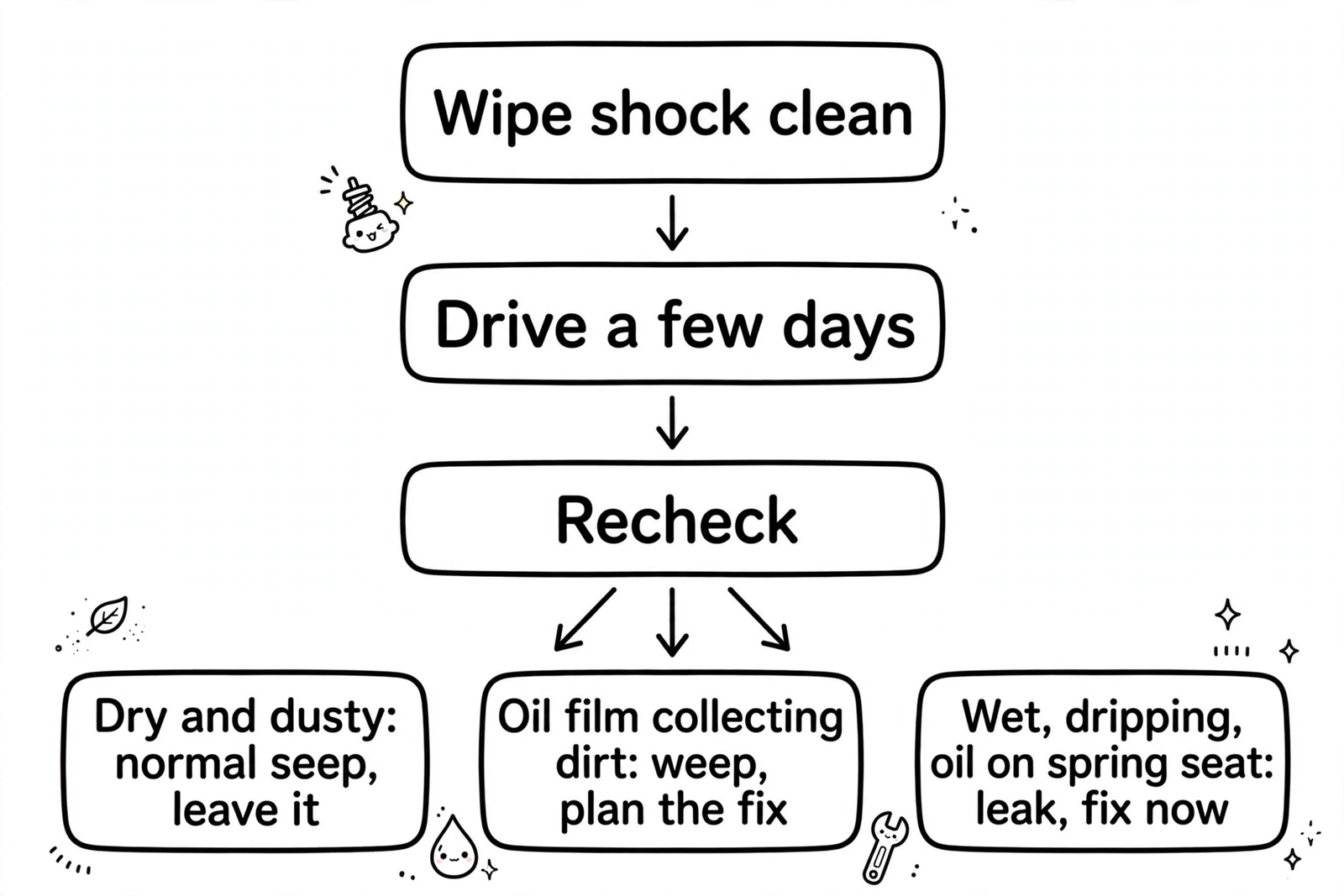
- Wipe each shock body clean with a rag.
- Drive normally for a few days, then look again.
- Dry and dusty means normal seep. Leave it alone.
- An oil film that collects dirt means a weep. The clock is ticking.
- Wet, dripping, or oil coating the spring seat means a leak. Plan the fix now.
- Check all four shocks plus the line fittings along the frame rails. Owners report leaks at the fittings and tubing too, not only at the shock seals.
Symptoms that the system has lost its nitrogen charge:
- One corner feels bouncier than the others over the same bumps.
- The truck wallows in turns the way it never used to.
- Clunking over potholes. That is the shock topping out because there is no gas pressure left to control it. Once clunking starts, replacement is the only fix.
- The diagonal partner of a leaking shock starts misbehaving too. The pair shares a circuit, so one bad shock drags its partner down.
Owners routinely drive on weeping X-REAS for months or even years while handling degrades gradually. A weep is not an emergency. Clunking and severe bounce mean the shock is no longer doing its job, and at that point you are riding on springs alone. Get it scheduled.
Toyota’s own service guidance shapes how dealers quote these repairs. A single component can be replaced on its own the first time the system is repaired, as long as there is no oil leakage at the joints. On the second and later repairs, the whole system has to be replaced as a unit, because the joints are likely to leak.[1] In practice, this is why dealer quotes jump straight to full-system replacement.
The real cost math
These figures come from owner forum reports. Your quote will vary. The spread is the point.
| Option | Typical cost | Notes |
|---|---|---|
| Dealer: full X-REAS system replacement | $3,000 to $5,000+ | One owner was quoted $5,096.19. Another was told $3,500 and up. Labor plus four X-REAS shocks, lines, and center absorbers |
| Dealer: single X-REAS shock | About $375 per shock, parts only, plus labor | One owner paid this per corner several years ago. Prices have not gone down |
| Dealer: X-REAS delete plus conventional shocks | About $2,000 | One owner’s quote to cap the lines and install standard shocks |
| Independent 4×4 shop: full conversion | About $750 install plus $100 X-REAS removal, plus parts | Reported from a Denver-area shop |
| DIY: four Bilstein 5100s | About $1,000 | Owner-reported with sale pricing. Street price varies |
| DIY: budget KYB set | About $480 | One owner bought KYB coilovers and rear shocks from Shock Surplus for $478.98 with tax |
| DIY: used factory takeoff set | About $200 | Low-mile X-REAS or standard takeoffs show up on Marketplace regularly |
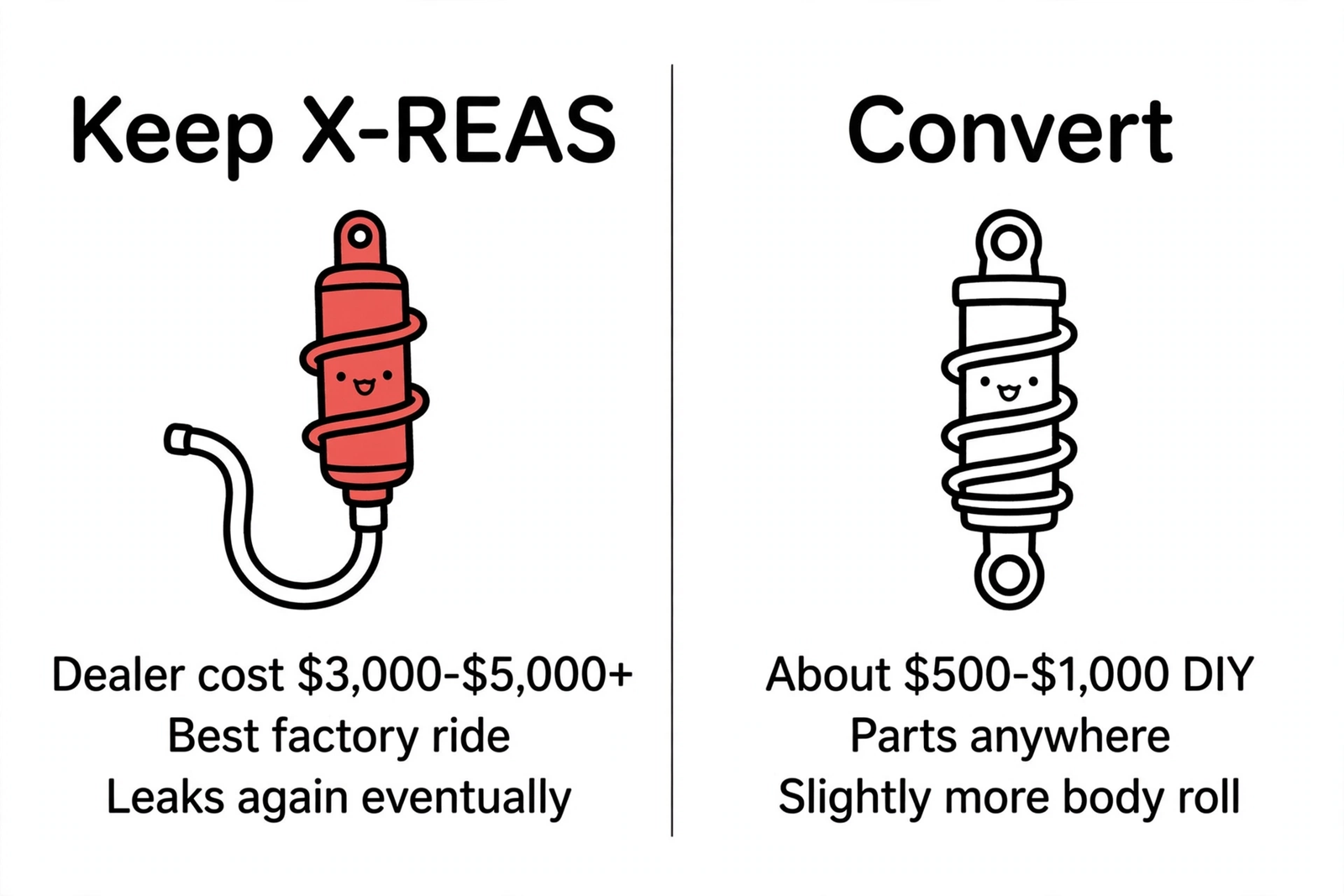
Owner reports agree on the pattern across every thread: keeping X-REAS costs three to five times what converting costs. The only cheap way to keep the system is scoring a used low-mile takeoff set from someone who lifted their truck.
The two ways out
Option 1: Replace the X-REAS system
Keeping X-REAS means paying roughly $3,000 to $5,000 or more at a dealer, or gambling on a used set. You keep the factory ride, the flatter cornering, and a system that owners describe as excellent while it works.
The case against it is the price and the repeat failure. Some owners report X-REAS leaks recurring even on trucks that were kept dealer maintained. A new system wears the same seals as the old one, so this is not a fix that ends the conversation. There is no aftermarket X-REAS. It is a proprietary Toyota system with no recharge port, no rebuild kit, and no third party making components. If you love the truck exactly as it is, you value originality, and the truck is otherwise mint, replacing the system can still be the right call.
One verified used-market shortcut exists: genuine front shocks do surface on eBay. The front right for a 4th-gen, part 48510-80229, listed at $344.80 new on October 22, 2026. The left side carries its own part number, and Toyota’s first-repair rule above still applies.
Option 2: Delete X-REAS and convert to regular shocks
Converting costs $500 to $1,000 in parts, DIY, and it converts the suspension future back to normal truck economics: one shock fails, you buy one shock, done. The guidance below applies to both generations, with one important difference: on a 5th-gen Limited you also have AVS adaptive dampers in the mix.
My take on converting
The factory ride changes, but most owners who convert report they are happier after:
- Owners who installed Bilstein 5100s describe a flatter, better handling truck with less body roll than their worn X-REAS, and a more truck like feel through corners.
- The 5100s are height adjustable up front, so leveling the front or adding up to 2.5 inches of lift for bigger tires is a bolt on job later.
- RockAuto and Amazon have the parts on the shelf. Bilstein, KYB, Rancho, and Monroe all make shocks for this truck. No more hunting proprietary assemblies.
- Several owners call the conversion the best money they spent on the truck and say they would not go back.
- The owners who miss X-REAS are the ones whose system was still healthy when something else forced the job, or who kept the truck stock and commuted in it. A working X-REAS does ride better than a budget shock set.
Owner rankings put the 5100 at the top for ride and handling, often reported to ride slightly smoother than stock with more stability. The Bilstein 4600 is the near stock option. The 5100 adds a grooved body and snap ring perches for ride height adjustment in quarter inch increments.
The best 4th-gen budget reports are on KYB. One owner with KYB Strut-Plus coilovers up front and KYB rears reports the ride is very comfortable and exactly like stock, with the cost-effectiveness noted separately. For a 5th gen, KYB sells a Strut-Plus line as well, and Excel-G shocks and struts are common owner picks for rears. KYB Excel-G restores factory ride at a fraction of the Bilstein price.
Before you buy parts
- If you want lift or adjustable height later, get Bilstein 5100s now. They come with grooved perches for 0.85, 1.75, and 2.5 inch front settings in the factory manual applications owners quote.
- For a keep it stock build, Bilstein 4600, KYB Excel-G, or KYB Strut-Plus pre assembled coilovers all work. The pre assembled KYB Strut-Plus units skip the spring compressor entirely, which is the main reason owners buy them.
- If your 5th gen Limited has AVS as well as X-REAS, your delete is bigger. AVS dampers have wiring connectors on top of each shock. Unplugging them can set dash warning lights, and 5th-gen owners handle this with a delete module or resistor setup. That part of the job goes beyond this guide’s mechanical scope and into model-specific electrical work.
How the delete works (overview)
Each X-REAS shock has a check valve built into the joint where its line meets the frame. When you disconnect the rubber line at that frame fitting, the valve closes and the oil stays in the lines and center absorbers.[3] Owners report losing only a few drips when the fitting is opened properly. The factory document also gives a firm warning: never loosen the union bolt on a shock absorber hose. The disconnect point is the frame joint.
You have two choices for the leftover plumbing:
- Leave the lines and center absorbers in place, capped at each corner. This is the faster path and leaves the door open to reconnect someday. The hard lines are light, and the absorbers sit tucked against the frame.
- Remove everything. More work, a cleaner underside, and shipping weight saved if you sell the truck later. Extra labor on a lift runs about $100 based on the Denver shop quote above.
The conversion, step by step
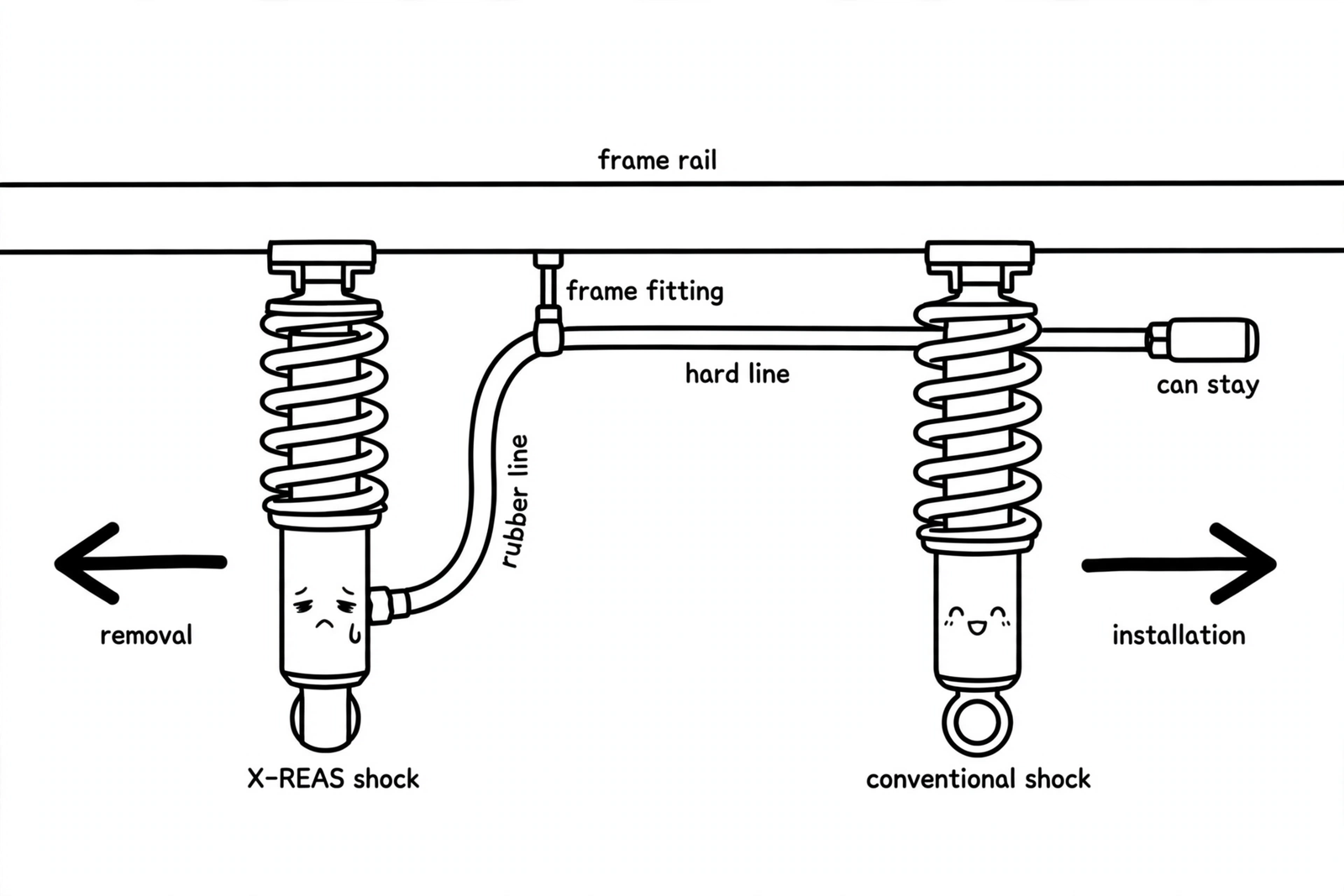
- Lift the truck and support it properly. Wheels off.
- At each corner, disconnect the rubber line from the frame hard line at the fitting. Do not cut anything and do not touch the union bolt at the shock hose. Owners who cut lines report oil spraying, because cutting defeats the check valve.
- Unbolt the X-REAS shocks. Fronts are strut assemblies under load from the coil spring, so treat them like any other strut job.
- (Optional) Unbolt the two center absorbers and the hard lines along the frame rails if you are removing everything.
- Install the new shocks or struts and torque to spec. The tables below carry both generations.
- Align the truck if you changed front ride height on 5100 perches. At stock height, an alignment check is still cheap insurance.
Warning lights: there are none. X-REAS is purely hydraulic, so the 4th-gen delete needs no resistors, no modules, and no dealer programming. On a 5th-gen Limited with AVS the wiring story is different, as noted above.
Parts and tools for the conversion
Prices below were read off the live listings on October 22, 2026. They move around, so treat them as a snapshot.
| Part | Fits | Part number | Price |
|---|---|---|---|
| Bilstein 5100 front strut | 4th-gen 4Runner | 24-324359 | $149.87 each |
| Bilstein 5100 front struts, sold as a pair | 5th-gen 4Runner | 24-328258 | $286.95 for the pair |
| Bilstein 5100 rear shock | Both generations | 33-313146 | $109.05 each |
| Bilstein 4600 front strut, stock height | 4th-gen 4Runner | 24-325462 | $105.79 each |
| Bilstein 4600 rear shock, stock height | 4th-gen 4Runner | 33-329093 | $104.00 each |
| KYB Strut-Plus front assembly, right | 4th-gen 4Runner | SR4694 | $150.57 |
| KYB Strut-Plus front assembly, left | 4th-gen 4Runner | SR4695 | $150.57 |
| Energy Suspension shock eye bushing | Tacoma-shock swaps, 4th-gen | 9.8108G | $6.29 |
| Genuine Toyota X-REAS front shock, right | 4th-gen 4Runner, keeping X-REAS | 48510-80229 | $344.80 |
The 5100 numbers above are Bilstein’s current numbers. Older listings and forum posts use the superseded numbers 24-239370 (4th-gen front), 24-196499 (5th-gen front), and 33-187174 (rear), and they point at the same parts. KYB also sells an Excel-G rear shock for the 4th-gen under number 344410, and owners fit Gas-a-Just rears as well, but no KYB number for the Gas-a-Just in this application could be confirmed, so it is named without one.
Tools for the job, with prices checked the same day:
- 3-ton low-profile floor jack, ARCAN A20003, $147.05. A lift works too if you have access to one.
- 3-ton jack stands, Torin BIG RED T43002A double locking, pair, $35.99.
- 1/2 inch drive torque wrench, GEARWRENCH 85066, 30 to 250 ft·lbf, $126.65. That range covers every mount nut and bolt in the torque tables below.
- Metric flare nut wrench set, GEARWRENCH 81906, 6 piece, $75.21, for the frame line fittings.
- MacPherson strut spring compressor, Orion Motor Tech, $26.99. Needed only if you build front struts from separate parts; pre-assembled units like the KYB Strut-Plus skip it.
Add a socket set from the garage shelf and the list is complete.
Tacoma shock swap note: some owners install Tacoma rear shocks because they are cheaper and easier to find. Owners report the lower eyelet width differs, and the Energy Suspension 9.8108G bushing above is the adapter owners use to make them fit.
Torque specs for the swap
Torque to the wheel or ground, never in the air, wherever the factory procedure says to stabilize the suspension first. The lower front mount nut is the big one: the procedure calls for stabilizing the suspension before final tightening.
4th-gen 4Runner, from the 2005 factory service manual:[4]
| Fastener | Torque |
|---|---|
| Front top mount nuts (3) | 47 ft·lbf (64 N·m) |
| Front lower mount nut | 100 ft·lbf (135 N·m) |
| Front piston rod lock nut, bench assembly only | 18 ft·lbf (25 N·m) |
| Rear top nut | 18 ft·lbf (25 N·m) |
| Rear lower bolt | 72 ft·lbf (98 N·m) |
5th-gen 4Runner, from the 2016 factory service manual:[5]
| Fastener | Torque |
|---|---|
| Front top mount nuts (3) | 52 ft·lbf (71 N·m) |
| Front lower mount nut | 70 ft·lbf (95 N·m) |
| Rear top nut | 18 ft·lbf (25 N·m) |
| Rear lower bolt | 72 ft·lbf (98 N·m) |
If you keep or reconnect any X-REAS hardware, the center absorber and REAS bracket bolts torque to 21 ft·lbf (29 N·m), and a rear REAS joint goes together at a reference torque of 18 ft·lbf (25 N·m) with a 1 mm gap, per the 4th-gen manual.
What actually changes in ride and handling
You keep a proper ride and lose the party trick. The cross-linked damping disappears, so the truck corners on its sway bars and spring rates alone. How noticeable that is depends on what you install and how worn the old system was:
- Body roll increases slightly on initial turn-in with soft stock-height replacements, per owner reports. The truck still tracks fine on the highway.
- Brake dive comes back a little. Pitch control was the other half of what the diagonal circuits did.
- Owners who install 5100s often report they cannot tell a handling difference, and some say the truck corners flatter than it did on their worn X-REAS. A fresh conventional shock beats a dying cross-linked one.
- A healthy X-REAS rides and handles better than a budget delete, and nobody deletes a healthy system. The comparison that matters is your leaking system.
A GX470 never had this dilemma. KDSS trucks fail differently (accumulators and control valves, and those parts at least exist in dealer channels), and AVS shocks are ordinary replaceable dampers with motors on top.
Related reading
For KDSS trucks like the GX460 and GX470 Sport, see KDSS Accumulator and Lift Guide, which also documents the DLC3 jumper method for reading chassis codes. For a rear suspension conversion on air-sprung trucks, see Rear Air Suspension: Diagnose and Coil Conversion. While you are under the truck removing shocks, our guide to Tacoma and 4Runner upper control arms covers the other wear item that shows up at this mileage.
FAQ
Can I replace just one X-REAS shock?
Toyota allows a single component replacement the first time the system is repaired, when the joints show no leakage. From the second repair on, the whole system goes as a unit.[1] A single shock is also only as good as the circuit it shares. If its diagonal partner is tired, the pair still underperforms.
How long can I drive on a leaking X-REAS shock?
A weep can go for months. Owners do it routinely. A shock that clunks or bounces is done, and driving on it beats up tires and bushings while the truck handles like a waterbed. At level 3 on Toyota’s leak scale and above, the shock is due.
Can X-REAS be recharged or rebuilt?
No. The factory document states that oil bleeding and changing cannot be performed on the system, and there is no recharge port or rebuild kit. Replacement is the only service path.
Will the delete hurt resale value?
A working X-REAS is a selling point to the small group of buyers who know what it is. A leaking X-REAS is a $3,000 to $5,000 negotiation anchor against you. Most buyers of a 15 to 20 year old 4Runner would rather see fresh Bilsteins than a tired proprietary system.
Does the 5th-gen delete work the same way?
The mechanical delete is the same. The wrinkle is AVS on the Limited, which adds damper wiring and possible dash lights to deal with. Expect extra time or a delete module for the electrical side.
Sources
- Toyota 4Runner factory service manuals, 2005 and 2016 editions, suspension sections (torque procedures and REAS replacement)
- Toyota X-REAS technical documentation, CH-57 to CH-61
- Toyota TSB SU007-06 via Toyota-4Runner.org
- SlashGear, “Toyota 4Runner Generations”
- 4Runner owner forums: deleted X-REAS cost reports, conversion ride reports, and part fitment threads
Footnotes
[1] Toyota X-REAS factory technical documentation (CH-57): system description, center control absorber operation, and replacement precautions, including the first-repair single-component rule and the full-system rule for later repairs.
[2] Toyota Technical Service Bulletin SU007-06, “Shock Absorber Replacement Criteria” (October 24, 2006): five-level leak grading for shock absorbers; levels 1 and 2 are normal seepage, levels 3 through 5 require replacement.
[3] CH-57 documents the check valves built into the joint portions of the system and warns against loosening the shock hose union bolt. The minimal fluid loss at a proper disconnect is owner-reported experience.
[4] Toyota 4Runner factory service manual, 2005 edition, front and rear suspension sections: removal and installation procedures with torque values.
[5] Toyota 4Runner factory service manual, 2016 edition, front and rear shock absorber installation procedures with torque values.
Leave a Reply