You walk out to your GX470 in the morning, turn the key, and the tailpipe coughs out a puff of blue-gray smoke. Ten seconds later it is gone and the truck runs like nothing happened. If that sounds familiar, you are in good company. This is one of the most recurring threads in GX470 owner circles, and on the 4.7 liter V8 (the 2UZ-FE) the cause is usually worn valve stem seals.
This guide covers what the smoke color tells you, why the seals fail, how to rule out the cheap stuff first, and what the fix actually costs.
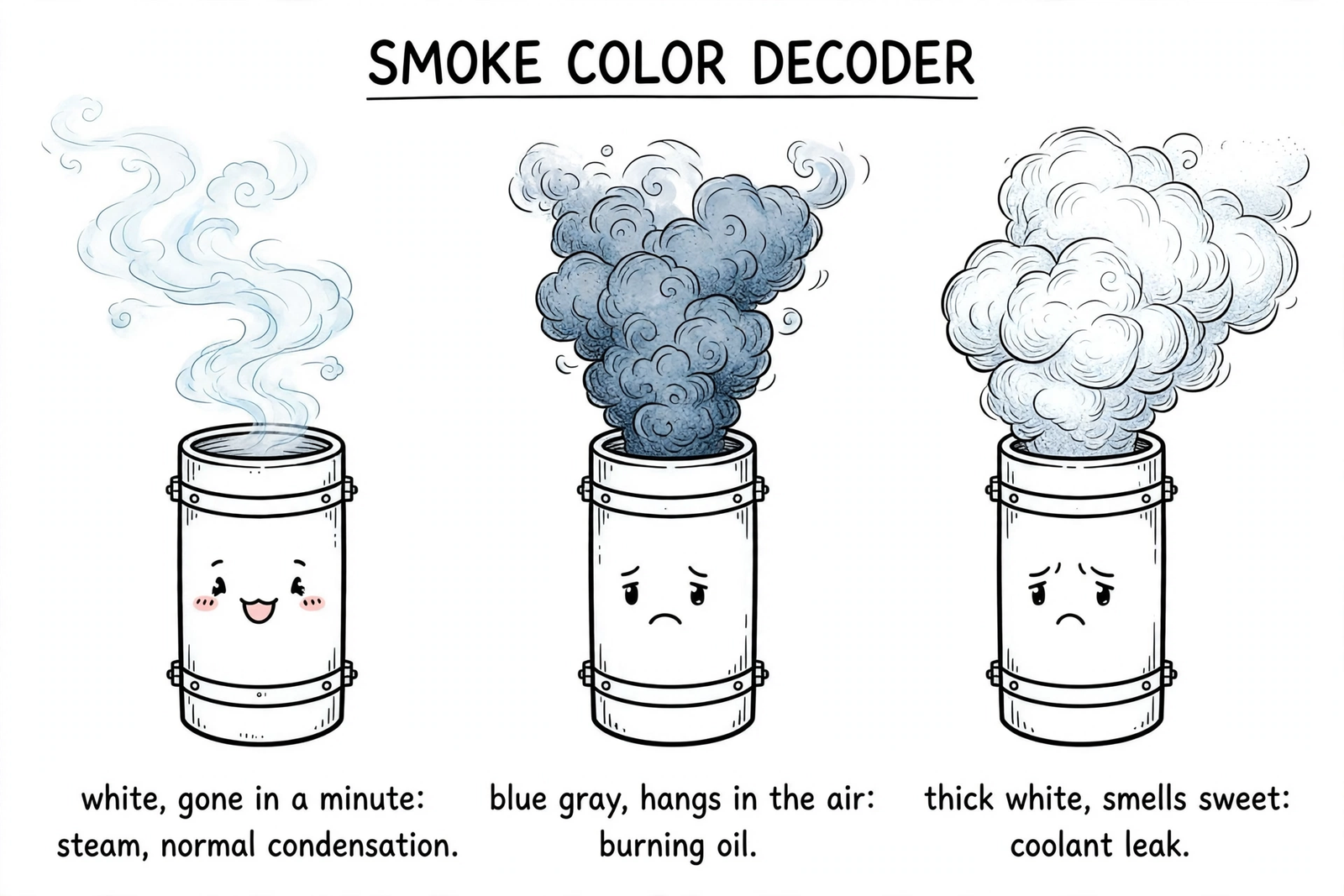
First: What Color Is the Smoke?
Before you spend a dollar, figure out what you are looking at. The color and how the smoke behaves point to the cause.
- Thin white, gone in under a minute. That is steam. Condensation in the exhaust burns off as the system heats up. Every car does this on cold mornings. Ignore it.
- Blue or blue-gray, hangs in the air, smells like burning oil. That is oil getting into the combustion chambers. This is the GX470 startup puff. Keep reading.
- Thick white that does not go away, with a sweet smell. That is coolant. That points at a head gasket or a crack, and it will not limit itself to startup. Check the coolant level and look for milky residue under the oil cap. That is a different, bigger problem.
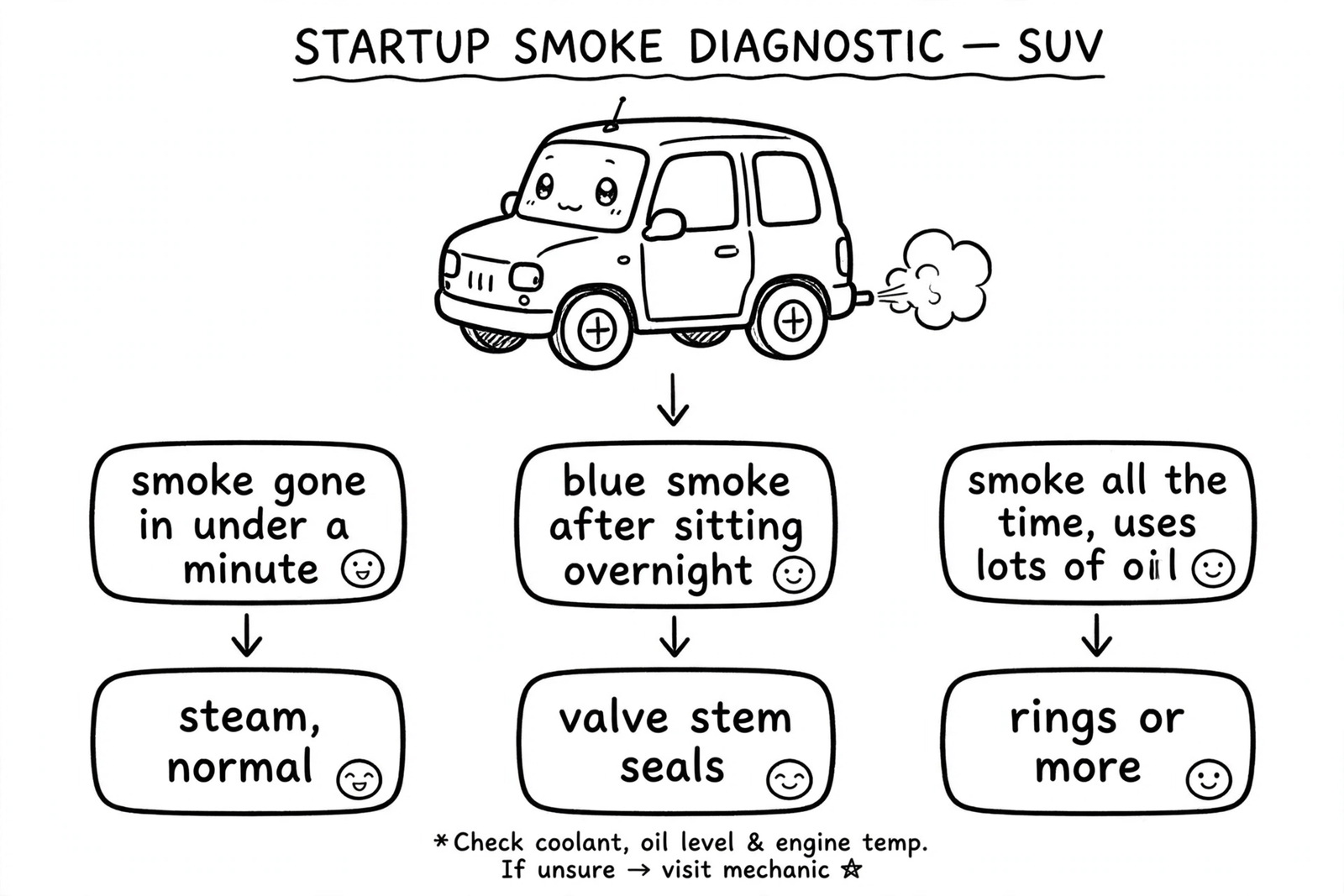
The classic valve seal puff shows up after the truck has sat for hours, lasts 5 to 30 seconds, and then clears completely. The engine idles fine and drives fine.
Why Valve Stem Seals Are the Usual Suspect
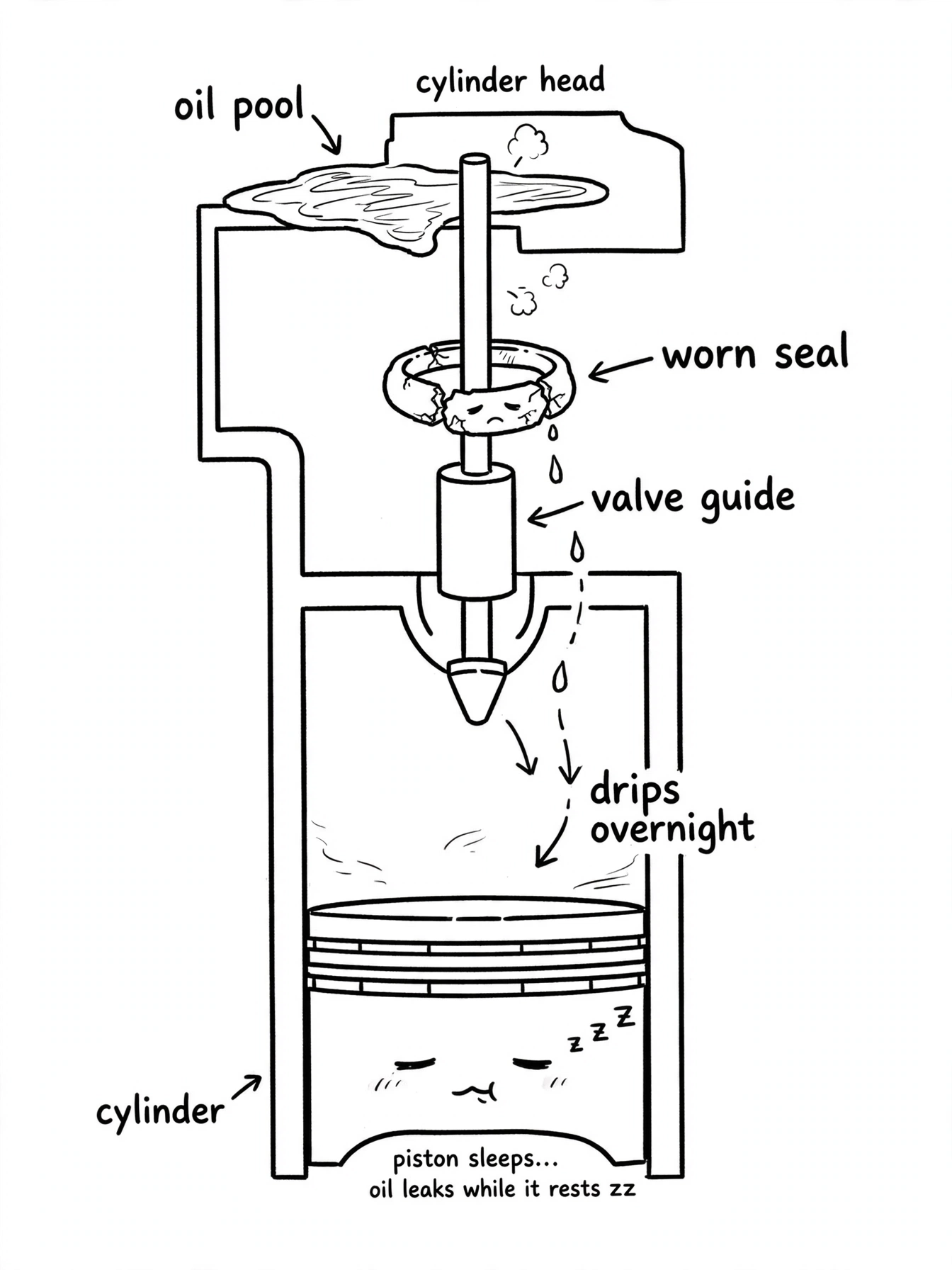
Valve stem seals are small rubber rings that sit where each valve stem passes through the cylinder head. Their job is to let a tiny film of oil lubricate the stem while keeping the pooled oil in the head from sliding down into the combustion chamber.
On a 2003 to 2009 GX470 the 2UZ-FE has 32 of them, 16 intake and 16 exhaust. After 150,000-plus miles of heat cycles, the rubber hardens and shrinks. Overnight, oil pooled in the cylinder heads seeps past the hardened seals and dribbles down the valve stems. When you fire it up the next morning, that oil burns off in one blue puff. Then the seals warm up, expand a little, and mostly do their job again until the next long sit.
The longer it sits, the bigger the puff. Owners report it is worst after the truck sits for a few days and barely noticeable on back-to-back daily starts. It also tends to show up when you accelerate hard after a long downhill coast, because high engine vacuum on deceleration pulls oil past the seals. That pattern, smoke on cold start plus a puff after engine braking, points strongly at the seals.
The Other Suspects (Cheaper Ones First)
Rule out these cheaper causes before you settle on valve seals.
Overfilled or wrong oil. Too much oil in the crankcase gives every seal more to leak. Check the level the way the factory service manual says: warm the engine up, shut it off, wait 5 minutes, then read the dipstick. The level belongs between the low and full marks, never above full.[1] The manual calls for 5W-30 as the preferred viscosity.[2]
Stuck PCV valve. The crankcase ventilation valve regulates pressure inside the engine. When it sticks, pressure pushes oil past seals and gaskets, and the engine can drink oil. On the 2UZ-FE the ventilation valve lives in the left cylinder head cover.[3] To run the factory test, pull the valve, attach a clean hose, and blow through it. Air should pass easily from the cylinder head side and not easily from the intake manifold side. If it fails either way, replace it.[4] Never suck air through it. The internals contain petroleum deposits you do not want in your lungs.
Worn piston rings. Rings usually announce themselves differently: constant oil use, smoke under load and on the highway, fouled plugs on one or two cylinders. If the truck uses a quart every 1,000 miles and puffs all the time, rings belong on the list. A leakdown test tells you for sure.
Valve cover gasket leaks. These drip oil onto the exhaust and make the engine bay smell like burning oil, but they do not put smoke out the tailpipe. That is a different symptom and a different job.
Home Mechanic Diagnostic Steps
You can narrow this down in the driveway with zero special tools.
- The smoke watch. Have a friend start the truck cold while you stand behind the tailpipe. If you are working alone, prop your phone in a safe spot behind the truck and record video of the startup instead. Note the color, how long it lasts, and whether it smells like oil. Repeat after the truck sits for three days versus overnight. Worse after the long sit points at seals.
- The downhill test. Find a long grade, coast down in gear with your foot off the throttle, then get back on it at the bottom. A visible puff right after the downhill points at seals, since decel vacuum pulls oil past them.
- Check the oil level and coolant. Level per the manual procedure above. Coolant should be full and clean. Milky sludge under the oil cap or dropping coolant points away from seals and toward gasket trouble.
- Test the PCV valve. Pull it and do the blow test described above. On a high-mileage truck, just replace it. It is a $15 part.
- Read the spark plugs. When you pull them, look at the threads. A light film of oil on the upper threads of several plugs suggests seals letting oil into the chambers while parked. One or two heavily fouled plugs suggest rings on those cylinders.
- Track consumption. Check the oil weekly and log miles per quart. A seeping set of seals might use a quart every 2,000 to 3,000 miles. A quart every 1,000 miles or less, with smoke that never fully clears, deserves a compression and leakdown test.
What the Fix Costs
There are three honest options, and the right one depends on your wallet and your patience.
Live with it. Many 2UZ-FE owners report driving 100,000 miles or more with the startup puff and no other symptoms. The engine runs fine. Keep the oil topped off, check it weekly, and use a high-mileage 5W-30 oil. Those blends contain seal conditioners that can soften hardened rubber a little. Some owners also report seal conditioner additives quieting the puff. These are owner-reported results, so treat them as a cheap experiment with modest expectations. The one long-term risk to watch: burning oil slowly degrades the catalytic converters, so this is a strategy for a truck with modest oil use, not one drinking a quart every few hundred miles.
The proper repair. Replacing all 32 seals is a real job. The seals themselves are cheap: a full 32-piece aftermarket set runs about $28, and genuine Toyota seals are sold individually and in sets. Labor is most of the cost. The cams have to come out, which means the timing belt has to come off, and most shops pull the valve covers and do the gaskets at the same time. The factory procedure replaces the seals with the cylinder heads off, but experienced techs do it with the heads in place by pressurizing each cylinder with shop air or packing the cylinder with rope at top dead center to hold the valves up.
The parts bill is small and the labor bill is big. Book time on a V8 this deep runs into the high single digits of hours, so get two or three written quotes from independent Toyota specialists before you decide. An independent shop lands well below a dealer on labor-heavy jobs, and a DIY run is parts only. No published estimate range exists for this specific job, so treat any single quoted number with suspicion until you have comparisons.
The middle path: seals plus timing belt. If your timing belt is due anyway, that is the time to do the seals. Most of the labor overlaps. Ask the shop for a combined quote. It is the cheapest way to buy the seal job, and our 2UZ-FE timing belt step-by-step walks through the shared half of the work.
Parts and tools
Prices below were read off the live listings on October 22, 2026. They move around, so treat them as a snapshot.
| Part | Part number | Price |
|---|---|---|
| Valve stem seal set, all 32, Fel-Pro | SS 72878-1 | $27.84 |
| Valve stem oil seals, intake, genuine Toyota (gray/brown, 16 needed) | 90913-02113 | $53.00 |
| Valve stem oil seals, exhaust, genuine Toyota (black/gray, set of 24 covers the 16 needed) | 90913-02112 | $188.00 |
| PCV (ventilation) valve, genuine Toyota | 12204-50020 | $15.00 |
| PCV valve grommet, genuine Toyota | 90480-18001 | $15.00 |
| Valve cover gasket set, Fel-Pro (genuine Toyota numbers: RH 11213-50030, LH 11214-50010) | VS 50583 R | $34.99 |
| Spark plugs, Denso SK20R11 iridium, set of 8 (Toyota 90919-01210) | 3297 | $68.53 |
Tools for the in-place seal swap:
- Valve spring compressor for overhead-cam engines, $20.69.
- Spark plug hole air hold adapter, M10/M12/M14/M18, $19.99. The 14 mm size fits the GX470 plug holes and holds the valves up on shop air.
- The timing belt tools for a 2UZ-FE, covered in the timing belt guide linked above.
A home mechanic attempting the seals needs the compressor, the air adapter or rope, and the timing belt tools. If that list sounds like a lot, it is. This is an advanced driveway job.
What About the GX460 and GX550?
This guide is written for the 2003 to 2009 GX470 and its 2UZ-FE V8. The owner reports that prompted it flag the 2007 to 2009 trucks most often, though owners report the same puff across the whole first generation. The GX460 runs a completely different engine (the 1UR-FE 4.6 liter V8) and the GX550 runs a twin-turbo V6 (the V35A-FTS). The valve seal failure pattern described here is not verified for either of those engines, so do not assume the same diagnosis. The smoke color decoder and the home mechanic tests apply to any engine, but the fix details are GX470 only.
Related reading
The seal job shares most of its labor with the 2UZ-FE timing belt and water pump service. If the diagnosis ever points past seals toward head work, Pulling a GX470 Cylinder Head covers what that job really involves.
FAQ
Is it safe to keep driving with valve seal smoke? In most cases, yes, as long as oil consumption stays modest and the truck runs normally. Check the oil every week and top it off. If consumption climbs past a quart every 1,000 miles or the smoke stops clearing after warmup, get it diagnosed.
Will thicker oil fix it? Thicker oil can reduce the seep a little because it flows past the hardened seals more slowly. High-mileage blends with seal conditioners are the more targeted choice. Neither is a repair.
Can the seals be replaced without removing the heads? Yes. Techs hold the valves up with compressed air fed through the spark plug hole, or with rope packed into the cylinder at top dead center, and swap the seals with the heads in place. The cams and timing belt still have to come out, so it remains a big job.
How do I know it is not the head gasket? Head gasket smoke is thick, white, and sweet-smelling, and it does not quit after 30 seconds. You will also usually see dropping coolant, milky oil, or overheating. The startup puff with steady coolant and clean oil is a different animal.
Will it pass a smog check? A brief puff on a cold start rarely affects the test, since the truck is fully warm by the time it is on the rollers. Heavy oil burning that fouls the cats can eventually cause an emissions failure. Another reason to track consumption.
Sources
- GX470 factory service manual, 2003 to 2009 (Lubrication, Emission Control, and Cylinder Head sections, 2UZ-FE). Reference copy on file.
- Toyota genuine parts catalog data via Partsouq (valve stem seal, ventilation valve, cylinder head cover gasket, and spark plug numbers)
- IH8MUD: Blue smoke on an LX470 with the 2UZ-FE, owner diagnosis thread
- IH8MUD: Smokey cold start thread, 2UZ-FE owner reports and the decel vacuum test
- Lexus Owners Club of North America: Startup smoke thread, valve seal diagnosis discussion
- Lexus Owners Club of North America: Blue smoke from the tailpipe on startup, PCV and oil discussion
- Lexus Owners Club of North America: PCV valve location and replacement on the GX470
- Tundras.com: Smoke at startup on a 2UZ-FE Tundra, valve seal replacement without removing heads
- Tundras.com: Additive discussion for valve seal leaks
- StartMyCar: Exhaust smoke colors guide for the GX470
Footnotes
[1] Oil level check procedure paraphrased from the GX470 factory service manual, Lubrication section: check after warming the engine and 5 minutes after shutdown, level between low and full marks, never above full.
[2] The factory service manual lists SAE 5W-30 as the preferred viscosity, API grade SL Energy-Conserving or ILSAC multigrade.
[3] The factory service manual’s Emission Control section names the part the Ventilation Valve Sub-Assy, and its torque table lists the valve against the left cylinder head cover.
[4] Ventilation valve inspection paraphrased from the GX470 factory service manual, Emission Control section: blow air into the cylinder head side (should pass smoothly) and into the intake manifold side (should not pass smoothly); never suck air through the valve.
Leave a Reply