Two patterns and two transmissions
This guide covers two shift complaints on the current platform trucks, and the two complaints come from two different transmissions. The GX550 uses a 10-speed automatic transmission, and its complaint is a harsh 2 to 1 downshift that arrives at the end of a stop. The Tacoma and the 4Runner use an 8-speed automatic transmission, and their complaint is a cold 2 to 3 shift flare and cold jerking that owners report on the first drives of the day.
The GX550 half rests on a verified Lexus service bulletin with a dealer reprogram. The Tacoma and 4Runner pattern rests on owner reports. For the Toyota trucks, the factory manuals supply the diagnosis side: a symptoms table with a row for harsh 2 to 3 engagement, a fluid level check with a temperature window, and a relearn procedure the dealer runs on GTS. The documentation steps below put a repeatable cold complaint in front of a dealer in a form the dealer can reproduce. Start with the table and work only inside the row for your truck.
| Truck | Years | Transmission | Pattern | Verified fix status |
|---|---|---|---|---|
| GX550 | 2024 to 2025 | 10-speed automatic | Harsh 2 to 1 downshift when slowing to a stop | Bulletin L-SB-0042-25 Rev2, ECT ECU reprogram at the dealer |
| Tacoma | 2024 to 2026 | 8-speed automatic (AL80E / AL80F) | Cold 2 to 3 shift flare and cold jerking | No bulletin fix. Manual diagnosis path at the dealer, fed by your log |
| 4Runner | 2025 to 2026 | 8-speed automatic (AL80E / AL80F) | Cold 2 to 3 shift flare and cold jerking | No bulletin fix. Manual diagnosis path at the dealer, fed by your log |
A GX550 owner walks into the dealer with a bulletin number. The outcome turns on the calibration ID already stored in the truck.
A Tacoma or 4Runner owner walks in with a cold pattern that a warm test drive will usually miss. The outcome turns on a written log and an overnight stay that lets the dealer start the truck cold. Grouping the three trucks under one transmission heading would send both owners in with the wrong preparation.
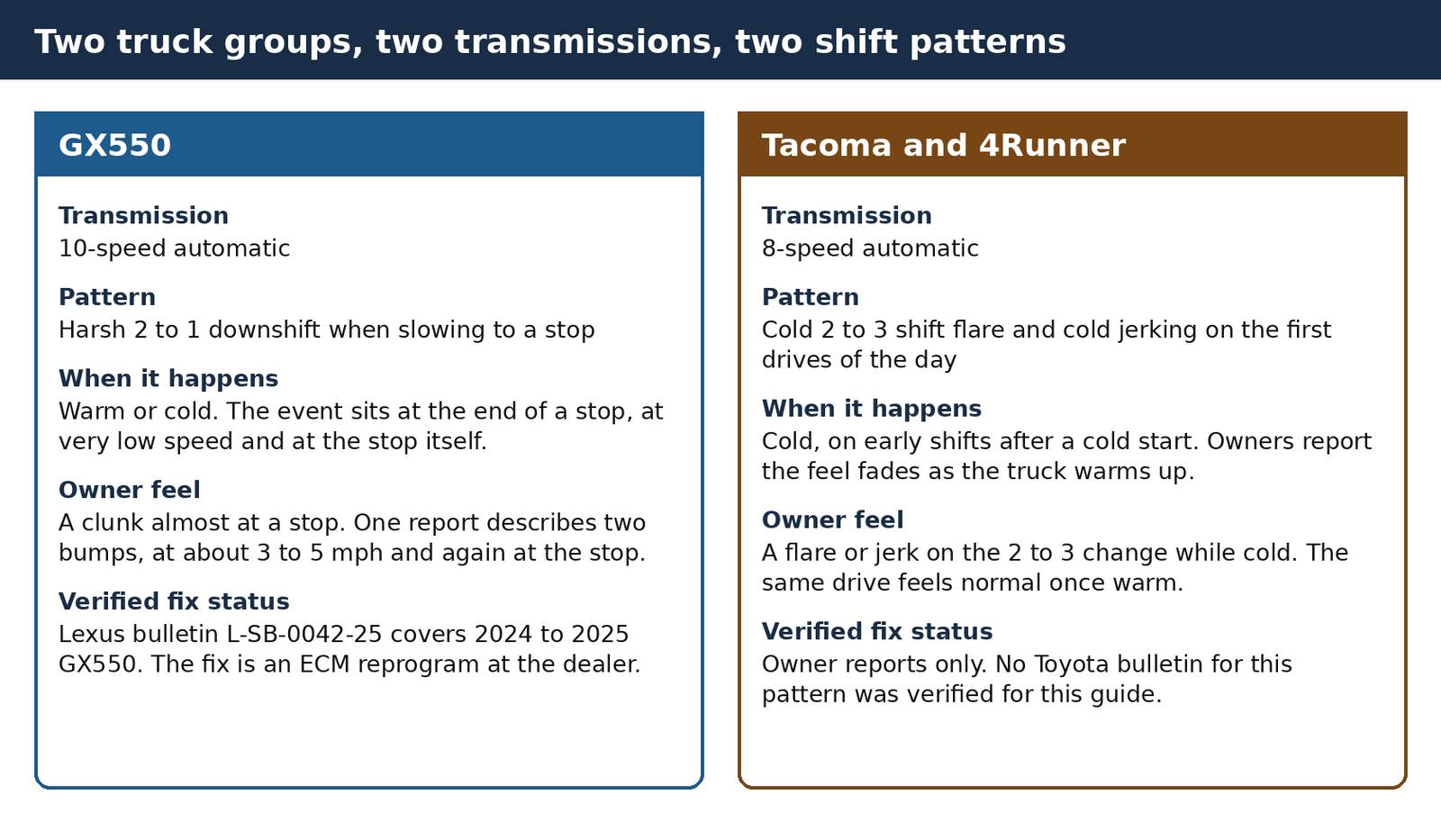
Pattern split. The GX550 complaint occurs at the end of a stop and has a bulletin. The Tacoma and 4Runner complaint occurs in the first cold shifts of the day, and its path runs through documentation and dealer diagnosis.
The GX550 fix is dealer work because the reprogram runs on dealer equipment. Your work on that half is the log. Ask for the bulletin by number at the counter, and confirm the calibration change on the visit paperwork before you leave.
On the Toyota half, your work is documentation, because a cold complaint depends on whether the dealer can reproduce it cold. Both halves end at the same place: a dealer visit backed by a written record of the visit. If you are shopping for a GX550 and want the wider ownership picture, read the buying guide alongside this one: Lexus GX550 Buying Guide.
The GX550 pattern as owners report it
Owners in the Lexus GX Forum thread in the Sources section describe the GX550 event as a 2 to 1 clunk that arrives when braking almost to a stop. The feel occurs at the very end of the stop, after the truck has already slowed through the higher gears without complaint. One owner described two bumps in a single stop, with the first bump at about 3 to 5 mph and the second bump at the full stop.
TorqueNews coverage from May 1, 2025 gathered the same pattern from other owners, who reported low speed jerk and hard 2 to 1 downshifts when coming to a stop. Use those reports as a description of where the event occurs: low speed, light braking, and the last gear change before the truck settles. A harsh event at highway speed, a harsh upshift under power, or a shudder that runs through a whole drive is a different diagnosis, outside the two patterns covered here.
One separation in the owner reports changes what an owner records before a dealer visit. Several owners separated the transmission clunk from Proactive Driving Assist deceleration braking, and they described the assist braking as a different feel tied to a settings item.
The practical step for a GX550 owner is to record the drive settings alongside the event: note the drive mode, note the assist settings in use on that drive, and keep the settings consistent across the drives in your log. A log that mixes settings from drive to drive gives the dealer two variables to argue about, and a log that holds the settings steady leaves the gear change itself as the item under discussion. When you describe the event at the service counter, describe the gear change, the speed, and the braking, and mention the settings you held steady while you recorded it.
One owner in the forum thread reported a harsh change in Comfort mode that went away in Normal mode. I count that as a single report. A single report still earns a line in your own log, because drive mode takes seconds to note.
Record the mode on every stop where the clunk appears and on comparable stops where the clunk stays absent. A pattern that follows one mode across many stops is useful information for the dealer, and a pattern that appears in every mode points the conversation back to the bulletin. Draw no conclusion from one drive in one mode, and let the accumulated log make the point.
The TorqueNews coverage noted one further owner observation on the GX550, a slow first to second shift when cold. This guide treats that observation as a separate item from the harsh 2 to 1 downshift at a stop.
The bulletin addresses the 2 to 1 downshift condition. It says nothing about a cold first to second shift. A GX550 owner who feels both events should log both events as separate lines, with the cold upshift marked as a cold start event. Separate lines keep the dealer visit clean. The bulletin covers one line, and the documentation steps cover the other.
Owner reports also describe mixed dealer experiences on this complaint, and those reports shape the preparation in the bulletin section. One forum owner reported a dealer reply that some units require a technology update for a communication delay in the software, described as warranty work.
TorqueNews reported one owner who was told a software update had no ETA, another owner who received a fix at the 10,000 mile service with a software update the same day, and one case described as an IP compensation code reset. TorqueNews also reported that some dealers declined to act when they could not recreate the symptom. The bulletin below is dated September 17, 2025, and it gives a GX550 owner a current document to bring to the counter in place of the general software update conversation those earlier reports describe.
Lexus bulletin L-SB-0042-25 Rev2
Lexus service bulletin L-SB-0042-25, dated September 17, 2025 and current at Rev2, May 5, 2026, has the title Harsh Downshift When Slowing to a Stop. The bulletin applies to 2024 to 2025 model year GX550 trucks in the USA and Mexico market. The condition in the bulletin reads as follows: some trucks may exhibit a harsh downshift, 2 to 1, when slowing to a stop, and the Electronic Controlled Transmission (ECT) ECU logic has been modified to address the condition.
The repair in the bulletin is a flash reprogram of the ECT ECU. An earlier bulletin, L-SB-0031-25, dated July 29, 2025, had the same title and condition for the same model years, and L-SB-0042-25 Rev2 is the bulletin to name at the dealer now, because the revision notice in Rev2 directs that previous printed versions be discarded.
The bulletin turns on one calibration change. GTS+ reads the calibration ID stored in the truck, and the repair applies when the stored ID is the previous ID in the table below.
When the stored ID already reads as the new ID, the bulletin repair ends at that check and the dealer continues diagnosis outside the bulletin. Ask the service advisor to record the ID found at the check and the ID present after any reprogram on your visit paperwork, because those two lines close the question of whether the bulletin work happened on your truck.
| Calibration item | Value |
|---|---|
| Previous calibration ID, USA and Canada | 8A2106022100 |
| New calibration ID, USA and Canada | 8A2106022200 |
| Previous calibration ID, Mexico | 8A2106023100 |
| New calibration ID, Mexico | 8A2106023200 |
| Diagnostic software | GTS+ software version 2026.01.003.02 or later |
| Programming voltage | 13.5 V held in ECU Reflash Mode during programming |
The equipment list in the bulletin names the tool set the repair requires. The dealer uses GTS+ at software version 2026.01.003.02 or later, with Techstream ADVi or Techstream Lite (only one of the two is required), and the DCA-8000 battery diagnostic tool runs in ECU Reflash Mode to hold battery voltage at 13.5 V during reprogramming. The MSP-070 power supply and charger is the second listed power unit, and it can run at its 13.6 V or 14.4 V setting to hold voltage during the reprogram.
The reflash itself follows bulletin L-SB-0036-22. That equipment list is why the fix is dealer work: the calibration read, the reprogram, and the controlled voltage supply all happen at the shop. Your side of the visit is the record you bring.
The ECT ECU stays in the truck through the whole repair. The bulletin procedure reprograms the existing computer and states that the ECT ECU should not be replaced as part of the repair procedure.
The bulletin parts information lists the computer with the quantity shown as a dash, and the warranty table below lists the OFP number for the operation. That number is a warranty coding entry. No part order is part of this repair, and a quote that lists a computer replacement for this condition describes work outside the bulletin procedure.
Warranty coverage in the bulletin gives the GX550 owner the terms to confirm before the visit. In the USA, the reprogram is covered under the Lexus Basic Warranty for 48 months or 50,000 miles from the in-service date, and the coverage is limited to occurrence of the specified condition. A truck with a California Certified Emission Control System, registered and operated in California or a state that adopts the California emission warranty, also has California Emission Long-Term Defect Warranty coverage for 7 years or 70,000 miles from the in-service date.
Mexico market coverage runs under the Lexus Basic Warranty for 48 months or 80,000 kilometers. The operation code, the time, and the coding entries from the bulletin appear in the table below, and a GX550 owner can read them back to the advisor when the advisor writes up the visit.
| Warranty item | Bulletin value |
|---|---|
| Operation | EL2515, reprogram the Electronic Controlled Transmission (ECT) ECU |
| Time | 0.5 hr |
| OFP | 89530-60770 |
| Condition and cause codes | T1 04, T2 74 |
| USA coverage | Lexus Basic Warranty, 48 months or 50,000 miles from the in-service date, limited to occurrence of the specified condition; California Certified Emission Control System trucks in California or a California-warranty state: California Emission Long-Term Defect Warranty, 7 years or 70,000 miles |
| Mexico coverage | Lexus Basic Warranty, 48 months or 80,000 kilometers |
The dealer procedure in the bulletin runs in a fixed order:
Knowing the order lets you follow the visit and ask about the step in progress.
- Confirm the harsh 2 to 1 downshift when slowing to a stop on the truck in the bay.
- Connect GTS+ and read the current ECT ECU calibration ID.
- Compare the stored ID with the new calibration ID 8A2106022200, and stop the bulletin repair when the stored ID already matches the new ID.
- Reprogram the ECT ECU when the stored ID is the previous ID, with battery voltage held at 13.5 V in ECU Reflash Mode.
- Disconnect the battery terminals after programming and leave them disconnected for at least 5 minutes.
- Reconnect the battery terminals.
- Clear any diagnostic trouble codes stored during the work with GTS+, then test drive the truck and confirm the harsh downshift condition improved.
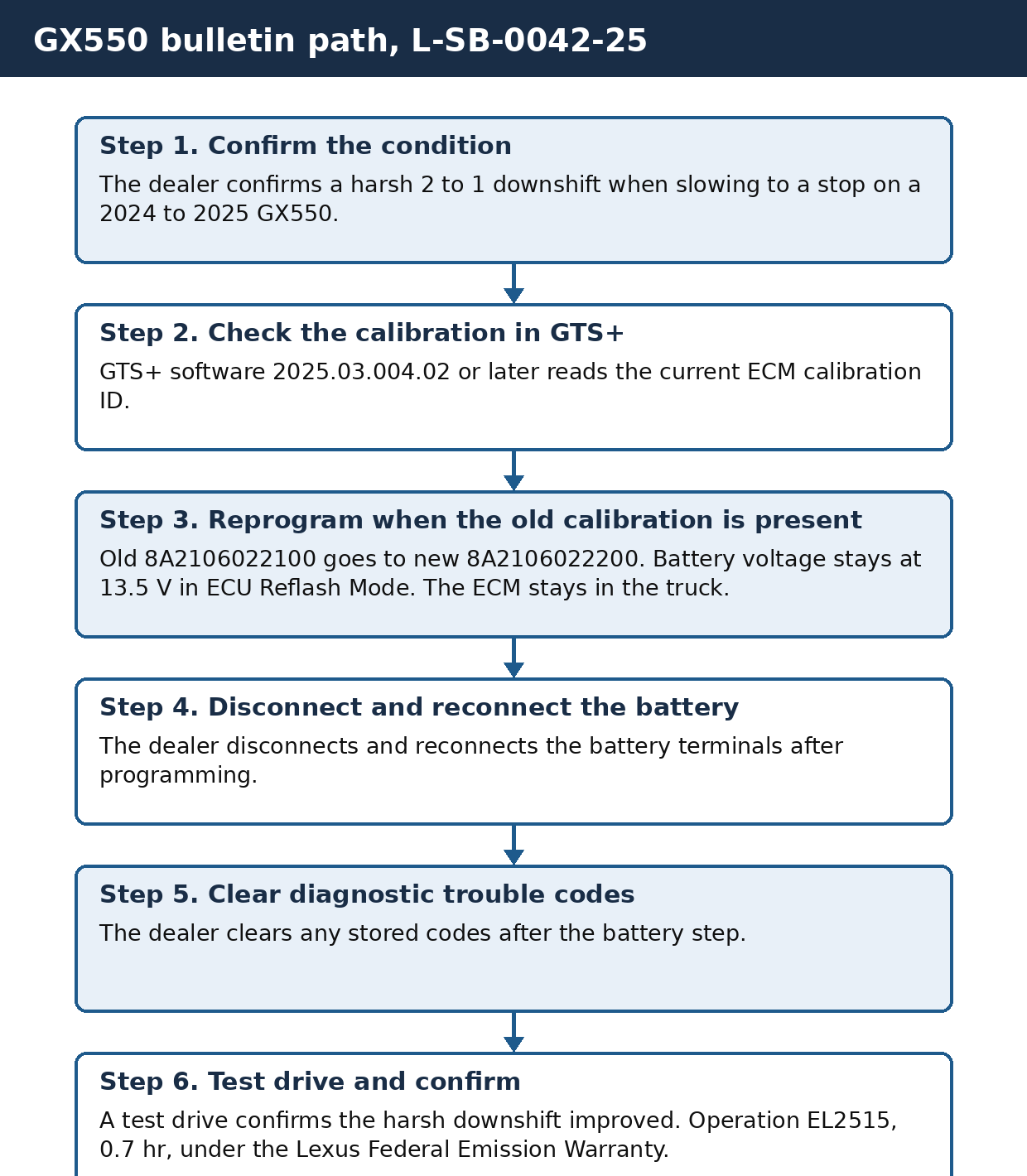
Bulletin flow. The calibration check decides whether the reprogram runs, and the battery step, the code clearing, and the test drive close the visit.
Ask for the work by bulletin number when you book the visit. Name L-SB-0042-25 on the phone call, name the condition in the bulletin words, a harsh 2 to 1 downshift when slowing to a stop, and hand over your log at the counter.
Ask for three items on the paperwork before you leave: the calibration ID found at the check, the calibration ID after the visit, and the operation code EL2515 on the warranty line. Those three items give you a complete record of the visit, and they give any second dealer a starting point if the symptom returns. Keep the paperwork with the log, because the pair of documents describes both the complaint as you recorded it and the repair as the dealer performed it.
A dealer who cannot reproduce the symptom on a short drive presents the problem the earlier owner reports describe. The GX550 answer differs from the cold pattern answer. The GX550 event happens at the end of a stop at very low speed, so a reproduction drive needs repeated full stops in conditions that match your log. Bring the log entries that name speed and braking conditions, and ask the advisor to drive the truck through repeated stops with your entries open on the seat.
When a dealer still declines to act, document the visit in writing, keep the decline on the visit paperwork, and return with a longer log. Owners in the TorqueNews coverage met declines when dealers could not recreate the symptom, and a written record across two visits has more weight at the second visit than a verbal description at the first. Leaving the truck overnight is part of the cold pattern method for the Toyota trucks, where the symptom needs a cold start to appear at all.
Owners of 2026 GX550 trucks follow the same documentation steps with one change in expectation. The bulletin covers 2024 to 2025 trucks, so a 2026 owner asks the dealer to check applicability for that truck by VIN and records the answer on the visit paperwork.
The log and the settings record apply to a 2026 truck in the same form, and so does the calibration question. A 2026 owner whose dealer confirms coverage gets the same procedure in the same order. A 2026 owner whose dealer declines gets the same written record advice as any owner whose symptom stayed unreproduced at a visit.
Owner battery reset reports on the GX550
Several owners in the Lexus GX Forum thread reported that disconnecting the battery cleared the harsh downshift on their GX550 trucks. The reported disconnect periods vary across the thread: reports name 5 minutes, and reports name 20 to 30 minutes. Owners reported the harsh downshift cleared for thousands of miles in some cases, and one owner reported the improvement still held at about 6,000 miles.
I read those reports as temporary relearn reports. A battery disconnect clears learned values, and the transmission then relearns shift behavior during the drives that follow, so an improvement after a reset describes a relearn window. The reports give no holding time that an owner can count on, and the range of outcomes in the thread runs from a lasting improvement in one report to the general pattern of a temporary change.
The bulletin itself gives the battery step a defined place, and that place explains why the reset reports exist. The dealer procedure ends its reprogram with a battery disconnect and reconnect, then code clearing, then a test drive.
The relearn that follows a dealer reprogram starts from the new calibration, and the relearn that follows an owner reset starts from the calibration already in the truck. An owner reset therefore tests the relearn behavior of the existing calibration, and it leaves the calibration question from the bulletin section unanswered. A truck that improves after a reset and later returns to the harsh downshift has given its owner useful log information, and the bulletin repair remains the documented repair for a 2024 to 2025 truck.
A battery disconnect needs care. Disconnecting the battery clears learned values and settings beyond the transmission, and the truck needs its settings checked and restored after the battery reconnects.
The parasitic drain guide on this site covers battery disconnect and sleep discipline, and you should keep it open on the bench during any battery work: GX Parasitic Battery Drain Diagnosis. Record the reset in your log: the date and mileage, the disconnect period you used, and the mileage at any return of the symptom. Those entries turn an informal reset into evidence, and they let you tell the dealer exactly how long a relearn held on your truck.
Run a reset as a recorded test with an end condition. The test runs as follows in practice: record the pattern for several stops before the reset, perform the reset once, then record the same stops under the same settings after the reset.
When the clunk returns, write the mileage beside the return entry and book the bulletin visit with the full log in hand. When the clunk stays away across thousands of miles, keep logging at service intervals anyway, because the calibration question stays open until a dealer reads the stored ID. Either outcome strengthens the dealer conversation, and neither outcome replaces the calibration check on a truck inside the bulletin years.
The Tacoma and 4Runner cold shift pattern
The Toyota half covers the 2024 to 2026 Tacoma and the 2025 to 2026 4Runner, and both trucks use an 8-speed automatic transmission, designated AL80E or AL80F depending on the drivetrain. Owners of these trucks report a cold pattern with a consistent shape across the threads gathered for this guide: a flare or a jerk on the 2 to 3 shift while the truck is cold, on the first drives after a cold start, with the shift feel settling as the truck warms up during the same drive.
Owners use both words for the cold 2 to 3 event. In the reports, a flare is engine speed rising during the change before the gear takes hold, and a jerk is a single abrupt engagement. A useful log records which feel your truck produces, because the dealer will ask and the two words describe two different sensations at the counter.
The owner evidence behind this section accumulated over a defined window, and the reports carry their dates so you can weigh them. The backlog record for this guide, taken on October 12, 2026 with a November 2026 update, lists r/ToyotaTacoma threads that include a 2 to 3 weird when cold report dated October 11, 2026, a Tacoma4G thread on jerky 2 to 3 cold shifts updated October 11, 2026, and a TacomaWorld TSB thread discussion of the cold 2 to 3 flare that had reached page 18.
The same record lists a 2026 4Runner owner report from September 2026 describing a full transmission replacement at about 6,500 miles for harsh shifting, with replies still arriving after the first report. That replacement is a severe individual case inside a thread set dominated by cold shift complaints, and a cold flare on its own does not point at a replacement.
The Kentucky case in the TorqueNews reporting shows why this pattern frustrates owners at the service counter. A 2025 Tacoma in Kentucky jerked through the low gears, described as jerking from 1st to 3rd, across a long mileage span that ran from 3,000 miles to 10,000 miles.
The dealer could not replicate the symptom, and the reason is inside the pattern itself: the symptom occurs on the cold first drive, and a truck that arrives warm at a dealer and goes out on a warm test drive presents a warmed up transmission for the whole visit. The owner experiences the event every morning, and the dealer experiences a normal truck every time the truck arrives. The factory road test explains part of that gap: the manual runs the test with the ATF between 50 and 100 °C (122 and 212 °F) and the coolant between 60 and 100 °C (140 and 212 °F), so the factory confirmation drive is a warm drive. The documentation steps below close the gap, and the central move is the overnight stay that hands the dealer a genuinely cold truck.
The factory manual gives the dealer a printed route for a harsh 2 to 3. Its Problem Symptoms Table lists harsh engagement on the 2 to 3 shift with suspected areas in order: the transmission valve body assembly first, then the No. 1 clutch (C1), the No. 3 clutch (C3), and the No. 1 brake (B1). A harsh 2 to 3 that stays after the truck warms up belongs on that route.
The fluid belongs on the same visit. The AL80 takes Toyota Genuine ATF WS and has no dipstick, and the level is set by overflow with the fluid between 35 and 45 °C (95 and 113 °F). A level check is dealer work with a narrow temperature window, and a truck whose level was set outside that window has a variable the dealer can rule out in one visit.
The GX550 bulletin applies to the GX550 alone, and it gives a Tacoma or 4Runner owner no claim at a Toyota counter. What a Toyota owner can do today is documented and repeatable: record the cold pattern in writing across several cold starts, leave the truck overnight for a cold reproduction, and ask the dealer to read stored codes and check the fluid level. Those actions are the steps below, and they apply in the same form to a Tacoma and to a 4Runner.
Documenting a cold shift complaint
A cold shift log converts a morning sensation into a record a dealer can act on. Build the log before the dealer visit, and build it the same way on every cold drive, because consistency across entries is what separates a pattern from a single odd shift.
The log fields match the diagram below: date, outside temperature, mileage, gear change, feel, whether the event faded as the truck warmed up, and the dealer action that followed. A phone note works for the log, and a paper notebook works equally well, and the medium matters less than completing one row per cold drive while the details are still fresh at the end of that drive.
- Start the log on the first cold drive where you notice the event. Before you drive off, write down the date and the outside temperature, and note the odometer mileage.
- Drive the truck normally and note each cold 2 to 3 event as it happens, with the gear change and the feel recorded as flare or jerk, and a note of how many times the event repeated on that drive.
- Keep driving until the truck is fully warm, then record whether the event faded as the truck warmed up and at roughly what point in the drive the shifts settled.
- Repeat the same entries across several cold starts, including at least one cold start after the truck sat for a full day, so the log shows the pattern returning from cold rather than appearing once.
- Check stored codes with a scan tool that covers transmission codes if you own one, and write any code into the log with the date and mileage of the read, and write a clean read into the log as a clean read.
- Book the dealer visit and arrange to leave the truck overnight, and tell the advisor at booking time that the truck must be driven cold the next morning for the symptom to appear.
- Hand the log to the advisor at drop off, and ask the advisor to attach the log to the visit paperwork so the technician drives the truck with your conditions in hand.
- Ask the dealer to read stored codes during the visit and to check the ATF level inside its adjustment window, 35 to 45 °C (95 to 113 °F), and ask for both results in writing on the visit paperwork.
- Record the dealer action in the final column of the log when you collect the truck, including a decline, so the next visit starts from a documented history.
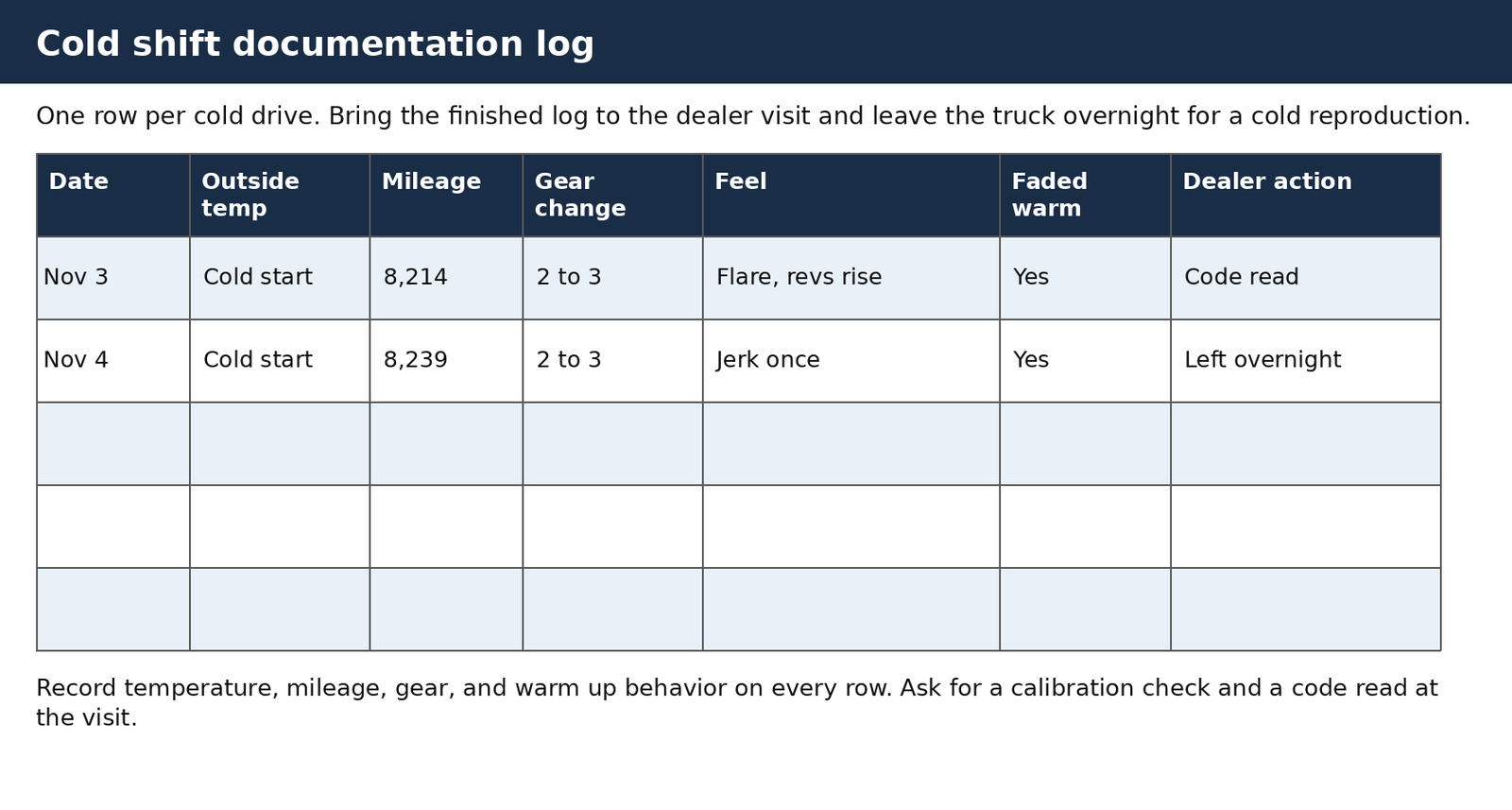
Cold shift log. One row per cold drive, completed on the day of the drive, with the dealer action recorded after each visit.
The overnight stay is the central move. A cold pattern needs a cold truck, and a truck that stays at the dealer overnight starts the next morning in the same state as your driveway starts. The technician can then drive the exact first shifts of the day with your log open, in the temperature range your entries name.
The Kentucky case above shows the alternative outcome: repeated warm visits that reproduce nothing and close with no action. An owner who cannot leave the truck overnight can ask the dealer to schedule the truck as the first drive of a morning after an overnight drop the evening before, which reaches the same cold start through a different booking shape. Either arrangement serves this complaint better than a midday drop off, and the log should state that the symptom requires a cold start so the booking desk routes the truck correctly.
A complete log also protects the owner when the first visit ends without a repair. Dealers record visits against the truck, and a second visit with a longer log and a documented first decline describes an ongoing complaint with dates and mileages attached.
Keep your copy of every visit paperwork sheet, keep the log growing between visits, and bring both to every appointment. When the pattern changes, record the change as new entries rather than editing old ones, because a log that shows the event growing more frequent or appearing in more gears has information that a rewritten log loses.
One more dealer action is worth requesting: Reset Memory. The dealer’s GTS utility clears the transmission control module’s learned values, and the drive learning that follows runs two set patterns with the ATF between 60 and 100 °C (140 and 212 °F). The manual repeats the patterns until shift shock and engine revving subside. A reset on the visit paperwork, with your log entries before and after, gives you relearn evidence with dates on it instead of a verbal report that the truck felt better.
Failure signs outside both patterns
Some transmission complaints fall outside both patterns, and they follow a different rule. A truck with no reverse, or with reverse that barely moves the truck, has left the harsh shift category. The factory symptoms table backs that separation: a truck that does not move in R sends the dealer to the valve body assembly, the No. 3 clutch (C3), and the No. 2 brake (B2).
A truck with slipping that leaves it barely moving has left the category as well. Warning lights on the dash or stored codes paired with a shift complaint move the truck into dealer diagnosis, and metal found in the transmission during any inspection moves it there at once. No sign in this group gets a repair drafted here or a documentation timeline. The correct action is dealer diagnosis now, with a tow when the truck cannot move safely under its own power.
One case from the backlog record shows the shape of this group at headline depth. A 2026 4Runner Limited at 4,671 miles reached TorqueNews on November 5, 2026 through a November 3, 2026 r/4Runner post, with metal shavings found and reverse barely moving.
A full transmission replacement was expected in that report, and the case was still open at the time of reporting, with no final outcome recorded. That case marks the distance between a cold flare that an owner documents over weeks and a failure that presents with metal and a lost reverse gear. If your truck shows any sign in this group, skip the logging steps and go directly to dealer diagnosis.
GX470 and GX460 scope note
The GX470 and the GX460 are outside this guide. Their transmissions are a different family from both transmissions covered above, and no value, procedure, or bulletin in this guide applies to them.
A GX470 or GX460 owner with a transmission complaint, a service question, or a shift feel concern should start with the transmission fluid service guide for those trucks: GX Transmission Fluid Service. That guide addresses the earlier trucks only. It makes no claim about the GX550, the current Tacoma, or the current 4Runner.
Parts and tools
The repairs here are dealer work. This table lists the tools you use for the log and for reading codes, and it marks the calibration equipment as dealer only.
The last row is the bulletin OFP entry. That row is paperwork, and it says so, so the number is not misread as a shopping item.
| Item | Side | Used for |
|---|---|---|
| LAUNCH CRP129X V2.0 scan tool that reads transmission codes | Owner | Reading and recording stored transmission codes before a dealer visit and after any visit where codes were cleared |
| NOCO GENIUS5 battery maintainer | Owner | Holding battery voltage steady during long diagnostic sessions and long shop visits where the truck stays parked with systems awake |
| Notebook or phone log | Owner | Pattern records with date, outside temperature, mileage, gear change, feel, and warm up behavior |
| OBDLink MX+ OBD2 dongle with a gauge app | Owner | Watching transmission temperature across a cold drive and a warm drive so the log can pair the event with a temperature range |
| GTS+ with Techstream ADVi or Techstream Lite, the DCA-8000 battery diagnostic tool, and the MSP-070 power supply and charger | Dealer only | Reading the calibration ID, reprogramming the ECT ECU under bulletin L-SB-0042-25 Rev2, and holding 13.5 V in ECU Reflash Mode during programming |
| Bulletin OFP 89530-60770, Computer Assy, Transmission Control | Dealer paperwork | Warranty coding entry in bulletin L-SB-0042-25 Rev2, listed with quantity shown as a dash. The ECT ECU stays in the truck during the reprogram, and no part is ordered for this repair. |
You can arrive at a visit with codes already recorded when you have a scan tool. A complete log lets you direct the advisor to the exact conditions that produce the event.
The reflash itself requires GTS+ and the controlled voltage supply in the table, and no owner tool in the table substitutes for that equipment. Owners who want a second set of eyes on a code read can still hand the repair itself to the dealer in every case this guide covers, because the GX550 repair is a calibration change and the Toyota trucks run through dealer diagnosis on the manual’s symptoms table.
Stop conditions
Warning lights with a shift complaint mean dealer diagnosis before further driving. A transmission related warning light, or a dash warning paired with slipping or a lost gear, takes the truck out of the logging steps. Arrange dealer diagnosis, and arrange a tow when the truck cannot move safely.
Loss of reverse means stop. A truck with no reverse, or with reverse that barely moves the truck, should not be driven to build a longer log. That sign is one of the failure signs, and it calls for dealer diagnosis now.
Slipping that leaves the truck barely moving means stop. A transmission that slips to the point where the truck struggles to move presents a safety problem in traffic as well as a mechanical one. Park the truck and arrange transport to the dealer.
A transmission temperature warning means stop and cool the truck. Pull off safely, stop the truck, and let the transmission cool before any further driving. A temperature warning paired with shift complaints goes to dealer diagnosis after the truck cools, and repeated temperature warnings end driving until the diagnosis happens.
A harsh shift alone, with none of the signs above, is not a stop condition. A GX550 clunk at the end of a stop with no warning lights and full drive and reverse follows the bulletin steps. A Tacoma or 4Runner cold flare that fades warm with no warning lights follows the logging steps. The stop conditions in this section govern only the signs they name.
FAQ
Does the GX550 use an 8-speed transmission?
The GX550 uses a 10-speed automatic transmission. The 2024 to 2026 Tacoma and the 2025 to 2026 4Runner use an 8-speed automatic transmission. Bulletin L-SB-0042-25 covers the GX550, and the bulletin makes no claim about either Toyota truck.
What does bulletin L-SB-0042-25 cover?
The bulletin covers 2024 to 2025 GX550 trucks that exhibit a harsh downshift, 2 to 1, when slowing to a stop.
The repair in the bulletin is an ECT ECU reprogram. The bulletin covers 2024 to 2025 trucks. A 2026 owner follows the same documentation steps while the dealer checks applicability by VIN.
Will the dealer replace my ECT ECU under the bulletin?
The dealer reprograms the existing ECT ECU and the computer stays in the truck.
The bulletin parts information lists the computer with quantity shown as a dash. The number is the warranty OFP entry. No part order is part of this repair.
What calibration change does the bulletin make?
The bulletin moves the GX550 ECT ECU calibration from the previous ID 8A2106022100 to the new ID 8A2106022200 on USA and Canada trucks, and from 8A2106023100 to 8A2106023200 on Mexico trucks.
The dealer reads the stored ID with GTS+ at software version 2026.01.003.02 or later, reprograms the truck when the stored ID is the previous ID, and ends the bulletin repair at the check when the stored ID already reads as the new ID.
Is the GX550 reprogram covered under warranty?
In the USA, the bulletin covers the reprogram under the Lexus Basic Warranty for 48 months or 50,000 miles from the in-service date, limited to occurrence of the specified condition. California Certified Emission Control System trucks registered and operated in California or a state that adopts the California emission warranty have California Emission Long-Term Defect Warranty coverage for 7 years or 70,000 miles.
The operation is EL2515 at 0.5 hr. Mexico market coverage runs under the Lexus Basic Warranty for 48 months or 80,000 kilometers.
My dealer could not reproduce the GX550 harsh downshift. What do I do next?
Bring a log that names speed and braking conditions for each event, and ask the advisor to drive repeated full stops with your entries in hand.
When a dealer still declines to act, keep the decline on the visit paperwork, extend the log, and return for a second visit with the longer record. Owner reports describe declines after unreproduced symptoms, and a documented history across visits is what I recommend.
Does disconnecting the battery fix the GX550 harsh downshift?
Owners reported that a battery disconnect cleared the harsh downshift for a period, with disconnect times of 5 minutes and of 20 to 30 minutes in the reports, and one report held at about 6,000 miles.
I read those reports as temporary relearn reports, because a disconnect clears learned values and the transmission relearns afterward. The bulletin reprogram remains the documented repair for a 2024 to 2025 truck, and the dealer procedure itself ends with a battery disconnect and reconnect after programming.
What should I ask the dealer to check on a Tacoma or 4Runner with a cold 2 to 3 flare?
Ask for a cold reproduction first: leave the truck overnight so the technician drives the first shifts of the day. Ask the dealer to read stored codes, and to check the ATF level inside its adjustment window, 35 to 45 °C (95 to 113 °F).
Record the pattern in a log with temperature, mileage, gear change, and warm up behavior across several cold starts, and hand the log over at drop off. If a harsh 2 to 3 stays after the truck warms up, the factory symptoms table sends the dealer to the valve body assembly first, then the No. 1 clutch (C1), the No. 3 clutch (C3), and the No. 1 brake (B1). Ask about Reset Memory as well: the dealer can clear the learned values on GTS and run the drive learning patterns that follow.
Sources
- Lexus service bulletin L-SB-0042-25 Rev2, Harsh Downshift When Slowing to a Stop, September 17, 2025, Rev2 May 5, 2026, hosted by NHTSA, bulletin PDF
- GX550 factory service manuals
- Tacoma factory manuals
- 4Runner factory manuals
- Lexus GX Forum, Downshift when approaching stops, owner reports thread, thread page
- TorqueNews, My Lexus GX550 Has Transmission Jerk Issue, May 1, 2025, article
- The Car Connection, 2024 Toyota Tacoma specifications, 8-speed automatic listing, specifications page
- Edmunds, 2025 Toyota 4Runner specifications, 8-speed shiftable automatic listing, specifications page
- RedBook, Lexus GX550 vehicle details, 10 gear listing for 2025 and 2026, vehicle details
Leave a Reply