Your GX has no transmission dipstick (the 2003 GX470 may still have one; see the note in the procedure section). The fluid is Toyota WS, and Lexus calls it lifetime fluid. None of that means you cannot service it, and none of it means you should ignore it. This guide covers the procedure, the argument about whether to touch it at all, and the shudder that sends owners down this rabbit hole in the first place. For the spec tables (grades, capacities, intervals), see the Truck Garage GX fluids guide. This is the hands-on companion: how the service works, how to decide when to do it, and what it can and cannot fix.
What lifetime fluid actually means
Lifetime does not mean the fluid lasts forever. It means Lexus does not put a change interval in the normal maintenance schedule.
The 2006 GX470 owner’s manual says to change the automatic transmission fluid only as necessary, generally only under the special operating conditions in the maintenance schedule [1]. Toyota went further in technical service bulletin TS-B0006-11, issued January 6, 2011: no fluid change or flush is needed for the life of the vehicle, and the 100,000-mile item people quote is an inspection, not a service [2].
There is one factory exception that matters. The GX460 Warranty and Services Guide calls for replacing the ATF at 60,000 miles under severe service: towing, using a car-top carrier, heavy vehicle loading, or extensive idling and low-speed driving [3]. No equivalent severe-service ATF replacement is published for the GX470; the 2006 manual keeps the “only as necessary” language [1].
So the factory position is: normal use, leave it alone; hard use on a GX460, replace it at 60k. Owners mostly reject the first half. The reasoning is simple. WS is a good synthetic fluid, but fluid still shears, oxidizes, and loses its friction modifiers with heat cycles. A truck bought at 180,000 miles with unknown history is not what the lifetime claim was written for. The Car Care Nut, a former Toyota master tech whose service-interval videos get quoted on every Toyota forum, lands at ATF WS every 60,000 miles or 6 years [4]. That is his recommendation, not the factory’s, but it lines up with the GX460’s own severe-service interval and it is the number most forum veterans use.
My judgment, clearly labeled: if you plan to keep the truck past 250,000 miles, service the fluid on a 60,000-mile cycle, sooner if you tow. If you bought it used with no service history, the decision gets harder. That is the next section.
Drain-and-fill vs flush: the debate
There are two ways to get fresh fluid into a sealed transmission, and the forums have been fighting about them for twenty years.
Drain-and-fill. Pull the drain plug, measure what comes out, pump that much fresh WS back in through the refill plug, then set the level through the overflow plug at the correct temperature. One service replaces roughly a quarter of the system. It is gentle, cheap, and impossible to mess up badly. This is what the Car Care Nut recommends: drain-and-fill removes some debris but leaves some behind, and even a small volume of new fluid adds enough additives and detergents to be beneficial [4].
Flush. A machine (or a cooler-line exchange done by hand) pushes new fluid through the whole system and gets nearly all of it. It is the only way to replace 100 percent in one sitting.
The case against flushing is about old, neglected transmissions. The argument, in its strongest form: clutch packs that have lived 150,000 miles on original fluid have wear debris suspended in the fluid, and that debris is contributing to friction. Strip it all out at once and the clutches can slip. The Car Care Nut’s rule of thumb: past 100,000 miles with no prior change, do not replace the fluid. There is a delicate balance between too much debris (which can clog the valve body and solenoids over time) and no debris (which can let worn clutches slip) [4]. Owners who have watched a flush turn a working transmission into a slipping one tend to become drain-and-fill people for life [5].
The case for flushing is that it is the only complete service, and plenty of owners have done it without incident, including dealer flushes that fixed shudder complaints [6]. The risk is concentrated in transmissions that are already worn, not in maintained ones. A dealer that refuses the job is usually refusing the liability, not making a technical claim [7].
The middle path: do a drain-and-fill now, then repeat it every 60,000 miles. One service replaces about a quarter of the fluid, which is gentle on the transmission, and staying on the interval keeps fresh additives in the mix. Skip the repeated back-to-back services. The 60,000-mile cycle is the whole strategy.
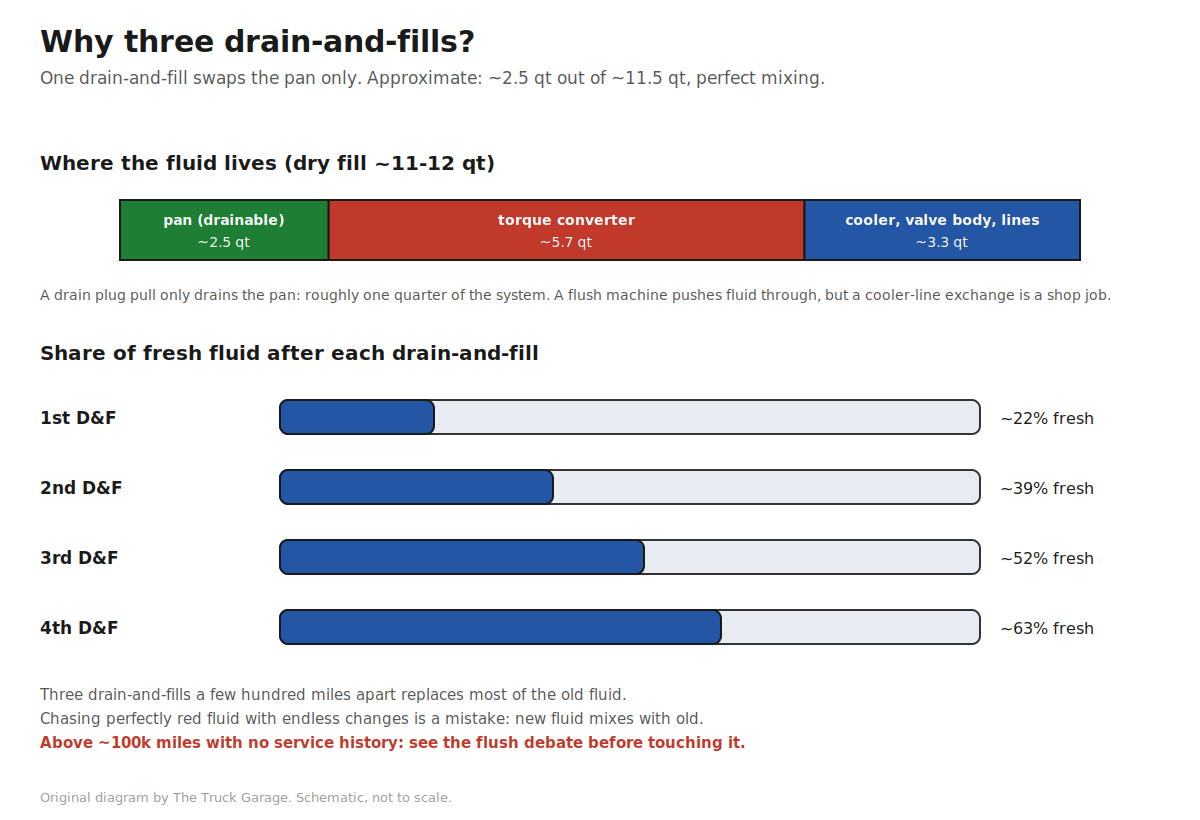
Two mistakes to avoid. First, do not keep changing fluid until it comes out bright red. New fluid mixes with old, so the color chases forever, and the Car Care Nut calls repeated changes to reach red a mistake [4]. Second, do not let anyone talk you into a flush on a high-mileage transmission that is already showing symptoms. If it is slipping before the service, new fluid will not rebuild the clutches.
The high-mileage rule
This deserves its own section because it is the most common question in the debate threads: my truck has 140,000 miles, the fluid has never been changed, and it shifts fine. Do I touch it?
If you do not know when the fluid was last serviced, start the 60,000-mile drain-and-fill cycle now, symptoms or not. A single drain-and-fill only replaces about a quarter of the fluid, so it is gentle enough for a neglected transmission, and getting on the interval is what matters. Do not try to catch up with repeated back-to-back services. Just start the cycle and stay on it.
If the fluid smells burnt or you find metal in the pan, stop and get a professional diagnosis. No service interval fixes that.
Servicing the sealed transmission
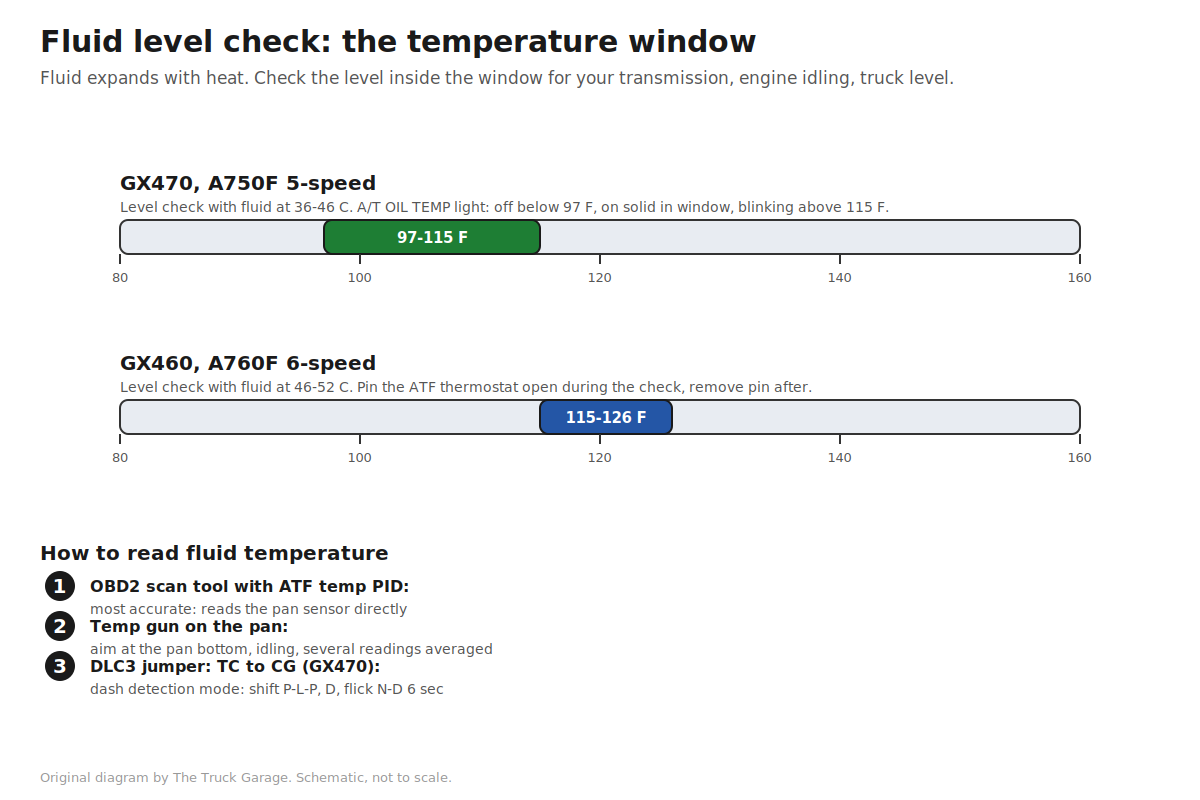
Here is the actual procedure. Both trucks are sealed, meaning no dipstick, with one exception: the 2003 GX470 may still have a dipstick (see the note above). The level is set from the overflow plug on the pan, with the engine idling and the fluid inside a narrow temperature window. Fluid expands with heat, so the temperature is the procedure. Get it wrong and the level is wrong. The procedure is the same whether or not your truck has a dipstick.
GX470 (A750F 5-speed)
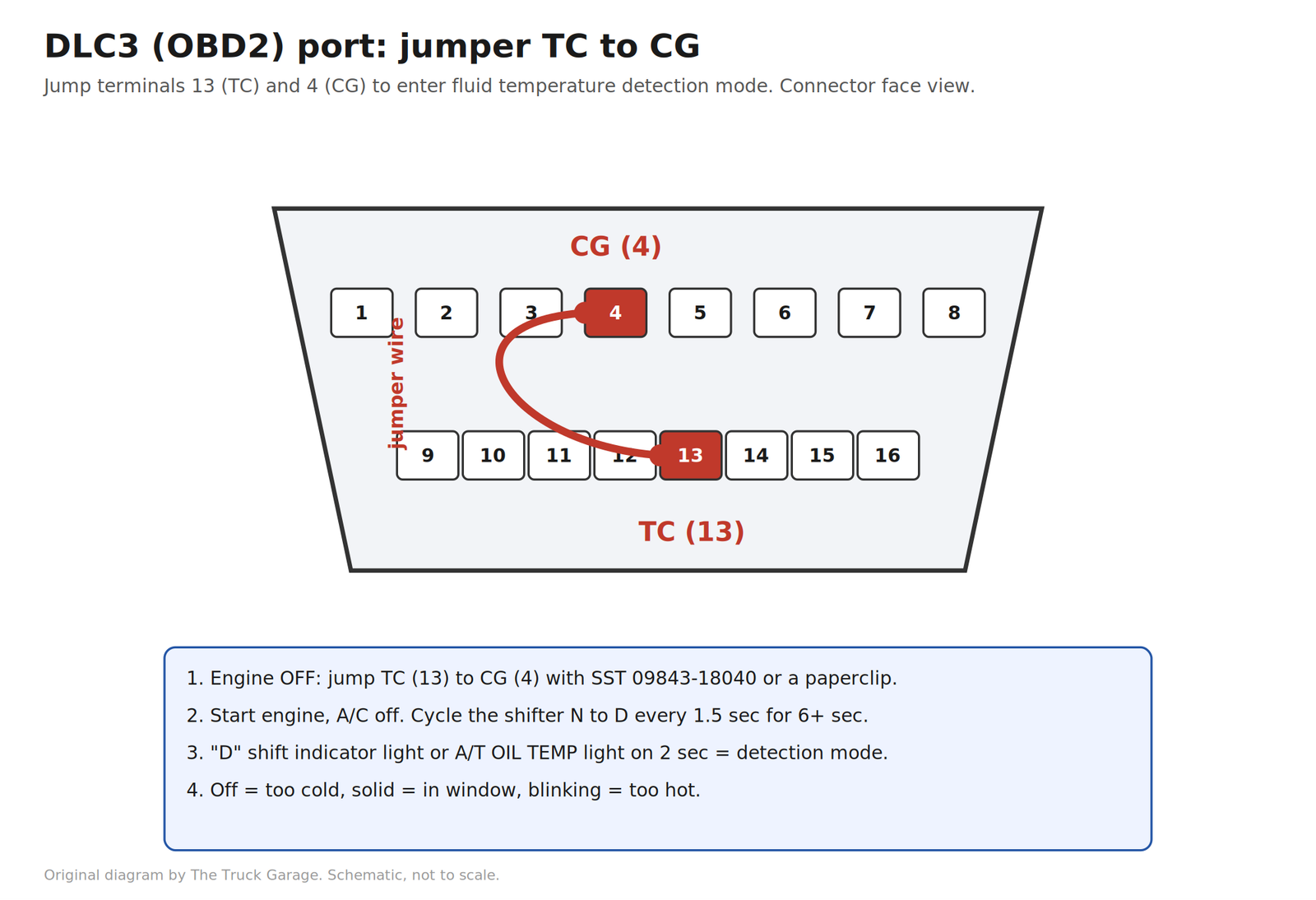
The temperature window is 36 to 46 C (97 to 115 F) [9]. The dash gives you a built-in thermometer: jumper terminals 13 (TC) and 4 (CG) of the DLC3 port, and the A/T OIL TEMP warning light stays off below 97 F, comes on solid inside the window, and blinks above 115 F. The factory SST for the jumper is 09843-18040; a short piece of wire does the same job in a driveway [9].
- Truck level on jack stands or a lift. Engine off and cold to start, fluid below 97 F.
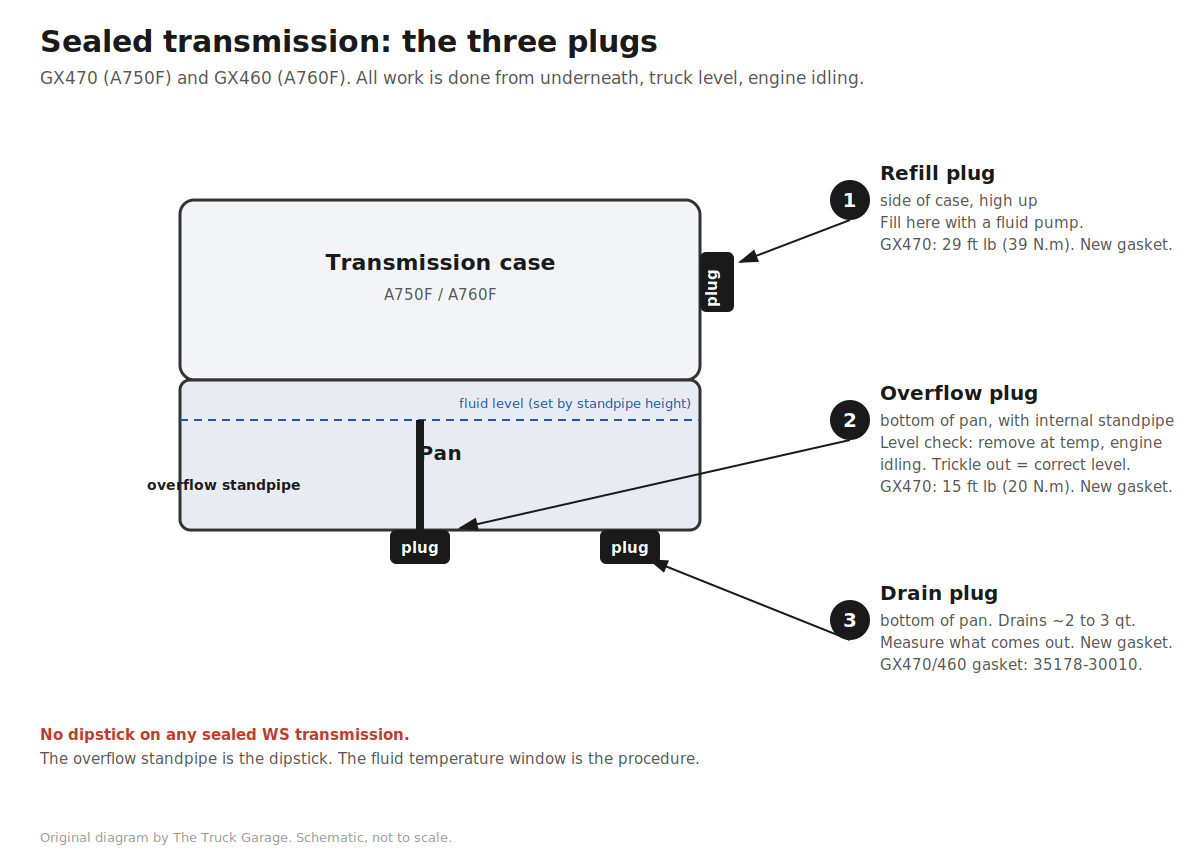
- Remove the refill plug on the side of the case and the overflow plug on the bottom of the pan. Fill through the refill hole until fluid trickles out of the overflow tube, then reinstall the overflow plug.
- Fill the correct amount for the repair. After a pan and drain plug removal, the factory refill figure is 1.7 L (1.8 US qt) [9]. Owners commonly measure a bit more or less coming out, which is why the next steps exist.
- Reinstall the refill plug. Idle the engine with the A/C off. Shift slowly through the entire gear range to circulate the fluid, then wait 30 seconds idling.
- With the jumper in place, enter fluid temperature detection mode: shift slowly from P to L and back to P, then move to D and flick quickly between N and D (once within 1.5 seconds) for at least 6 seconds. The A/T OIL TEMP light stays on for 2 seconds and goes off when detection mode is active [9].
- Let the engine idle until the light comes on solid, meaning the fluid is inside the 97 to 115 F window.
- Remove the overflow plug with the engine still idling. Fluid should come out of the overflow tube. Wait until it slows to a trickle. If nothing comes out, reinstall the plug, stop the engine, add 0.4 L (0.42 US qt) through the refill plug, idle 10 seconds, and recheck [9].
- Install the overflow plug with a new gasket. Stop the engine. Install the refill plug with a new gasket. Torques: overflow plug 15 ft lb (20 N.m), refill plug 29 ft lb (39 N.m) [9].
Shadetree notes: the refill plug sits in an awkward spot near the exhaust, so a fluid pump with a long hose routed from above saves burned knuckles. Several owners have rigged a permanent funnel hose for trail top-ups [10]. An OBD2 scan tool with an ATF temperature PID or a temp gun on the pan works in place of the jumper method; the light method is free and factory-approved [9]. The GX470’s 2004 and newer transmissions are the sealed WS type with no dipstick per Lexus bulletin L-TC009-03; WS is not compatible with other fluids [11]. A 2003 GX470 may still have a dipstick and Type T-IV fluid, but that is owner-reported, not factory-verified in this guide. If you own a 2003, pop the hood and look for a transmission dipstick before you buy fluid. Type T-IV and Toyota WS are strictly incompatible, so confirm which one your truck takes first.
GX460 (A760F 6-speed)
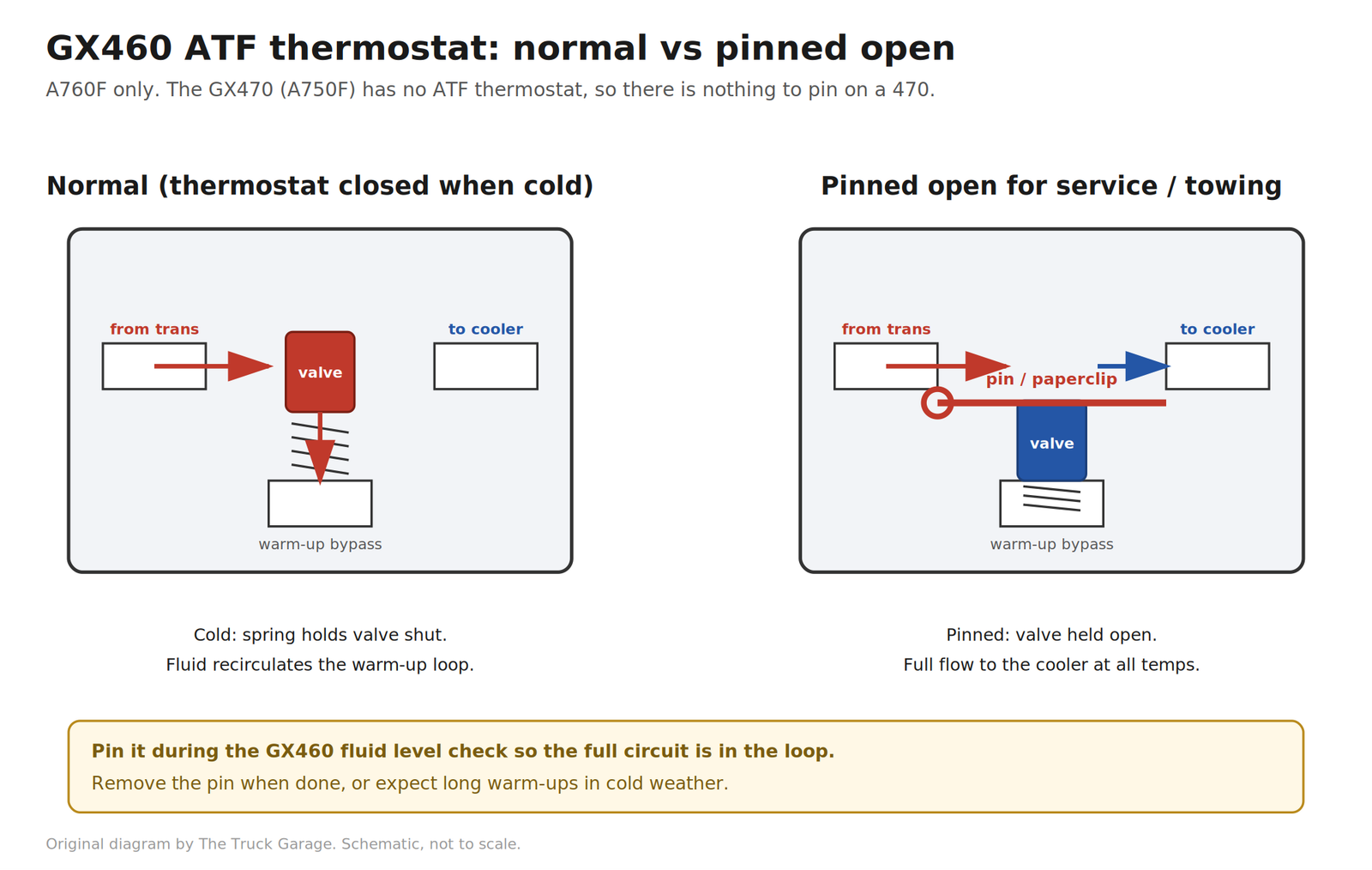
Same sealed concept, different temperature window: 46 to 52 C (115 to 126 F) [12]. The GX460 also has a thermostat in the ATF circuit that must be pinned open during the level check so the full circuit is in the loop; remove the pin when you are done. The full thermostat-pin and overflow-plug procedure is covered step by step in the Truck Garage transmission health and cooling guide, which is the companion to this one.
Shadetree notes: everything about temperature reading applies. An OBD2 dongle with a transmission temp PID is the easiest method on the GX460, and it doubles as the monitoring tool the cooling guide recommends. A temp gun on the pan, aimed at the bottom and averaged over several readings with the engine idling, is the no-electronics fallback.
GX550 note
The GX550’s 10-speed is also a sealed WS unit with no dipstick [12]. It uses an integrated fluid warmer and cooler rather than the older heat-exchanger layout. No factory service interval was verified for this guide, and community service data is still thin. Log your temperatures before modifying anything, and verify every figure against the factory manual for your year.
Parts and tools
Gather everything before you start. Nothing ends a Saturday faster than a parts run with the truck on jack stands and the pan off.
- Toyota Genuine ATF WS. Buy 4 quarts for one drain-and-fill and keep a couple extra on the shelf. Nothing else goes in these transmissions. The factory warns that other fluids can cause abnormal noise, vibration, and damage.
- Drain plug gaskets. New gaskets on the drain, overflow, and refill plugs every time. The common gasket for these plugs is 35178-30010 [13]; this 12-piece kit covers the plugs with spares left over.
- Fluid transfer pump. Mandatory. You cannot pour uphill into the side refill plug.
- A way to read fluid temperature: OBD2 scan tool with an ATF temp PID (ScanGauge II and OBDLink MX+ both support it), an infrared temp gun, or a short jumper wire for the DLC3 TC-to-CG method on the GX470.
- Drain pan with quart markings. Measure exactly what comes out and put that much back in. This is the single most important step.
- 10 mm hex socket for the plugs, torque wrench, jack stands, wheel chocks. A 3/8-inch digital torque adapter is ideal for the 15 ft-lb overflow plug on aluminum threads.
- Shop towels, nitrile gloves, and brake cleaner. ATF finds every surface you own.
Shadetree rule that overrides the book: the published drain-and-fill volumes disagree with each other (the 2006 adjustment table says 1.7 L after pan and drain plug removal; the 2005 manual spec page says 3.0 L; owners measure about 2 to 2.5 quarts). So do not fill by the book number. Drain it, measure it, replace exactly that amount, then set the final level through the overflow plug at temperature. The overflow plug is the arbiter, not the spec table.
What is transmission shudder
Shudder is a vibration or shaking felt under light throttle, usually around 30 to 45 mph, often right before a shift or when the torque converter locks up. Owners describe it as driving over rumble strips for a second or two. The A750 is known for it, particularly in the 4Runner and GX applications [14].
The usual suspect is the torque converter lockup clutch. The converter has a clutch that locks the engine to the transmission at cruising speed for efficiency. When the friction modifiers in the ATF deplete with age and heat, the clutch stops engaging smoothly and chatters instead. Depleted friction modifiers producing converter shudder is the most common complaint pattern on these transmissions [15].

The brake-tap test
This is the home diagnostic the forums swear by [15]. Warm the truck to full operating temperature, because the converter will not lock up when cold. Drive in overdrive until you feel the shudder. The moment it starts, keep your right foot steady on the gas and tap the brake pedal about a quarter inch with your left foot. Tapping the brake commands the converter to unlock. If the shudder instantly stops, the torque converter clutch is your problem.
Will a fluid change fix it?
Sometimes, and that is an honest sometimes. Fresh WS restores the friction modifiers, and owners report that a drain-and-fill fixes the shudder, at least for a while [14]. One owner had the shudder cured by a dealer fluid flush [6]. Others changed the fluid and the shudder stayed, which points at a glazed or worn converter clutch that no fluid will unglaze [16].
The reasonable sequence: confirm it with the brake-tap test, check the fluid level and condition first (low fluid causes its own problems), then do a drain-and-fill with genuine WS. Use WS only. Owners report that universal fluids can cause converter shudder on their own [6]. If the shudder survives fresh fluid at the correct level, the torque converter is the repair. That means transmission removal, so get a second opinion before you commit.
Other causes worth ruling out
Not every shake at speed is the converter. Two specific checks from the forums:
- Coolant contamination. The ATF heat exchanger lives in the radiator end tank. If the barrier fails, coolant gets into the transmission fluid, and contaminated fluid can cause shudder [14]. Milky or strawberry-colored fluid is the tell. This is the same failure behind the pink-milkshake threads, and it is a radiator problem wearing a transmission costume.
- Wrong fluid or low level. Already covered, but worth repeating because it is the cheapest fix on the list. Check the level through the overflow plug before you buy anything.
Harsh shifts, slipping, or getting stuck in gear are different symptoms with different causes: shift solenoids, the valve body, or fluid level. A shudder that happens at takeoff in first or second gear rather than at lockup speed points away from the converter [17]. And a rumble at 55 to 65 mph that does not change with braking is more likely tires, wheel bearings, or the driveshaft than the transmission.
Service intervals: a judgment call
Here is where the guide stops quoting and starts advising. The factory says lifetime, with a 60,000-mile severe-service replacement on the GX460. The forums say 60,000 miles regardless. I say: match the service to how you use the truck.
- Daily driver, no towing: a drain-and-fill every 60,000 miles is cheap insurance. The severe-service schedule agrees with this if you count city heat and short trips as severe, which you should.
- Towing, overlanding, bigger tires: every 30,000 to 50,000 miles, and watch your temperatures with a scan tool. Heat is what kills fluid, and towing is what makes heat. The transmission cooling guide covers temperature management in detail.
- Bought used with unknown history under 100,000 miles: do a drain-and-fill now, then put it on the 60,000-mile cycle. This is the highest-value service you can do on a used GX.
- Over 100,000 miles, never serviced, shifts fine: one cautious drain-and-fill, drive it for a few hundred miles, and decide whether to continue the cycle based on how it behaves. Do not flush it. Do not chase red fluid.
- Any symptoms already present: diagnose first, service second. Fluid is maintenance, not repair.
FAQ
Do I really need to change lifetime transmission fluid? Lexus does not schedule it under normal use, and Toyota’s TSB TS-B0006-11 says no change is needed for the life of the vehicle [2]. The exception is severe service on the GX460: replace at 60,000 miles when towing or heavily loaded [3]. Most long-term owners service it anyway, typically a drain-and-fill every 60,000 miles, because fluid degrades with heat and age regardless of what the schedule says [4].
Drain-and-fill or flush? Drain-and-fill. It replaces about a quarter of the fluid per service, it is gentle, and it is the recommendation of the techs the forums trust [4]. Do one now and repeat every 60,000 miles. Reserve flushes for maintained transmissions, and never flush a high-mileage transmission that has never been serviced.
How do I check the fluid level with no dipstick? Through the overflow plug on the pan, engine idling, truck level, fluid inside the temperature window: 97 to 115 F on the GX470, 115 to 126 F on the GX460 [9] [12]. Remove the plug and let the excess drain to a trickle.
What is transmission shudder, and will a fluid change fix it? Shudder is usually the torque converter lockup clutch chattering from depleted friction modifiers in old fluid [15]. A drain-and-fill with genuine WS sometimes fixes it [14]. Confirm it first with the brake-tap test, rule out coolant contamination and low level, and accept that a glazed clutch needs a converter, not fluid.
Can I use aftermarket ATF instead of Toyota WS? The factory says WS only and warns of noise, vibration, and damage from other fluids. Owners report that universal fluids can cause converter shudder [6]. If you use a WS-licensed alternative, do it as a full fill, not mixed with Toyota fluid. For a top-up or a single drain-and-fill, use genuine WS.
How much fluid comes out in a drain-and-fill? About 2 to 2.5 quarts from the pan on the A750F. Published figures disagree (1.7 L in the adjustment table, 3.0 L on the 2005 spec page), so measure what comes out and replace exactly that amount, then set the final level at the overflow plug.
Should I replace the filter while I am in there? If the fluid has been serviced on schedule, the filter is a waste of money [4]. If you are opening a neglected high-mileage transmission, a pan drop with filter replacement is reasonable, but weigh it against the high-mileage rule above.
Sources
- 2006 Lexus GX470 A750F automatic transmission fluid Adjustment procedure (Toyota-licensed service data via ClubLexus): https://www.clublexus.com/forums/attachments/gx-1st-gen-2003-2009-218/amount-of-transmission-fluid-added-on-final-fill-843807/2006-lexus-gx470-transmissions-a750f-automatic-transmission-automatic-transmission-fluid–402035d1483855671dl
- The Truck Garage transmission health and cooling guide: https://thetruckgarage.com/transmission-health-cooling-for-the-lexus-gx/
- The Truck Garage GX fluids guide (https://thetruckgarage.com/gx-fluids-guide/): ATF WS grades, capacities, and the GX460 severe-service interval
- The Truck Garage GX towing guide: https://thetruckgarage.com/lexus-gx-towing-guide/ (tow ratings and temperature management under load)
- Tacomaworld, How to Drain/Refill Automatic Transmission (116-page reference thread): https://www.tacomaworld.com/threads/how-to-drain-refill-automatic-transmission.63851/page-116
- Tacomaworld, The Truth on Transmission Service Intervals (Toyota TSB TS-B0006-11): https://www.tacomaworld.com/threads/the-truth-on-transmission-service-intervals.244084/
- Tacomaworld, Automatic Transmission Flush or Fill Best Method: https://www.tacomaworld.com/threads/automatic-transmission-flush-or-fill-best-method.795393/
- Tacomaworld, Torque converter (brake-tap test): https://www.tacomaworld.com/threads/torque-converter.748135/
- Tundras.com, Possible torque converter shudder: https://www.tundras.com/threads/possible-torque-converter-shudder.77163/
- Tundras.com, Intermittent shudder, torque converter: https://www.tundras.com/threads/intermittent-shudder-torque-converter.130986/
- IH8MUD, 06 LX470 204k miles tranny shudder: https://forum.ih8mud.com/threads/06-lx470-204k-miles-tranny-shudder-looking-for-advice-as-i-continue-to-troubleshoot-thanks.1214110/
- IH8MUD, Transmission fluid change mistakes: https://forum.ih8mud.com/threads/transmission-fluid-change-mistakes.1247140/
- 4runners.com, Should I change my transmission fluid: https://www.4runners.com/threads/should-i-change-my-transmission-fluid.30350/
- YouTube, Toyota / Lexus Sealed WS Transmission Fluid Change: https://www.youtube.com/watch?v=Aa5p4Sx9apU
- YouTube, GX470 Transmission Fill Hack: https://www.youtube.com/watch?v=nfktM2JL7ig
- Lexus bulletin L-TC009-03 (ATF WS introduction, via ClubLexus attachment): referenced in the Truck Garage GX fluids guide
- parts.lexus.com and toyodiy.com for part-number lookups
Footnotes
[1] 2006 Lexus GX470 Owner’s Manual: change automatic transmission fluid only as necessary, generally only under the special operating conditions in the scheduled maintenance supplement; use only Toyota Genuine ATF WS.
[2] Toyota technical service bulletin TS-B0006-11 (issued 1/6/11), via the tacomaworld service-intervals thread: transmissions with WS fluid do not need a fluid change or flush for the life of the vehicle; the 100,000-mile item is an inspection.
[3] Lexus GX460 Warranty and Services Guide: replace automatic transmission fluid at 60,000 miles under severe service (towing, car-top carrier, heavy vehicle loading, extensive idling or low-speed driving).
[4] Car Care Nut service-interval video, summarized in the tacomaworld drain/refill thread: ATF WS every 60,000 miles or 6 years; do not replace fluid past 100,000 miles if never changed; drain-and-fill preferred over flush; do not chase bright red fluid with repeated changes; filter replacement unnecessary at proper intervals.
[5] Tacomaworld flush-or-fill thread: owner consensus against flushing neglected high-mileage transmissions; drain-and-fill recommended.
[6] Tundras.com intermittent-shudder thread: one owner reports shudder fixed by a dealer fluid flush; WS fluid only recommended, universal fluids reported to cause converter shudder.
[7] Tacomaworld dealer-refusal thread: multiple owners report Toyota dealers declining early ATF changes, citing the lifetime-fluid position.
[8] Sealed WS fluid-change video explainer: one drain-and-fill replaces about 2.5 quarts; repeating 3 to 4 times a few hundred kilometers apart cycles most of the fluid since new and old mix.
[9] 2006 Lexus GX470 A750F ATF Adjustment procedure: refill/overflow plug positions; pan fill until trickle from overflow tube; refill 1.7 L (1.8 US qt) after pan and drain plug removal; circulate through gear range; fluid temperature detection mode via DLC3 jumper TC to CG (SST 09843-18040); A/T OIL TEMP light off below 97 F, on solid at 97 to 115 F, blinking above 115 F; level check at 36 to 46 C with engine idling; add 0.4 L (0.42 US qt) and recheck if nothing drains; overflow plug 20 N.m (15 ft lb), refill plug 39 N.m (29 ft lb), new gaskets.
[10] GX470 transmission fill-hack video: the factory refill plug sits near the exhaust; owners route a hose and funnel from above for fills and trail top-ups.
[11] Lexus bulletin L-TC009-03: ATF WS introduced on 2004-2005 GX470; WS is not compatible with other transmission fluids; 2004+ transmissions are sealed with no dipstick.
[12] The Truck Garage transmission health and cooling guide: GX460 (A760F) level check at 46 to 52 C (115 to 126 F) with the ATF thermostat pinned open; GX550 10-speed sealed WS with integrated warmer/cooler.
[13] Tacomaworld flush-or-fill thread and GX fluids guide: genuine Toyota gasket 35178-30010 for drain, fill, and overflow plugs on the A750/A760 family.
[14] Tundras.com torque-converter-shudder thread: shudder typically around 30 mph under light throttle right before a shift; the A750 is known for it; a drain-and-fill sometimes fixes it for a while; coolant contamination from the radiator can cause shudder.
[15] Tacomaworld torque-converter thread: home brake-tap test (tap brake 1/4 inch with left foot while steady on gas; shudder stopping points to the converter clutch); friction modifiers deplete and converter shudder is the most common complaint.
[16] 4runners.com transmission-fluid thread: third-gear shudder case where a fluid and filter change did not resolve it; diagnosis moved to solenoids.
[17] Tacomaworld A750E transmission-troubles thread: takeoff shudder in first or second gear as a distinct symptom from lockup shudder; valve-body solenoids discussed as the next step.
Leave a Reply