What the codes mean
The GX460 runs the A760F, a 6-speed automatic. The engine control module commands each shift by switching solenoid valves inside the valve body, and it watches the turbine speed sensor and the output speed sensor to confirm the gear the transmission reached. A performance code stores when the commanded gear and the measured gear disagree, or when the module measures more clutch slip than its limit allows. Both code types in this guide use 2-trip detection logic, so the fault had to occur on two drive cycles before the light came on.
P2714: the SLT solenoid
Shift solenoid valve SLT controls line pressure. The module raises and lowers current to SLT to set hydraulic pressure for smooth shifts across engine loads. P2714 is the performance code for that solenoid, and the trouble area list for the code runs wider than one part: SLT stuck open or closed, shift solenoid S1, S2, S3, S4, or SL2 stuck open or closed, an incorrect 6th gear ratio at the sequence valve, a stuck 1-2 shift valve, a blocked valve body, or the transmission assembly itself (clutch, brake, or gear).
P0894: measured slip
P0894 is Transmission Component Slipping. The module calculates the heat the friction material absorbs from the speed difference between the turbine and the output shaft, and it stores P0894 when that heat passes the specified value at the C1 or C2 clutch. P0894 and P2714 share one chart, and trucks commonly store the pair together. The same chart carries the warning that shapes this whole guide: continued driving with these codes lets the clutch burn out, and the truck can reach a state where it no longer drives.
P0761: the S3 solenoid
Shift solenoid valve S3 is one of the on and off shift solenoids. With S3 stuck on, a commanded shift to 4th produces 3rd, and commanded shifts to 5th and 6th produce neutral during the fault, with fail-safe operation capping the truck at 3rd. With S3 stuck off, 1st through 3rd become unreachable in the pattern the gear table records, and fail-safe operation starts the truck in 3rd. The trouble area list for P0761 names the S3 valve, the SLT valve, a blocked valve body, and the transmission assembly.
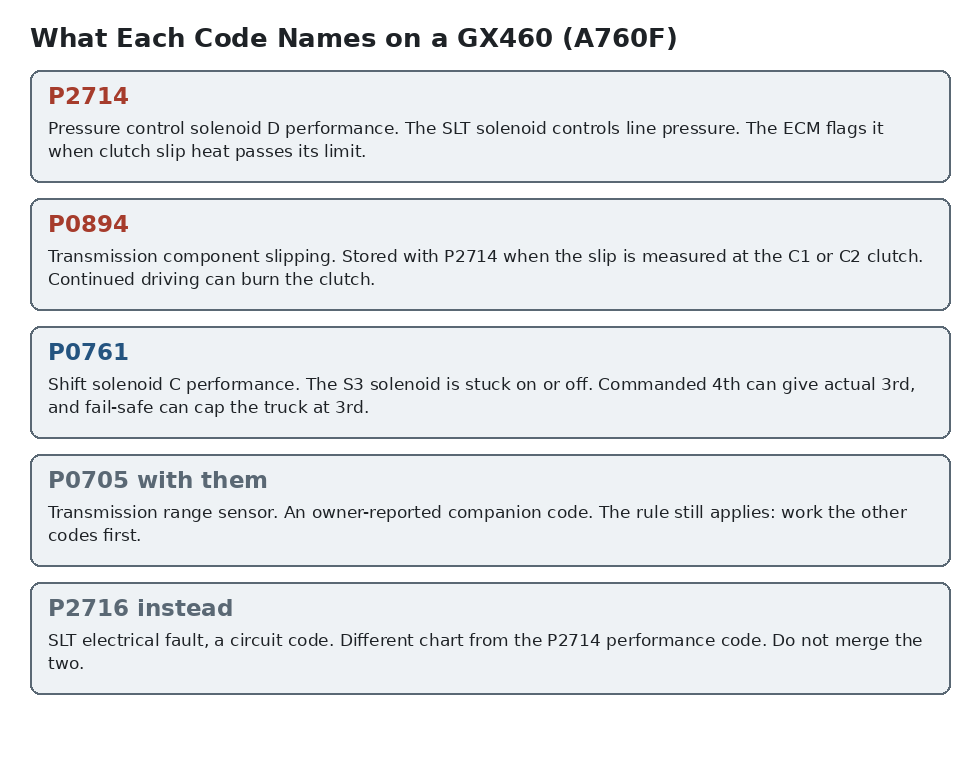
Code map. The three main codes share one diagnostic order.
Two companion codes change the first step. P0705, the transmission range sensor code, arrived alongside P0894 and P2714 on a slipping GX460 in a ClubLexus thread recorded in the project backlog in October 2026. P2716 is the electrical fault code for the same SLT solenoid that P2714 covers as a performance fault, and it has its own chart. The rule for all of these charts is the same: read every stored code first, and work any other code before the P2714, P0894, or P0761 chart.
Symptoms owners report
Owner reports in the IH8MUD thread in the Sources section describe a consistent pattern, and every item in this section is an owner report from that thread.
The pattern usually starts cold. The truck fails the 3rd to 4th shift on a cold start, stores the codes, and lights the check engine, VSC, and 4LO lamps together. One owner lived with that pattern for about 2.5 years by shifting manually in sport mode, because the truck shifted acceptably once warm. Delayed reverse when cold appears in the same reports. A 2010 truck at 140,000 miles in the newest pages of the thread would not shift past 3rd until the transmission warmed, which matches the fail-safe behavior recorded for a stuck S3 valve.
The pattern also survives the cheap parts. That same 140,000 mile truck received shift solenoids, a fluid change, and a filter change with no fix. An earlier truck in the thread received an SLT solenoid and fluid for a P0894 and P2714 pairing and ended at a transmission replacement. Owners reading this guide should treat a solenoid swap done without the test order in the next sections as a guess, because the thread shows guesses failing in both directions.
Parts and tools
Gather the test tools before any parts order. The parts list grows only after a test names a failed part.
| Item | Used for |
|---|---|
| XTOOL D7 bidirectional scan tool | Recording every DTC and comparing commanded gear against actual gear |
| Techstream or a shop with it | The active test and the running test in Steps 3 and 4. A bidirectional scan tool such as the XTOOL D7 covers both tests for a Home Mechanic |
| Toyota Genuine ATF WS, 1 quart, also in a pack of 4 quarts | Topping up and the fluid service. The A760F requires ATF WS |
| Klein MM420 multimeter | The solenoid resistance checks in Step 5 |
| 21 W incandescent bulb, 7440 type, in a wedge socket with wire leads, plus a 12 V source | The SLT bench check in Step 5 |
| Lisle transmission drain pan and a Slippery Pete fluid transfer pump for quart bottles | The fluid level check and any fluid service |
| Thermometer path for fluid temperature | Techstream data, the dash indicator method, or an infrared thermometer such as the Klein IR1 as a rough cross-check |
Replacement parts stay on hold until a test calls for them. Confirm every part by VIN on parts.lexus.com before ordering, because the strainer number changes during the run.
| Part | Part number | Source |
|---|---|---|
| SLT solenoid (line pressure control) | 35290-34010 | LexusPartsNow or a genuine SLT solenoid on eBay |
| S3 solenoid (3-way; S1 and S3 share this number) | 35240-50030 | LexusPartsNow or a genuine S3 solenoid on eBay |
| Oil strainer, trucks built through December 2014 | 35330-60060 | LexusPartsNow or a genuine strainer on eBay |
| Oil strainer, trucks built from January 2015 | 35330-60070 | LexusPartsNow |
| Pan gasket | 35168-60010 | LexusPartsNow |
| Strainer O-ring | 90301-31014 | LexusPartsNow |
| Drain plug gasket | 35178-30010 | LexusPartsNow |
| Valve body assembly | 35410-35810, replaced by 35410-60660 | LexusPartsNow |
| Aftermarket strainer and pan gasket kit | Kit | A760 strainer and gasket kit on Amazon |
Step 1: Record every code, then work the outsiders first
Connect the scan tool, record every stored and pending code with its freeze frame data, and photograph the list before clearing anything. The charts for P2714, P0894, and P0761 all open with the same instruction: if any code besides the chart codes is present, perform troubleshooting for those codes first. A range sensor code such as P0705, a speed sensor code, or an SLT electrical code such as P2716 each has its own chart, and each one can distort the gear comparison the performance codes depend on.
Note the conditions from the freeze frame and from the owner: cold only or at all temperatures, which shift fails, whether reverse engages promptly, and whether the fault clears warm. Those four facts sort the trucks in the owner thread, and they sort yours.
Step 2: Check the fluid level and condition
Line pressure codes and slip codes both change meaning when the fluid is low, burnt, or the wrong type. The A760F has no dipstick, so the level check is a temperature-controlled overflow procedure, and the Truck Garage fluid service guide covers the full job: GX Transmission Fluid Service.
- Confirm the fluid type. This transmission requires Toyota Genuine ATF WS, and the truck must sit level for the level adjustment.
- Pin the transmission thermostat open before the check. Push the thermostat shaft in 5.5 to 7.0 mm (0.217 to 0.276 in.) and fix it with a pin of 1.0 to 1.8 mm (0.0394 to 0.0709 in.) diameter through the cap.
- Enter fluid temperature detection mode and idle until the fluid reaches the check window. The window is 46 to 52 C (115 to 126 F). The D indicator turns solid at 46 C (115 F) and blinks above 52 C (126 F).
- Remove the overflow plug at temperature and confirm a thin trickle. A dry overflow at the correct temperature means the level is low. Add ATF WS through the refill hole and repeat the check.
- Read the fluid that drains. Dark fluid with a burnt smell and friction debris supports the slip side of the code pair. Clean red fluid at the correct level supports the solenoid and valve body side.
Refill amounts depend on how much of the transmission came apart:
| Job | Refill amount |
|---|---|
| Transmission pan and drain plug removal | 1.7 liters (1.8 US qts, 1.5 Imp. qts) |
| Transmission valve body removal | 4.3 liters (4.5 US qts, 3.8 Imp. qts) |
| Torque converter removal | 5.4 liters (5.7 US qts, 4.8 Imp. qts) |
The pan and drain plug figure tells you how much of the system volume a pan drop moves. A fluid service at this step is maintenance, and it is also a data point. Owners in the thread changed fluid and filters on trucks that kept coding, so a fluid change that leaves the codes in place has told you the fault sits deeper. Record the result either way.
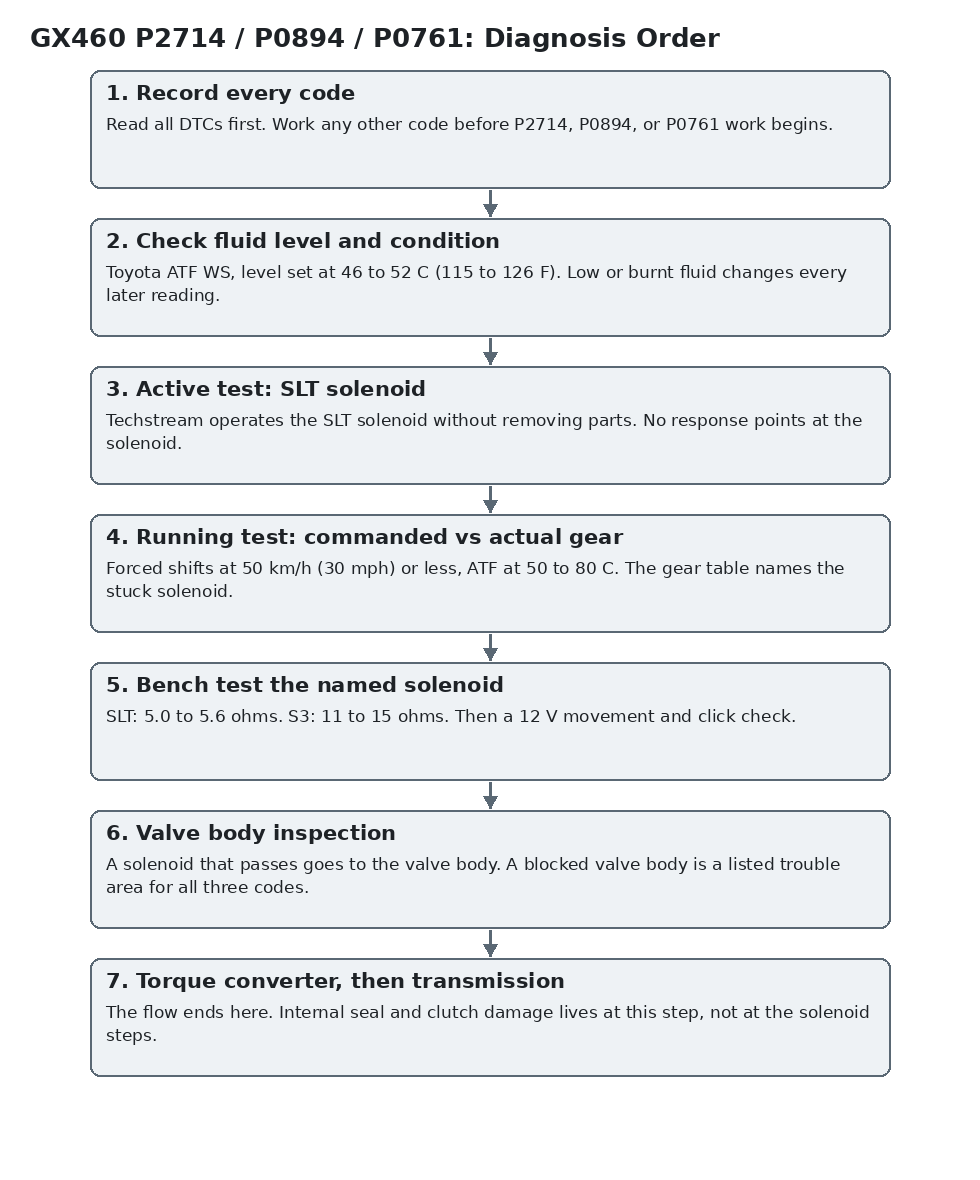
Diagnosis order. Each step either names a part or sends the diagnosis one level deeper.
Step 3: Run the active test on the SLT solenoid
The active test operates the SLT solenoid from the scan tool with no parts removed. Warm the engine, connect the tool at the DLC3, and enter the Powertrain, Engine and ECT, Active Test menus. The P2714 chart runs this test early because an SLT valve that fails to respond electrically and mechanically separates from a valve that responds and still sets the code under load.
A failed active test sends the diagnosis to the SLT bench inspection in Step 5. A passed active test sends it to the running test in Step 4. Home Mechanics without a bidirectional tool hand these two steps to a shop and keep the results in writing, because the bench values in Step 5 only have meaning after the active test and running test have named a suspect.
Step 4: Run the running test and read the gear table
The running test forces each shift from the scan tool while the truck drives, and it compares the commanded gear against the gear the transmission reaches. The test conditions are specific: at least two people, the air conditioning off, ATF temperature between 50 and 80 C (122 and 176 F), and vehicle speed at 50 km/h (30 mph) or less while shifting. The 4th to 5th and 5th to 6th upshifts run with the accelerator released, and each shift needs at least 2 seconds before the next.
Read the result against the gear table. The S3 rows of that table read:
| Commanded gear | S3 state | Actual gear |
|---|---|---|
| 4th | Stuck on | 3rd |
| 5th | Stuck on | Neutral during the fault |
| 6th | Stuck on | Neutral during the fault |
| 1st | Stuck off | 3rd |
| 2nd | Stuck off | 4th |
| 3rd | Stuck off | 4th |
The S1 and S2 patterns sit in the same table with their own signatures, including a truck that cannot drive in reverse when S1 is stuck on. The pattern your truck produces names the solenoid the chart sends you to inspect, and a truck that hits every commanded gear correctly leaves the solenoid set and moves to Step 6 with the SLT result from Step 3.
For a P0761 truck, the same comparison runs through the shift position active test, and the S3 on and off states in the data list should follow the lever pattern for the code: S3 on in 1st, 2nd, and 3rd, and off in 4th, 5th, and 6th.
Step 5: Bench test the named solenoid
The pan comes off for solenoid access, and the solenoid the earlier steps named comes out for two checks: a resistance measurement at 20 C (68 F), and a 12 V movement check. Work clean. Dirt introduced at the valve body creates the blocked valve body fault that sits on every trouble area list in this guide.
| Solenoid | Measurement points | Standard at 20 C (68 F) | 12 V movement check |
|---|---|---|---|
| SLT (the P2714 suspect) | Across terminals 1 and 2 | 5.0 to 5.6 ohms | Battery positive through a 21 W bulb to terminal 2, battery negative to terminal 1. The valve moves and makes an operating noise |
| S3 (the P0761 suspect) | Connector terminal to solenoid body | 11 to 15 ohms | Battery positive to the connector terminal, battery negative to the solenoid body. The valve moves and makes an operating noise |
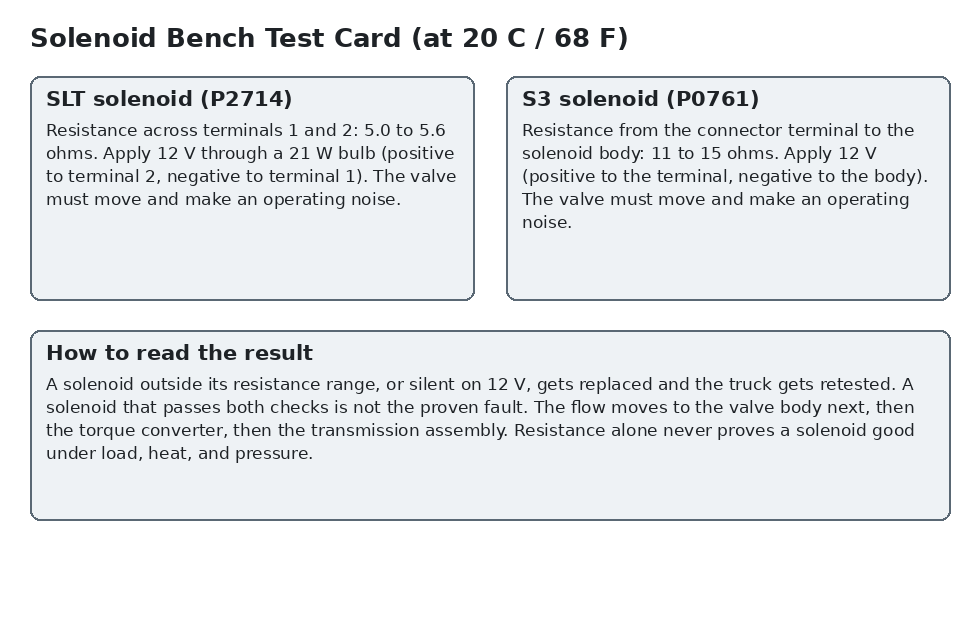
Bench test card. Both checks run at 20 C (68 F).
A solenoid outside its range, or silent on 12 V, gets replaced, and the truck gets the full retest from Step 1. A solenoid that passes both checks has passed two checks only. Resistance and a click at room temperature leave heat, load, and pressure untested, and the flow treats a passing solenoid as a reason to move deeper, which is Step 6.
Reassembly uses a new pan gasket, a new strainer O-ring coated with ATF, and a new drain plug gasket. The valve body bolts come in four lengths, marked A at 36 mm, B at 25 mm, C at 45 mm, and D at 50 mm in the procedure illustration. Keep each bolt in order during removal so each length returns to its own position.
| Fastener | Count | Torque |
|---|---|---|
| Oil pan bolts | 20 | 62 in·lbf (7.0 N·m) |
| Oil strainer bolts | 4 | 7 ft·lbf (10 N·m) |
| Valve body bolts | 19 | 8 ft·lbf (11 N·m) |
| Detent spring bolt | 1 | 7 ft·lbf (10 N·m) |
| Transmission wire bolt | 1 | 48 in·lbf (5.4 N·m) |
Step 6: Valve body, torque converter, transmission assembly
The charts end in the same place for all three codes. After the named solenoid passes, inspect the transmission valve body assembly and repair or replace it on a failed inspection. A replacement valve body assembly is part 35410-35810, replaced by 35410-60660, on LexusPartsNow. After the valve body passes, check the torque converter assembly. A passing torque converter leaves the transmission assembly itself as the remaining trouble area, which means internal clutch, brake, and gear components.
That endpoint matters for how you spend. A shop quote that jumps from a code read to a full transmission replacement has skipped the middle of the flow. A shop quote that lists the active test, the running test, the solenoid bench values, and a valve body inspection has worked the flow, and its conclusion carries the evidence with it. Ask for the bench values in writing either way. The two resistance ranges in Step 5 give you the numbers to compare against.
The seal and heat account from owners
This section is owner reporting from the IH8MUD thread in the Sources section, and it explains why so many of these trucks end at Step 6. Treat it as the thread’s working account, with the evidence the owners attach to it.
Owners who paid for rebuilds report a consistent finding inside the transmission: the internal seals and O-rings came out hard, brittle, and shrunken. The 140,000 mile truck in the newest pages of the thread went to a rebuild at about $5,500 after solenoids, fluid, and a filter failed to fix it, and the shop found every soft seal in the transmission hard and brittle. That owner concluded the transmission had run hot for an extended period and that the heat destroyed the rubber. Other owners in the thread support the same reading and point to the bonded piston seals and drum O-rings as the pressure loss points that produce the slip the module measures.
The prevention step the thread repeats is an auxiliary transmission cooler, fitted before the codes arrive. Owners name a Hayden 678 cooler at about $55 to $56 as the cheap version and bracket kits at higher prices, and several owners fitted a cooler and pinned the thermostat after a rebuild. The Truck Garage cooling guide covers cooler selection and installation: Transmission Health and Cooling for the Lexus GX. Owners also contrast the GX460 with the GX470, which shipped with a small factory auxiliary cooler in the US market, and report the same P2714 code growing common on Tundra forums. Those comparisons are owner reports, and this guide claims no procedure or fitment for those trucks.
The account also explains the cold pattern. A hardened seal leaks pressure worst when cold and stiff, and seals marginally better as the fluid warms and the rubber softens. That is the owners’ explanation for trucks that fail the 3rd to 4th shift cold and shift acceptably warm, and it matches the trucks that kept coding after new solenoids: the solenoid was switching correctly, and the pressure it controlled was escaping past the seals behind it.
AT-205 and the last-resort reports
ATP AT-205 is a seal conditioner that owners in the thread add to the transmission fluid as a last resort before a rebuild. The reports conflict, and this guide presents them without a recommendation.
One owner reports a clean result so far: 410 miles since adding AT-205, 7 days of driving in Drive only, no codes, and no reverse issues, after about 2.5 years of living with the codes. Another owner in the same thread warns against the product in direct terms, stating that AT-205 is not safe for transmissions because it changes the frictional properties of the fluid, and friction behavior is what the clutches depend on. The rebuild evidence sets the outer limit on any conditioner: a seal that has cracked or gone brittle to the point of crumbling has no elasticity left for a conditioner to restore, and the owners who opened their transmissions describe seals in exactly that condition.
A GX460 owner reading the thread should take three things from it. The conditioner reports are short-mileage reports. The warning comes from the same community as the success report. The diagnostic order in this guide costs less than either outcome and tells you which failure you have before you choose.
What owners report paying
Every figure in this section is an owner report from the thread, recorded in November 2026 crawls, and none of it is a verified shop quote.
| Job | Owner-reported figure |
|---|---|
| Parts-level work, one owner’s low budget band | Under $1,500 |
| Rebuild or valve body work, one owner’s middle budget band | Under $3,500 |
| Rebuild on the 140,000 mile truck in the thread | About $5,500 |
| Full rebuild after solenoid and valve body work failed, October 2026 report | $5,800 |
| Lexus remanufactured transmission at a dealer, one owner’s top budget band | $6,300 to $7,000 |
A replacement transmission for the 194,000 mile truck was available from the dealership in 2 days in that owner’s report, against an earlier backorder report for the same transmission family. Those figures frame the value of the test order. The distance between a solenoid at the low band and a remanufactured transmission at the top band is the distance the six steps in this guide are built to close with evidence.
Stop conditions
Slip that is getting worse week to week. The chart for P0894 and P2714 warns that continued driving under the slip condition burns the clutch until the vehicle can no longer drive. A truck that starts slipping in more gears, or starts delaying reverse, is spending its remaining clutch life.
Debris in the pan. Friction material and metal in the pan or on the magnets during a fluid service moves the diagnosis past solenoids. Price the Step 6 work with that evidence in hand.
A code that returns within one drive cycle after a solenoid replacement. The replacement part was a guess or the fault sits deeper. Return to Step 3 with the new part in place and work the flow in order.
No forward or no reverse movement. A truck that will not move in either direction has left the diagnostic stage. Tow it, because driving a slipping transmission to the shop can turn a rebuild candidate into a core with no reusable parts.
FAQ
Do P2714 and P0894 mean my GX460 needs a transmission?
The codes name a test order before they name a transmission. The trouble areas for P2714 run from the SLT solenoid through five other solenoids, the sequence valve, the 1-2 shift valve, and the valve body before the transmission assembly appears, and P0894 measures slip that any of those faults can produce. Trucks in the owner thread did end at rebuilds and replacements, and trucks also ran for years on the codes in sport mode. The six steps in this guide exist to find out which truck you have.
Why does my GX460 fail the 3rd to 4th shift only when cold?
Owners in the thread report that pattern most, and their explanation is hardened internal seals that leak pressure cold and seal marginally better warm. The tabulated behavior points the same way: a stuck S3 valve caps the truck at 3rd in fail-safe, and a commanded 4th that produces 3rd is one of the P0761 detection conditions. The running test in Step 4 separates a stuck valve from a pressure loss.
Can I just replace the SLT solenoid?
You can, and owners have, with mixed results recorded in the thread. One P0894 and P2714 truck received an SLT solenoid and fluid and ended at a transmission replacement. The bench standard for the SLT solenoid is 5.0 to 5.6 ohms at 20 C (68 F) with a 12 V movement check through a 21 W bulb, and a solenoid that passes both checks points the diagnosis at the valve body instead. Testing the solenoid you remove, even after the fact, tells you whether the swap had evidence behind it.
Does AT-205 fix P2714?
Owner reports conflict. One owner reports 410 miles with no codes after adding it, and another owner in the same thread warns that it changes transmission fluid friction properties and should stay out of a transmission. The rebuild reports in the thread describe seals that are hard, brittle, and shrunken. This guide recommends no conditioner, and the test order in this guide costs less than the gamble either way.
What fluid does the A760F take, and how is the level set?
The transmission requires Toyota Genuine ATF WS. The level is set with the truck level, the thermostat pinned open, and the fluid in the 46 to 52 C (115 to 126 F) window, confirmed by a trickle at the overflow plug. The full procedure is in the Truck Garage fluid service guide: GX Transmission Fluid Service.
Is the GX470 transmission the same?
The GX470 uses the A750F 5-speed, a related earlier design, and owners in the thread compare the two and note the GX470 shipped with a small factory auxiliary cooler in the US market. This guide prints no GX470 code chart or value. Every value in this guide is a GX460 A760F value.
Should I fit a transmission cooler before the codes appear?
Owners who rebuilt their transmissions recommend it, and several fitted a cooler as part of the rebuild job. The cooling guide covers the hardware and the thermostat decision: Transmission Health and Cooling for the Lexus GX. The cooler recommendation in this guide is an owner recommendation, and the heat account behind it is owner reporting, presented in its own section above.
Sources
- GX460 factory manuals: A760F Automatic Transmission System sections (P0894, P2714, P0761, and P2716 charts, solenoid inspection values, active test and running test procedures) and Automatic Transmission Fluid adjustment (ATF WS specification, thermostat pin dimensions, level check window, refill amounts)
- IH8MUD, GX460 P2714 P0761 Ultimate Summary and Hope For A Fix Thread, https://forum.ih8mud.com/threads/gx460-p2714-p0761-ultimate-summary-and-hope-for-a-fix-thread.1328266/page-52
- IH8MUD, GX460 P2714 P0761 Ultimate Summary and Hope For A Fix Thread, page 39 (AT-205 report at 410 miles), https://forum.ih8mud.com/threads/gx460-p2714-p0761-ultimate-summary-and-hope-for-a-fix-thread.1328266/page-39#post-16377342
- IH8MUD, GX460 P2714 P0761 Ultimate Summary and Hope For A Fix Thread, page 35 (194,000 mile truck, replacement transmission report), https://forum.ih8mud.com/threads/gx460-p2714-p0761-ultimate-summary-and-hope-for-a-fix-thread.1328266/page-35#post-16368167
- IH8MUD, GX460 P2714 P0761 Ultimate Summary and Hope For A Fix Thread, page 25 (remanufactured transmission install report), https://forum.ih8mud.com/threads/gx460-p2714-p0761-ultimate-summary-and-hope-for-a-fix-thread.1328266/page-25
- Lexus Parts, parts diagrams and part lookup by VIN, https://parts.lexus.com/
Leave a Reply