Scope and the two trucks
This guide covers early ownership maintenance for two trucks. The 4Runner coverage runs from 2025 to 2026 and covers the 6th generation truck. The Tacoma coverage runs from 2024 to 2026 and covers the 4th generation truck. Both trucks use the 2.4L turbo i-FORCE engine, with an i-FORCE MAX hybrid option. The shared engine and the shared visit pattern let one guide cover both trucks for the maintenance items in the schedule sections. Items that differ between the two trucks name the truck in the sentence, and a reader should follow the entries that name the truck in the driveway. The guide covers the work a home mechanic can plan, perform, inspect, and record during the early miles: visits every 5,000 miles, oil and filter changes, tire rotation, filter replacement at 30,000 miles, inspections, and record keeping from the first day of ownership. The propeller shaft bolt torque differs by truck, and the 15,000 mile section prints the value for each truck in a table. Readers who own an older Lexus GX alongside a new Toyota truck should keep the two maintenance programs separate: GX Fluids Guide and Lexus GX550 Buying Guide. The Land Cruiser is outside the scope of this guide, and no interval, capacity, or torque in this guide should be applied to that truck.
The schedule at a glance
Visits run every 5,000 miles or 6 months for both trucks. The mileage steps and the time steps run together, and a truck reaches a visit when either step arrives. A low mileage truck still reaches visits on the time step, and a high mileage truck reaches visits on the mileage step well before six months pass. Every visit includes the same base list. The base list covers a driver floor mat installation check, inspection and adjustment of all fluid levels, wiper blade inspection, tire rotation, and a visual inspection of brake linings and drums and brake pads and discs. Heavier items land on specific visits, and the table below places each item on its visit.
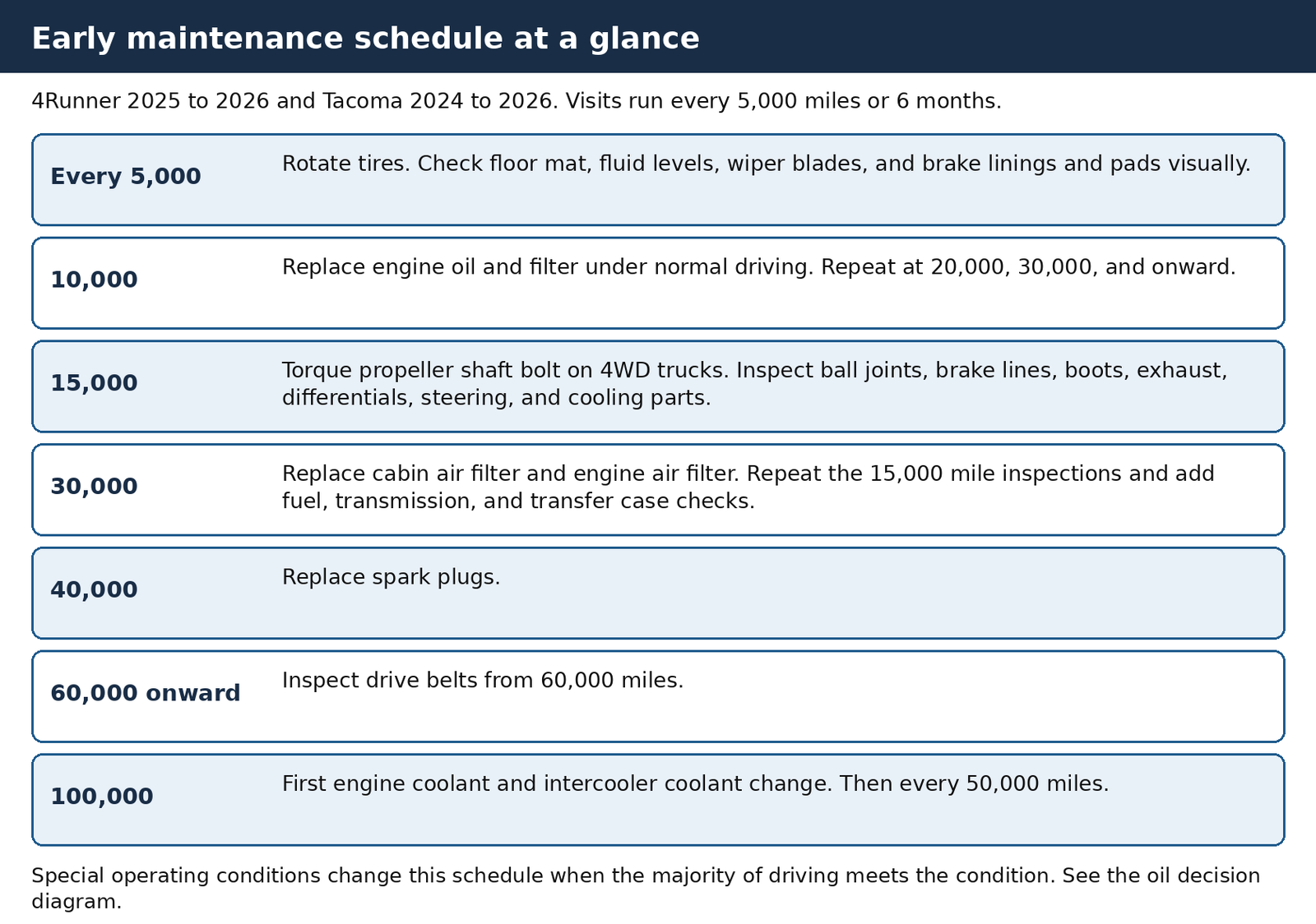
Schedule at a glance. The visit pattern runs every 5,000 miles or 6 months, and the heavier items land at 15,000, 30,000, 40,000, and 100,000 miles.
| Interval | Task or inspection |
|---|---|
| Every 5,000 miles or 6 months | Check driver floor mat installation, inspect and adjust all fluid levels, and inspect wiper blades |
| Every 5,000 miles or 6 months | Rotate tires and visually inspect brake linings and drums and brake pads and discs |
| Every 10,000 miles or 12 months, normal driving | Replace engine oil and oil filter |
| 15,000 miles or 18 months, 4WD | Torque the propeller shaft bolt and inspect drive shaft boots and front differential oil |
| 15,000 miles or 18 months | Inspect ball joints and dust covers, brake lines and hoses, and exhaust pipes and mountings |
| 15,000 miles or 18 months | Inspect radiator, condenser, and intercooler, rear differential oil, and steering gear, steering linkage, and boots |
| 30,000 miles or 36 months | Replace cabin air filter, engine air filter, and engine oil and oil filter, and torque the propeller shaft bolt |
| 30,000 miles or 36 months | Inspect automatic transmission fluid and cooler hoses and connections, and inspect fuel lines, connections, tank band, vapor vent hoses, and tank cap gasket |
| 30,000 miles or 36 months, 4WD | Inspect transfer case oil and inspect the transmission for signs of leakage |
| 40,000 miles | Replace spark plugs |
| From 60,000 miles | Inspect drive belts |
| 100,000 miles | Replace engine coolant and intercooler coolant for the first time, then every 50,000 miles |
The fluid level entry covers sealed transmissions, transfer cases, and differentials inspected for leakage, power steering fluid on equipped trucks, brake fluid level and condition, and cooling system coolant level, condition, and freezing point. The 4Runner material also names inverter coolant on equipped trucks.
Break-in for the first 1,000 miles
Break-in rules for this guide come from the 2025 4Runner owner manual material. The rules govern towing and driving style during the first miles, and they apply to a new truck during the periods the manual names. A truck with new powertrain components follows the towing schedule in this section for those components. For the first 500 miles (800 km), do not tow a trailer. For the first 1,000 miles (1600 km), four driving limits apply together.
- Do not drive at extremely high speeds.
- Avoid sudden acceleration.
- Do not drive continuously in low gears.
- Do not drive at a constant speed for extended periods.
The towing break-in schedule adds limits after the first 500 miles. The schedule applies when the vehicle is new and when the vehicle has new powertrain components. The components named for this schedule are the engine, the transmission, the transfer case on 4WD trucks, the rear differential, and a wheel bearing.
- Do not tow until the truck passes 500 miles when the truck is new or has a new powertrain component from the list above.
- Drive under 45 mph (72 km/h) during the next 500 miles of towing.
- Avoid full throttle acceleration during the next 500 miles of towing.
- Retighten the fixing bolts of the towing ball and bracket after approximately 600 miles (1000 km) of trailer towing.
Toyota schedules no break-in oil change for these trucks. The first scheduled oil change under normal driving is at 10,000 miles. An owner who chooses an early first oil change makes an owner choice, and the record routine in this guide gives that choice a place in the log with the date, the mileage, the oil, and the filter recorded.
The 5,000 mile visit pattern
The 5,000 mile visit is the unit of the whole program. A visit arrives every 5,000 miles or every 6 months, and the visit includes the base list plus any heavier item scheduled for that mileage. The Tacoma log directs a reset of the oil replacement reminder light, named MAINT REQD, or the OIL MAINTENANCE REQUIRED message after maintenance at every 5,000 miles. A home mechanic can run a visit as a fixed sequence, and a fixed sequence keeps a visit complete when the work happens in a driveway across an afternoon.
- Record the date and the odometer mileage at the start of the visit.
- Check the driver floor mat installation.
- Inspect and adjust all fluid levels, including the leakage and condition checks in the fluid list above.
- Inspect the wiper blades.
- Rotate the tires and torque the wheel nuts to the value for the wheel material on the truck.
- Retighten the wheel nuts within 100 miles (160 km) of driving after the rotation, as the wheel section of this guide describes.
- Visually inspect brake linings and drums and brake pads and discs.
- Add the heavier items scheduled for that mileage from the schedule table.
- Reset the oil replacement reminder after maintenance, and write the completed visit into the record with every item marked as done, inspected, or replaced.
Add Toyota EFI Tank Additive or an equivalent at every visit on Hawaii trucks. Readers who run a GX beside a new Toyota truck can read the tire pressure guide for upsized tires on the GX trucks alongside this guide: Tire pressure for upsized tires.
Engine oil: 10,000 miles under normal driving and 5,000 miles under special conditions
The oil question for these trucks has a schedule answer, and the answer turns on how the truck spends its miles. Under normal driving, Toyota schedules an engine oil and filter replacement every 10,000 miles or 12 months. The 4Runner chart material adds a direct instruction for the normal interval: replace the oil and filter at the interval even if the maintenance reminder has not appeared. The Tacoma log lists oil and filter replacement at 10,000 miles, at 20,000 miles, at 30,000 miles, and onward in the same steps. The Tacoma log also includes a note for trucks where the recommended oil was not used at the last change. A truck in that position gets an oil and filter replacement at the 15,000 mile visit and at the 25,000 mile visit as well, and the owner record should show which oil went in at each change so the note can be applied correctly at the next visit.
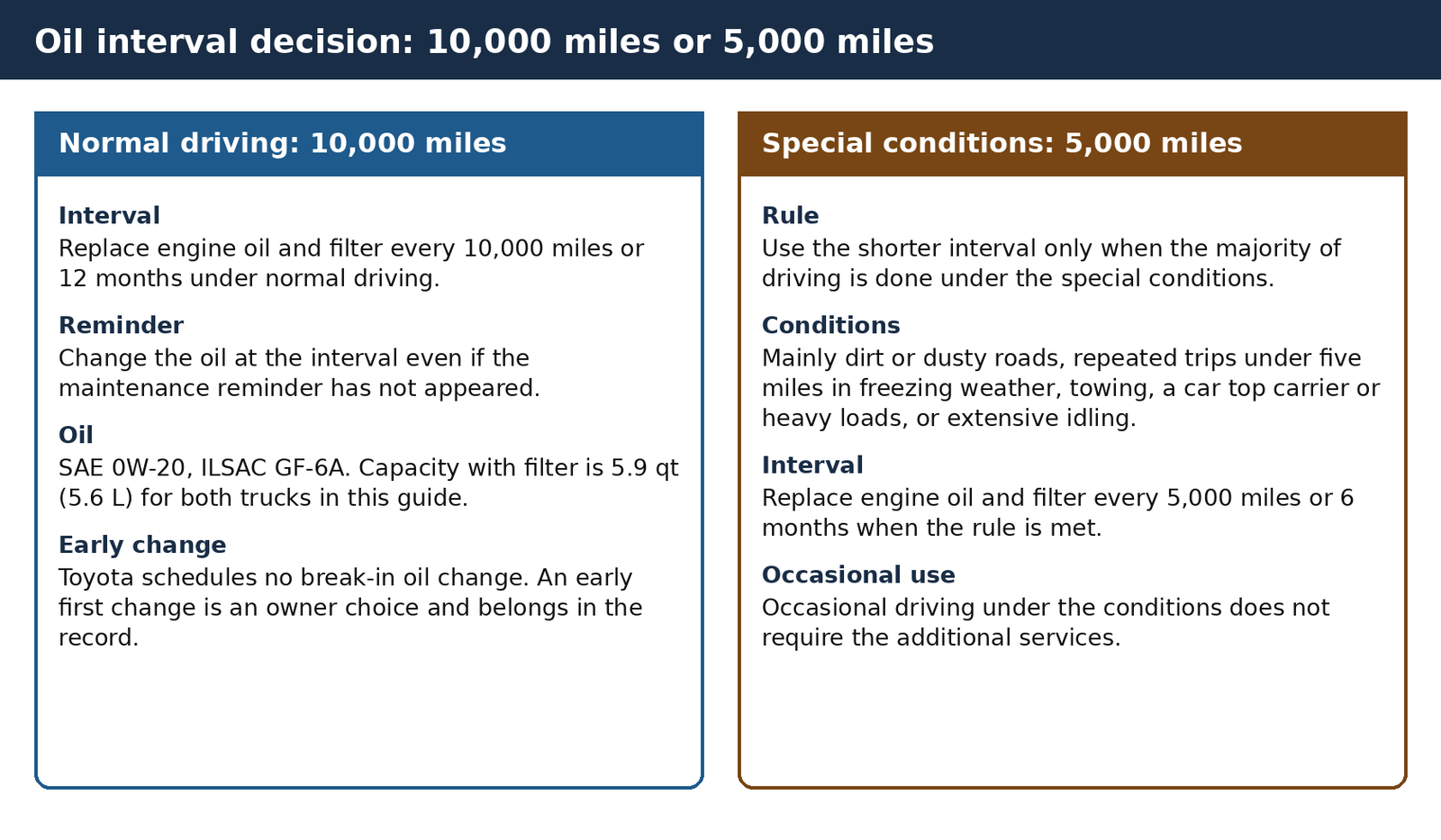
Oil interval decision. The majority of driving decides the interval, and occasional driving under a special condition leaves the normal interval in place.
Special operating conditions move the oil interval to 5,000 miles when the rule for those conditions is met. Toyota states the rule in the maintenance chart guidance: perform the additional services only if the majority of driving is done under the special conditions. Occasional driving under the conditions does not require the additional services. The conditions that move the oil interval appear in the schedule material and in the summaries of that material. The list includes driving mainly on dirt roads or dusty roads. The list includes repeated trips under five miles in freezing weather. The list includes towing, a car top carrier, and heavy vehicle loading. The list includes extensive idling and repeated short trips.
A 4Runner that is mainly driven on dirt or dusty roads gets an oil and filter replacement every 5,000 miles or 6 months. The Tacoma dirt and dusty entries at the 5,000 and 10,000 mile visits include an oil and filter replacement with the other dirt and dusty services. A truck that meets the majority rule for any condition in the list follows the 5,000 mile oil interval for as long as the majority pattern holds, and the record should name the condition that placed the truck on the shorter interval. The oil specification for the 4Runner comes from the owner manual pages for the 2025 truck, and the Tacoma service information states the same oil and the same capacity figures for the 4th generation Tacoma. The table below collects the oil facts that this guide prints, and a home mechanic should buy oil and a filter against the table before a change begins.
| Oil item | Specification |
|---|---|
| Oil grade | ILSAC GF-6A |
| Oil viscosity | SAE 0W-20 |
| Capacity with filter | 5.9 qt (5.6 L) |
| Capacity without filter | 5.6 qt (5.3 L) |
| Oil filter, both trucks | Toyota 90915-YZZN1 (previous version 90915-YZZF2) |
| Drain plug torque | 30 ft·lbf (40 N·m) |
| Oil filter torque | 13 ft·lbf (17.5 N·m) |
| Temporary viscosity rule | SAE 5W-20 may be used when 0W-20 is unavailable, and the 5W-20 fill must be replaced with 0W-20 at the next oil change |
- Record the date, the mileage, and the interval basis for the change, normal or special conditions, with the condition named when the shorter interval applies.
- Drain the old oil and remove the old filter. Refit the drain plug with a new gasket at 30 ft·lbf (40 N·m).
- Fit the new filter at 13 ft·lbf (17.5 N·m) and fill with SAE 0W-20 oil meeting ILSAC GF-6A, using the capacity in the table as the fill guide and the dipstick or level check on the truck as the final check.
- Run the engine, check for leaks at the filter and drain area, and recheck the oil level after a short wait.
- Reset the oil replacement reminder after the maintenance, following the Tacoma reminder entry in the rhythm section for Tacoma trucks.
- Write the oil grade, the viscosity, the quantity added, and the filter into the record before the tools go away.
The drain plug and filter torque values in the table apply to both trucks and to every year this guide covers in the service information, 2024 and 2025 for the Tacoma and 2025 for the 4Runner.
Owner reports on early oil changes
Owner reports on early oil changes belong in this guide at the weight of owner reports, and every report in this section is labeled as an owner report. TorqueNews coverage of a 2024 Tacoma first oil change reported that an owner changed the oil at 5,000 miles instead of the scheduled 10,000 miles. That owner report described metal in the filter and dark oil at the 5,000 mile change. The same coverage included reports from other owners. Owner reports in that coverage described the same findings and described plans for 5,000 mile oil changes. One owner report described an owner doing his own oil change at 5,000 miles between dealer services at 10,000 miles, which places an owner change inside the scheduled pattern while the scheduled changes stay at the dealer. The same coverage included a Universal Technical Institute statement that tiny metal particles in the filter during the first 5,000 miles are expected from break-in. Owners reported visible material and dark oil at an early change, and that statement describes tiny particles during the first 5,000 miles as an expected break-in result. Owner practice in a Tacoma forum thread proposed a 1,000 mile break-in oil change and used oil analysis as owner practice only. The schedule position in this guide follows the Toyota rule stated above: special conditions put oil at 5,000 miles by the book, and an early first change under normal driving is an owner choice that belongs in the record.
The 15,000 mile visit: propeller shaft bolt and the long inspection list
The 15,000 mile visit arrives at 18 months for a truck on the time step. The visit includes the base list, and the visit adds two groups of work: the propeller shaft bolt torque on 4WD trucks, and a long inspection list that reaches from the ball joints to the cooling parts at the front of the truck. Tacoma wording for the bolt job reads re-torque, and the 4Runner chart entry reads torque with a T entry in the chart. Both wordings name the same scheduled job: the propeller shaft bolt gets torqued at this visit on 4WD trucks. The flange bolt value splits by truck, and a single shared value would be wrong for one of the two trucks.
| Truck | Propeller shaft flange bolt torque |
|---|---|
| Tacoma, 2024 to 2025 | 55 ft·lbf (74.4 N·m) at every flange joint, front shaft and rear shaft |
| 4Runner, 2025 | 65 ft·lbf (88.2 N·m) at the front shaft joints and 65 ft·lbf (88.3 N·m) at the rear shaft joints |
The 2026 maintenance guides for both trucks schedule the same bolt job at the same visits. On the 4Runner, keep grease off the flange contact surfaces and the bolts during this work. I learned the split the way most people will, by assuming the two trucks matched because the engines match. They do not, and the ten ft·lbf gap between the two values is exactly the kind of gap that strips a flange bolt pattern into a second job.
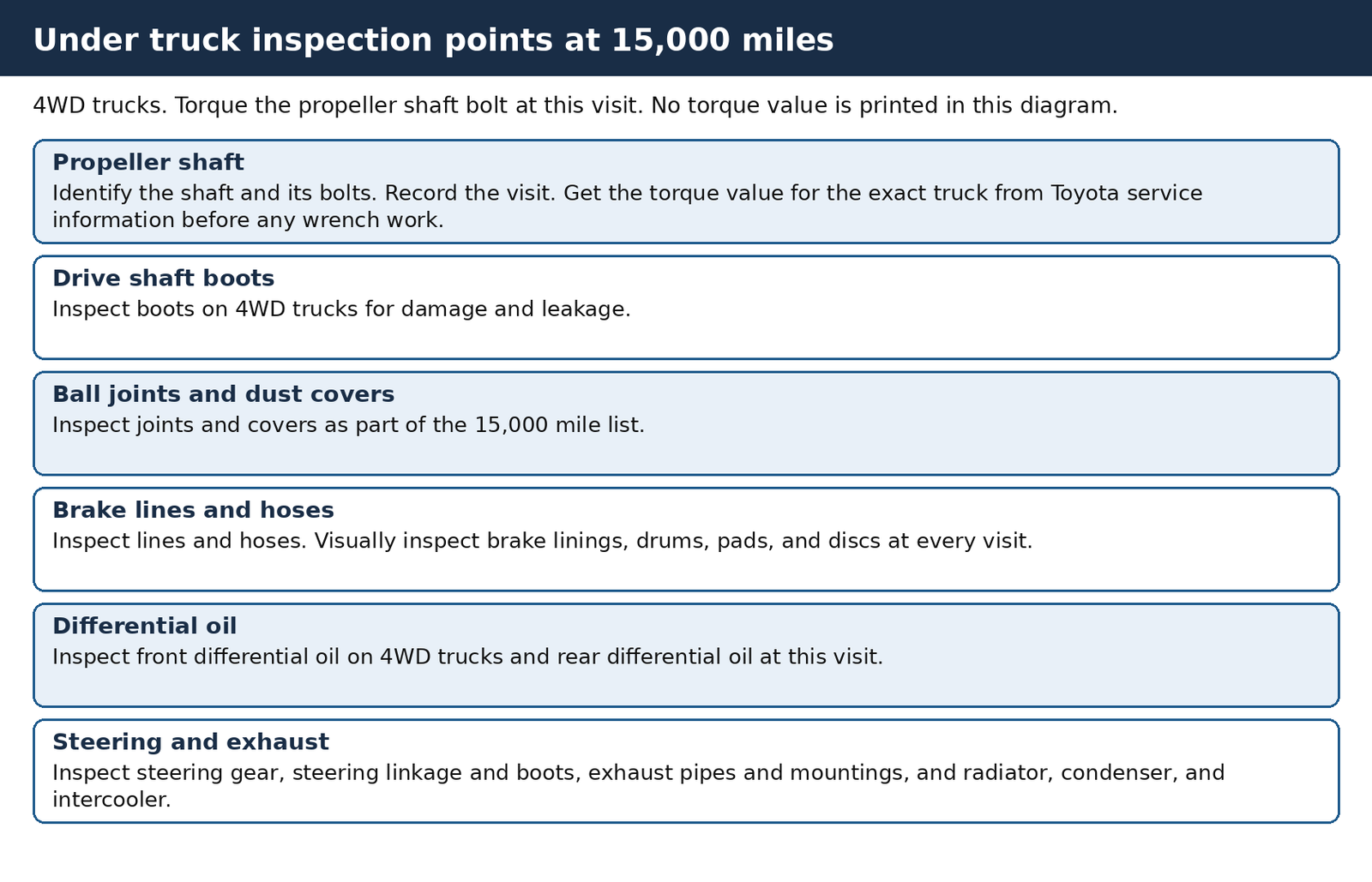
Under truck inspection points at 15,000 miles. Torque values for the propeller shaft flange bolts are in the table in this section.
- Inspect ball joints and dust covers, and inspect brake lines and hoses.
- Inspect drive shaft boots and front differential oil on 4WD trucks.
- Inspect exhaust pipes and mountings, and inspect radiator, condenser, and intercooler.
- Inspect rear differential oil, and inspect steering gear, steering linkage, and boots.
- Inspect cabin air filter and engine coolant and intercooler coolant on Tacoma trucks at this visit, following the Tacoma list entries.
The 4Runner cabin air filter note at 15,000 miles addresses filter life under hard use. Heavy traffic, dirt roads, urban driving, and dusty or desert use may shorten cabin air filter life on the 4Runner. The stated signs of a shortened filter life are reduced airflow and easy window fogging in Fresh mode. A 4Runner owner who notices either sign before the 30,000 mile replacement visit has schedule support for an earlier filter inspection, and the record should name the sign that prompted the inspection. The scheduled propeller shaft item on these generations is the bolt torque. The scheduled maintenance sections read for this guide list no propeller shaft lubrication line for these trucks, and the lubrication item in older 5th generation schedules does not appear as a scheduled item here. A home mechanic can prepare the bolt job and complete the inspection list at home with the values in the table above.
- Park the truck on a level surface and choose the access method. Ramps give under truck access in a driveway, and a lift gives the same access in a shop.
- Locate the propeller shaft and identify the flange bolts at each end of each shaft as the fasteners for the scheduled torque job.
- Inspect the drive shaft boots on 4WD trucks while the shaft area is in view, and record any damage or leakage as a written finding.
- Work through the numbered inspection list above in order, and write a result beside each item in the record.
- Set the torque wrench to the value for the truck in the table above, 55 ft·lbf (74.4 N·m) for the Tacoma and 65 ft·lbf (88.2 to 88.3 N·m) for the 4Runner.
- Torque the flange bolts to that value, and record the value used, the date, and the mileage.
- Lower the truck, road test at low speed in a safe area, and record any new noise or vibration as a written finding for follow up.
A dealer visit remains a valid way to close this item. An owner who completes the inspection list at home can book the bolt torque as a single line item and check the value on the visit paperwork against the table above. Readers who also keep an older GX will find the frame rust guide on this site useful for that truck, and the inspection habits in that guide transfer as habits to a new truck even though the schedules differ: Frame rust guide.
The 30,000 mile visit: filters and the wider inspection list
The 30,000 mile visit arrives at 36 months for a truck on the time step. The visit replaces two filters, repeats the oil change and the propeller shaft bolt torque, and widens the inspection list to fuel, transmission, and transfer case items. A home mechanic should plan this visit as a longer session than a base visit, with filters bought ahead against the truck application and the record open before the work starts. The replacement list at 30,000 miles is short and direct.
- Replace the cabin air filter.
- Replace the engine air filter.
- Replace engine oil and oil filter.
- Torque the propeller shaft flange bolts on 4WD trucks to the value for the truck in the 15,000 mile table.
- Rotate tires and complete the wheel nut torque and retightening steps in the wheel section.
The inspection list at 30,000 miles includes the full 15,000 mile inspection list and adds the items below.
- Inspect automatic transmission fluid and automatic transmission fluid cooler hoses and connections.
- Inspect fuel lines and connections, fuel tank band and vapor vent hoses, and fuel tank cap gasket.
- Inspect intercooler coolant, inspect transfer case oil on 4WD trucks, and inspect the transmission for signs of leakage.
- Inspect brake thickness and disc runout, following the 4Runner schedule note that pairs a visual brake inspection every 5,000 miles with a thickness and disc runout inspection every 30,000 miles.
A 4Runner truck that showed reduced airflow or easy window fogging in Fresh mode earlier in its life gets a new cabin air filter at this visit by schedule, and the record should note whether the signs cleared after the replacement. Tacoma trucks also replace the cabin filter at this visit, and the Tacoma list named the filter as an inspection item at 15,000 miles. Transmission items at 30,000 miles stay at inspection depth in this guide, because the schedule material names inspection at this visit and this guide drafts no fluid replacement procedure for these trucks. Readers with a GX transmission service question belong in the GX guide for that truck: GX Transmission Fluid Service.
Later early milestones: 40,000, 60,000, and 100,000 miles
Spark plugs come due at 40,000 miles on both trucks. The schedule lists spark plug replacement at that mileage as a replacement item. The 4Runner chart material adds a warranty note for the plug service: spark plug maintenance services are required under the terms of the Emission Control Warranty. A home mechanic should record the plug change with the date and the mileage in the same record as every other visit, and a truck that reaches a dealer for the plug service should leave with the service written on the visit paperwork. The plug for both trucks is the NGK DILZKAR8E7H, an iridium plug. A new plug gap measures 0.6 to 0.7 mm (0.024 to 0.028 in), and the gap of a used plug is never adjusted. Plug torque is 15 ft·lbf (20 N·m), and the ignition coil bolts take 66 in·lbf (7.5 N·m). Drive belts enter the schedule as an inspection item from 60,000 miles, and the compiled Tacoma schedule states an inspection every 15,000 miles from that point. Engine coolant and intercooler coolant reach a first change at 100,000 miles, and the interval after the first change runs every 50,000 miles. Coolant level, condition, and freezing point already appear in the every visit fluid work, so the early visits build a coolant condition record long before the replacement visit arrives.
Special operating conditions
Special operating conditions add services at the visits, and the majority rule governs every addition. Perform the additional services only if the majority of driving is done under the special conditions, and occasional driving under the conditions does not require the additional services. Write the decision into the record and revisit the decision when the driving pattern changes in a lasting way. Dirt roads and dusty roads have a defined service list in the Tacoma log at the 5,000 and 10,000 mile visits. The list for a truck that meets the majority rule for dirt or dusty driving reads as follows.
- Inspect ball joints and dust covers.
- Inspect drive shaft boots on 4WD trucks.
- Inspect the engine air filter.
- Inspect steering linkage and boots.
- Replace engine oil and oil filter.
- Re-torque the propeller shaft flange bolts on 4WD trucks to the value for the truck in the 15,000 mile table.
- Tighten nuts and bolts on chassis and body.
- Lubricate the clutch fork on Tacoma trucks with a manual transmission only, and complete that lubrication within 24 hours after submerging the truck, following the Tacoma footnote for the manual transmission entry.
The 4Runner dirt and dusty material states the oil rule directly: a 4Runner mainly driven on dirt or dusty roads gets an oil and filter replacement every 5,000 miles or 6 months. Its special chart adds front and rear differential oil replacement at intervals, transfer case oil replacement at one interval, propeller shaft bolt torque at 5,000 mile steps, and nuts and bolts on chassis and body torque at every 5,000 mile step. Towing, a car top carrier, and heavy vehicle loading have a service pattern in the Tacoma log. At the 5,000 and 10,000 mile visits under this pattern, the log calls for propeller shaft bolt re-torque and tightening of nuts and bolts on chassis and body. At 15,000 miles under towing, the log calls for front differential oil replacement on 4WD trucks, rear differential oil replacement, and tightening of nuts and bolts on chassis and body. At 30,000 miles under towing, the Tacoma log calls for front differential oil replacement on 4WD trucks, manual transmission oil replacement on manual trucks, rear differential oil replacement, transfer case oil replacement on 4WD trucks, and tightening of nuts and bolts on chassis and body.
Off-road daily maintenance
Both maintenance guides include a daily list for off-road driving. After driving off-road through deep sand, mud, or water, perform the inspections on the daily list every day. The daily list applies on the days that follow that kind of driving, and the list is an inspection routine that a home mechanic can run at camp or at home at the end of a day.
- Check ball joints and dust covers, brake lines and hoses, and brake pads and discs.
- Check drive shaft boots on 4WD trucks and check the engine air filter.
- Check front differential oil on 4WD trucks, following the 4Runner list entry, and check rear differential oil.
- Check nuts and bolts on chassis and body, and check steering linkage and boots.
- Check transfer case oil on 4WD trucks and check transmission fluid or oil.
- Inspect the propeller shaft, following the 4Runner wording for this item.
The Tacoma daily list says lubricate propeller shaft on 4WD models. The scheduled maintenance sections list the propeller shaft bolt torque as the scheduled propeller shaft item and list no lubrication line. This guide records the wording difference and builds no lubrication procedure on the daily list wording.
Wheel nut torque by wheel material
Wheel nut torque on these trucks depends on wheel material, and the two values differ by a wide margin. The values below come from the owner manual material for both trucks. A home mechanic should confirm the wheel material on the truck before a torque wrench is set, because an aluminum wheel and a steel wheel on the same truck model take different values in this table.
| Wheel material | Wheel nut torque |
|---|---|
| Aluminum wheel | 97 ft·lbf (131 N·m, 13.4 kgf·m) |
| Steel wheel | 154 ft·lbf (209 N·m, 21.3 kgf·m) |
Older truck values do not apply to these generations. Compilations for this guide note that 2023 and older Tacoma trucks used 83 ft-lb, and the 5th generation 4Runner used 76 ft-lb (103 N·m) for aluminum wheels and 83 ft-lb (112 N·m) for steel wheels. Retightening after a tire change has a distance rule. Retighten the wheel nuts within 100 miles (160 km) of driving after a tire change. After replacing a tire, check the tightening torque as soon as possible. A rotation at a scheduled visit is a tire change for the purpose of the retightening habit in this guide, and every rotation should start the 100 mile window in the record.
- Torque the wheel nuts to the value for the wheel material in the table at the time of the rotation or tire change.
- Record the date, the mileage, the wheel material, and the value used.
- Drive the truck and retighten the wheel nuts within 100 miles (160 km) of driving.
- Record the retightening with its date and mileage beside the rotation entry.
A record keeping routine that starts on day one
A maintenance record for a new truck can be a notebook, a folder of visit paperwork, or a file on a computer. The medium matters less than the fields, and the fields in this guide match the work in the earlier sections. A complete record lets an owner prove the visit pattern, apply the oil notes that depend on the last oil used, and hand a dealer a written history at any visit. Build the record with one entry per visit and one entry per owner choice between visits.
- Write the date and the odometer mileage at the top of every entry.
- List every task performed at the visit, with each task marked as done, inspected, or replaced.
- Record inspection results beside each inspection item, including clean results.
- Record every fluid, oil, and filter used, with grade, viscosity, quantity, and filter name or number where the guide gives one.
- Record the interval basis for each oil change, normal or special conditions, and name the condition when the shorter interval applies.
- Record wheel material and the wheel nut torque value used at every rotation, and add the retightening entry within the 100 mile window.
- Record the propeller shaft bolt torque value used and the source of that value at the 15,000 and 30,000 mile visits, or record the dealer visit that performed the job with the value from the visit paperwork.
- File dealer visit paperwork with the record in date order, copy any value or finding from that paperwork into the matching entry, and record owner choices, including an early first oil change, as owner choices with the reason written in the entry.
- Record break-in milestones during the first 1,000 miles, off-road daily check results after trail trips, and any sign or symptom with the date and mileage where the sign appeared.
Start the record before the first visit arrives. The first entries are the purchase date, the in service mileage, the break-in milestones, and any owner choice made during the first months.
I keep the log for a Tacoma in my own shop in a paper notebook that lives in the glovebox, and the paper has one advantage a phone app does not. The dealer writer can read the whole history in thirty seconds while the truck is still on the service drive, and nobody has to unlock anything or wait for a screen to load.
Parts and tools
The table below covers the owner side of the work in this guide. The items support oil changes, filter changes, tire rotation, inspections, and record keeping. Dealer equipment appears in no row, because every task in this guide that a home mechanic performs runs on the owner tools in the table, and the propeller shaft bolt torque job uses the torque wrench from the table at the values in the 15,000 mile section.
| Item | Used for |
|---|---|
| Engine oil, SAE 0W-20, ILSAC GF-6A, Mobil 1 Extended Performance 0W-20, 5 quart, and oil filter, Toyota 90915-YZZN1 for both trucks | Scheduled oil and filter changes at the interval that applies to the truck, with 5.9 qt (5.6 L) as the capacity with filter |
| Engine air filter, EPAuto GP075, replacing the 17801-0P050 filter family | Replacement at 30,000 miles and inspection entries at the visits that name the filter |
| Cabin air filter, filter kit for both trucks, and Toyota 87139-0C010 for the Tacoma | Replacement at 30,000 miles and inspection entries at the visits that name the filter |
| Torque wrench covering 97 ft·lbf (131 N·m) and 154 ft·lbf (209 N·m), LEXIVON 1/2 inch drive click torque wrench, 25 to 250 ft-lbf | Wheel nut torque by wheel material, retightening within 100 miles, and the propeller shaft flange bolts at 55 and 65 ft·lbf |
| Ramps, MaxxHaul 50515 car ramps, and an inspection light, LED rechargeable magnetic work light, 2 pack | Driveway access and lighting for under truck inspections at the 15,000 mile visit and the off-road daily checks |
| Drain container, MaxWorks 16 quart oil drain container, and a filter wrench, DURATECH swivel oil filter wrench | Oil and filter changes at home |
| Notebook or record file | The record keeping routine with date, mileage, tasks, materials, and values for every visit |
Buy parts against the truck in the driveway. The oil, the capacity, and the oil filter number in the table apply to both trucks in this guide. The engine air filter number family in the table is the cross-listed production number 17801-0P050, and 4Runner trucks in TRD Pro and Trailhunter trim use a reusable cone filter in a barrel airbox instead of the rectangular filter. Record the filter used at each change.
Stop conditions
Use the propeller shaft value for the truck in the driveway. Tacoma flange bolts take 55 ft·lbf (74.4 N·m) and 4Runner flange bolts take 65 ft·lbf (88.2 to 88.3 N·m). A value remembered from an older 4Runner or an older Tacoma is a value for those older trucks and must stay off the trucks in this guide.
A fastener with no value in this guide waits for a value from Toyota service information for the exact truck. Record no torque in the log for a fastener until that value is in hand.
A leak found during a fluid inspection means diagnosis before the visit closes. A truck with an active leak at a sealed transmission, a transfer case, or a differential needs the leak identified and addressed as its own job, with the finding recorded in the entry.
A brake finding beyond a visual note means the truck stays parked until the brake job is assessed. Damage to a pad, a disc, a brake line, or a hose moves the truck out of the routine visit path and into brake diagnosis before further driving.
A wheel torqued to a wrong value gets corrected before regular driving. Confirm wheel material before the torque wrench is set, correct any wheel torqued to the older truck values, record the correction, and restart the 100 mile retightening window.
Support the truck correctly for every under truck task. Ramps or a lift must hold the truck in a stable position, and no work in this guide should be performed under a truck held by a jack alone.
FAQ
How often do maintenance visits run on the new 4Runner and Tacoma? Visits run every 5,000 miles or 6 months for both trucks. Every visit includes a driver floor mat installation check, inspection and adjustment of all fluid levels, wiper blade inspection, tire rotation, and a visual inspection of brake linings and drums and brake pads and discs.
When is the first oil change due under normal driving? The first scheduled oil and filter change under normal driving is due at 10,000 miles or 12 months. Toyota schedules no break-in oil change. An early first change is an owner choice, and owner reports in this guide describe owners who made that choice at 5,000 miles and at 1,000 miles as owner practice.
What moves an oil change to every 5,000 miles? Special operating conditions move the interval when the majority of driving is done under the conditions. The conditions include mainly dirt or dusty roads, repeated trips under five miles in freezing weather, towing, a car top carrier or heavy loads, and extensive idling or repeated short trips. Occasional driving under a condition does not require the additional services.
What oil and how much do these trucks take? The oil grade is ILSAC GF-6A and the viscosity is SAE 0W-20. Capacity with a filter is 5.9 qt (5.6 L) for both trucks in this guide, and capacity without a filter is 5.6 qt (5.3 L). The oil filter for both trucks is Toyota 90915-YZZN1. Drain plug torque is 30 ft·lbf (40 N·m) and oil filter torque is 13 ft·lbf (17.5 N·m). SAE 5W-20 may be used temporarily when 0W-20 is unavailable, and that fill must be replaced with 0W-20 at the next oil change.
What happens at the 15,000 mile visit? The visit torques the propeller shaft flange bolts on 4WD trucks and adds a long inspection list. Tacoma flange bolts take 55 ft·lbf (74.4 N·m) and 4Runner flange bolts take 65 ft·lbf (88.2 to 88.3 N·m). The list covers ball joints and dust covers, brake lines and hoses, drive shaft boots on 4WD trucks, exhaust pipes and mountings, front differential oil on 4WD trucks, radiator, condenser, and intercooler, rear differential oil, and steering gear, linkage, and boots.
What gets replaced at 30,000 miles and at 40,000 miles? The 30,000 mile visit replaces the cabin air filter and the engine air filter, along with engine oil and filter, and the visit adds fuel, transmission, and transfer case inspections to the 15,000 mile list. Spark plugs are replaced at 40,000 miles. The plug is the NGK DILZKAR8E7H, and plug torque is 15 ft·lbf (20 N·m).
When does the coolant get changed, and when do drive belts enter the schedule? Engine coolant and intercooler coolant get a first change at 100,000 miles, and the interval after the first change runs every 50,000 miles. Drive belts enter the schedule as an inspection item from 60,000 miles.
What wheel nut torque should I use, and when do I retighten? Aluminum wheels take 97 ft·lbf (131 N·m, 13.4 kgf·m). Steel wheels take 154 ft·lbf (209 N·m, 21.3 kgf·m). Retighten the wheel nuts within 100 miles (160 km) of driving after a tire change, and check the tightening torque as soon as possible after replacing a tire.
Sources
- Toyota, 2025 4Runner Warranty and Maintenance Guide, guide PDF
- Toyota, 2025 Tacoma Warranty and Maintenance Guide, guide PDF
- Toyota, 2026 Tacoma Warranty and Maintenance Guide, guide PDF
- Toyota, 2026 4Runner Warranty and Maintenance Guide, guide PDF
- Toyota Tacoma factory service manuals, 2024 and 2025
- Toyota 4Runner factory service manual, 2025
- Toyota Parts, oil filter 90915-YZZN1, parts page
- Toyota Parts, cabin air filter element 87139-0C010, parts page
- Toyotadata, 4th Gen Tacoma Maintenance Schedule and Checklist, schedule page
- 4Runner6G, Break In Period Procedure for 2025 4Runner, thread page
- 6th Gen 4Runner, 2025 4Runner Engine Oil Type, Oil Change and Capacity, thread page
- 2025 Toyota 4Runner Owner Manual, page 601, carmanuals2 viewer, manual page
- 2024 Toyota Tacoma Owner Manual, page 618, ownersmanuals2 viewer, manual page
- Off-Road Handbook, Lug Nut Torque Specs, specifications page
- Peoria Toyota, Toyota 4Runner Maintenance Schedule, schedule page
- TorqueNews, 2024 Tacoma oil changed at 5K coverage, article
Leave a Reply