Meta description: P0412, P0418, P2440–P2447? The SAIS failure that hits every aging Toyota truck. Diagnosis, OEM repair vs. bypass kits, emissions legality, and real owner costs.
Reading time: ~12 minutes · Difficulty: diagnosis easy, OEM repair hard (manifold removal on V8s), bypass kit easy · Applies to: Toyota/Lexus trucks and SUVs with the secondary air injection system, roughly 2005–2018
If you own an aging Toyota truck, this failure isn’t a question of if. It’s when. The secondary air injection system (SAIS) fails on nearly every Toyota V6 and V8 truck from the mid-2000s onward, usually announcing itself with a check-engine light, a TRAC OFF light, and in many cases a sudden loss of power that owners describe as borderline dangerous in traffic. [community]
The dealer fix runs $2,000–$3,000. [vendor] The fix most owners actually choose costs under $500. This guide explains what the system does, why it dies, how to diagnose it properly, and which repair path makes sense for your truck and your situation.
Parts and tools
For diagnosis (either path):
- OBD-II Bluetooth scanner. Pulling codes is step zero. [community]
- Toyota-compatible scan cable with Techstream. For the air-injection active test. [community] Shadetree: a Mini VCI cable (about $25) plus the Techstream software gets you the same active test as the dealer tool.
- Spare fuses and a pump relay. The cheap-first electrical checks. [manual: GX470]
For the bypass route:
- Bypass kit: Hewitt Technologies Gen 2 ($450–$495) [vendor], or a Gen 1-style kit ($48–$78) [community]
- Stainless block-off plates, about $33 shipped. [community] Required if any valve is stuck open. Smart preventive maintenance otherwise.
- Basic hand tools. V6 installs are 30-minute plug-and-play. V8 kits need a wire run through the firewall to the ECM. [community]
For the OEM repair route:
- Air pump assembly, switching valves, and possibly the air injection driver module. Order by VIN for your exact year and model. [vendor]
- Intake manifold gaskets. The whole system lives under the manifold on the 4.7L V8s. [vendor]
What the SAIS does (and why yours is dying)
The secondary air injection system is a cold-start emissions device. For a short period after a cold start (owners consistently report roughly 30–60 seconds [community]), an electric air pump pushes fresh air through switching valves into the exhaust manifolds. The extra oxygen helps the catalytic converters light off faster, cutting cold-start emissions. Once the cats are hot, the pump shuts off and the system goes dormant until the next cold start.
The system has four main components: the air pump (an electric blower), the switching valves (which open and close the air path to each bank), the air injection driver module (which the ECM uses to switch the pump and valves), and the pressure sensors the ECM uses to monitor everything. [manual: GX470]
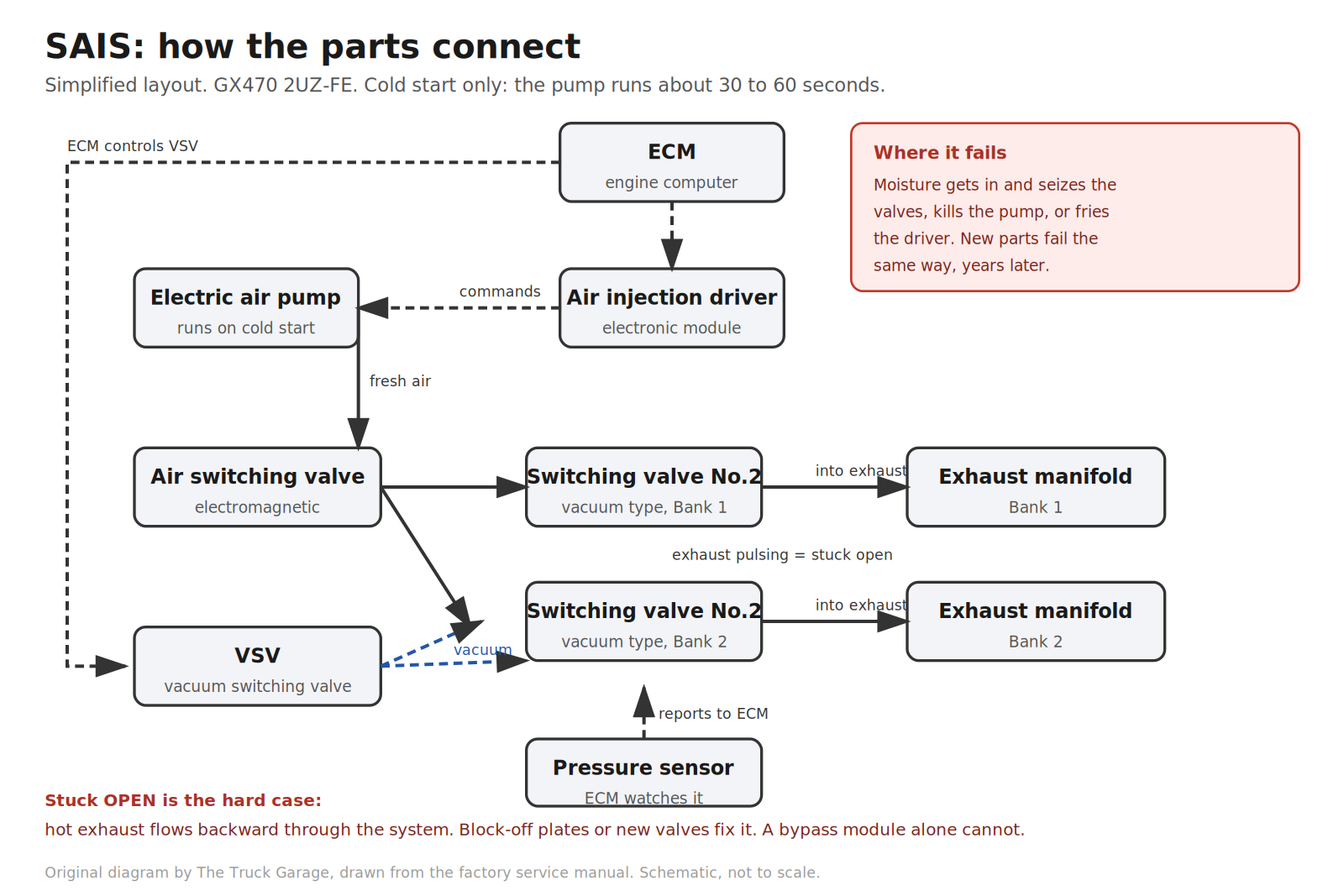
The failure mode is depressingly consistent: moisture gets in. Toyota’s own technical service bulletin T-SB-0160-11 documents water intrusion into the air injection pump assemblies causing exactly these fault codes. [TSB] Corrosion seizes the switching valves (open or closed), kills the pump, or takes out the driver electronics. Heat cycles and age do the rest. Replacing the parts doesn’t fix the design. The new parts fail the same way, years later.
Symptoms
The classic presentation: check-engine light plus TRAC OFF light, sometimes with the truck dropping into limp mode. Severely reduced power until you restart. The truck often drives fine between episodes, which is why owners sometimes clear the codes and hope, then get stranded again on the next cold morning. [community]
Clearing the codes buys you a normal drive until the next cold start. Then the ECM runs its SAIS self-test and the codes return. [community]
The codes
SAIS codes cluster in three families:
- P0412. Air switching valve circuit fault. [manual: GX470]
- P0418 / P0419. Air pump relay circuit faults. [manual: GX470]
- P2444. Pump stuck ON, Bank 1. P2445. Pump stuck OFF, Bank 1. [manual: GX470]
- P2446 / P2447. Same pair, Bank 2. [manual: GX470]
- P2440. Switching valve stuck open, Bank 1. P2441. Stuck closed, Bank 1. [manual: GX470]
- P2442 / P2443. Same pair, Bank 2. [manual: GX470]
- P1441 / P1444. Valve stuck open on some applications. [community]
This distinction matters enormously: a dead pump with healthy closed valves is the easy case. Valves seized open are the hard case, because exhaust is leaking backward through the system. And no bypass kit can seal a valve that’s physically stuck open. More on that below.
Diagnosing it properly
Don’t throw parts at this. The diagnostic tree is short and logical.
- Check fuses and the pump relay first. Electrical codes (P0412/P0418/P0419) can be as dumb as a blown fuse or a corroded relay. The manual’s trouble areas for these codes start with opens and shorts in the valve and pump drive circuits before condemning parts. [manual: GX470]
- The cold-start listen test. On a stone-cold engine, have someone start the truck while you stand at the open hood. You should hear the air pump whir for roughly half a minute after startup. [community] Silence with pump codes means a dead pump (or no power to it). A pump that runs but you still get valve codes means the valves aren’t doing their job.
- A scan tool with an active test is the definitive check. Toyota’s TSB procedure uses Techstream’s air-injection active test to command the pump on and watch for voltage at the pump and a pressure rise. [TSB] If voltage arrives and the pump doesn’t run, the pump is dead. If the pump runs and pressure doesn’t behave, suspect valves or plumbing.
- Determine whether valves are stuck open or closed. This is the fork in the road for your repair decision. Stuck-closed valves (P2441/P2443) just don’t flow air. Annoying to the ECM, harmless to the engine. Stuck-open valves (P2440/P2442, P1441/P1444) let hot exhaust pulse backward into the system, which is what destroys pressure sensors and pumps downstream. The ECM detects this via its pressure sensor. It literally watches for exhaust pulsation when the system should be sealed. [manual: GX470]
Option 1: The OEM repair (expensive, correct, compliant)
The factory repair means replacing the failed components: pump assembly, switching valves, sometimes the driver module. On the 4.7L V8s the entire system lives under the intake manifold, so the job includes manifold removal. That’s a big chunk of the labor. [vendor]
Expect $2,000–$3,000 at a dealer for parts and labor. [vendor] One GX470 owner was quoted $4,000 by Lexus for the pump-and-valve job. [community]
Option 2: The bypass kit (cheap, effective, popular)
This is what the forums overwhelmingly recommend, and it’s worth understanding what the kits actually do rather than treating them as magic boxes.
Gen 1 kits (including budget options from vendors like Slyfox and FireWaterMarine, roughly $48–$78 [community]) intercept the system so the pump never runs and the ECM never sees a fault for mechanical failures. Dead pumps, seized valves. They typically wire into the starter circuit so the emulation is active from crank. [community]
Gen 2 kits (Hewitt Technologies, $450–$495 [vendor]) go further. They fully emulate the SAIS electrically, which means they can also cover electrical fault codes that Gen 1 kits can’t. They stay compatible with later ECM software flashes, and the emissions monitors show as ready/complete. They ship with stainless block-off plates. [vendor]
Block-off plates deserve their own callout. The plates bolt between the switching valves and the exhaust manifolds, physically sealing off the leak path. They’re cheap (one owner paid about $33 shipped [community]) and many owners install them preventatively at the same time as a bypass. If your valves are verified closed and healthy, you can often skip the plates. But on a rusty truck, the plate bolts themselves can be the hardest part of the job, so plenty of owners do it once, while they’re in there. [community]
Install difficulty is genuinely DIY-friendly: owners routinely report 30-minute plug-and-play installs on the V6 trucks. [community] The V8 “3-valve” kits need some wiring run through the firewall to the ECM. Still a driveway job if you’re comfortable tapping a harness. [vendor]
The emissions question
The secondary air injection system is an emissions device, and federal law (the Clean Air Act’s tampering prohibition) prohibits defeating or bypassing emissions controls on road vehicles. The kit vendors sell these explicitly “for off-road use only.” [vendor]
If your state or county does emissions inspections, a visual inspection can fail you regardless of what the monitors say. And a sharp inspector knows what block-off plates look like.
Many owners in non-inspection areas run bypass kits for years without issue, and that’s the reality of the community. But go in with your eyes open: the OEM repair is the only option that keeps the truck unambiguously compliant everywhere.
Which option should you choose?
- Pump dead, valves verified closed, no inspection worries. Bypass kit. This is the overwhelming community consensus and the best dollars-to-outcome ratio in this entire guide.
- Any valve stuck OPEN. You need block-off plates at minimum (to seal the exhaust leak path), or the OEM valve replacement. A bypass module alone cannot fix a physically open valve.
- Electrical codes (P0412/P0418). Check fuses/relay/wiring first. If the driver or ECM side is genuinely dead, lean toward a Gen 2-style full-emulation kit rather than Gen 1.
- You face emissions inspections, or you just want it factory. OEM repair. Expensive, correct, compliant.
- Nothing failed yet and you’re doing preventive maintenance. Some owners install the bypass before failure, often skipping the block-off plates while the valves are still healthy and the bolts aren’t rusted solid. [community]
Can you just ignore it?
The system only operates for under a minute on cold starts. It has no effect on power, fuel economy, or drivability once warm. [community] The truck runs fine with a dead SAIS. The problems are the check-engine light (you’ll never know when a new, unrelated code appears), the limp-mode episodes some trucks throw, and inspections. Ignoring it indefinitely is common. Ignoring it knowingly is fine. Ignoring it unknowingly is how a $200 problem becomes a $2,000 one.
FAQ
Will a failed SAIS damage my engine? No. It only runs briefly on cold starts and has no role in normal operation. The risk is to your wallet and your inspection sticker, not your engine. [community]
Can I just clear the code and keep driving? You can, and the truck will drive normally until the next cold start. Then the ECM re-runs its self-test and the light returns, along with any limp-mode behavior your truck exhibits. [community]
Does the bypass affect gas mileage or power? No. The system is inactive 99% of the time anyway. Emulating it changes nothing about how the truck runs warm. [community]
Will I pass emissions with a bypass kit? Maybe, maybe not. Gen 2 kits report monitors as ready [vendor], which satisfies OBD-based inspections in many areas. But a visual inspection can still catch block-off plates, and defeating emissions equipment violates federal tampering law regardless. Know your local inspection type before deciding.
My 2003–2004 GX470 doesn’t have this system? Correct, as far as the community has documented. The SAIS arrived with the VVT-i 2UZ-FE update. If you have a pre-2005 truck, don’t chase SAIS codes. Look elsewhere. [community]
Why didn’t Toyota just recall it? They extended the warranty to 10 years/150k miles on the Tundra, but never on the GX470, 4Runner, LX470, or Land Cruiser. A sore point with owners to this day. That extension is long expired by now. [community]
Bottom line
The SAIS failure is a design flaw, not a maintenance failure, and the owner community solved it better than Toyota did. Diagnose properly, pick your path based on your valves and your inspection reality, and fix it once.
Leave a Reply