For: GX470 (2003–2009), GX460 (2010–2023), GX550 (2024+) owners — beginner to intermediate DIY.
In our experience, tires are the single most impactful modification you can make to a GX. The right size transforms capability; the wrong size turns your daily driver into a rubbing, gear-hunting mess. This guide distills what actually fits on each generation — drawn from r/GXOR, IH8MUD, and ClubLexus community experience — so you can pick a size once and buy with confidence.
Know Your Starting Point: Factory Baselines
Before changing anything, know what you have. Specs vary by trim and year, so verify against the factory manual or door-jamb sticker for your year.
| GX470 (J120) | GX460 (J150) | GX550 (J250) | |
|---|---|---|---|
| Stock tire size | 265/65R17 (~30.6″) | 265/60R18 (~30.5″) | 265/70R18 on Overtrail (~32.6″); 265/55R20 or 265/50R22 on other trims |
| Stock wheel | 17×7.5 | 18×7.5 | 18×7.5, 20×7.5, or 22×7.5 |
| Stock wheel offset | +25mm | +25mm (later years; verify early 2010–13) | +50mm |
| Bolt pattern | 6×139.7 | 6×139.7 | 6×139.7 |
| Smallest wheel that clears the brakes | 16″ | 17″ (16″ will not clear the calipers) | 17″ (verify — the GX550 has large brakes) |
| Factory axle gearing | ~3.73 (verify)[2] | 3.909[3] | Verify for your trim |
Key detail: offset differs hugely between generations — the GX550 runs +50mm vs. +25mm on the older trucks. That number is your anchor: the further you stray from it, the more trimming you’ll do.
What a Lift Actually Does (and Doesn’t Do) for Tire Clearance
The most common misconception in GX fitment: a lift lets you fit bigger tires. Only partly true.
A suspension lift raises resting ride height, improving ground clearance and approach/departure/breakover angles. But your IFS suspension cycles through the same full travel range lifted or not — at full compression and full steering lock, the tire sits in exactly the same place relative to the body mount, fender liner, and bumper. In other words, a lift does not create clearance at the points where tires actually rub. Real tire clearance comes from trimming, body-mount chops, wheel offset, alignment (caster), and fender-liner massaging — not from inches of lift.
Why pair lifts with bigger tires, then? Two inches of lift means you hit full compression less often in daily driving, and it naturally accompanies the armor, bumpers, and sliders of a serious build. Just don’t expect a lift alone to make 35s fit.
If you lift: ~2″ is the sweet spot for IFS GXs. Beyond ~2.5–3″, you’ll need aftermarket upper control arms to restore alignment, and CV angles and down-travel start working against you.
Max Tire Size on Stock Suspension
GX470 (stock)
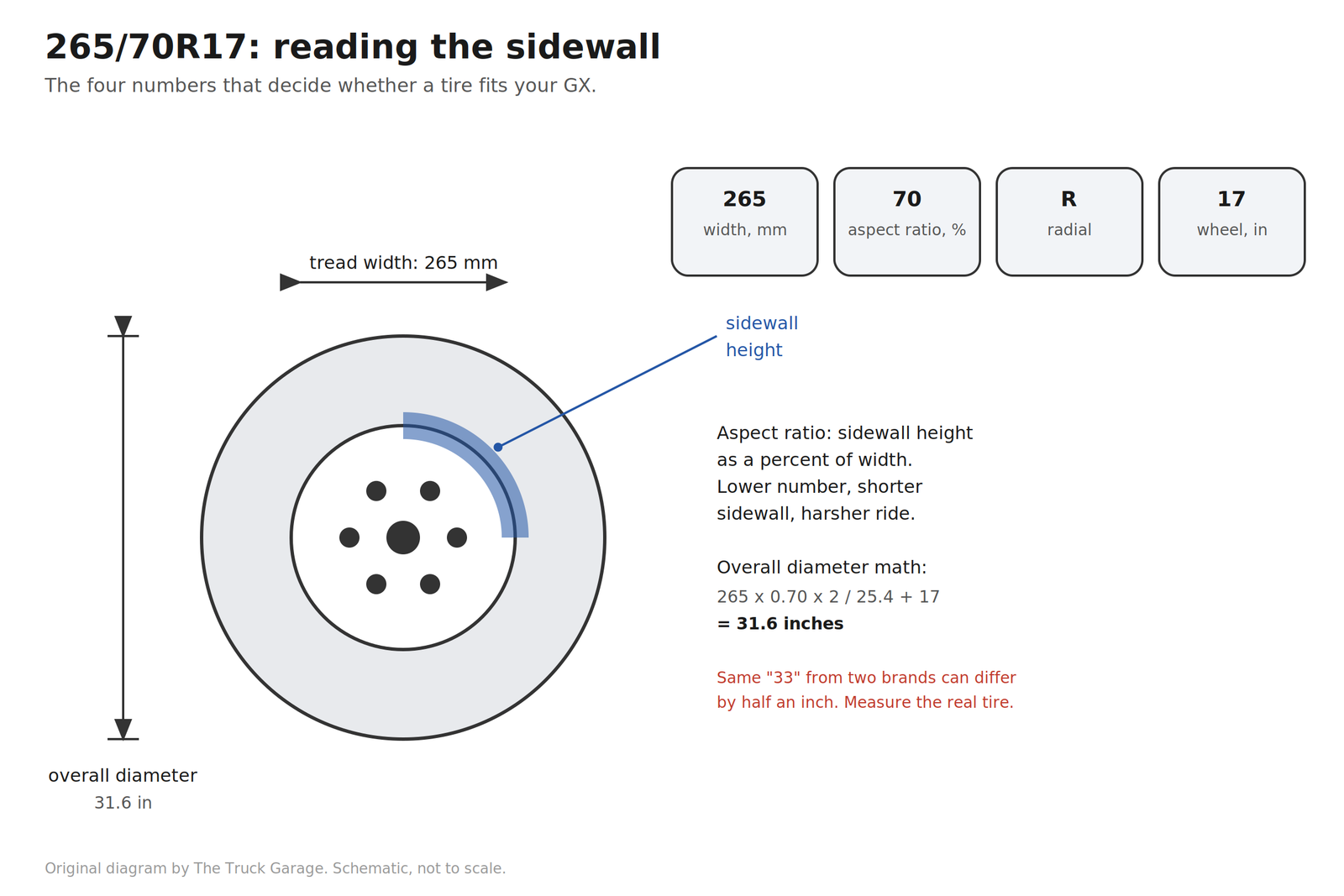
- Fits cleanly: 265/70R17 (~31.6″) — the classic “one size up” with no mods. 265/75R16 (~31.6″) also fits on 16″ wheels.
- Borderline: 285/75R16 (~32.8″) has been run stock, but expect rubbing at full lock; true 33s will rub without a lift.
GX460 (stock)
- Fits cleanly: 275/65R18 (~32.1″) fits with no rub — a popular no-mod upgrade. 265/70R18 (~32.6″) works with stock wheels and no lift, though you may need to push the front fender liners forward and remove the small bolt at the back of the front wheel well.
- Borderline: 285/70R17 (~32.7″) is the classic gray zone. With wheels near the factory +25 offset, many owners run it with just liner massaging and a good alignment; with aggressive low-offset wheels, you’ll rub the body mount at lock and compression.
GX550 (stock)
- Fits cleanly: 33s. The Overtrail ships from the factory on 265/70R18 (~32.6″) Toyo Open Country AT III tires[1], so 33″ is effectively the stock-size benchmark. Premium/Luxury trims on 20s and 22s can swap to Overtrail 18″ wheels and run the same 265/70R18 with no modifications.
- Borderline: 34s (e.g., 295/70R18, ~34.3″) on a stock-height 550 need careful offset selection (+25 to +40 range) and minor liner trimming. 35s on stock suspension: not realistic without significant trimming.
What Fits With a ~2″ Lift
At 2″ of lift, which in our experience is the sweet spot, the proven size is the 285/70R17 (~32.7″):
- GX470 + 2″ lift: 285/70R17 fits with minimal work — push the fender liners forward, remove or relocate running boards (they’re the first thing big tires eat), and get a good alignment. This is the most common setup in the community for a reason.
- GX460 + 2″ lift: 285/70R17 fits with minor front bumper corner and wheel-well plastic trimming, plus liner massaging. Body-mount chop is generally not required at factory-ish offset (+25 or higher).
Narrower alternatives in the same height class — 255/75R17 or 275/70R17 (~32″) — fit even more easily, weigh less, and are worth considering if you want the look without the fitment fight.
What Fits With a 2.5–3″ Lift
- GX470/GX460 + 2.5–3″ lift: 285/75R17 (~33.8″) and similar tall-skinny sizes are achievable, but now you’re into real modification: body-mount chop, pinch-weld flattening, pulling inner-fender plastic out of the way, removing running boards, and high-caster upper control arms. Expect occasional light rubbing on plastic off-road even then.
- GX550 + 1.5–2″ lift: 285/75R17 (~33.8″) and some 35s clear on carefully chosen wheels. Community testing suggests +40mm offset clears wide 35s and below, while +25 is marginal at full compression without extended bump stops.
35s (35×12.5, 315/70R17) on a 470/460: expect a body-mount chop, aggressive fender and bumper trimming, aftermarket UCAs with max caster, and possibly re-gearing (below). A few owners run them, but expect a project, not a tire swap.
When You Need a Body-Mount Chop (BMC) and Trimming
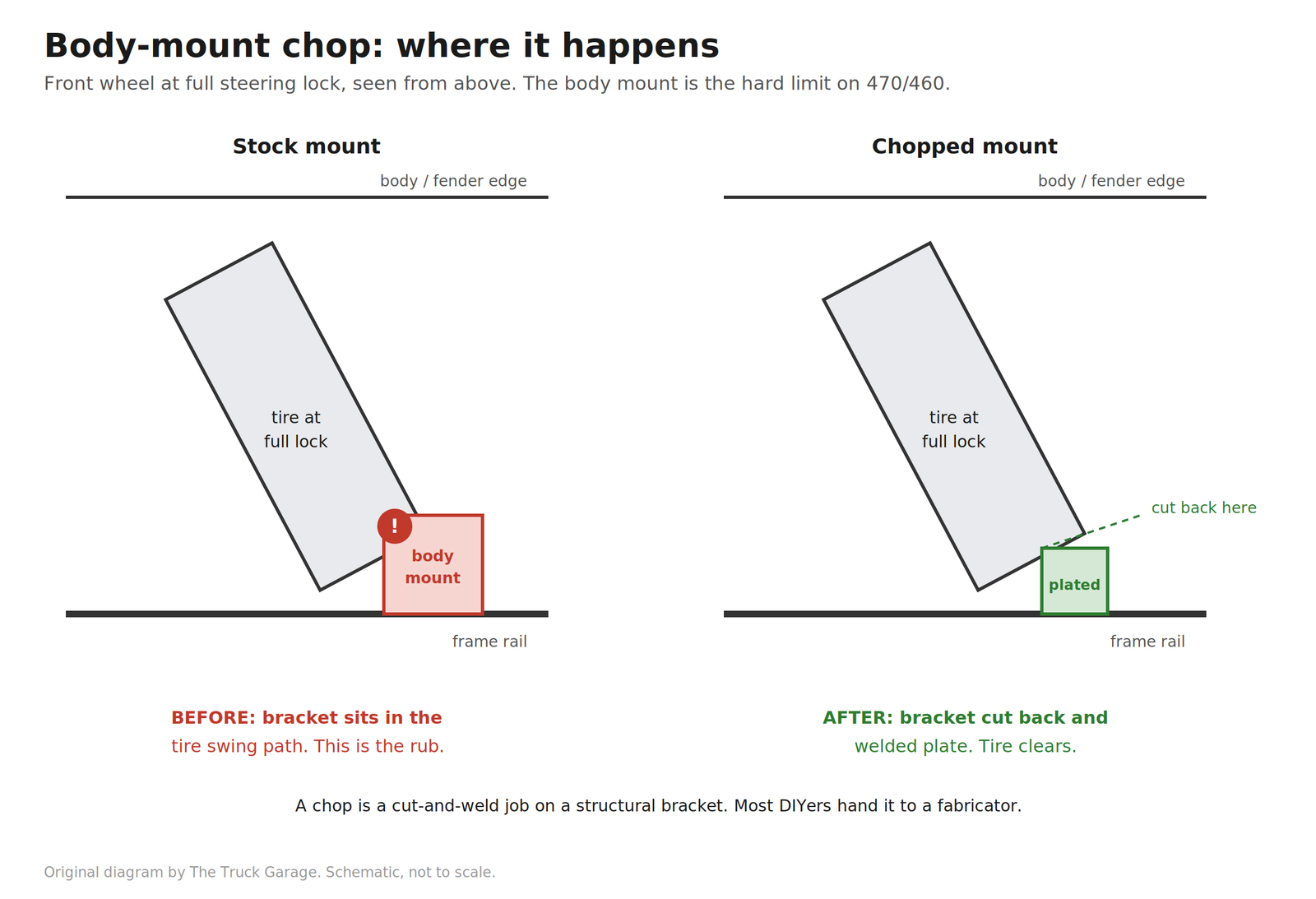
The body mount — a bracket where the frame meets the body, right behind the front tires — is the hard limit on the 470 and 460. Three variables decide whether your tire hits it: wheel offset (lower offset pushes the tire outward — away from the body mount but into the fender flares; higher/near-stock offset tucks it in — friendlier to fenders, harsher on the body mount), tire width and actual diameter (aggressive brands run large), and alignment caster (aftermarket UCAs pushing caster to +3.5°–4° move the tire forward in the wheel well, buying real clearance).
If/then guidance:
- If you’re running 285s or narrower with wheels at or near factory offset (+25 for 470/460) → a BMC is usually not needed; do the fender-liner mod and a proper alignment first.
- If you’re running 285s with low-offset wheels (0mm or negative, or wide wheels with spacers) → plan on a BMC, or accept rubbing at lock off-road.
- If you’re running 34″+ tires on a 470/460 → BMC + pinch-weld flattening + bumper/fender trimming is essentially required, regardless of offset.
- If you’re on a GX550 → the higher +50 factory offset gives more breathing room; 34s–35s need careful offset choice (+25 to +40) and trimming.
A BMC is a cut-and-weld job on a structural bracket — the point where most DIYers call a fabricator or off-road shop. Budget accordingly.
Spare-Tire Clearance Under the Truck
This is the step people forget, and on the full-time-4WD GX it matters more than most trucks: your spare must be the same rolling diameter as your other four tires. The Torsen center differential doesn’t tolerate a mismatched spare — running a smaller spare for real miles can damage the transfer case and axle components.
What fits in the stock underbody spare location:
- GX460: Roughly 32″ is the practical ceiling (reports of ~31.7″ max stock). A 265/70R17 (~31.6″) fits. A 275/70R18 (~33.2″) has been shoehorned in “nice and snug” by some owners, while others couldn’t get a deflated 33 (285/70R17) to fit at all — an aftermarket hitch (Curt, etc.) makes it worse, and KDSS relocation spacers can help slightly. Results vary truck to truck; test-fit before you buy five tires.
- GX470: Similar — a 265/70R17-class spare fits; 33″+ spares typically don’t go under the truck. Common solutions: rear swing-out bumper, roof basket, or hitch-mounted carrier.
- GX550: A full 33″ spare fits — the Overtrail’s stock 265/70R18 is proof. Beyond 33″, plan on an alternate carrier.
Rule of thumb: if your new tires are bigger than ~32″ (460/470) or ~33″ (550), solve the spare before you buy five tires.
Wheel Offset and Width: Why It Matters for Rubbing
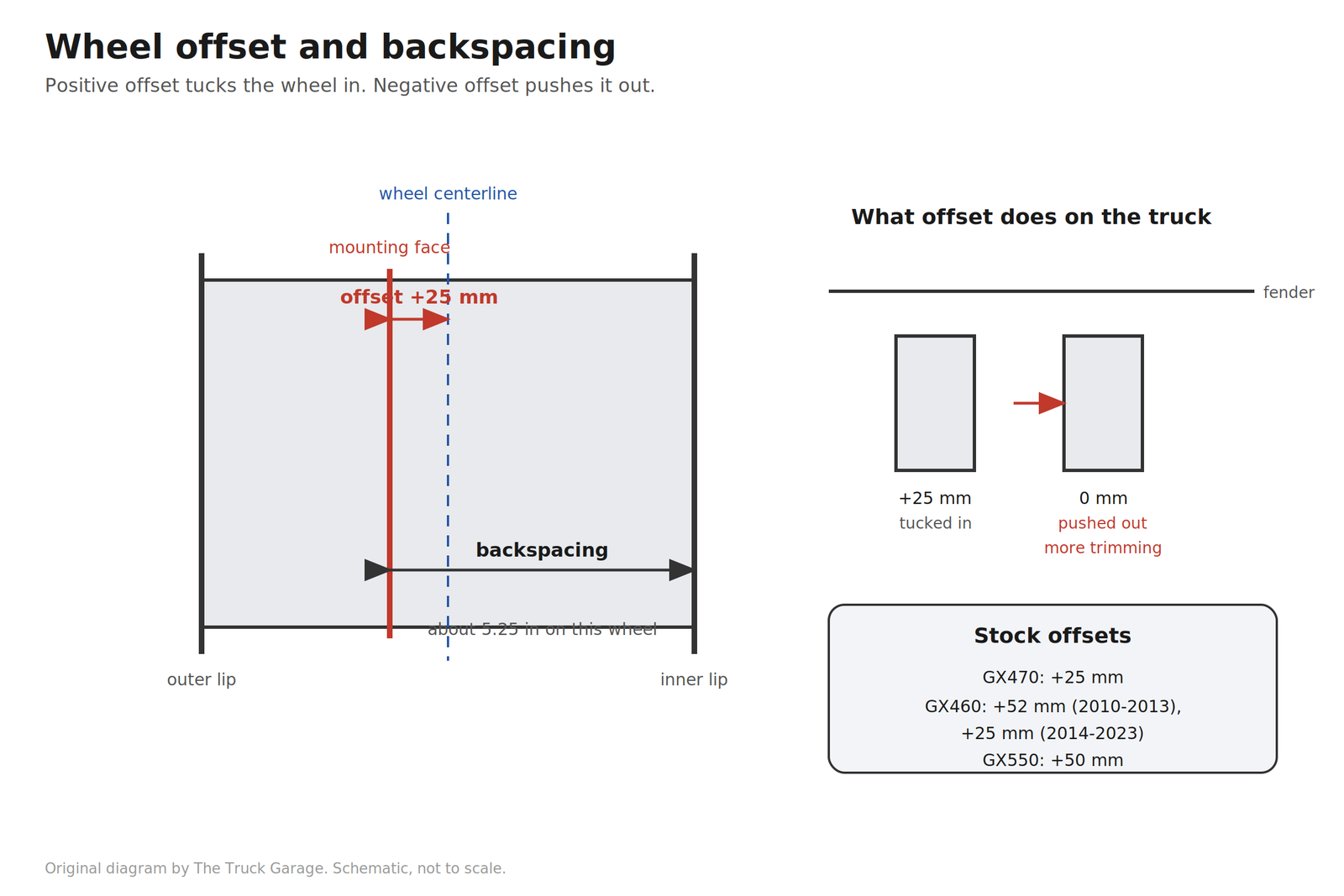
Offset (ET) is the distance from the wheel’s mounting face to its centerline. Positive offset tucks the wheel in; negative offset pushes it out (“poke”).
- Stay near stock offset to minimize trimming. On 470/460, that’s +25mm (verify your year). On the GX550, that’s +50mm.
- Common aftermarket offsets (0 to −12mm) look great and give a wider stance, but they push the tire’s shoulder into the fender flare at full lock and require more trimming and usually a BMC with 285s or bigger.
- Wider wheels (8.5–9″) with the same offset also push the tire’s outer edge outward — width and offset work together, not independently.
- Wheel diameter: In our experience, 17″ is the sweet spot for 470/460 (cheaper tires, taller sidewalls). Remember 16″ wheels won’t clear GX460 brake calipers. For the GX550, verify brake clearance before buying 17s — fitment is finicky on the new platform.
- Backspacing vs. offset: shops and forums use both — for an 8.5″-wide wheel, 0mm offset ≈ 4.75″ backspace. Keep both in mind when cross-checking fitment threads.
Easy path: factory or factory-offset wheels (TRD Pro wheels, Overtrail takeoffs, stock 470 wheels) with a moderate tire size always fit with the least drama.
The 33s vs. 35s Decision Framework
This is the fork in the road. Here’s how to think about it honestly.
Choose 33s (285/70R17, 265/70R18, 275/65R18, ~32–33″) if:
- This is your daily driver. 33s fit with minimal trimming, no re-gear, and no structural cutting on all three generations (with a small lift on the older trucks).
- You tow. The GX460’s 3.909 gearing[3] handles 33s fine with no meaningful gear-hunting. The 470’s taller stock gearing feels 33s more, especially towing, but stays livable.
- MPG matters. Expect roughly 1–2 mpg loss with 33″ all-terrains vs. stock, mostly from weight and rolling resistance. Your speedometer will also read slightly low. I recommend hand-calculating MPG rather than trusting the dash.
- Budget is real. In our experience, five 33s on reasonable wheels is dramatically cheaper than a 35″ build once you count the BMC, trimming, possible re-gear, and spare solution.
Choose 35s (35×12.5R17, 315/70R17, ~34–35″) if:
- You’re committed to the project. On 470/460: BMC, pinch weld, bumper/fender trimming, aftermarket UCAs, and a real spare solution are the entry fee. On the 550: careful wheel selection and trimming.
- You can accept re-gearing. The consensus: 33s don’t need a re-gear; 35s make one worth serious consideration (commonly 4.56 or 4.88 on the older trucks). A re-gear is a professional shop job costing several thousand dollars. I recommend it as the only way to fully restore stock driving feel, towing manners, and transmission behavior. Note it restores drivability, not MPG — heavier tires still cost you fuel.
- You actually need the clearance. The honest math: 35s give you roughly 1″ more ground clearance under the diffs than 33s. If you rock crawl or run deep ruts, expect that inch to matter. For overlanding, forest roads, and snow, in our experience it usually doesn’t.
The middle path: tall and skinny
Tall-and-skinny sizes — 255/80R17 (~33″), 285/75R17 (~34″) — give you most of the ground-clearance benefit with far less fitment pain, because width is what hits the body mount. They’re lighter, cheaper, and steer better on-road. Trade-off: less aggressive stance and slightly less flotation in sand.
Power and gearing summary:
| Setup | Re-gear needed? | Daily drivability |
|---|---|---|
| 32–33″ on GX460 (3.909 gears)[3] | No | Stock-like; the V8 masks the difference |
| 32–33″ on GX470 (taller stock gears)[2] | Usually no | Slightly lazier; tow in a lower gear |
| 34–35″ on any GX | Strongly consider 4.56/4.88 | Noticeable power loss, gear hunting, 2–4 mpg hit without it |
| 33″+ on GX550 (twin-turbo V6) | Rarely | Turbo torque handles bigger tires better than the old V8s |
Common Mistakes
- Buying wheels before deciding on tire size. Offset dictates everything downstream — BMC, trimming, spare. Pick the tire size first, then choose wheels that make it fit with the least surgery.
- Assuming the lift solves fitment. A 3″ lift with low-offset wheels and 35s will still eat the body mount at full lock. Trim and offset first, lift second.
- Forgetting the spare. Five-tire rotations only work if the spare matches. Budget the fifth wheel/tire and its mounting solution into the build from day one.
- Ignoring tire weight. Two tires can both be “33s” while differing by 15+ lbs each. Load range E mud-terrains will feel — and drink fuel — nothing like a P-metric all-terrain on 17s. Weight matters as much as diameter.
- Running mismatched diameters on full-time 4WD. The GX’s Torsen center diff needs four matching tires. A smaller spare is a get-home-only emergency measure, not a plan.
- Chasing width instead of height. A 285-wide tire is what forces the BMC, not the 33″ diameter. A tall-skinny tire fits with far less work.
- Skipping the alignment. After any lift or tire change, get a proper alignment and ask for maximum caster. Caster is free clearance at the body mount.
- GX550 owners: assuming old-platform rules apply. The +50 offset, different suspension geometry, and big brakes mean 470/460 fitment advice doesn’t transfer directly. Lean on GX550-specific threads and verify brake clearance on any 17″ wheel.
FAQ
What’s the biggest tire I can fit with zero modifications?
GX470: 265/70R17. GX460: 275/65R18. GX550: 265/70R18 (Overtrail stock size — it fits every trim with the right wheels). Always verify against the factory manual for your year.
Do I need a body-mount chop for 285/70R17?
On a 470/460: usually not, if your wheels are near factory offset (+25) and you have ~2″ of lift with a good alignment. With 0mm or negative-offset wheels, plan on it — or accept rubbing at full lock off-road. On a GX550, 285-width tires at sensible offsets generally don’t need one.
Will 33s fit my spare location?
GX550: yes. GX460/470: roughly 32″ is the practical max — a 265/70R17-class spare fits; a 285/70R17-class spare usually doesn’t. Aftermarket hitches make it tighter.
Do I need to re-gear for 33s?
No — 33s work fine on stock gearing across all three generations. Consider it at 34″+, with heavy armor, or frequent towing on big tires.
Can I run 16″ wheels on my GX460?
No — 16″ wheels don’t clear the brake calipers. 17″ is the minimum. (GX470 owners can run 16s.)
How far off will my speedometer be?
Roughly proportional to the diameter change: going from a 30.5″ stock tire to a 33″ tire makes the speedo read ~7–8% low (you’re going faster than indicated). Recalibration options are limited — most owners learn the offset or use GPS.
Fitment varies with tire brand, wheel specs, alignment, and suspension condition. Use this guide to narrow your choices, then confirm with a test-fit or generation-specific build threads before spending money.
Sources
- Lexus USA, official GX documents on file (2024 brochure, 2025 features document, 2026 spec sheet): E-KDSS standard on Overtrail and Overtrail+, unavailable on other trims; Overtrail factory tire fitment 265/70R18 Toyo Open Country AT III. ↑
- 2005 GX470 factory service manual: axle gearing, wheel and brake specifications. ↑
- 2013 GX460 factory service manual: axle gearing 3.909, wheel and brake specifications. ↑
- IH8MUD, GX470 wheel/tire/lift picture combination thread: owner-documented wheel, tire, and lift combinations with ride reports. https://forum.ih8mud.com/threads/gx470-wheel-tire-lift-picture-combination-thread.970666/page-10
- IH8MUD, GX lift advice thread: Bilstein/OME lift combos, air-to-coil conversion, and fitment discussion. https://forum.ih8mud.com/threads/another-help-with-gx-lift-thread.988314/
Leave a Reply