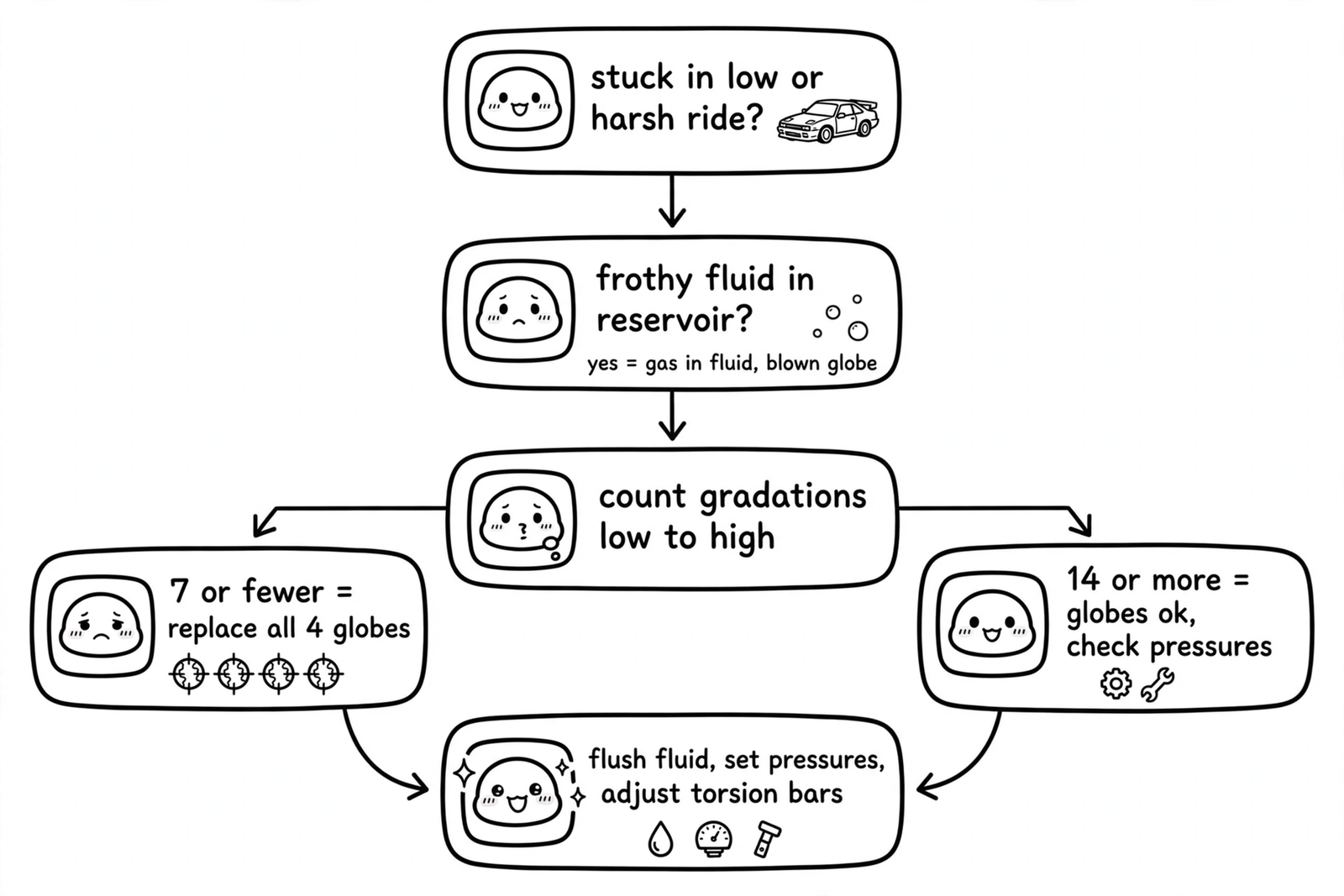
You bought a 1998 to 2007 LX470 because it rides like a magic carpet. Then one morning the rear end is sitting on the bump stops, the AHC OFF light is flashing, the ride is harsh enough to rattle your teeth, and Techstream shows C1762. If the fluid reservoir looks frothy, you are looking at the most common AHC failure there is: dead globes.
This guide covers how the system works, the one test that tells you globe health, what the codes mean, and the full fix: four new globes, a fluid flush, and correct pressures. It applies to the LX470 (1998-2007) and AHC-equipped Land Cruiser 100 series. It does not apply to the GX470, GX460, or GX550, which never had AHC.
How AHC Works (the Short Version)
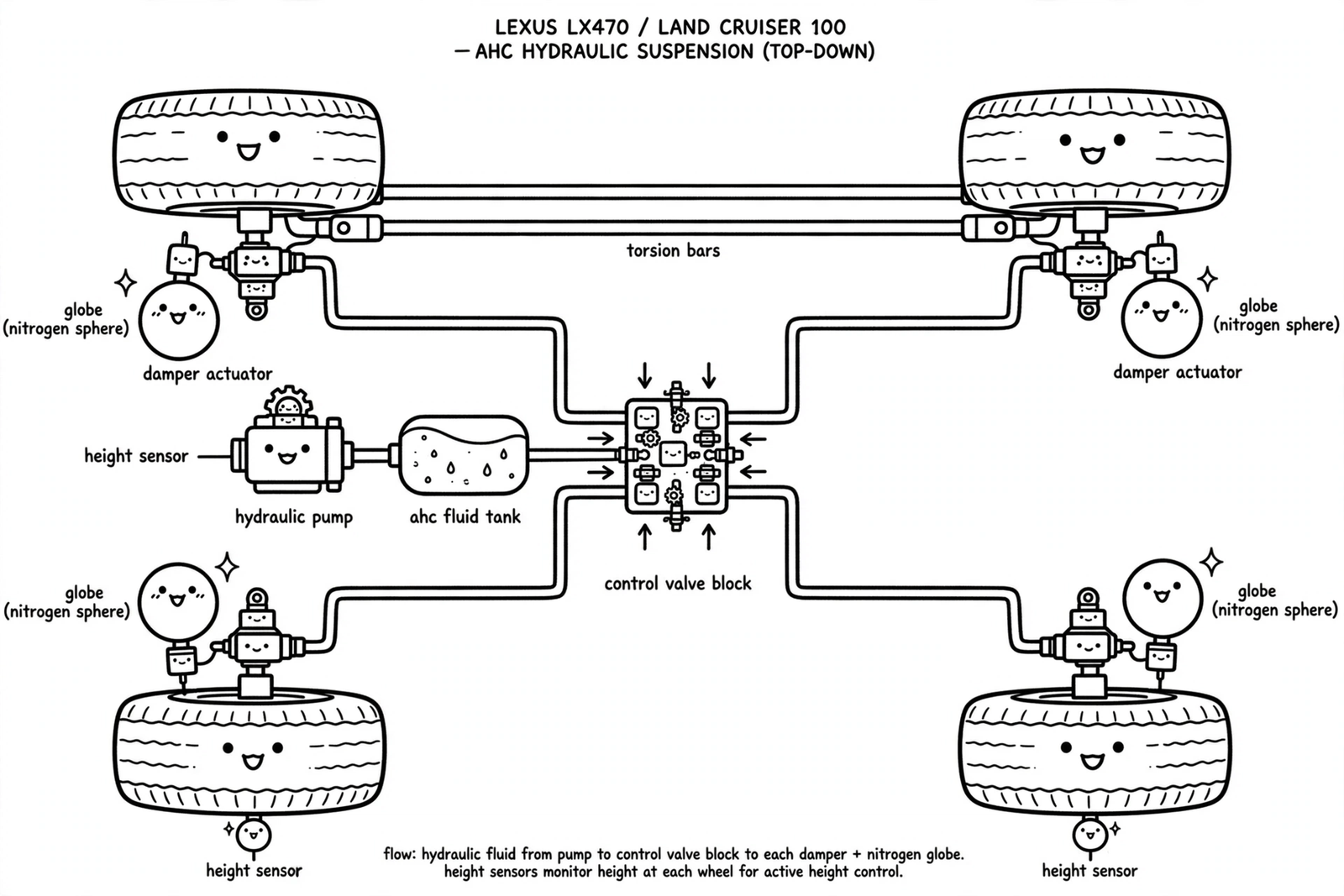
AHC is a hydraulic suspension. An electric pump pressurizes special fluid from a reservoir tank. That fluid feeds hydraulic actuators at each corner, and each actuator has a round nitrogen-filled sphere attached to it. Owners call them globes. The globes are gas springs: the nitrogen charge behind a rubber membrane is the actual spring of the system. The actuators control how fast fluid moves in and out, which is the damping. The globes and the actuators together are the shock absorbers.
The front suspension also has torsion bars carrying part of the front weight, and the rear has coil springs. Height control sensors at the wheels tell the ECU the ride height, and the console switch gives you LOW, N (normal), and HIGH. The pump, leveling valves, and sensors keep the truck at the commanded height in real time.
The globes are wear items. Think of them like shock absorbers. The nitrogen charge slowly leaks through the membrane over the years. Owner consensus puts globe life at roughly 5 to 10 years or 50,000 to 150,000 miles, and after that their performance fades gradually. Then one ruptures outright, and the party is over.
What a Dead Globe Does
When a globe membrane fails, its nitrogen charge escapes into the hydraulic fluid. The reservoir turns frothy. The pump is trying to pressurize a fluid full of compressible gas instead of incompressible oil, so it cannot build pressure. The ECU notices the pump drawing current without results and sets C1762 (abnormal pump pressure). If the pump keeps running against the fault, C1751 (continuous current to the pump) can follow.
The symptoms line up:
- Truck sinks to LOW, usually starting at the rear, and will not come back up. The AHC OFF light flashes.
- Ride turns brutally harsh. The truck feels like it is riding on the bump stops, because the damping is gone.
- The reservoir fluid looks frothy or bubbly.
- Pressures read high or the pump runs and squeals, then the ECU shuts it down and the code returns.
One more characteristic owners report: the system will still raise and lower with failed globes. Raising and lowering is done by the pump and leveling valves, not the globes. A truck that goes up and down fine but rides terribly is a classic globe symptom, not a pump symptom.
The Gradations Test (Globe Health in 5 Minutes)
This is the owner-community standard for globe health, and the factory manual ties globe replacement to it. You need no tools and no Techstream.
- Park on level ground. Start the engine.
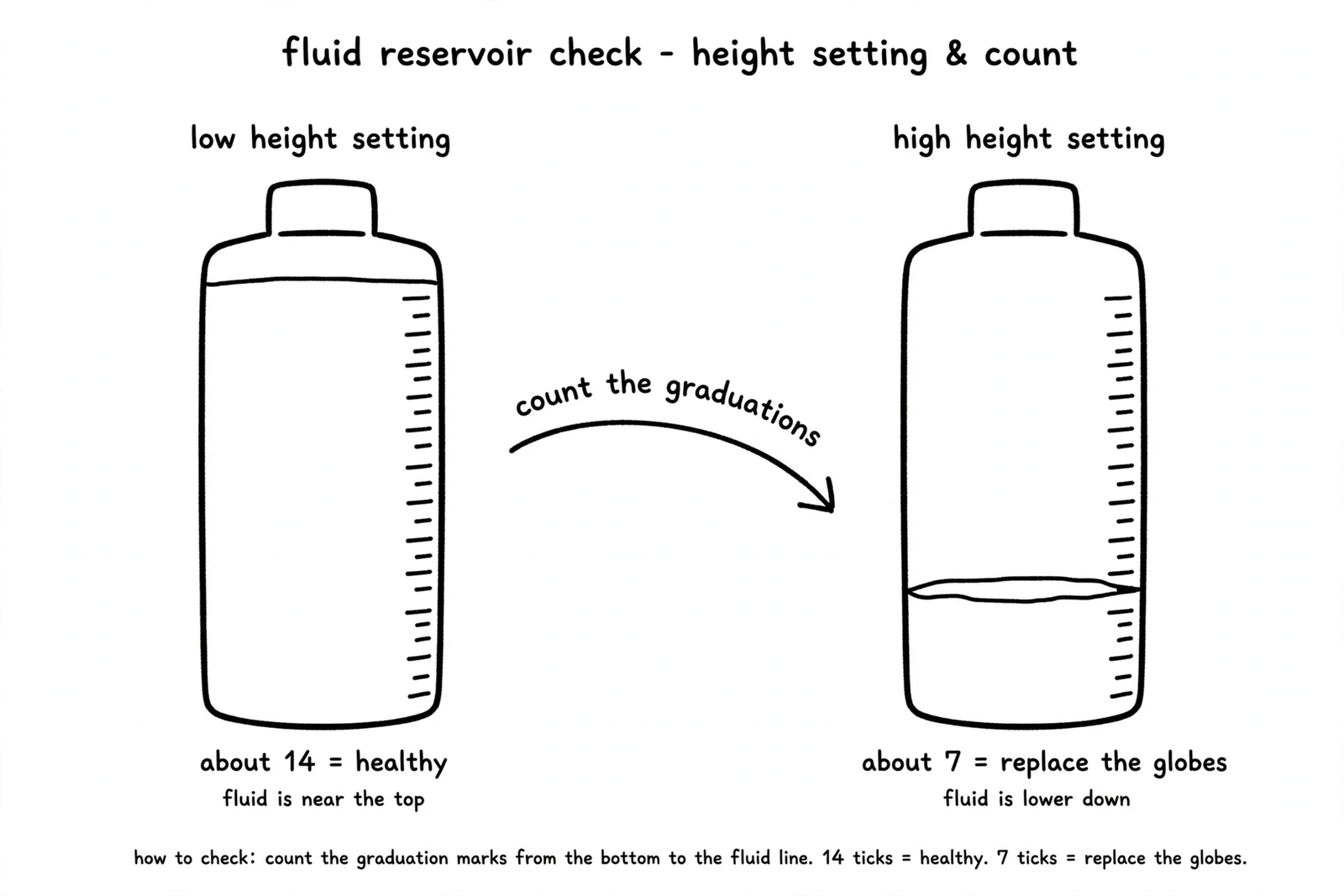
- Read the fluid level on the reservoir bottle. It has graduated tick marks on the side. Note the level.
- Switch the height control to LOW. Wait about 30 seconds for the system to settle, engine off after that. Read the level again.
- Switch to HIGH, let it settle, engine off. Read the level a third time.
What matters is the difference in graduations between LOW and HIGH:
- About 14 graduations: globes near new. Healthy, full nitrogen charge.
- About 10 to 12: aging but serviceable. Ride quality is already fading, but not failed.
- About 7: replace all four globes. This is the consensus replacement threshold tied to the factory manual.
- About 4 or fewer: globes dead or ruptured. Roughly 2.5 graduations per globe, so 4 total means nearly nothing is left.
Two rules. Run the test from LOW to HIGH, not the reverse; several owners note the direction matters for a valid reading. And the test judges all four globes as a set. It will not tell you which one failed.
| Graduations (LOW to HIGH) | Globe condition | What to do |
|---|---|---|
| About 14 | Healthy, near new | Standard maintenance; flush fluid on interval |
| About 10 to 12 | Aging, performance fading | Plan a globe replacement |
| About 7 | Depleted | Replace all four globes |
| About 4 or fewer | Dead or ruptured | Replace all four globes now |
A shadetree cross-check for the failed corner: drive slowly over a speed bump one wheel at a time. The corner whose globe ruptured makes the truck feel unstable and harsh when that wheel hits the bump. That tells you where to look first, though the fix is still all four.
Codes: C1762 and C1751
These are AHC-specific codes. A generic OBD reader will not show them. You need Techstream (the inexpensive Mini-VCI cable and software is what most owners use) or the manual diagnostic procedure.
- C1762: abnormal pump pressure. The pump is running but pressure is not building as expected. The number one cause is gas in the fluid from failed globes. It is also the code you get with air in the system after a bad bleed.
- C1751: continuous current to the pump. The pump has been running too long against a fault. Often follows C1762. Clear it, fix the root cause, and it stays gone.
Both codes put the system in fail-safe: the flashing OFF light and no height changes. Clear the codes after the repair and the system should come back to life.
The Fix: Four Globes, Fresh Fluid, Correct Pressures
Do all three. Globes without a flush leaves nitrogen-laden fluid in the system. A flush without globes is a temporary patch. Pressures out of spec after new globes gives you a truck that sits crooked or rides wrong.
Step 1: Replace the four globes
There are four globes, one per corner, and the front and rear are different parts. Front globe: 49141-60010. Rear globe: 49151-60010. Verify by VIN at a dealer or partsouq before ordering. Do not order LX570 globes (49141-60020 / 49151-60020); interchange with the LX470 is not verified.
Cost: owner reports put a full set around $600 from Impex (Japan, door to door in under two weeks, per a 2025 owner thread) and more from eBay sellers. A dealer charges far more. Budget roughly $600 to $1,000 for the set depending on source, and treat current prices as quotes to get, not gospel.
Removal notes:
- The globes unscrew from the damping actuators. Penetrating oil first. The wrench flats are large (one owner ground a 32 mm open-end wrench down to 8-9 mm thick to fit; another found a 36 mm Ford fan clutch wrench, rentable free at parts stores, fits the flats; a strap wrench also works). Do not round them off.
- Replace all four at once. A set with one new globe and three old ones rides wrong and the old ones will fail soon anyway.
- While the system is open, owners recommend considering the AHC pump sub-assembly (48901-60010) and its seals if the pump is original. The pump is easy to reach once you are in there.
Golden rule, shouted on every ih8mud AHC thread and repeated here: put jackstands under the chassis rails before working under the truck. Never rely on the AHC system or a jack to hold the truck up while you are underneath. The system can drop without warning.
Step 2: Flush the fluid
AHC fluid is a light mineral oil with proprietary additives, not brake fluid and not ATF. Neither belongs in this system. Toyota fluid part number 08886-01805 comes in 2.5 liter steel drums. Get at least two, probably three. Two drums cover a full system flush; a third covers the repeated bleeds after a globe replacement.
One strong owner consensus item: avoid the 1 liter plastic bottles (08886-81221). Owners report jelling and contamination problems with the plastic bottles starting around 2020, and the standing advice is to use the steel drums and strain new fluid through a clean cloth before it goes into the reservoir. Treat this as owner consensus, not a Toyota bulletin.
The one-can exchange method from the owner community:
- This is done on level ground with the truck’s weight on its wheels, not on a lift. You need the weight to compress the actuators.
- Lower the truck to LOW, wait 30 seconds to settle, engine off. Do not restart until told.
- The reservoir is now at its fullest. Suck out as much old fluid as you can with a turkey baster or suction pump, about a liter.
- Pour in fresh fluid to near the top of the reservoir.
- Bleed at the bleeders: crack each bleeder (there are five: one at each globe plus the height control accumulator), let fluid flow into a clear tube and catch can, close it. The fluid gushes under pressure, so use a tube and a can, not an open wrench and hope. Bleeder plug torque is 73 in.lbf (8.3 N.m).
- Cycle the height LOW to HIGH a few times, re-bleed, and top off the reservoir to between the marks at N height.
Total cost for fluid alone runs under $50 and under an hour for an exchange, per the how-to video. A full flush after globe replacement takes longer because you bleed several times. One owner filters the flushed fluid and reuses it on the second pass rather than opening a third drum.
Watch the bled fluid. Gas bubbles in the catch can confirm a ruptured globe. Debris in the fluid after a rupture is common; flush it out, because the system is not sealed and debris circulates.
Step 3: Set pressures and cross-level
With new globes and fresh fluid, the system needs correct pressures. This is where owners get into trouble by adjusting torsion bars by feel.
Front pressure spec from the factory manual: 825 +/- 43 psi (5.7 +/- 0.3 MPa). Read it in Techstream. If the front pressure is out of spec, adjust the torsion bar adjusting bolts. Loosening the adjusters raises the pressure; tightening lowers it. Roughly 0.2 MPa (about 28 psi) of change per full turn of both adjusters. Always engine off when turning the adjusters.
Before touching pressures, cross-level the front: on level ground, engine off, measure hub-to-fender on both front corners and equalize them with the torsion bar adjusters. The manual tolerance is 10 mm (0.39 in), and owners recommend doing better than that. Then set ride height with the height control sensors. The ECU is permanently programmed to seek about 2.25 volts at N height, which shows as roughly zero inches on Techstream. Moving the sensor adjusters changes where the truck sits relative to that target. That is the so-called sensor lift.
The rear has no torsion bars. Rear pressure is set by the rear coil springs. If the rear pressure is out of spec with correct height, the springs are sagging and need replacement (some owners fit heavier aftermarket rear springs made for AHC trucks, or air bags, to handle towing loads).
No verified rear pressure spec was found for this guide. Owner posts show rear pressures in a wide band. Confirm the rear spec in the factory manual for your year before adjusting anything.
Keep AHC or Delete It?
When the globes die, owners ask whether to delete AHC for conventional suspension. The honest math from the threads: four globes plus fluid comes in under $1,000 in parts, and the globe job is a driveway afternoon. A full delete means torsion bars, rear springs, four shocks, and alignment, and it costs more in parts and labor than fixing AHC.
The ride is the deciding factor for most owners who keep it. Multiple owners who have owned both say the AHC truck is night and day better off road and on: quieter, more comfortable, and the height control is genuinely useful. AHC is only a money pit if you throw parts at it without diagnosing. Run the gradations test first. It costs nothing and tells you the answer.
Parts and tools
Verify every part number by VIN before ordering.
| Part | Notes | Part number |
|---|---|---|
| Front globes (2) | Nitrogen spheres, one per front actuator | 49141-60010 |
| Rear globes (2) | Different from front | 49151-60010 |
| AHC fluid | 2.5 L steel drums, 2-3 needed | 08886-01805 |
| Bleeder valves | 5 in the system, replace if corroded | 49189-60010 |
| Bleeder caps | 5, cheap insurance | 49177-60010 |
| AHC pump sub-assembly | Consider while the system is open | 48901-60010 |
Tools: 10 mm wrench for bleeders, clear PVC tube and catch can, turkey baster or suction pump, penetrating oil, strap wrench or 36 mm fan clutch wrench for the globes, jackstands for the chassis rails, and a Mini-VCI Techstream cable for codes and pressures. A torque wrench that reads in inch-pounds for the bleeder plugs.
FAQ
How do I know my globes are bad without any tools? Run the gradations test. Count the reservoir graduations from LOW to HIGH. About 14 is healthy, about 7 means replace all four, about 4 means they are dead. Frothy fluid in the reservoir and a harsh bump-stop ride back up the diagnosis.
Will the truck still raise and lower with dead globes? Yes. Raising and lowering is done by the pump and leveling valves. The globes handle damping. A truck that goes up and down fine but rides terribly is a classic globe symptom.
Can I replace just one globe? You can, but the owner consensus is to replace all four. The others are the same age and will fail soon, and mixed old and new globes ride unevenly.
Is C1762 always the globes? Not always, but it is the most common cause. C1762 means the pump cannot build pressure as expected. Gas from failed globes is cause number one. Air introduced by a bad bleed is cause number two. Diagnose the globes with the gradations test before buying a pump.
Do I need Techstream? For codes and pressure readings, yes, or the manual diagnostic procedure from the factory manual. The gradations test needs nothing. A Mini-VCI cable is the standard owner tool.
Can I drive it stuck in LOW? Owners do, but the ride is harsh because the damping is gone, and handling suffers. One owner in the threads put it plainly: do not risk other road users on a truck you know has a suspension problem. Fix it before any long trip.
Sources
- 2003 LX470 factory manual, Active Height Control adjustment procedure (front pressure spec, torsion bar sensitivity, cross-level tolerance, bleeder torque). Posted on IH8MUD: https://forum.ih8mud.com/attachments/r-m-2003-suspension-and-axle-active-height-control-system-adjustment-lx470-pdf.940354/
- IH8MUD: LX470 stuck in LOW, cannot raise back up (C1751 + C1762, frothy reservoir, globe consensus). https://forum.ih8mud.com/threads/lx470-stuck-in-low-and-cant-raise-back-up.1354328/
- IH8MUD: 2000 LX470 AHC high pressure in front (gradations, globe gas release, fluid bottle warning). https://forum.ih8mud.com/posts/15549982/
- IH8MUD: Impex AHC globe thread (gradations 14 new / 7 replace, one-can fluid exchange, jackstand safety rule). https://forum.ih8mud.com/threads/impex-is-legit-4-new-ahc-globes-door-to-door-from-japan-less-than-2-weeks.1256544/page-14
- IH8MUD: Globes passed the pencil test but ride is awful (2.5 graduations per globe, 50-150k mile life). https://forum.ih8mud.com/threads/lx470-globes-passed-the-pencil-test-but-my-ride-is-aweful.1300312/
- IH8MUD: Bouncing and jarring ride, fixed (6 graduations = shot, 7 minimum). https://forum.ih8mud.com/threads/lx470-bouncing-and-jarring-ride-fixed.1178993/
- IH8MUD: Replacing AHC globes and accumulators (36 mm fan clutch wrench trick, strap wrench method). https://forum.ih8mud.com/threads/replacing-ahc-globes-accumulators.716383/
- IH8MUD: Front AHC shock leak (pump sub-assembly and seal part numbers, steel drum fluid guidance). https://forum.ih8mud.com/threads/front-ahc-shock-leak.1341753/
- IH8MUD: Torsion bar adjustment on LX470 AHC (cross-level first, sensor voltage at N). https://forum.ih8mud.com/threads/torsion-bar-adjustment-lx470-ahc.1339887/
- IH8MUD: LX570 vs LX470 accumulators (part numbers, no verified interchange). https://forum.ih8mud.com/threads/lx570-accumulators-vs-lx470-accumulators.1281161/
- Lexus Owners Club: AHC suspension accumulators and bleed system (fluid part number, wrench trick). https://us.lexusownersclub.com/forums/topic/62067-ahc-suspension-accumulators-b-b-suspensions-bleed-system/
- YouTube: AHC suspension fluid flush how-to, LX470 and Land Cruiser 100 (one-can method, under $50). https://www.youtube.com/watch?v=2Q_8j7Pj0vU
Leave a Reply