A practical guide to keeping your automatic transmission alive: GX470 (2003 through 2009), GX460 (2010 through 2023), and GX550 (2024+)
Who This Guide Is For
This guide is for GX owners who use their trucks: daily drivers that tow, overland rigs on bigger tires, weekend trail trucks, and anyone who bought a high-mileage GX and wants the transmission to survive another 100,000 miles. It covers beginner-to-intermediate DIY work: reading transmission temperature, doing a drain-and-fill, checking fluid level, and deciding whether you need an auxiliary cooler.
The three generations run different hardware. The GX470 uses the A750F five-speed automatic.[1] The GX460 uses the A760F six-speed. The GX550 uses a 10-speed automatic paired with the twin-turbo V6. The 2003 GX470 has a transmission dipstick and uses Toyota Type T-IV fluid.[2][3][4] The 2004 through 2009 GX470, all GX460, and GX550 are sealed units with no dipstick and use Toyota WS fluid.[2][3][4] On sealed units, fluid level is checked through an overflow plug on the pan while the engine idles at a specific temperature. That one detail shapes everything about servicing these trucks.
Why GXs Run Hot
Heat is what kills automatic transmissions, and it kills them by cooking the fluid. Fresh ATF lubricates, cools, and carries friction material where it needs to go. Overheated fluid oxidizes: it darkens, loses viscosity, and stops protecting clutches, seals, and the valve body. The working rule of thumb is that fluid oxidation roughly doubles for every 20°F above about 175°F, so fluid that would last 100,000 miles at 175°F might last only 25,000 at 215°F. Your transmission doesn’t need a dramatic overheat to die early; running persistently warm shortens its life quietly.
Several GX-specific factors stack the deck:
Bigger tires with stock gearing. The most common GX modification, 33-inch tires, makes the final drive effectively taller. The torque converter stays unlocked longer and slips more getting the truck moving, and converter slip is the single biggest source of heat in an automatic. In my experience, this is the number one reason a lifted GX on stock gears runs hotter than the same truck did from the factory.
Slow-speed crawling. In 4LO on technical trails, the converter spends most of its time in the stall range, churning fluid with little airflow through the grille. In my experience, GXs tolerate this better than you’d expect (the bigger problem is usually long grades and towing), but sustained summer crawling still adds up.
Towing with the converter unlocked. Pulling a trailer up a grade with the converter unlocked turns the converter into a fluid heater, and the radiator exchanger can only shed so much heat when engine coolant itself is running 200°F.
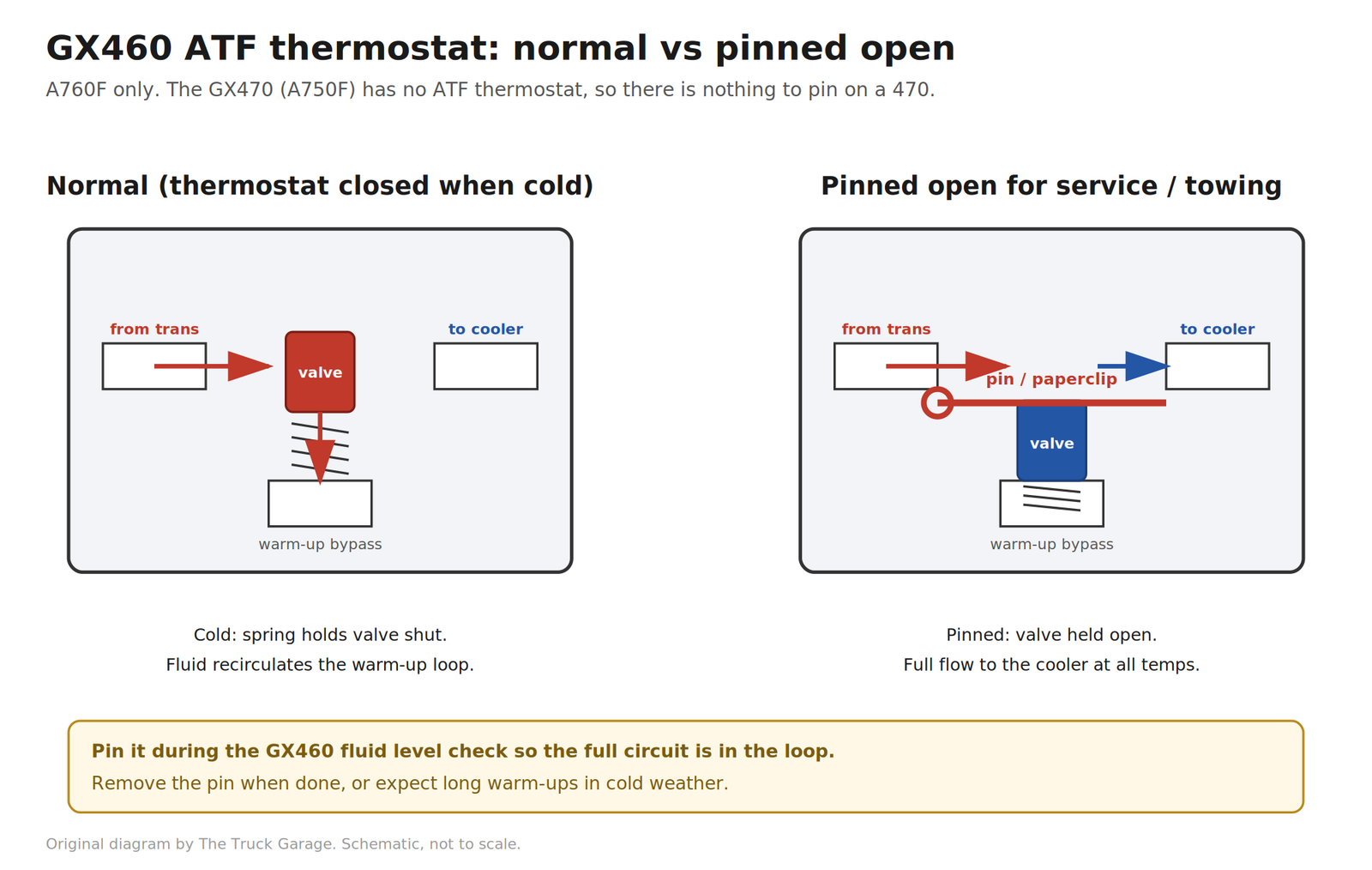
Factory cooling limits, by generation. The GX470 and GX460 both route ATF through a heat exchanger in the radiator end tank (engine coolant warms the fluid on cold starts and cools it once hot) plus a small auxiliary tube-and-fin cooler ahead of the A/C condenser. Expect it to be sized for a stock truck doing stock things. On the GX460, an external air-to-oil cooler only appeared on certain trims (in the U.S., the 2020 to 2023 Luxury with the off-road package), so most GX460s have the same modest setup as the 470. The GX460 also has a thermostat in the ATF circuit that holds fluid in the warm-up loop until roughly 190°F. That helps on cold mornings, but hot fluid recirculates without seeing the aux cooler until it opens, which is why some owners pin it open when adding an auxiliary cooler. The GX550 10-speed uses an integrated fluid warmer/cooler and is a newer, less community-tested design, so monitor your temperatures before modifying anything.

Reading Your Transmission Temperature
Before you buy cooling hardware, you need data. A stock GX has no transmission temperature gauge. The only warning is the A/T OIL TEMP light, which is a “you are already in trouble” indicator, not a management tool.
Tools that work:
- ScanGauge II, OBD-II display with custom X-gauge codes for Toyota ATF temperature.
- UltraGauge, similar OBD-II display with ATF temperature support.
- OBDLink MX+ (eBay), Bluetooth adapter whose app shows both pan temperature and torque converter outlet temperature.
- Torque (Android) / OBD Fusion (iOS): inexpensive apps paired with a Bluetooth ELM327 adapter, configurable for Toyota ATF PIDs (see PID table below).
Toyota ATF PIDs for Torque (A750F/A760F):
| Label | PID | Equation (°F) | Notes |
|---|---|---|---|
| Trans Pan | 2182 | ((((A*256)+B)*(7/100)-400)/10)[6] | Fluid entering the transmission, sump temp. Use for level checks. |
| Torque Converter | 2182 | ((((C*256)+D)*(7/100)-400)/10)[6] | Fluid exiting the transmission, converter outlet temp. Spikes first under load. |
Set both to unit °F, min -40, max 350, OBD header blank. On 2010 and newer with 21D9, use PID 21D9 with E*256+F for pan and G*256+H for converter.[7]
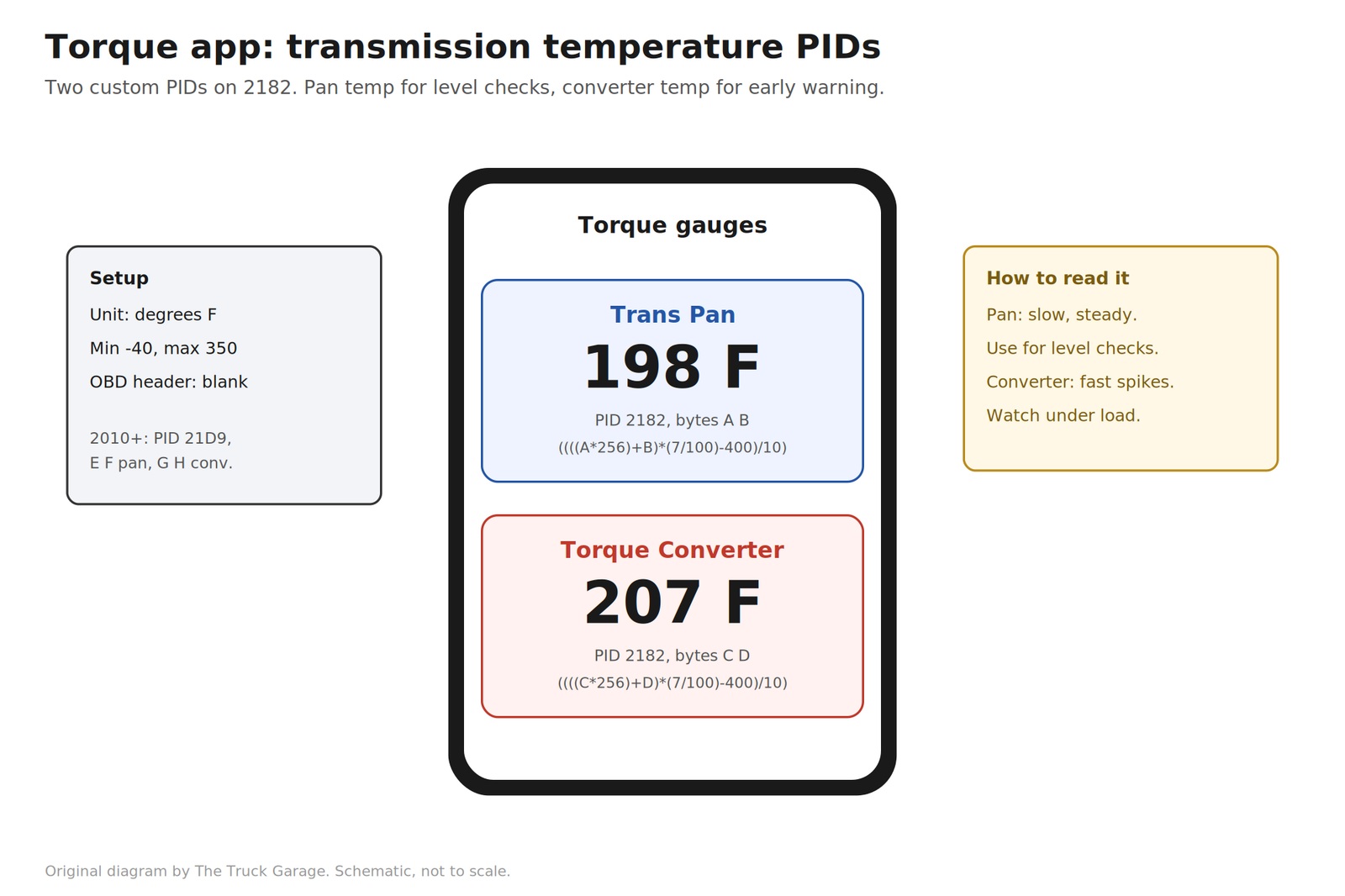
Try to watch two temperatures if your tool offers them: the pan (sump) temperature and the torque converter temperature. Pan temp is the slow, steady number. Converter temp reacts fast: it spikes the moment the converter unlocks, then settles when lockup resumes. Expect converter temp to run 5 to 15°F above pan temp in normal driving; stock trucks commonly show pan temps around 205 to 210°F in summer.
Safe, Concerning, and Dangerous: Temperature Ranges
There is no single factory-published “max safe temperature,” so treat these as community- and industry-informed working bands. Watch the trend more than any single number.
| Band | Pan temp | What it means |
|---|---|---|
| Ideal | 150 to 180°F | Converter locked, cruising, healthy cooling. Fluid life at its best. |
| Normal | 180 to 210°F | Ordinary summer driving, traffic, light grades. Typical stock-GX behavior. No action needed. |
| Watch | 210 to 225°F | Sustained towing, long grades, bigger tires working hard. Time to change driving habits (see below) and check fluid condition. |
| Dangerous | 230°F+ | Fluid degrading rapidly. Back off immediately, slow down, lock out overdrive, let it cool. Repeated excursions here are how transmissions die. |
Two practical rules of thumb: on the highway with the converter locked, expect roughly ambient temperature plus 80 to 90°F. And watch the converter temperature, not just the pan. If converter temp climbs past 230°F while the pan still reads 200°F, the fluid inside the converter is cooking even if the average looks fine.
Auxiliary Cooler Options and Install Overview
Do you need one? If your GX tows regularly, runs 33-inch or larger tires on stock gearing, sees sustained mountain grades, or your logs show pan temps routinely above 205 to 210°F, I recommend an auxiliary cooler as cheap insurance, commonly a sub-$100 part plus a bracket and an afternoon of work.
Which cooler. The community default choices are stacked-plate tube-and-fin coolers in the 11 by 5.75 inch footprint. The Hayden 678 and 698 are the names you will see most, with the 698 adding an internal bypass that routes cold, thick fluid around the core for faster warm-ups. Either is roughly triple the size of the factory aux cooler. Bolt-on brackets for the factory location are sold by GX/4Runner specialty vendors (some GX460 installs require relocating the horns).
How it plumbs in. Keep the factory system intact and add the cooler in series on the return side: ATF exits the radiator heat exchanger, enters the auxiliary cooler, and returns to the transmission. Do not bypass or delete the radiator built-in exchanger, because it warms the fluid on cold starts and the factory thermostat logic expects it to be there.
- Mount the cooler ahead of the A/C condenser, behind the grille, where it gets direct airflow. The OEM cooler location is the natural choice.
- Tap into the return line from the radiator (the line going back to the transmission).
- Route transmission-rated hose from the radiator-side line into the cooler inlet, and from the cooler outlet back to the transmission-side line. Sheath any hose that touches metal edges or brackets, because chafed ATF lines fail at the worst times.
- Secure everything with proper clamps. Confirm nothing rubs the radiator fan, belts, or steering components at full lock.
- Check and correct the fluid level after the install, you drained lines and added cooler volume. Adding fluid without re-setting the level through the overflow-plug procedure (below) is the most common install mistake.
Thermostat considerations. The GX470 has no ATF thermostat, so there is nothing to pin on a 470. On the GX460, the factory ATF thermostat (about 190°F opening) is the reason some owners pin the thermostat open during a cooler install. Otherwise the aux cooler sees little flow in moderate driving. Owners who pin it report no cold-weather issues, but the trade-off is longer winter warm-ups. A cooler with an internal bypass (like the 698) plus a functional thermostat gives reasonable cold-weather behavior without the pin.
Do you need a fan? My recommendation: almost certainly not. The cooler sits behind the grille with good airflow at any meaningful road speed, and the situations that generate the most heat (towing grades, converter unlocked) come with plenty of airflow. Fan-equipped coolers are for applications with poor airflow at low speed, which is not this truck.
Plan on overcooling being a real thing. With a big aux cooler, several owners report summer towing temps near 170°F but slow winter warm-ups. A removable partial cover over the cooler in cold months is the simple fix, just take it off in spring.
ATF Service Notes: Fluid, Intervals, and the Flush Debate
Use the correct fluid. The 2003 GX470 with a dipstick uses Toyota Type T-IV. All sealed units (2004 through 2009 GX470, all GX460) specify Toyota WS. Mixing in Dexron or generic universal ATF is a gamble with clutch engagement characteristics, so do not do it.
The sealed transmission. There is no dipstick on 2004 and newer. Fluid level is set through the overflow plug on the pan with the engine idling and the fluid inside a narrow temperature window:
- GX470 (A750F): level is correct when checked with fluid at 36 to 46°C (97 to 115°F). Remove the overflow plug with the engine idling and let the excess drain to a trickle. If nothing drains, add 0.4 liters (0.42 US qt) and recheck.[1] Finish with new gaskets on the overflow and refill plugs. The factory procedure specifies 15 ft·lbf (20 N·m) for the overflow plug and 29 ft·lbf (39 N·m) for the refill plug (verify against the factory manual for your year).[1]
- GX460 (A760F): same overflow-plug concept, but the window is higher, 46 to 52°C (115 to 126°F) per the current procedure. The factory procedure pins the ATF thermostat open during the check so the full circuit is in the loop. Remove the pin when done.
Keep the truck level, the engine idling, and the fluid in the window. Checking with the engine off, or at 160°F, will set the level wrong. Slightly low or high both cause problems.

Dash shift-indicator temperature check (no scan tool):
- With the engine off, jump terminals TC and CG at the DLC3 OBD port with SST 09843-18040 or a paperclip.[5]
- Start the engine and let it idle with the A/C off.
- Move the shift lever from N to D and back every 1.5 seconds for at least 6 seconds.[5]
- The “D” shift indicator light or A/T OIL TEMP light will stay on for 2 seconds, confirming temperature detection mode.
- Let the engine idle. The light stays off below the window, comes on solid inside the window, and blinks above it.
- When the light comes on solid, remove the overflow plug immediately with the engine still idling and let fluid drain to a trickle.
- Reinstall the overflow plug with a new gasket. Remove the TC/CG jumper.
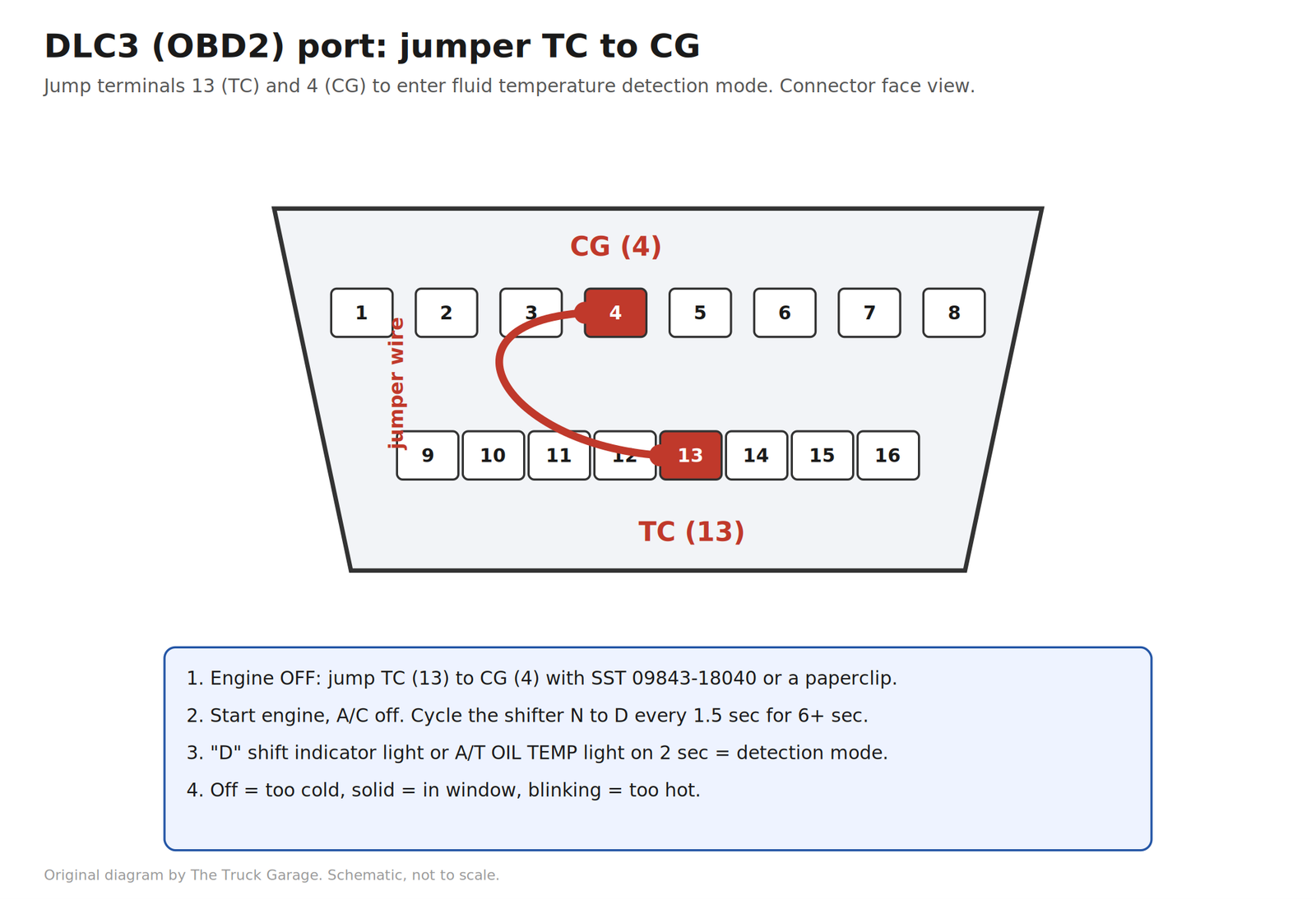
Do not drive with the jumper installed. If the light is blinking, the fluid is too hot. Shut down, let it cool, and repeat.
Service intervals. Toyota calls WS lifetime fluid, but I recommend reading that as the lifetime of the warranty, not of the truck. The service manual recommends 30,000 to 60,000 miles for severe driving (towing, off-road, mountain driving, or big tires on stock gears). Follow that.
My recommendation: drain and refill only. Never power flush. A pan drain pulls roughly 2 to 3 quarts of the total. The rest stays in the torque converter and cooler circuit. If the fluid is dark but the transmission shifts fine, do a second drain and refill after running one full tank of gas (about 300 miles) to circulate the new fluid. That consecutive service is only for extreme cases. It should never be routine.
If the transmission already slips, flares, or shifts harshly, fresh fluid rarely fixes mechanical wear. Get a diagnosis before you touch it. No flush fixes a mechanical failure.
Filter. The A750F and A760F use a metal-screen filter in the pan rather than a disposable paper element. Dropping the pan to clean the screen and magnets every 60,000 to 100,000 miles is worthwhile, and it lets you inspect for abnormal debris.
“If X, Then Y”, Quick Decision Guide
- If your GX is stock height, stock tires, and never tows: check fluid condition and level at 60k intervals. My recommendation: skip the cooler for now.
- If you just upsized to 33s on stock gearing: log temps for a few weeks. If pan temps consistently break 205 to 210°F, add an aux cooler in series.
- If you tow a camper or trailer regularly: install an aux cooler and service fluid every 30k. Hold a gear to keep the converter locked: shift to 4 on the GX470, or use S mode on the GX460 and GX550.
- If temps spike on grades: shift down (4 or lower on the GX470, S4 or lower on the GX460 and GX550) to keep the converter locked, back out of the throttle, and if temps pass 230°F, pull over and idle in Park until they drop.
- If fluid is dark brown with a burnt smell: do a drain and refill promptly and shorten your interval going forward.
- If the transmission slips or shudders: stop modifying and get a professional diagnosis. No cooler or flush fixes mechanical failure.
- If you bought a high-mileage GX with unknown service history: do a drain and refill. If the fluid is still very dark, do one more after a full tank of gas. Never power flush.
Common Mistakes
- Skipping the temperature window on a level check. The most common DIY error on the “sealed” transmissions. Fluid expands with heat, checking at 160°F instead of 115°F sets the level wrong. Use a scan tool or the dash detection mode.
- Overfilling after a cooler install. The new cooler and hoses add volume. Always re-set the level through the overflow plug afterward.
- Using the wrong fluid. WS only. “Universal” ATF that claims to cover everything is the fastest way to change how your transmission shifts, not for the better.
- Power-flushing any unit. Never power flush. At 180k on the original fluid with acceptable shifting, a drain and refill is the safe move. A second drain and refill after one tank of gas is the most you should do.
- Bypassing the radiator heat exchanger. Some owners consider deleting the factory circuit and running the aux cooler alone. The radiator exchanger handles cold-start warm-up and provides a thermal buffer, keep it in the loop and plumb the aux cooler in series.
- Pinning the GX460 thermostat open and forgetting about winter. Fine for hot climates and tow rigs, but cold regions will notice longer warm-ups. Know which way yours is set.
- Ignoring the converter temperature. Watching only the pan number misses the fast spikes that do the real damage. If your tool shows both, watch both.
- Forgetting to remove the thermostat pin after a GX460 service. The level-check procedure pins the ATF thermostat open during the check, leaving the pin in guarantees cold-weather warm-up complaints.
FAQ
Can I check the fluid without a scan tool?
Yes. See the dash shift-indicator procedure above. Jump TC and CG, cycle N to D every 1.5 seconds for 6 seconds, then watch the D light: off is too cold, solid is the window, blinking is too hot.
Drain and refill or full exchange, which is actually better?
My recommendation: drain and refill, always. Never power flush. If the fluid is very dark but shifting is fine, do a second drain and refill after one full tank of gas (about 300 miles). Never change fluid to fix slipping. Diagnose first.
Do I need a regear instead of a cooler?
They solve different problems. A cooler manages heat; a regear reduces the load that creates the heat. On 33s+ with stock gears, my honest recommendation is often “both”, the cooler is the cheap first step, and the regear is the complete fix.
GX550 owners: is any of this different?
The principles are identical, monitor temperatures, respect the 210/230°F working bands, service fluid on a severe-duty schedule. What is different is the hardware: the 10-speed integrated warmer/cooler design is newer and community cooler-install data is thin. Log your temps before modifying anything, and verify every fluid, capacity, or torque figure against the factory manual for your year.
Sources
- Factory manual: 2005 GX470 repair manual, Automatic Transmission Fluid replacement, fluid temperature check and overflow plug procedure ↑
- Factory manual: A750F transmission fluid procedures, DLC3 TC/CG jumper and shift indicator temperature detection mode ↑
- ih8mud, 05 GX470 – Add a Transmission Dipstick?, 2003 dipstick vs 2004+ sealed discussion: https://forum.ih8mud.com/threads/05-gx470-add-a-transmission-dipstick.947478/ ↑
- ih8mud, Where is the transmission fill plug on my 04 LC?, dipstick eliminated in 2004: https://forum.ih8mud.com/threads/where-is-the-transmission-fill-plug-on-my-04-lc.295003/
- 4Runners.com, Need help identifying trans fitment, 2003 unsealed A750 with dipstick vs 2004 sealed: https://www.4runners.com/threads/need-help-identifying-trans-fitment.37947/ ↑
- Lexus Owners Club, Changing Transmission Fluid, 2003 Type T-IV vs 2004+ WS: https://us.lexusownersclub.com/forums/topic/55947-changing-transmission-fluid/ ↑
- Tundras.com, Torque App PID for 22 Tundra Trans Temp, PID 2182 pan and converter equations: https://www.tundras.com/threads/torque-app-pid-for-22-tundra-trans-temp.106060/ ↑
- Tundras.com, Trans temp monitoring, 21D9 and 2182 PID details: https://www.tundras.com/threads/trans-temp-monitoring.126324/ ↑
- 4Runners.com, Transmission Temperatures, ScanGauge codes for pan and converter: https://www.4runners.com/threads/transmission-temperatures.37274/
- YouTube, Toyota/Lexus Sealed (No Dipstick) Automatic Transmission Flush, GX470 A750F fluid exchange: https://www.youtube.com/watch?v=gx5dU3UVcRs
- Standard part number references: parts.lexus.com and toyodiy.com
Leave a Reply