How to judge an AT tire on a daily-driven GX
A tire for a daily-driven GX has to pass six tests before off-road grip even enters the conversation.
- Road noise. You will spend 90 percent of your miles on pavement. A tire that drones at 70 mph gets old fast.
- Wet traction. Most daily-driver accidents happen on wet pavement. Trails get the glory, but rain gets the insurance claims. Siping and compound matter more than lug size here.
- Snow capability. All three tires in this guide carry the three-peak mountain snowflake (3PMSF) symbol, meaning they passed a standardized severe-snow traction test. That symbol is the entry fee, not the final grade. Real winter performance varies.
- Tread life. Treadwear warranties are manufacturer promises, but the spread between them tells you something about how the brands expect their tires to wear.
- Weight. A heavier tire costs you MPG, braking distance, and steering feel every single day. On a 5,000-lb GX, 5 extra pounds per corner is noticeable.
- Load range. E-rated tires are built for 3/4-ton trucks. On a GX they ride harder and weigh more. More on this below.
The three contenders, honestly
BFGoodrich All-Terrain T/A KO2
The benchmark. The KO2 has been the default answer for a decade, and its CoreGard sidewall is genuinely tougher than the competition when you scrape it across rocks. BFG markets it as severe-snow rated with the 3PMSF symbol, and it backs it with a 50,000-mile treadwear warranty.
Strengths. Toughest sidewall of the three, especially aired down on rocks. Looks the part; resale-friendly name if you ever sell the truck with the tires on it. Deep, proven tread design with a huge owner base.
Weaknesses. Owners consistently report that the KO2 falls behind the other two on wet pavement and especially on ice as the tread wears. It is also the heaviest of the three in common GX sizes: in LT265/70R17, the E-rated version weighs about 53.5 lb per tire versus about 45 lb for the C-rated version of the same tire. That weight shows up at the gas pump and in steering feel. It is also usually the most expensive of the three.
Buy it if: you rock crawl, you run sharp desert trails where sidewall punctures are the real risk, or you keep your GX long enough that the tough sidewall pays for itself. Note: BFG is phasing out the KO2 in favor of the KO3, so check KO3 availability in your size first.
BFGoodrich All-Terrain T/A KO3
The KO2’s successor. BFG launched the KO3 to fix the KO2’s two biggest complaints: wet traction and road noise. Early owner reports say it delivers on both, with a new tread compound and redesigned siping that bites better on wet pavement. It keeps the CoreGard sidewall toughness and the 3PMSF snow rating.
Strengths. Same tough sidewall as the KO2. Noticeably quieter on the highway. Better wet traction than the KO2 thanks to the new compound.
Weaknesses. Newer tire means a smaller owner base and less long-term treadwear data. Pricing sits at or above KO2 levels. In LT265/70R17 load range E, the KO3 weighs about 55 to 56 lb per tire, roughly 2 lb heavier than the KO2 in the same size, with an upgraded load index (123/120S vs 121/118S).
Buy it if: you want the toughest sidewall in the group with better wet manners than the KO2. Get the KO3 unless your size is only available in KO2, or you find KO2s heavily discounted and the budget is tight.
Weight comparison: LT265/70R17
| Tire | Load range | Weight (lb) |
|---|---|---|
| Toyo Open Country AT3 | C | 49.5 |
| Toyo Open Country AT3 | E | 48.2 |
| BFG KO2 | C | 44.9 |
| BFG KO2 | E | 53.5 |
| BFG KO3 | E | 55-56 |
| Falken Wildpeak AT4W | E | 53.2 |
Note: weights from retailer spec listings; verify against manufacturer spec sheets. The KO2 in C is the lightest E-or-C option here, but C-rated KO2s are harder to find than E. The Toyo AT3 is the lightest widely available option in this size.
Falken Wildpeak AT3W / AT4W
The value pick that punched above its weight for years. The AT3W built its reputation on strong wet and winter traction for less money than the big names. Falken has now replaced it with the AT4W, which keeps the 3PMSF snow rating and adds a tougher build: full-depth sipes that hold winter traction as the tire wears, 3-ply DURASPEC sidewalls on select sizes, and a 60,000-mile warranty on P-metric sizes (50,000 on LT). The outgoing AT3W carried a 55,000-mile warranty on P-metric sizes only; LT sizes were excluded from the mileage warranty.
In LT265/70R17, the AT4W weighs about 53.2 lb in load range E. Falken does not offer this size in load range C.
Strengths. Best wet traction for the money, according to both owner reports and tire reviewers. Quietest of the three on the highway. Usually the cheapest. The AT4W specifically answers the old AT3W’s two complaints: softer sidewalls and shorter tread life.
Weaknesses. The AT4W is heavier than the AT3W it replaced, which costs a little fuel economy. The AT3W’s 2-ply sidewalls on most sizes were the soft spot for rock-heavy use; the AT4W’s 3-ply DURASPEC sidewalls only come in select sizes. The AT3W is no longer manufactured and getting harder to find. Get the AT4W; if you cannot find it in your size, then grab leftover AT3Ws on clearance, but do not mix AT3W and AT4W on the same axle; Falken does not approve it.
Buy it if: your GX sees mostly pavement with rain or snow in the forecast, or you want the most tire per dollar.
Toyo Open Country AT3
The on-road specialist. Toyo developed the AT3 with the KO2 as its benchmark, and owners describe it as the most street-tire-like of the three: quiet, composed, and stable in fast turns. It carries the 3PMSF snow rating and a 65,000-mile warranty on P/Euro-metric sizes (50,000 on LT).
In LT265/70R17, the AT3 weighs about 49.5 lb in load range C and about 48.2 lb in load range E, making it the lightest of the group in this size.
Strengths. Best on-road manners of the three. Owners report slightly better MPG than the KO2 and good balance out of the box. Strong warranty for the segment.
Weaknesses. The sidewall is the question mark. Owners who run rocky trails report less confidence in the AT3’s sidewall than the KO2’s, and it is the one area where the Toyo consistently loses the comparison. It also tends to get a bit louder than the Falken as it wears.
Buy it if: your GX is 95 percent pavement with occasional forest roads and snow trips, and you care most about quiet highway miles and long tread life.
What the 3PMSF symbol actually means
The three-peak mountain snowflake means the tire passed an acceleration traction test on packed snow. It says nothing about ice braking, slush planing, or how the tire behaves at half tread. All three of these tires earn the symbol. In owner reports, the Falken and the Toyo consistently rate better on ice and wet pavement than the KO2, and every owner in the threads we read agreed on one thing: no all-terrain replaces a dedicated winter tire on real ice. If you ski fifty days a year, budget for a winter set.
Load range E vs C vs SL on a 5,000-lb GX
| Load range | Max PSI | Sidewall | Best for a daily-driven GX |
|---|---|---|---|
| Standard Load (SL) | 35-44 | Softest | Fine for street use on a stock GX |
| Load Range C | 50 | Medium | Sweet spot for daily driving with trail use |
| Load Range E | 80 | Stiffest | Heavy towing or rock crawling where the stiff sidewall earns its keep |
Load range is about sidewall stiffness and max pressure, not about how much your truck weighs. A GX470 or GX460 weighs around 5,000 lb. Standard Load tires handle that fine on the street.
The rule: run the softest load range your actual use allows. C is the sweet spot for a daily-driven GX that sees trails. E makes sense if you tow heavy or crawl rocks regularly, where the stiffer sidewall earns its keep. If you buy E-rated tires for a commute, expect a firmer ride and a few pounds more per corner. And note that the same tire model can come in multiple load ranges with very different weights: the KO2 in LT265/70R17 is about 53.5 lb in E and about 45 lb in C. That is a free 8 lb per corner you can choose not to carry.
The two sizes: 265/70R17 vs 285/70R17
These are the two sizes every GX owner debates. The numbers are nominal diameters: 265/70R17 works out to about 31.6 in and 285/70R17 to about 32.7 in.
265/70R17. The largest size most daily drivers run without metal work. It fits stock GX470 and GX460 17-in wheels (17×7.5, +25mm offset) and usually clears on stock suspension, with at most minor rubbing at full lock on some trucks. This is the no-drama choice.
285/70R17. Looks right on a lifted GX, but the extra inch of diameter costs real work. Owner consensus from the IH8MUD threads is consistent: plan for plastic trimming in the front wheel wells, a body-mount chop in most cases, and aftermarket upper control arms for proper caster once you are at 2.5 in of lift or more. Even with 2 to 3 in of lift, some owners still report slight rubbing at full lock and full compression. The 285 fits the stock underbody spare carrier but it is a tight fit; many owners air down 10 to 15 psi as a precaution to hoist and stow it without interference.
The honest daily-driver advice: if your GX is stock or leveled, buy the 265/70R17 and spend the money you saved on five tires instead of four. If you are already lifting it and trimming it, the 285 is the classic look and the work is mostly one weekend.
A note on the GX550: the GX550 ships with 18, 20, or 22-in wheels from the factory, so the 17-in sizes above do not apply directly. Whether 17-in wheels clear the GX550’s brakes depends on the specific wheel; confirm fitment before buying.
Dial in your PSI with math first, chalk test second
Factory door-jamb pressures were set for the stock tire size. The moment you go to 265/70R17 or 285/70R17, especially in a different load range, start with the load-based calculation below, then fine-tune with the chalk test if you want it perfect.
The math. Take the tire’s max load rating (printed on the sidewall) at its max PSI. Divide your GX’s actual corner weight by that max load to get your load ratio. Multiply by the max PSI. That is your starting pressure.
Example: a tire rated 2,535 lb at 50 PSI max, on a 5,000-lb GX (about 1,250 lb per corner before weight transfer). 1,250 / 2,535 = 0.49. 0.49 x 50 = 24.5 PSI. That is the theoretical minimum to carry the load. Add 10 to 15 percent for safety margin and dynamic loads, which lands most GX owners running 265/70R17 in load range C or E somewhere in the low-to-mid 30s cold. Your truck, your tires, your number.
The chalk test (fine-tuning). If you want to dial it in further:
- Rub chalk or a paint marker across the full width of the tread on all four tires.
- Drive straight about 100 feet on flat pavement. No turning, no hard braking.
- Read the chalk. Worn off in the center only means overinflated. Worn off on the edges only means underinflated. Worn off evenly across the tread means the pressure is right.
- Adjust 2 psi at a time and repeat. Write down the number that wears even, front and rear separately. They often differ by a couple of psi.
For the full method and why upsized tires want different pressures than the door sticker, see the guide What PSI Should You Run in Upsized Tires.
Shadetree note: you do not need a fancy tool for this. Sidewalk chalk works. A two-dollar paint marker from the hardware store lasts longer in the rain.
Rotation discipline: the cheapest tire life extender
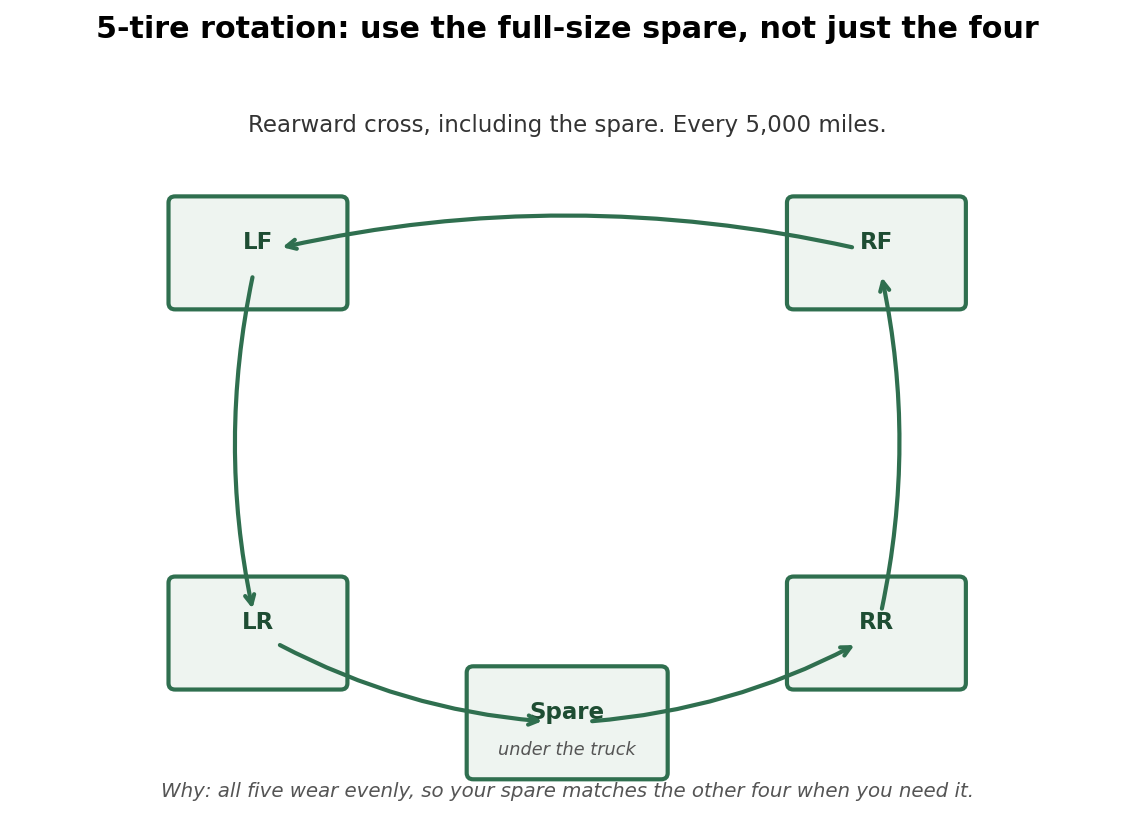
All-terrains wear unevenly if you let them. The lugs cup, the noise climbs, and a 60,000-mile tire becomes a 35,000-mile tire. Rotate every 5,000 miles, at every oil change, and the habit is free.
Do a five-tire rotation that includes the full-size spare. The pattern moves counter-clockwise: spare goes to the right rear, right rear to the right front, right front to the left front, left front to the left rear, and left rear becomes the spare. Easy way to remember it: everything moves counter-clockwise. That way all five wear evenly, and the spare matches the other four when you actually need it. Check the spare’s date code and pressure while it is down there.
Rotation alone is not enough. Four other things kill tires just as fast, ordered from most to least frequent:
| Item | What to check | When |
|---|---|---|
| PSI | Wrong pressure wears the center or the edges. Use the calculation above. The door sticker was for the stock tires. | Monthly |
| Balance | Get all five balanced at every rotation. An unbalanced all-terrain vibrates, cups, and wears the suspension. | Every 5,000 miles |
| Alignment | Check toe and caster, especially after lifting or hitting potholes. Bad toe eats the inside edge fast. | Yearly, or after suspension work |
| Suspension health | Worn bushings, ball joints, and shocks let the tire bounce and wander instead of tracking flat. | Inspect at every rotation |
When you rotate, torque the wheel nuts in a star pattern to spec:
| Generation | Torque spec |
|---|---|
| GX470 (2003-2009) | 83 ft-lb (112 N·m) |
| GX460 (2010-2023) | 76 ft-lb (103 N·m) |
| GX550 (2024+) | 97 ft-lb (131 N·m) |

Parts and tools
| Item | Notes |
|---|---|
| All-terrain tires, 265/70R17 or 285/70R17, set of 5 | You must buy all five. The spare has to match. |
| Torque wrench, 1/2-in drive | For wheel nuts at rotation time |
| Tire pressure gauge, analog or digital | Check PSI monthly; pencil gauges are fine but digital reads faster |
| Chalk or paint marker | Chalk test |
| Tread depth gauge | Measure wear across the tread to catch cupping early (see below) |
| Portable 12V tire inflator | Set exact PSI from the calculation; air back up after trails |
How to use a tread depth gauge
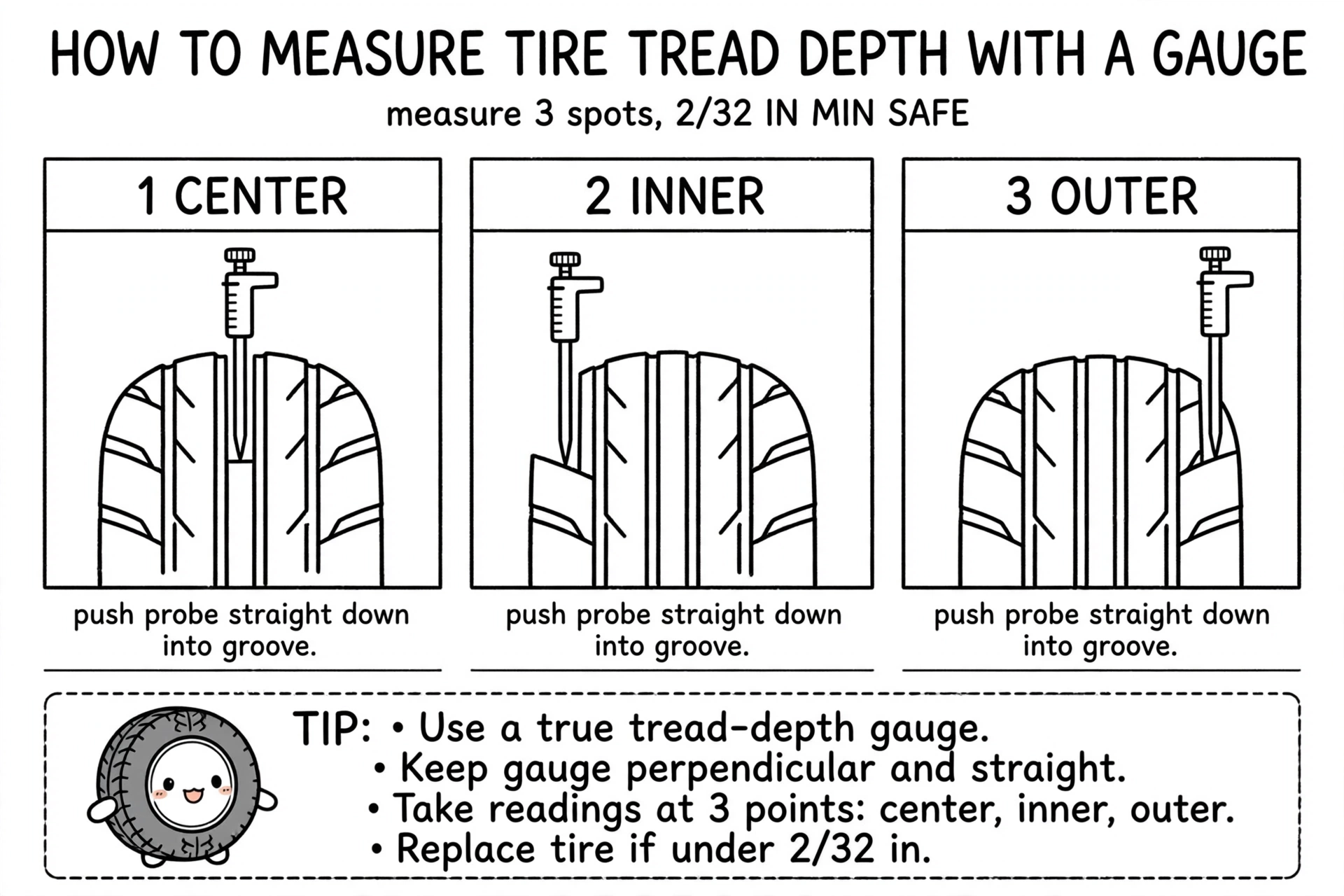
Push the gauge probe into the tread groove until the base sits flat on the tread blocks. Read the depth in 32nds of an inch. Measure three spots across each tire: center, inner edge, outer edge.
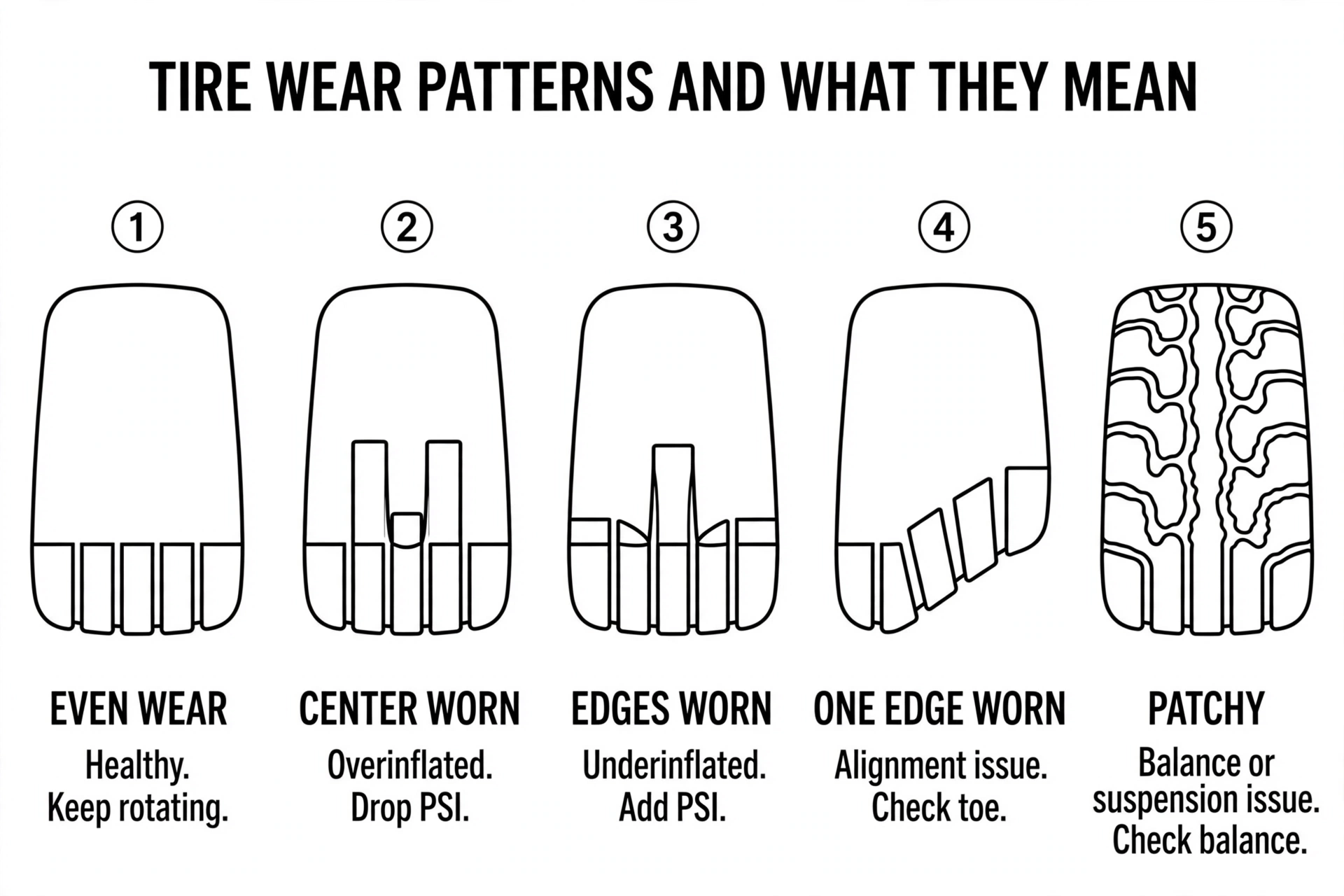
| Reading | What it means |
|---|---|
| Even across all three spots | Healthy wear. Keep rotating. |
| Center lower than edges | Overinflated. Drop PSI. |
| Edges lower than center | Underinflated. Add PSI. |
| One edge lower than the other | Alignment issue. Check toe. |
| Patchy or cupped | Balance or suspension issue. |
Limits: new all-terrains start around 16/32 to 18/32. At 4/32, wet traction drops off sharply. At 2/32, the tire is legally worn out (wear bars sit at 2/32). For a daily driver that sees rain, start shopping at 4/32.
How much tread do you actually need?
| Condition | Minimum tread | Why |
|---|---|---|
| Snow | 6/32 in | Below 6/32, an all-terrain loses most of its snow bite. This is why the 3PMSF symbol is tested on new tires. |
| Wet pavement | 4/32 in | Below 4/32, wet traction and hydroplane resistance fall off sharply. |
| Legal minimum (most states) | 2/32 in | Wear bars sit at 2/32. Below this the tire is legally worn out. |
The shadetree buying guide: take-offs and date codes
New sets of name-brand all-terrains are expensive. Two ways owners cut the bill.
Take-off wheels and tires. GX470, GX460, 4Runner, Tacoma, and FJ Cruiser all share the Toyota 6-lug bolt pattern, so take-off sets from any of them bolt straight onto a GX470 or GX460. Marketplace and forum classifieds are full of nearly new take-offs from owners who upsized immediately. Check that the wheels are hub-centric for Toyota (73.1mm bore; many aftermarket wheels are not) and that the tires are the size you actually want.
Read the date code. Every tire has a DOT date code on the sidewall: four digits, week then year. 3523 means the 35th week of 2023. Do not buy used tires older than about five years no matter how much tread is left; the rubber hardens and wet traction falls off. This applies to the full-size spare under your truck right now, too. If it is original to a 15-year-old GX, it has the structural integrity of a hockey puck.
Which tire for which driver
No fake winner. Match the tire to your driving.
| Driver | Pick | Why |
|---|---|---|
| Highway-heavy daily driver | Toyo Open Country AT3 | Quietest highway manners, strong warranty, best MPG reports. Give up some rock-sidewall toughness you will never use. |
| Snow country daily driver | Falken Wildpeak AT4W | Best wet and winter reports of the three for the money, 3PMSF rated, and the AT4W’s tougher build fixed the old tire’s weak spots. |
| Budget pick | Falken Wildpeak AT4W | Most tire per dollar in the group. The AT3W is discontinued; if you find old stock on clearance, check the date codes. |
| Longevity pick | Toyo AT3 (65,000-mile P-metric warranty) or Falken AT4W (60,000 P-metric, 50,000 LT) | Rotate every 5,000 miles or the warranty math does not matter. |
| Rock crawler / sharp desert trails | BFG KO3 (KO2 if phased out in your size) | The toughest sidewall of the group is worth the weight, the noise, and the price when punctures are the risk. |
Whatever you buy, run the PSI calculation, rotate every 5,000 miles, and check the spare. Those three habits matter more than which of these tires you pick.
FAQ
Can I run 285/70R17 on a stock GX470 or GX460? You can bolt them on, but you will rub. Owner reports are consistent: 285s on stock suspension need plastic trimming at minimum, and most trucks end up wanting a body-mount chop. The 265/70R17 is the largest size that generally fits without metal work.
Are load range E tires bad on a GX? Not bad, just stiffer and heavier than most daily drivers need. If you tow heavy or crawl rocks, E makes sense. For commuting and forest roads, C or SL rides better and saves unsprung weight. Buy the softest load range your actual use justifies.
Do I really need five matching tires? Yes. A mismatched spare is fine to limp home on, but an all-terrain that is a different diameter than the other three will upset the center diff on dry pavement. The owner’s manual and the factory service manual both specify a five-tire rotation. Buy all five up front.
Do I have to do the five-tire rotation? Yes. It is in the owner’s manual and the factory service manual. Five matching tires with no rotation plan means the spare ages out while the other four wear down, and you end up buying tires more often.
How often should I rotate all-terrain tires? Every 5,000 miles, or at every oil change. All-terrains cup and wear unevenly faster than highway tires, and rotation is the difference between hitting the treadwear warranty and replacing them early.
Will these tires hurt my MPG? Yes, some. Heavier, more aggressive tires cost rolling resistance. Owners typically report 1 to 2 MPG less than stock highway tires, more with E-rated 285s. The lighter the tire and the narrower the size, the smaller the hit.
Is the Falken AT4W just a renamed AT3W? No. The AT4W is the replacement generation: tougher construction, 3-ply DURASPEC sidewalls on select sizes, full-depth sipes for longer-lasting winter traction, and a longer warranty. It is also heavier and slightly more expensive. Do not mix AT3W and AT4W on the same axle.
Should I get the BFG KO2 or the KO3? Get the KO3. BFG is phasing out the KO2, so the KO3 is the current tire. It keeps the KO2’s sidewall toughness and improves the two things owners complained about: wet traction and road noise. Only get the KO2 if your size is not available in KO3, or you find KO2s heavily discounted and the budget is tight.
Sources
- IH8MUD, Toyo Open Country AT3 owner experience thread: https://forum.ih8mud.com/threads/toyo-opencountry-at3-experience.1220561/page-7
- IH8MUD, Battle of the LT all-terrain thread: https://forum.ih8mud.com/threads/battle-of-the-lt-a-t.1275998/
- IH8MUD, 285/70/17 rub thread (GX470): https://forum.ih8mud.com/threads/285-70-17-rub.1185789/
- IH8MUD, 285/70R17 on stock suspension (GX470): https://forum.ih8mud.com/threads/285-70r17-tires-on-stock-suspension-gx470.1261254/
- IH8MUD, mild lifts and tire clearance: https://forum.ih8mud.com/threads/most-mild-gx470-lifts-dont-permit-additional-tire-clearance-size-correct.1242291/
- TacomaWorld, KO2 vs Toyo Open Country AT3: https://www.tacomaworld.com/threads/personal-experience-with-toyo-open-country-at3-vs-bfg-ko2.798019/
- Tundras.com, KO2 vs Falken Wildpeak thread: https://www.tundras.com/threads/bfgoodrich-ko2-vs-falken-wildpeak-a-t3w.125759/page-2
- TireGrades, Falken Wildpeak AT3W vs Toyo Open Country AT3: https://tiregrades.com/buying-guides/reviews/falken-wildpeak-a-t3w-vs-toyo-open-country-at3/
- Redline Car Garage, Falken Wildpeak AT4W review (Sep 2026): https://redlinecargarage.com/tires/reviews/falken-wildpeak-a-t4w/
- Falken Australia, Wildpeak AT4W product page: https://www.falken.com.au/product/wildpeak-at4w/
- 4WDTalk, Falken Wildpeak AT3W vs AT4W comparison: https://www.4wdtalk.com/falken-wildpeak-at3w-vs-at4w-which-tire-should-you-buy/
- SimpleTire, Toyo Open Country AT3 FAQ: https://simpletire.com/brands/toyo-tires/open-country-a-t-iii/p/198532
- America’s Tire, BFGoodrich All-Terrain T/A KO2 product page: https://www.americastire.com/buy-tires/bfgoodrich-all-terrain-t-a-ko2
- 2006 GX470 owner’s manual (wheel nut torque): https://lexusgxor.com/_media/general:2006_gx470_owner_s_manual.pdf
- 2021 GX460 owner’s manual (wheel nut torque): https://carmanuals2.com/lexus/gx460-2021-owner-s-manual-115879/page-540/
Leave a Reply