Your heater tees are small plastic T-shaped connectors in the heater hoses behind the intake manifold. They split coolant flow to the front and rear heaters. They are made of plastic, they bake in the engine bay for a decade or more, and when one lets go it dumps coolant fast. This is a known stranding risk on the Land Cruiser 100 and LX470. It is a 90k-mile service item in the owner community, and it deserves the same respect on the 1st-gen Sequoia.
A note on provenance: we usually start with the GX470 and work outward to the newer trucks and Toyota cousins. This guide arrived in reverse. The Land Cruiser crowd requested it so many times we wrote the 100-series version first, but the GX470 does not even use these tees. The Cruiser people were right to yell.
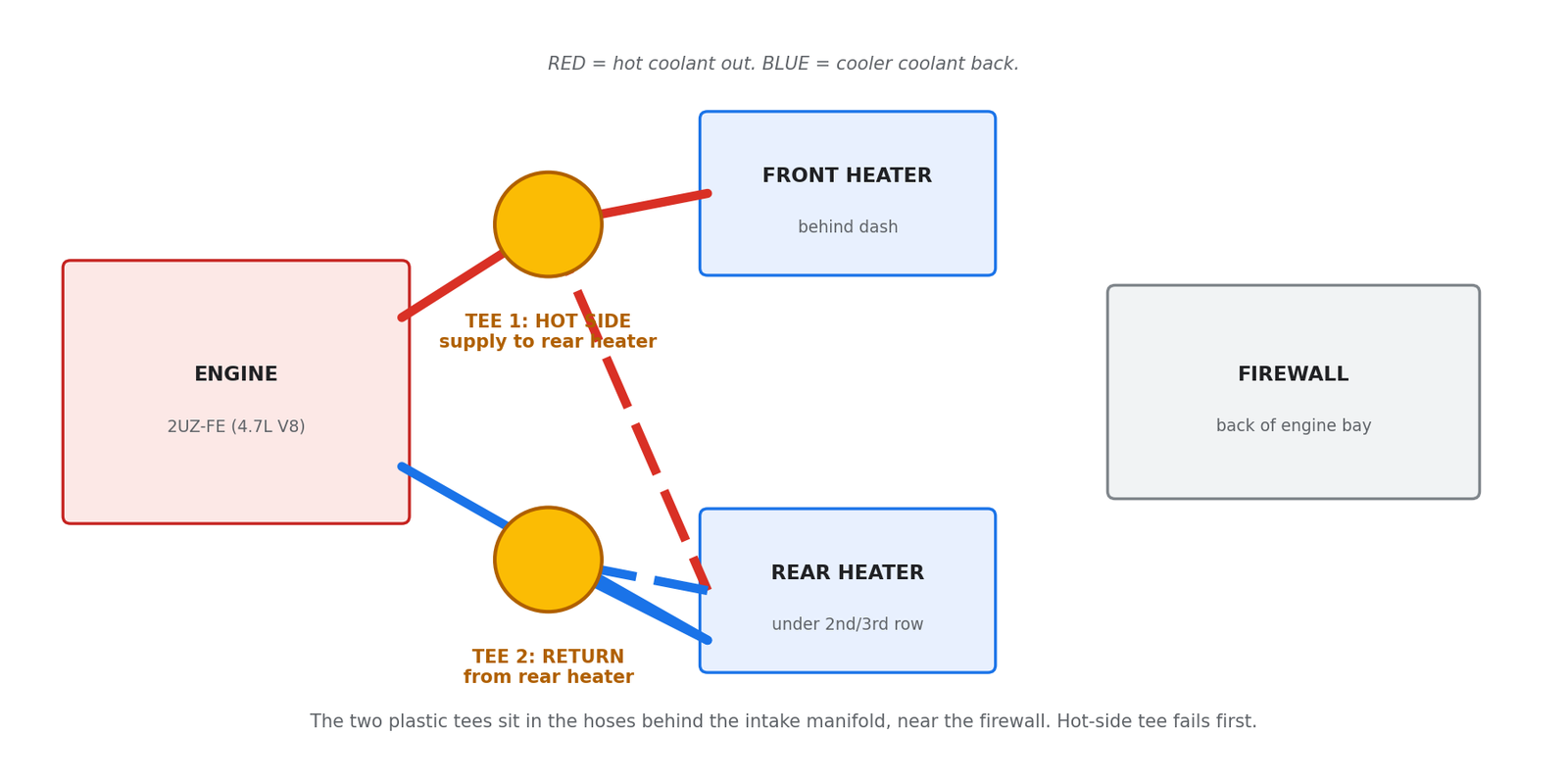
Why these tees matter
One side of each tee carries much hotter coolant than the other. The hot-side tee takes the brunt of the heat cycling. Owners report the hot-side tee turning brittle and crumbling at mileages as low as 115k, while some trucks are fine past 180k. There is no consistent pattern by year or mileage. A 1999 LX470 at 125k had a hot-side tee fall apart the moment a clamp was touched; the only warning was a faint crust of dried coolant at the hose joint, visible only with a flashlight.
When a tee fails on the road, it does not seep. It cracks or disintegrates, coolant dumps out, the engine overheats, and the truck is done until it is repaired. One owner got a face full of hot coolant when a tee burst during a driveway inspection. Finding out in your driveway is the best case.
Which trucks this applies to
Confirmed by owner reports and part catalog data:
- Toyota Land Cruiser 100 / Lexus LX470 (1998-2007). Two tees per truck. This is the primary vehicle where failure is documented.
- Toyota Sequoia, 1st gen (2001-2007). Rear HVAC plumbing uses the same part.
- Toyota Land Cruiser 80 / Lexus LX450 (1990-1997). Same part, but one tee on rear-heat models, not two.
- Toyota Mega Cruiser and select 70-series with rear heat. Same part.
And yes, the 2004-2009 Sienna minivan uses this part too. This is a truck site, but if the Sienna owners yell as loud as the Cruiser crowd did, we will cover it. (The procedure is identical. You are welcome.)
Explicitly NOT applicable, despite sharing the 2UZ-FE V8:
- Lexus GX470 (2003-2009). Rear heater plumbing runs under the body, not through these tees.
- Toyota 4Runner V8, 4th gen (2003-2009). Does not use these tees.
- Toyota Tundra, 1st gen (2000-2006). Does not use these tees.
- Lexus GX460, 5th-gen 4Runner, FJ Cruiser. Different engines and plumbing.
The OEM part is Toyota 87248-60460 (described as “PIPE, WATER” in dealer catalogs). If your truck is on the confirmed list, order two, except the 80-series which takes one.
Symptoms of failing tees
- Dried pink or red crust at the hose joints around the tees. Look with a flashlight behind the intake manifold.
- Slow, unexplained coolant loss with no puddle under the truck.
- Smell of burning coolant after a drive.
- In the worst case: sudden steam, temperature gauge climbing, and a burst tee.
Most failing tees look fine from the outside. Do not trust a visual pass. If they are original and the truck is past 90-100k, replace them.

Parts and tools
You need two tees for the 100-series, LX470, or Sequoia, one for the 80-series. The factory part is Toyota 87248-60460.
| Part | What to get | Source |
|---|---|---|
| Heater hose tees, 87248-60460 | Genuine Toyota OEM, set of 2 | eBay, Manhattan Beach Toyota |
| Worm-drive hose clamps | 304 stainless assortment covering 5/8 in and 1/2 in (TICONN 40 pc) | Amazon |
| Toyota Super Long Life coolant | Pink 50/50 premix, 1 gallon (00272-SLLC2) | Amazon |
| Hose clamp pliers | Short-handle spring clamp pliers (Knipex 85 51 180 A) | Amazon |
| Spill-free funnel | Lisle 24680 | Amazon |
Parts cost is small, roughly $25 to $30 for the pair of OEM tees.
Replacement options, with tradeoffs:
- OEM plastic tees. Cheap. The originals lasted 90k-plus in most trucks. Replace again in another 90k. Simplest choice. Singles are also available from Desert Toyota Parts and Bell Lexus North Scottsdale on eBay if you only need one.
- Brass tees. A permanent upgrade. Brass is compatible with Toyota coolants according to one thread report citing coolant certification testing. Sold individually by Cruiser Patch and others.
- Stainless or aluminum tees. Also permanent. Note the catch: owners report the stock spring clamps do not seal well on metal tees. If you go metal, switch to worm-drive clamps on the tees.
Tools: a step stool, a moving blanket or fender cover, short-handle pliers or curved-head channel locks for the spring clamps, a flathead screwdriver to help pry hoses, and soapy water in a spray bottle. Have a jug of Toyota Super Long Life pink coolant premix on hand for top-off. A drain pan and towels catch the small spill. See the Truck Garage GX fluids guide for the coolant spec and the rule against mixing coolant chemistries: https://thetruckgarage.com/gx-fluids-guide/.
If your heater hoses are original and swollen or mushy, consider replacing them at the same time. One owner posted the OEM hose list for a 2006 LX470: 87245-6A220, 87245-6A190, 87245-6A210, 87245-6A180, 99556-20200, 87245-6A201. Verify these per your VIN before ordering.
The replacement procedure
Work on a cold engine. The whole job takes about an hour.
- Park with the nose slightly downhill. This keeps coolant from running out of the heater side when you open the first hose.
- Remove the engine cover for access. Drape a blanket over the fender. There is a ground wire clipped to the heater hose back there; unclip the plastic snap clamp and move the wire aside.
- Find the tees behind the intake manifold, near the firewall. The hot-side tee is the one to worry about most, but replace both (or the single tee on an 80-series).
- Slide the spring clamps back off the tees with your pliers. Spray soapy water on the clamps to help them rotate. Short-handle pliers or curved channel locks make this much easier in the tight space.
- Work the hoses off the tees gently. If a tee is brittle, this is the moment it breaks. That is expected. Do not yank. If pieces fall into the hose, pull the hose off and fish them out.
- Push the new tees into the hoses with a dab of soapy water. Slide the clamps back onto the tees, into the indentations the old clamps left on the hoses. If you installed metal tees, use new worm-drive clamps and snug them by feel.
- Reclip the ground wire. Put the engine cover back on.
- Coolant loss is small, reported at under a cup. Still, burp the system: turn the truck nose-uphill, open the radiator cap, start the engine, turn the heater to high, and let coolant circulate. Top off with the pink premix as the level settles.
- Check for leaks at all hose joints after a full heat cycle. Recheck the reservoir the next morning.
Shadetree note: the stock spring clamps go back into their old indentations on the hose, which helps them seat. If you turn the clamps to face outward while you are in there, the next replacement goes easier.
When to do this
Fold it into the 90k timing belt service. You already have the front of the engine apart, you are already thinking about cooling system age, and the parts cost is trivial. Owners who have done it call it cheap insurance against being stranded far from home. There is no factory replacement interval; this is community judgment, and it is good judgment.
Do not drive the truck if a tee is actively leaking. A cracked tee can go from seep to burst in one heat cycle.
Plastic vs metal: which to choose
OEM plastic is the safe, cheap, known quantity. It worked for a decade or more; it will work for another. Metal tees are the fix-forever option, and they are cheap too, but remember the clamp rule: metal tees need worm clamps, and snug them by feel since there is no factory spec. Do not reuse the spring clamps on a metal tee and expect them to seal.
One more consideration from owners: some of the newest OEM plastic tees appear to be a thinner revision than the originals. That is one data point, not a verdict, but it is another reason metal appeals to people who never want to think about this again.
FAQ
How often should heater tees be replaced?
There is no factory interval. The owner community treats them as a 90k-mile service item, paired with the timing belt. Some tees are brittle at 115k, some are fine past 180k. Replace on age and mileage, not on looks.
Does my GX470 have these tees?
No. The GX470 does not use part 87248-60460. Its rear heater plumbing runs under the body rather than branching behind the intake manifold. Same answer for the 4th-gen 4Runner V8 and 1st-gen Tundra: same engine, different plumbing, no tees.
Do I need to drain the coolant first?
No. Parked nose-downhill, the job loses under a cup of coolant according to owner reports. Have premix on hand for top-off and burp the system after.
Can I just replace the hot-side tee?
Do both. The return-side tee is the same age, the same plastic, and the same heat environment. You are already back there. (On an 80-series there is only one tee.)
What are the symptoms of a failing tee?
Dried coolant crust at the hose joints, slow unexplained coolant loss, a burning coolant smell after driving, and at the end, steam and overheating. Most bad tees show nothing until touched.
Are metal tees better than OEM plastic?
They are a permanent fix, and owners like them. The tradeoff is fitment: stock spring clamps reportedly leak on metal tees, so use worm clamps. OEM plastic is proven for 90k-plus and costs very little.
Will this fix my “no heat” problem?
Maybe. Air in the heater hoses causes no-heat symptoms, and the tee area is the highest point in the system on some trucks. But no heat has other causes: low coolant, a stuck thermostat, or a clogged heater core. Do not assume the tees are the cause; inspect first.
Sources
- IH8MUD: DIY: Replacing heater hose pipe T’s *important* — https://forum.ih8mud.com/threads/diy-replacing-heater-hose-pipe-ts-important.610334/
- IH8MUD: Heater Hose T’s – Do NOT Wait!!! — https://forum.ih8mud.com/threads/heater-hose-ts-do-not-wait.835912/
- IH8MUD: Change Those Heater Tees! — https://forum.ih8mud.com/threads/change-those-heater-tees.1049255/
- IH8MUD: Reminder to replace your Heater Ts! — https://forum.ih8mud.com/threads/reminder-to-replace-your-heater-ts.1306428/
- IH8MUD: Need Part Number for Heater Hose T’s — https://forum.ih8mud.com/threads/need-part-number-for-heater-hose-ts.1144327/
- IH8MUD: New 100 Series heat not working — https://forum.ih8mud.com/threads/new-100-series-heat-not-working.1330213/
- Cruiser Patch: heater tee search results — https://www.cruiserpatch.com/search?q=heater+hose+tee+kits
- The Truck Garage GX fluids guide: coolant spec and chemistry rules — https://thetruckgarage.com/gx-fluids-guide/
Leave a Reply