
A practical buying guide for the Lexus GX: GX470 (2003 through 2009) and GX460 (2010 through 2023). Which one to buy, the best years of each, how many miles is too many, the full inspection checklist, and what to pay.
Who This Guide Is For
This guide is for anyone shopping for a used Lexus GX. If you are choosing between the GX470 and the GX460, wondering which years are best, trying to figure out whether 200,000 miles is too many, or asking what a fair price is, this is the guide. It answers the questions that come up every week in buyer threads: what to check, how to verify the history, and when to walk away.
GX470 vs GX460: The Quick Comparison
| GX470 (2003 through 2009) | GX460 (2010 through 2023) | |
|---|---|---|
| Engine | 4.7L V8 (2UZ-FE) | 4.6L V8 (1UR-FE)[1] |
| Power | 235 hp 2003 through 2004, 270 hp 2005, 263 hp 2006 through 2009 (revised SAE rating, same engine)[2][3] | 301 hp[1] |
| Torque | 320 to 323 lb-ft[2] | 329 lb-ft[1] |
| Transmission | 5 speed automatic | 6 speed automatic[1] |
| Timing | Belt, change every 90,000 miles or 10 years | Chain, no scheduled replacement |
| Rear suspension | Air springs, all trucks | Air springs on select trims, coils on base |
| Fuel economy, real world | 12 to 14 city, high teens highway | 13 to 15 city, high teens to 20 highway |
| Towing | 6,500 lbs | 6,500 lbs[1] |
| Seating | 7 or 8, power third row optional early | 7 standard, power third row |
| Typical price, Sep 2026 | $8,000 to $25,000 | $13,000 to $60,000 plus |
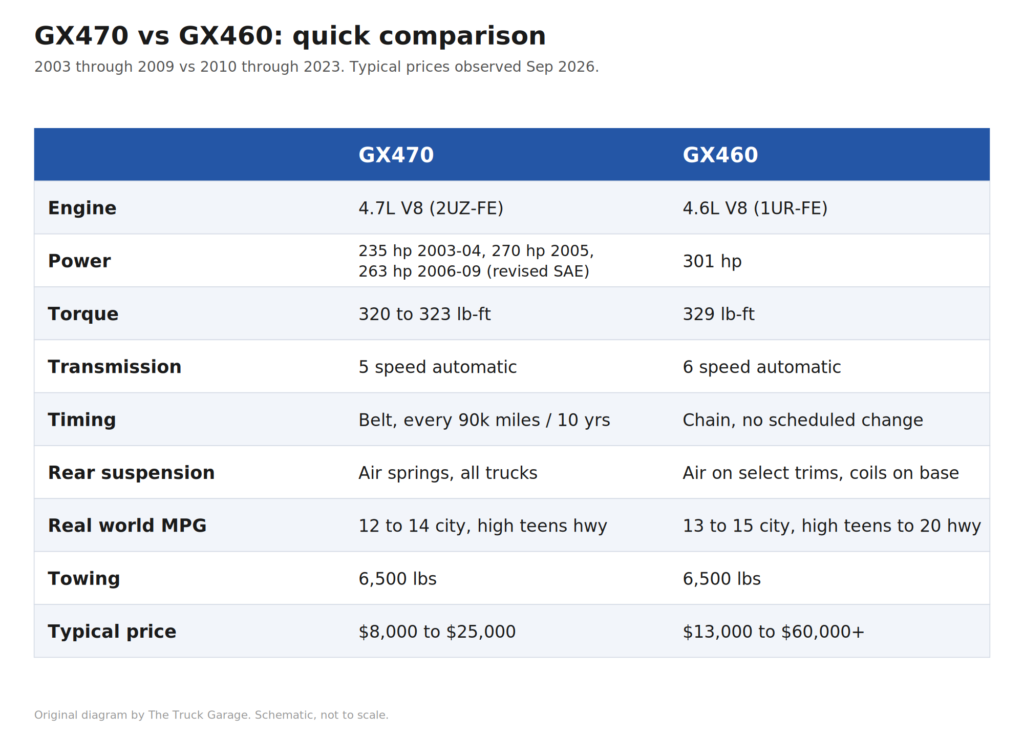
The short version. The GX470 is the simpler, cheaper truck. It has a timing belt you must maintain, an older interior, and worse tech. It also has the legendary 2UZ-FE, the simplest electronics of any GX, and the lowest buy in of any generation. The GX460 is the newer, nicer truck. It has more power, a 6 speed transmission, a timing chain, and modern safety tech on later years. It costs more to buy, its common problems (coolant valley plate, water pump, secondary air system on early years) cost more to fix, and premium fuel is recommended on both.
Which one should you buy? Buy the GX470 if your budget is under $20,000, you want the simplest truck to maintain yourself, and you do not care about modern infotainment or driver assists. Buy the GX460 if you want more power and refinement, a timing chain instead of a belt, and you are shopping at $20,000 and up. I recommend weighing condition and service history over the badge every time. A clean 200,000 mile GX470 with full dealer records is a better buy than a neglected 120,000 mile GX460.
Best GX470 Years
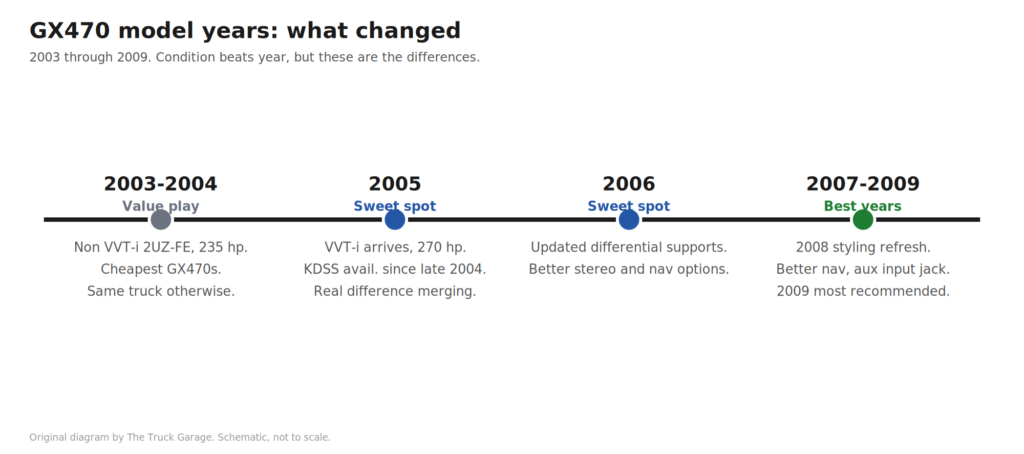
2003 to 2004: the value play. Non VVT-i 2UZ-FE at 235 hp. Same truck otherwise. These are the cheapest GX470s and the engine is just as durable. Owners note the discontinued TRD supercharger for the non VVT-i 2UZ-FE has been documented on 2003 and 2004 GX470s, a perk if forced induction is your thing.[4][5] Not a reason to pick them, but a perk if you want one.
2005 to 2006: the sweet spot for most buyers. VVT-i arrives in 2005 with 270 hp (2006 through 2009 rate 263 hp under revised SAE testing, same engine), a real difference you feel merging onto the highway. KDSS (Kinetic Dynamic Suspension System) first became available as a late 2004 model year option, the optional adjustable sway bar system that helps both on road handling and off road articulation. The 2006 got updated differential supports. Stereo and nav options improve from 2006 on.
2007 to 2009: the best years to buy. This is the owner consensus across the forums. The 2008 styling refresh brought the dark metallic grille, clear rear lenses, and updated wheels. The 2007 and newer nav system is a generation better and adds an auxiliary input jack. The last years of any generation tend to have the most kinks worked out, and in our experience, 2009 is the single year owners recommend most. Expect to pay a premium for 2008 and 2009 trucks in good shape.
The honest caveat. One GX470 buyer thread puts it well: there are so many condition and maintenance issues with these that you cannot be too picky about the year. A neglected 2009 costs more than a maintained 2005. Year is a tiebreaker, not a decision maker.
Best GX460 Years and Model Changes
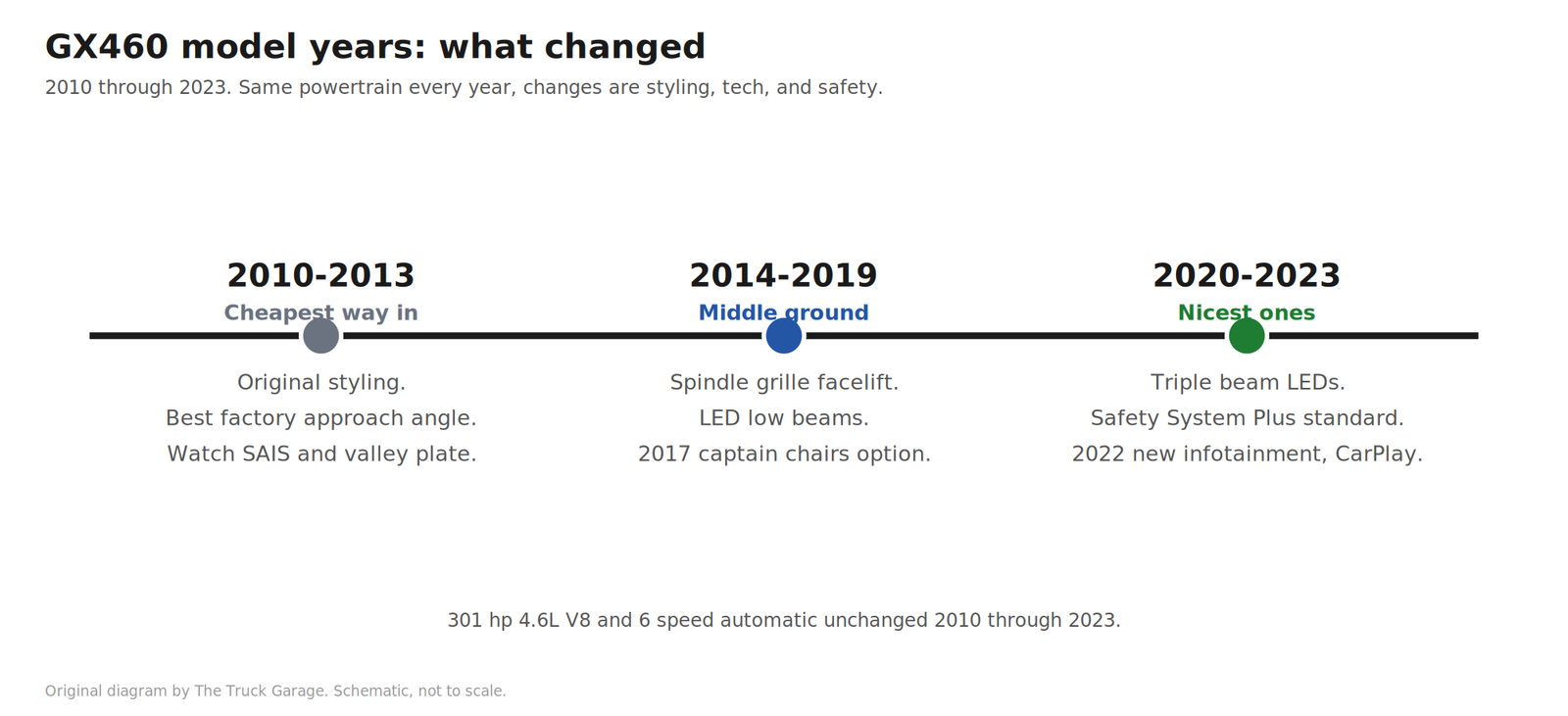
The important fact first: the powertrain never changed from 2010 through 2023. Same 301 hp 4.6L V8, same 6 speed automatic, same full time 4WD with low range and center diff lock.[1] Every change worth knowing about was cosmetic, tech, or safety equipment. Owner consensus is that GX460 reliability is about the same across all years, so buy on mileage, condition, and service history.
2010 to 2013: the cheapest way in. Original styling, best factory approach angle of any GX460 (the later bumpers stick out more), and the standard power folding third row. Watch for the secondary air injection system issues that affect the 2010 through 2013 trucks (see the Truck Garage SAIS guide) and the coolant valley plate leak that shows up on early 460s. These are the lowest priced GX460s and the best value if you plan to modify the truck.
2014 to 2019: the middle ground. The 2014 facelift brought the spindle grille, LED low beam headlights, and updated styling. The 2017 added second row captain chairs with the luxury package. In our experience, these years hit the sweet spot for many buyers: modern enough looks, old enough prices.
2020 to 2023: the nicest ones. The 2020 second facelift brought triple beam LED headlights, a new grille, standard Lexus Safety System Plus (pre collision, lane departure, adaptive cruise), and an Off Road package on Luxury trims with crawl control, multi terrain select, a transmission cooler, and the panoramic view monitor.[6] The 2022 added a redesigned dashboard with a new infotainment system and Apple CarPlay with Android Auto, the first GX with real smartphone integration. The 2022 Black Line Edition is a cosmetic package. If you want the driver assists and the modern stereo, 2020 and newer is the answer. If you prefer the pre facelift look, several owners say the 2014 through 2019 styling aged better.
Which GX460 year should you buy? 2020 to 2022 for the safety tech and the Off Road package. 2014 to 2019 for the best balance of looks and price. 2010 to 2013 for the lowest buy in and the best approach angle for a build. Any year with complete service history beats a newer year without one.
How Many Miles Is Too Many
There is no mileage limit on a maintained GX. This is the closest thing to a universal rule in GX buyer threads. Owners report GX470s running past 300,000 to 400,000 miles on the original drivetrain with oil changes and timing belt replacements. One owner bought a GX470 at 289,000 miles, did the suspension, water pump, and axles, and reported zero issues with a goal of 500,000. A carsurvey owner reports 320,000 miles on a 2007 with the interior looking new. The GX460 has fewer extreme mileage examples only because it is newer, and owner reports at 150,000 to 200,000 miles with routine maintenance are routine.
The real answer is condition over mileage. The forums repeat this constantly, and it is right. A 200,000 mile truck with full dealer service history, no rust, and a fresh timing belt is a better buy than a 120,000 mile truck with no records and deferred maintenance. At high mileage, budget for wear items no matter how good the truck is: bushings, mounts, shocks, and cooling system parts all age.
The 300,000 mile question. Will a GX last 300,000 miles? Yes, with maintenance. The 2UZ-FE in the GX470 is one of the most proven engines Toyota ever built, shared with the Land Cruiser 100, Tundra, and Sequoia. The 1UR-FE in the GX460 is newer but the same formula: simple V8, conservative tuning, no turbos. The things that kill GXs are neglect (skipped timing belts, never changed fluids), rust, and deferred cooling system maintenance. Not miles.
Used GX Inspection: What to Check Before Buying
Work through this list before you pay for a professional inspection. It takes an hour and saves you from inspecting trucks you should have rejected in the driveway.
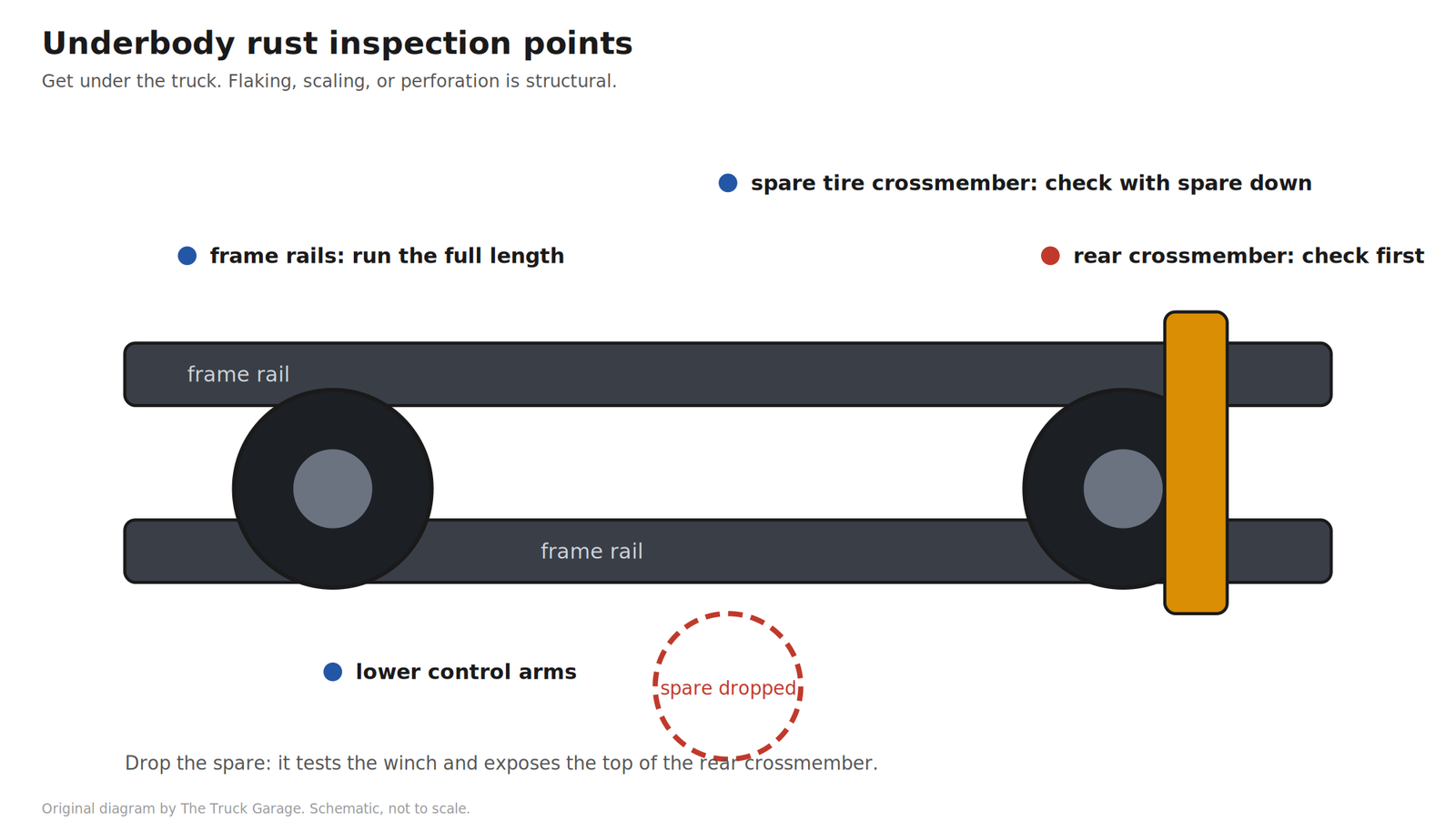
Frame and underbody rust. Get under the truck. Check the frame rails, the rear crossmember, the lower control arms, and the spare tire crossmember. Surface rust on a southern truck is cosmetic. Flaking, scaling, or perforation is structural. Drop the spare tire: it tells you whether the winch works and lets you see the top of the rear crossmember. Never buy a rust belt truck sight unseen. Owners in northern buyer threads name the rear crossmember and lower control arms as the first places to look.
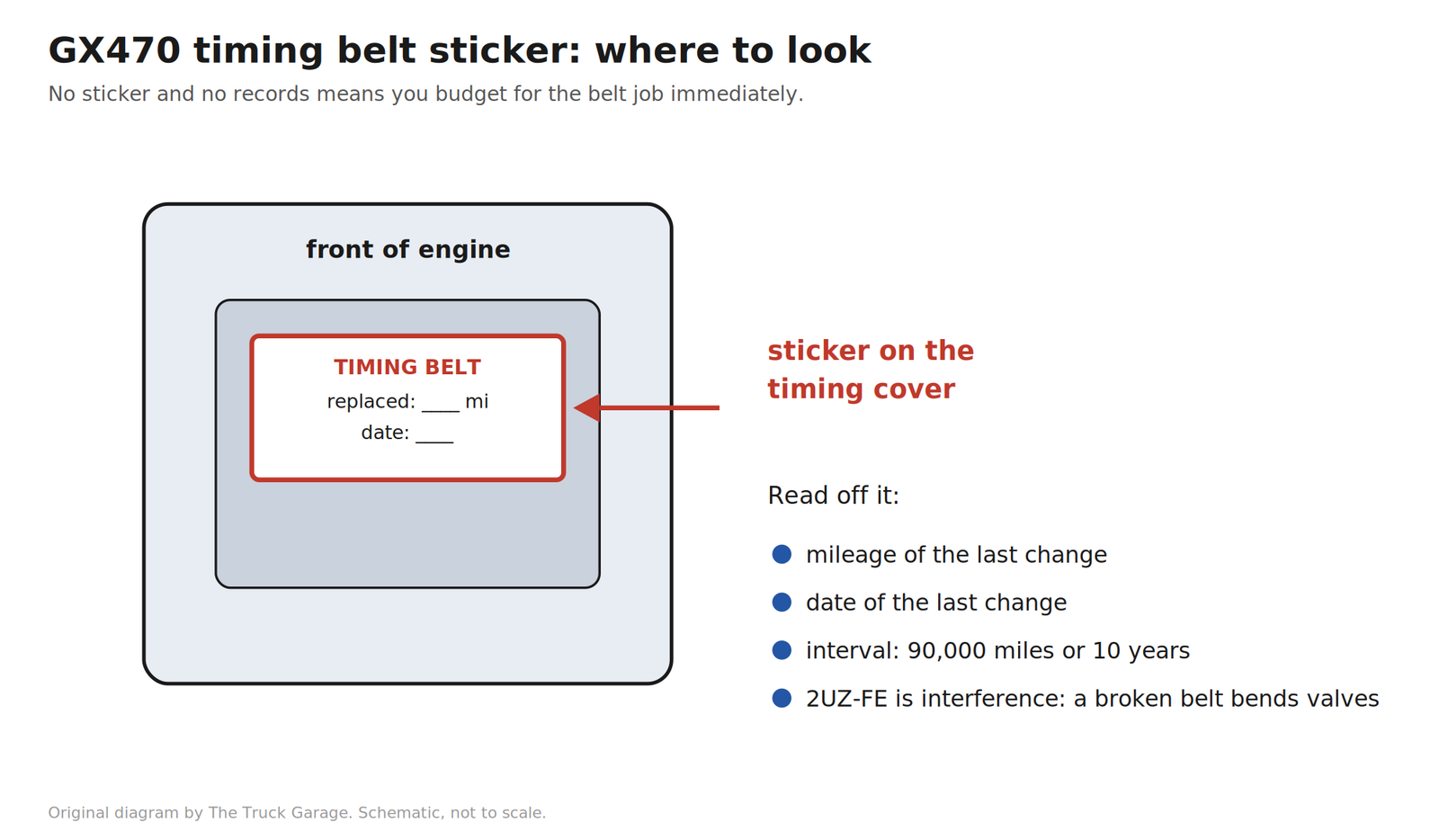
Timing belt, GX470 only. Look for the timing belt sticker on the front of the engine with the date and mileage of the last change. The interval is 90,000 miles or 10 years. The 2UZ-FE is an interference engine: a broken belt bends valves. No sticker and no records means you budget for a belt, water pump, and tensioners immediately, or you walk away. The GX460 has a timing chain with no scheduled replacement.
Coolant leaks. On the GX470, check the radiator top seam for seepage and look for any pink crust around hoses. The radiator is a known wear item and a failing one risks the transmission cooler inside it. On the GX460, look down into the engine valley for coolant: the valley plate leak is the canonical GX460 problem, most common on early years. Check the water pump weep hole too. A $2,000 valley plate job is a bargaining chip, not a dealbreaker, but you need to know it is there.
Rear air suspension. Walk around back and look at the ride height. A truck sitting low on one side or both has leaking air springs. Start it cold and listen: the compressor should run briefly and stop. If it runs constantly or the truck sags overnight, the bags are done. On the GX470 all trucks have air springs. On the GX460, check whether the truck has the height control switch on the dash. Budget a coil conversion or new air springs into your offer if the system is tired. The full diagnosis is in the Truck Garage air suspension guide.
Service history. Ask the seller for records. Then verify them yourself with the VIN on the Lexus drivers site (below). Expect a one owner truck with every service at the dealer to command a real premium. A truck with no records is a truck with unknown everything.
Dash and electronics. Start it cold. All warning lights should come on, then go out. A Christmas tree dash (check engine plus VSC TRAC plus VSC OFF) is the classic GX470 secondary air system failure, a $250 bypass kit or a multi thousand dollar dealer repair. Check the dashboard for cracks, a known GX470 issue. Cycle the sunroof and check the carpets for dampness: clogged sunroof drains let water under the carpet. Test the nav, Bluetooth, and backup camera, and know that the pre 2007 nav units are weak and hard to upgrade.
4WD system. Engage 4HI, then 4LO, then the center diff lock. All should engage and disengage without drama. A blinking 4LO light or a stuck center diff points at actuator issues. Grease in the driveshaft slip yoke every oil change is the factory schedule, so ask when it was last done.
Test drive. Drive it cold first, since the secondary air pump only runs on cold start and a failing one sounds like a 777 taking off. Listen for the exhaust manifold tick on cold startup (cracked manifolds are a known GX470 issue, roughly $1,400 per side at the dealer). Brake downhill and feel for steering wheel shake. Drive at 55 to 65 mph and note any vibration. Shift through all gears including reverse. Check that the transmission does not shudder or flare between gears.
The pre purchase inspection. After your own inspection, pay for a professional PPI at an independent Toyota/Lexus specialist or a dealer. Bring them your specific concerns: frame rust, the timing belt sticker, coolant leaks, the air suspension. A generic inspection catches generic problems. A directed one catches GX problems.
What to Bring to the Inspection
This is not a parts list, it is an inspection kit.
- A flashlight and an OBD-II scan tool or OBDLink MX+ (eBay) with a Toyota capable app. Pull codes before you fall in love.
- A jack handle or tire iron to drop the spare tire and look at the rear crossmember.
- Your phone, with the VIN photo and the Lexus drivers site loaded.
- A printed copy of this checklist. Memory fails in driveways.
How to Check the Service History With the VIN
The Lexus drivers site keeps every dealer reported service record tied to the VIN, and it is free. Create an account, add the VIN to your garage, and open the service history. You will see every dealer oil change, recall, warranty repair, and major service with dates and mileage. This is the single highest value pre purchase check on a used Lexus, and owners cite it in nearly every buyer thread.
Two quirks to know. First, a VIN can only be attached to one account at a time. If the seller has it in their garage, it disappears from yours, and vice versa. Second, only dealer reported work shows up. Independent shop work and DIY maintenance do not. That is why you still ask the seller for their own records.
A Carfax or AutoCheck report is the backup. It catches accidents, title issues, and registration history the dealer records miss, but it misses service done at shops that do not report. Use both, not one.
Pricing by Age and Mileage
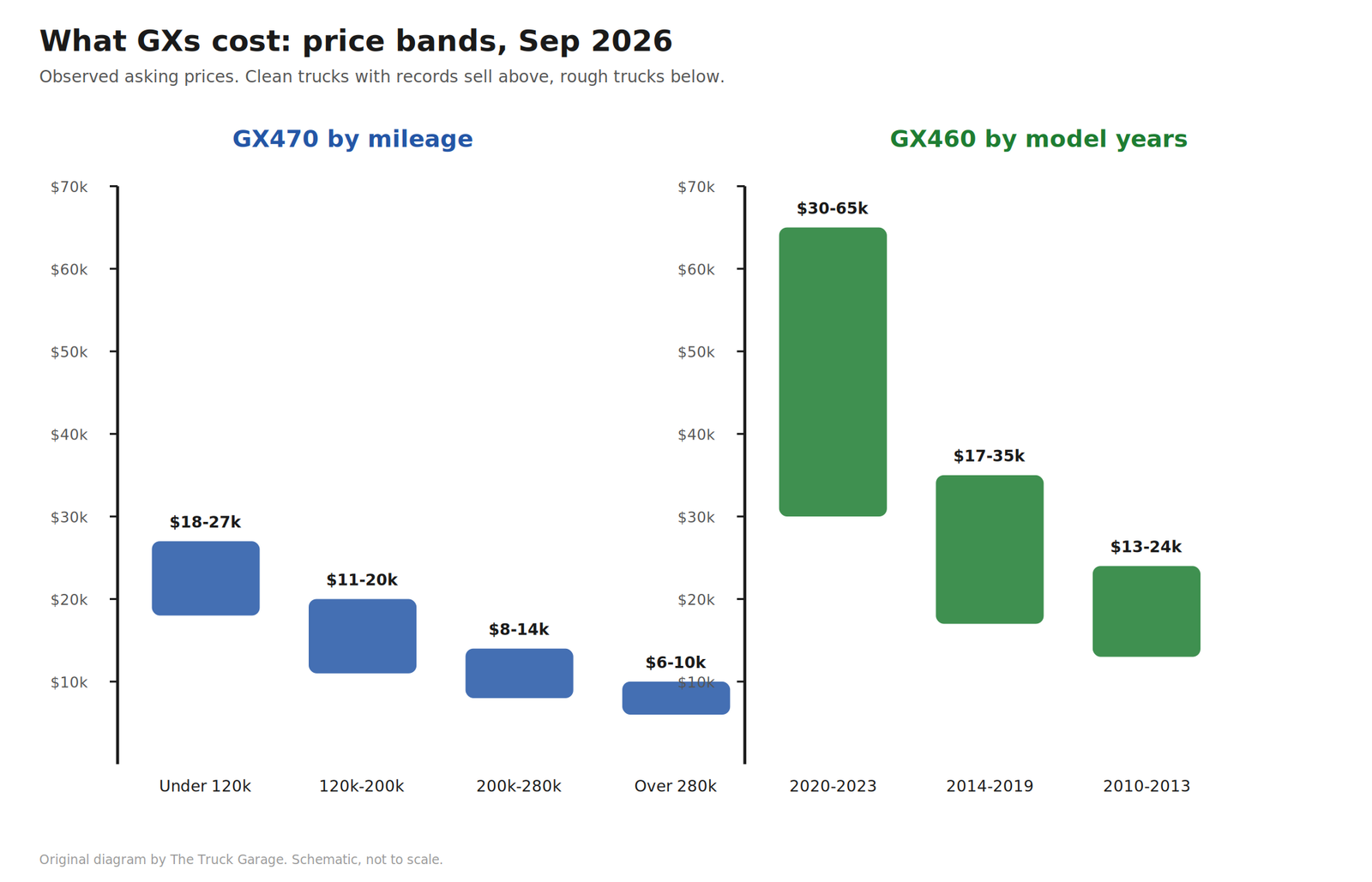
Prices below are observed from September 2026 nationwide listing snapshots and owner reported purchases. They are starting points, not quotes. Clean trucks with records sell above these ranges. Rough trucks sell below. Local markets vary a lot.
GX470 (2003 through 2009)
| Mileage | Typical asking range |
|---|---|
| Under 120,000, clean with records | $18,000 to $27,000 |
| 120,000 to 200,000 | $11,000 to $20,000 |
| 200,000 to 280,000 | $8,000 to $14,000 |
| Over 280,000 | $6,000 to $10,000 |
Observed examples: a 2007 with 75,000 miles listed at $27,000. A 2005 with 99,000 miles at a Lexus dealer listed at $24,974. A 2008 with 114,000 miles listed at $19,995. A 2008 with 246,000 miles listed at $10,999. A 2005 with 310,000 miles listed at $6,488.
Expect the GX tax. Clean GX470s command a premium because overland demand met a fixed supply. The spread between a rough 200,000 mile truck and a clean one is five figures. Buy the cleanest truck your budget allows, not the cheapest truck in your zip code.
GX460 (2010 through 2023)
| Model years | Typical asking range |
|---|---|
| 2020 to 2023 | $30,000 to $65,000 |
| 2014 to 2019 | $17,000 to $35,000 |
| 2010 to 2013 | $13,000 to $24,000 |
Observed price floors from September 2026 listings: 2023 from $34,900. 2022 from $35,990. 2021 from $32,995. 2020 from $29,989. 2019 from $22,733. 2018 and 2017 from $17,999. 2016 from $17,582. 2015 from $13,185. Low mileage certified trucks and 2022 to 2023 models run well above these floors. Clean, unusually low mileage 2012 and 2013 examples can approach $28,000.
How mileage moves the price. As a rough rule of thumb, every 50,000 miles within a model year band is about $3,000 to $5,000 of price difference. Service history moves it more than mileage does. A 150,000 mile truck with full dealer records outsells a 100,000 mile truck with no history.
Also Asked: The Cross Shop Questions
GX460 vs 4Runner: why pay more for the GX? They share the platform and the assembly line, but they are different trucks. The GX460 has the 301 hp V8 versus the 4Runner's V6, full time 4WD with a standard center diff lock, and a genuinely luxurious interior.[7] The surprise is that on the used market, a GX460 is often cheaper than an equivalent 5th gen 4Runner, because 4Runners hold value better and GXs were mostly bought as family haulers, not off road toys. That is why I recommend the used GX as the value play of the pair. The tradeoffs: the GX recommends premium fuel and drinks more of it, insurance and maintenance run higher, and the GX has the side hinged rear door versus the 4Runner's liftgate. If you want luxury and the V8, buy the GX. If you want the stronger resale and the simpler V6, buy the 4Runner.
GX470 or LX470? The LX470 (100 Series Land Cruiser) is bigger, heavier, and more expensive to buy and to fix. The GX470 is lighter, cheaper, shares more parts with the 4Runner, and gets slightly better fuel economy. The LX has the bigger reputation and the bigger price tag. For most buyers, I recommend the GX470 as the smarter buy. For the Land Cruiser faithful, nothing else will do.
Is the GX a good family daily driver? Yes, with two honest costs. The third row fits kids fine and folds for cargo, the interior is quiet and comfortable, and the safety record is strong. The costs are fuel and size. Real world fuel economy is 12 to 14 mpg in the city on both generations, and premium is recommended. Do the math on your commute before you fall in love.
Premium fuel or regular? Premium is recommended on both generations, but the GX470 details differ by year. The 2003 and 2004 GX470 manual permits 87 octane and recommends 91 for improved performance. The 2005 and later GX470 manual calls for 91 for optimum performance but allows 87 if premium is unavailable. The GX460 recommends premium as well. Owner consensus is that 87 runs fine in either truck, but the manuals say 91 for the best performance.
Is the GX460 better off road than the GX470? The GX470 is simpler and lighter, and the 2010 to 2013 GX460 has the best factory approach angle. The GX460 counters with more power, available KDSS, and crawl control with multi terrain select on the 2020 and newer Off Road package. For a stock truck that sees dirt roads, expect any of them to be more capable than the driver.
Should I buy an extended warranty? Expect a Lexus to cost less to own than the warranty companies price for. Put the warranty money in a maintenance fund instead. The exception is a GX460 with unknown history at high miles, where one valley plate or water pump job can exceed the warranty cost.
Related guides
- Rear air suspension: diagnose and coil conversion: the full air suspension guide, including what to check on a used truck.
- 2UZ-FE timing belt and water pump: the GX470 belt job. In our experience, it is the single most important maintenance item on a used GX470.
- Transmission health and cooling: what to check in the cooling system and transmission on a used GX.
- GX tire size and fitment guide: what fits each generation.
- Lift kits and suspension for the Lexus GX: what to know before you lift a truck you just bought.
Sources
- ih8mud, Best model year for GX470: https://forum.ih8mud.com/threads/best-model-year-for-gx470.1233948/
- ih8mud, Buying a GX470 what to look out for: https://forum.ih8mud.com/threads/buying-a-gx470-what-to-look-out-for.979417/
- ih8mud, What issues need to look for when buying 2003/2004 GX470 with 200k miles: https://forum.ih8mud.com/threads/what-issues-need-to-look-for-when-buying-2003-2004-gx470-with-200k-miles.1216808/
- ih8mud, Whats the highest mileage GX470 (2005+) you would purchase: https://forum.ih8mud.com/threads/whats-the-highest-mileage-gx470-2005-youd-purchase.1312587/
- ih8mud, The Car Care Nut: Should You Buy a Lexus GX460? The Ultimate Buying Guide: https://forum.ih8mud.com/threads/the-car-care-nut-should-you-buy-a-lexus-gx460-the-ultimate-buying-guide.1359370/
- ih8mud, GX460 Production Year Question: https://forum.ih8mud.com/threads/gx460-production-year-question.1330945/
- ih8mud, Prospective GX buyer looking for some clarification: https://forum.ih8mud.com/threads/prospective-gx-buyer-looking-for-some-clarification.1140248/
- ih8mud, Considering moving to a GX, have some questions: https://forum.ih8mud.com/threads/considering-moving-to-a-gx-have-some-questions.1325241/
- ih8mud, GX460 buying advice request: https://forum.ih8mud.com/threads/gx460-buying-advice-request.1260787/
- ih8mud, Most common problems GX460 for current owners: https://forum.ih8mud.com/threads/most-common-problems-gx460-for-current-owners.1239798/page-5
- ih8mud, Where to find LX570 service history on Lexus site: https://forum.ih8mud.com/threads/where-to-find-lx570-service-history-on-lexus-site.1209030/
- ih8mud, GX470 premium fuel: https://forum.ih8mud.com/threads/gx470-premium-fuel.926205/
- ClubLexus GX forums, buyer and model year threads: https://www.clublexus.com
- Lexus GX model history: https://en.wikipedia.org/wiki/Lexus_GX ↑
- DrivingLine, Fifth-Gen 4Runner vs Lexus GX460: https://prdmgmt.drivingline.com/articles/fifth-gen-4runner-vs-lexus-gx460-which-of-these-toyota-cousins-is-the-better-buy-used-or-new/ ↑
- Jalopnik, Lexus GX Buyers Guide: https://www.jalopnik.com/lexus-gx-jalopniks-buyers-guide-1744664802/
- JD Power, Lexus GX model year history: https://www.jdpower.com/cars/history/lexus/gx
- MotorTrend, 2020 Lexus GX facelift update: https://motortrend.com/news/2020-lexus-gx-facelift-update-specs-photos ↑
- CarParts.com, Lexus GX470 reliability and common problems: https://www.carparts.com/blog/lexus-gx470-reliability-and-common-problems/
- HotCars, Lexus GX470 reliability: https://www.hotcars.com/bulletproof-luxury-suv-that-made-land-cruiser-owners-jealous/
- CarSurvey.org, Lexus GX owner reviews: http://www.carsurvey.org/reviews/lexus/gx/
- Carscoops, 229k mile GX470 restoration: https://www.carscoops.com/2022/06/spending-24000-to-fully-restore-a-229k-mile-lexus-gx470-makes-more-sense-than-youd-think/
- JD Power, 2006 Lexus GX470 specs: https://www.jdpower.com/cars/2006/lexus/gx470-v8-4wd/utility-4d-4wd/specs ↑
- Work Truck, Lexus GX470 takes Four Wheeler of the Year (VVT-i 270 hp): https://www.worktruckonline.com/news/lexus-gx-470-takes-four-wheeler-of-the-year-award-for-second-consecutive-year ↑
- ih8mud, TRD supercharger for 2UZ-FE: https://forum.ih8mud.com/threads/co-usa-trd-supercharger-for-2uz-fe-4-7l-v8-toyota-or-lexus.1043586/ ↑
- ih8mud, TRD supercharger kit, 4.7L with 9th and 10th injector: https://forum.ih8mud.com/threads/portland-oregon-4-7l-trd-supercharger-kit-9th-10th-injector-model-complete.1309339/ ↑
- 2003 GX470 owner manual (fuel octane): https://www.carmanualsonline.info/lexus-gx470-2003-audio-lexus-2003-gx470-owner-s-manual-om60a45u/?srch=fuel+additives
- 2006 GX470 owner manual (fuel octane): https://www.carmanualsonline.info/lexus-gx470-2006-audio-lexus-2006-gx470-owner-s-manual-om60b99u/?srch=fuel+additives
- Edmunds, used 2012 GX460 listings: https://www.edmunds.com/used-2012-lexus-gx-460-wichita-ks/?pagenumber=2
- Edmunds, used 2012 GX460 listing: https://www.edmunds.com/used-2012-lexus-gx-460-wilmington-de/
- Edmunds, used 2013 GX460 listings: https://www.edmunds.com/used-2013-lexus-gx-460-wichita-ks/
- September 2026 listing data: https://www.jdpower.com/cars-for-sale/make-lexus/model-gx-470 and https://www.truecar.com/used-cars-for-sale/listings/lexus/gx/location-los-angeles-ca/
- Standard part number references: parts.lexus.com and toyodiy.com
Leave a Reply