Meta description: A practical GX overland armor guide: rock sliders before skids, steel vs aluminum bumpers, winch sizing, and roof racks with real wind-noise and MPG numbers from owner reports. GX470, GX460, and GX550.
For: GX470 (2003-2009), GX460 (2010-2023), and GX550 (2024+) owners planning an overland build that still has to drive to work on Monday.
Armor is the most satisfying part of an overland build and the easiest place to waste money. The veteran advice across the GX forums is simple: tires, then sliders, then skids when you start aiming at rocks, then a bumper, then a winch, then the rooftop tent. This guide walks through each piece in that order, with the tradeoffs owners report most often.
The build order that keeps the GX a daily driver
Weight compounds. A steel bumper, a winch, sliders, full skids, a roof rack, and a rooftop tent can stack hundreds of pounds high on the truck and far out front. The GX rides beautifully stock. Add armor in this order and stop when your terrain stops demanding more.
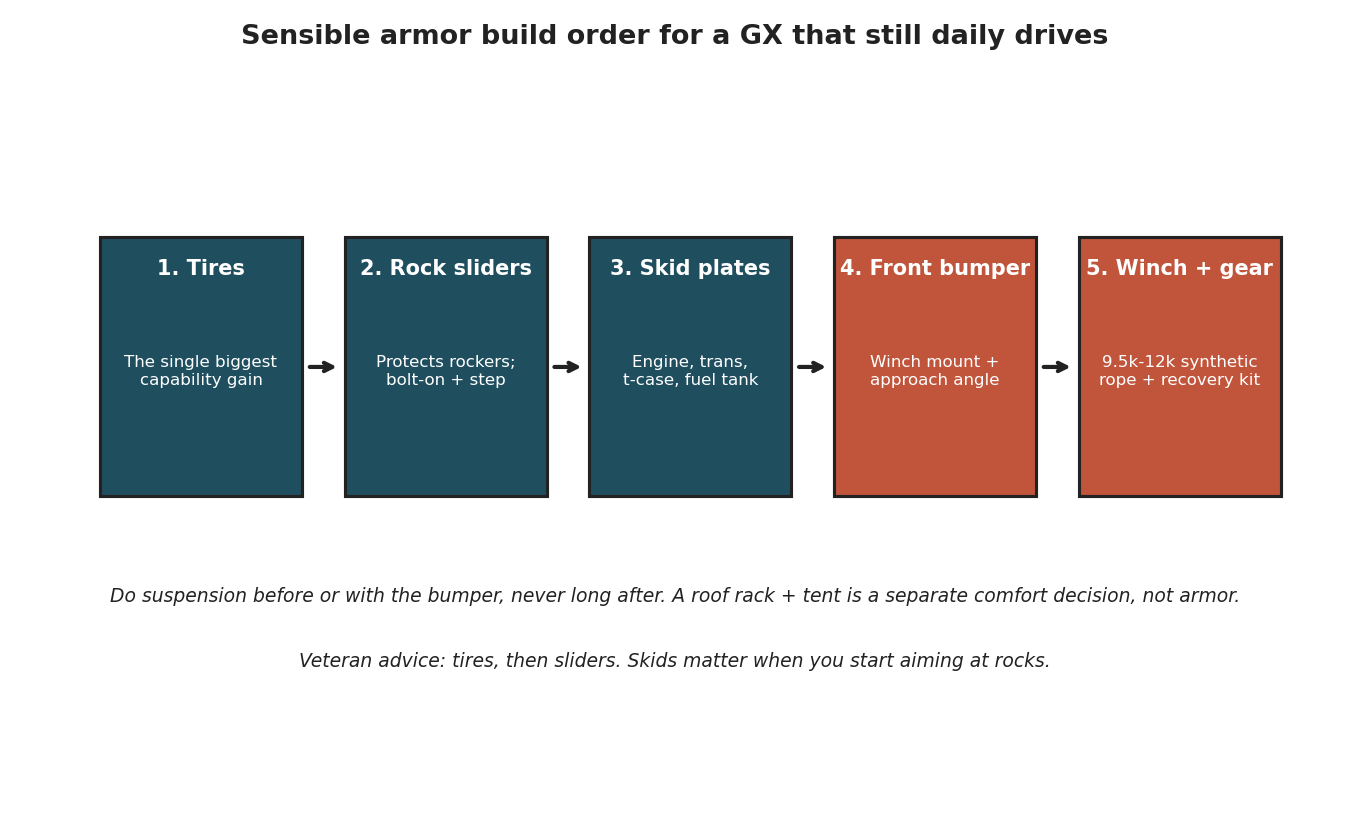
For the first two steps, see our GX tire size and fitment guide and the lift and suspension guide. Armor protects what tires and lift let you reach.
Rock sliders: buy these before skids
Sliders protect the rocker panels between the wheels. A rock that misses the tires and clears the diff can still fold a rocker panel. Sliders bolt to the frame (real sliders) or to the body (glorified side steps). Buy frame-mounted sliders. They also double as a step for daily use and as a jacking point on the trail.
| Factor | Frame-mounted sliders | Body-mounted steps |
|---|---|---|
| What it is | Bolts to the frame | Bolts to the body |
| Protection | Real rock protection for the rocker panels. Also doubles as a step and a trail jacking point | A step only. Not rock protection |
The forum consensus is blunt: tires, then sliders, skids way down the list.[1] Unless you play in rocks, skids are lower priority than sliders. One GX owner summed it up as getting bigger tires first and being glad despite having decent tread left on the street tires.
GX470 (2003-2009): A wide aftermarket exists, from simple tube sliders to kick-out designs. Remove the factory running boards first for clearance. Frame access is straightforward.
GX460 (2010-2023): More options than the 470 in recent years. If your truck has KDSS, check compatibility with the factory KDSS line skid plate before you order. One owner found that the Victory Blitz sliders covered the mounting holes for the factory KDSS line protection, leaving the KDSS lines exposed on the frame rail, and had to modify the plate to make it fit.[2] Confirm KDSS clearance with the vendor.
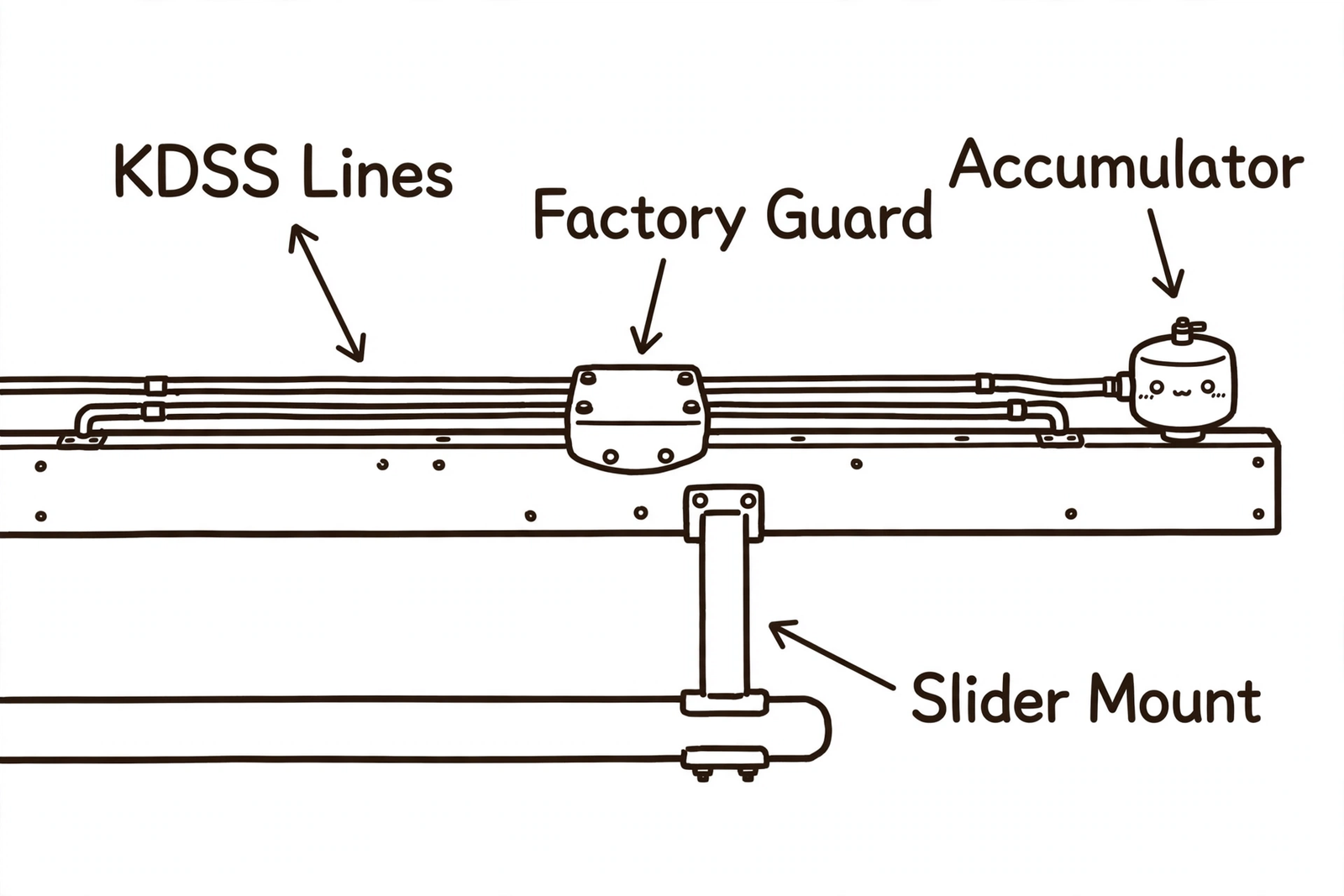
GX550 (2024+): Bolt-on frame-mounted options exist from CBI and others, listed as one-hour installs that support the weight of the vehicle.[3] Buy only kits listed for the GX550. The TNGA-F platform is new hardware, and 460-generation sliders do not automatically fit.
Shadetree note: some owners have bolted OEM 5th-gen 4Runner sliders onto a GX460 as a cheap daily-driver step,[4] but these are body-mounted steps, not rock protection. Treat them as steps.
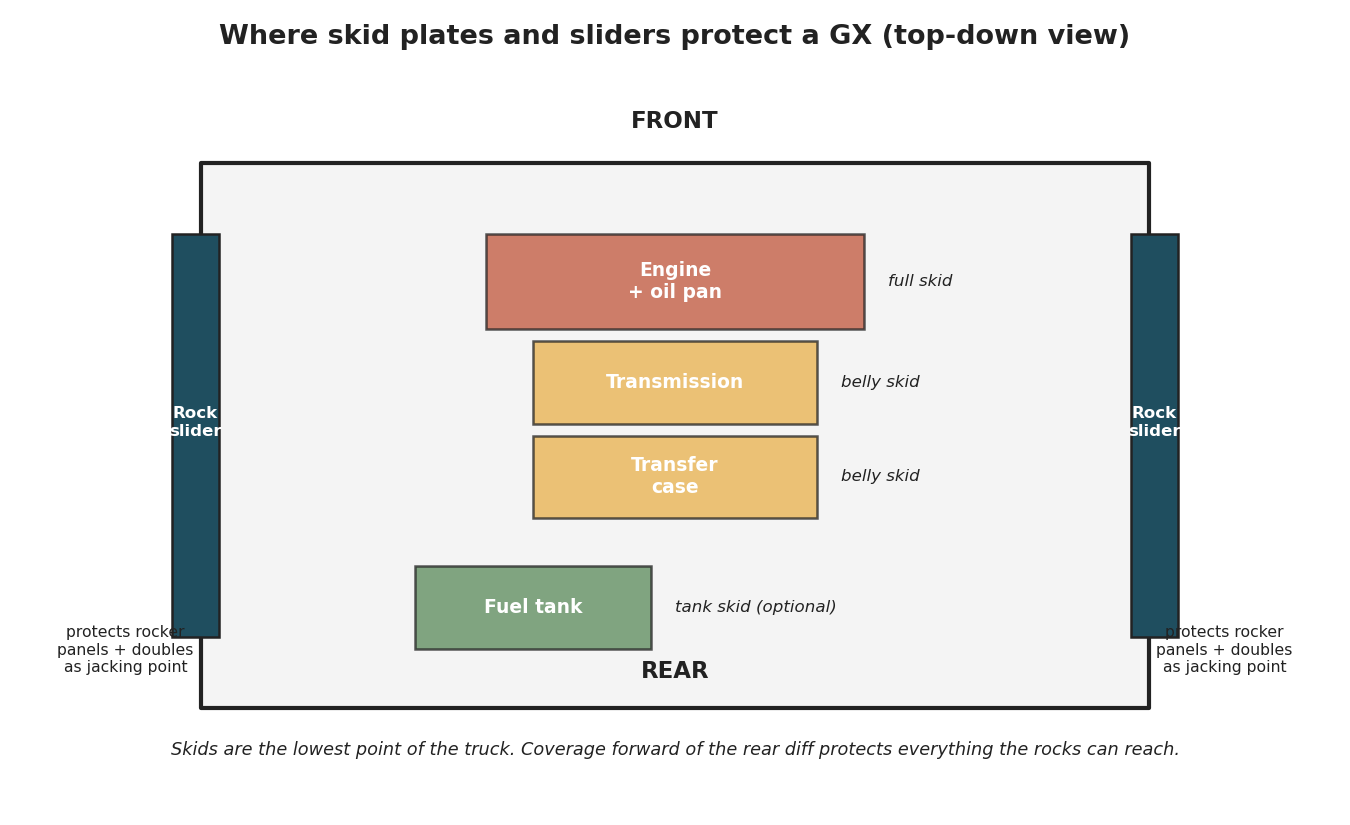
Skid plates: cover the engine, transmission, transfer case, and fuel tank
Skids protect the oil pan, transmission pan, transfer case, and fuel tank from surprise hits. Stock, the GX has thin factory splash coverage. Aftermarket sets slot together from the front bumper area back to the fuel tank.
Steel vs aluminum
You need to decide steel or aluminum before anything else in this section. Owners who wheel rocks mostly land on steel, with one caveat each way.
Steel slides. Owners report that steel skids glide over rocks with less gumming and less resistance, and steel takes repeated hits that would gouge aluminum.[5] One GX owner put it plainly: the whole reason for skids is protection, so material, thickness, and coverage beat weight as the deciding factor. A full steel set weighs about as much as another adult passenger, and skids sit at the lowest point of the truck, so the weight penalty bothers owners less than bumper weight does.[5]
Aluminum resists corrosion and saves weight, which matters for long-distance overland travel and rust-belt trucks. The compromise view: aluminum skids where impacts are rare and steel where they are common.
Thickness: RCI and BudBuilt both build their GX460 skids from 3/16-inch steel, and both offer 1/4-inch aluminum. BudBuilt also sells a lighter 1/8-inch Lite steel line. At the same thickness, the real argument is coverage, oil access, and fit, not the number on the caliper. One owner dismissed 1/4-inch aluminum as basically a splash guard for real rock work.[6] Match thickness to your terrain.
| Factor | Steel | Aluminum |
|---|---|---|
| On rocks | Glides over rocks with less resistance | Gouges under repeated hits |
| Impact pattern | Built for repeated hits | Best where impacts are rare |
| Weight | Heaviest. A full set runs about an extra adult passenger, carried at the lowest point of the truck | Lighter, which suits long-distance overland travel |
| GX460 thickness options | 3/16 in from RCI and BudBuilt, plus BudBuilt’s 1/8 in Lite steel | 1/4 in from RCI and BudBuilt |
| Pick it if | You wheel rocks | You tour long distances or run a rust-belt truck |
Fit and maintenance access
Two practical details owners learn the hard way. First, brand mixing works but lines are rarely perfect. One owner runs an Ironman bumper with BudBuilt skids and reports they do not line up exactly but close enough that you cannot tell unless you crawl under.[7] Second, oil changes. Some skid sets force you to drop a plate for every oil change. BudBuilt’s GX-specific design includes access doors so you do not have to.[5] One owner asked whether RCI bolts to factory holes while Victory requires drilling, and got brand-specific answers, so confirm before ordering.[6] UNCERTAIN: which brands drill for your year. Ask the vendor.
Steel skids rust where the rocks sand them. Crawl under with a wire brush and spray touch-up paint a few times a year. If you undercoat with Woolwax or Fluid Film, do it before mounting the skids, then recheck the bolt holes after the first trip. See the GX frame rust guide for the undercoating procedure.
Roof racks: platform racks, wind noise, and MPG
The recurring owner question is which platform rack to buy: Prinsu, Front Runner, or Sherpa. All three are full-length aluminum platform racks that bolt to the factory roof rail mounting points, with crossbars that slide in slotted side rails for custom spacing. All three will carry a rooftop tent. The differences are fit, noise, and cost.

Prinsu: The most common sight on GX builds. GX470 owners picked it because the rack runs all the way to the rear of the roof, where other racks angle back toward the body.[8] GX460 owners report being quiet at highway speeds and happy with everything it carries.[9] Prinsu crossbars can be a pain to run hardware through, but once the hardware is in, it stays.
Front Runner Slimline II: The utilitarian choice. Beefier in feel than the Prinsu, and one owner who ran both judged the Front Runner’s powder coating superior. The tradeoff is looks. It sits like a top hat on the truck, and crosswinds were a bit louder on the Front Runner in his testing.[10]
Sherpa: Born from a founder who bought a Prinsu and found it weaker than he wanted, so he built his own stronger version with built-in handles at a small price premium.[11] Owners who want the stiffest rack gravitate to Sherpa.
| Factor | Prinsu | Front Runner Slimline II | Sherpa |
|---|---|---|---|
| The pitch | The most common sight on GX builds | The utilitarian choice | Built stronger after its founder found a Prinsu weaker than he wanted |
| Standout strength | Runs all the way to the rear of the roof, where other racks angle back toward the body | Beefier feel than the Prinsu, and the best powder coating in one owner’s back-to-back test | The stiffest of the three, with built-in handles |
| Tradeoff | Crossbar hardware is a pain to run, though it stays put once in | Sits like a top hat on the truck, and crosswinds run a bit louder | A small price premium |
Wind noise: Every rack can whistle. The fix owners report: run the wind fairing and add a rubber gasket strip along its lower edge, and most of the noise goes away.[8] One GX460 owner reports maybe 1 mpg of penalty and tolerable noise with a bare rack.[9] With cargo boxes on the roof, one owner sold the rack over noise and measured about a 3 mpg loss.[12] UNCERTAIN: your penalty will vary with rack, cargo, and speed. Expect the bare rack to cost a little; expect loaded roof cargo to cost a lot.
Rooftop tent mounting: A full-length platform spreads the tent across five or more crossbars, which is kinder to the roof than two factory crossbars carrying the same tent. Two or more crossbars are the minimum for any roof load; more is better for a tent.
Weight limit: The factory roof luggage carrier ratings from the owner’s manuals: 130 lb (58 kg) on the GX470, 176 lb (80 kg) on the GX460, and 165 lb (75 kg) on the GX550.[13] A tent plus two sleepers passes all three numbers fast, which is the real argument for a platform rack. Treat the factory crossbars as the weakest link regardless of generation.
| Model | Factory roof load limit |
|---|---|
| GX470 | 130 lb (58 kg) |
| GX460 | 176 lb (80 kg) |
| GX550 | 165 lb (75 kg) |
GX550 (2024+): Prinsu Pro and CBI make GX550 racks, and the Lexus/JAOS Tokyo Auto Salon concept wore a JAOS aluminum flat rack roughly 1,250 x 1,400 mm.[14] Verify mounting-point compatibility for your trim before ordering a 120/150-generation rack.
Shadetree note: if you only camp a few weekends a year, two quality crossbars plus a cargo box or basket beat a full platform on cost, noise, and MPG. The factory GX460 crossbar set (PT278-60170) turns up new from Lexus dealers on eBay for under $200. Buy the platform when you actually mount a tent or traction boards up there.
Bumpers and winches: suspension first
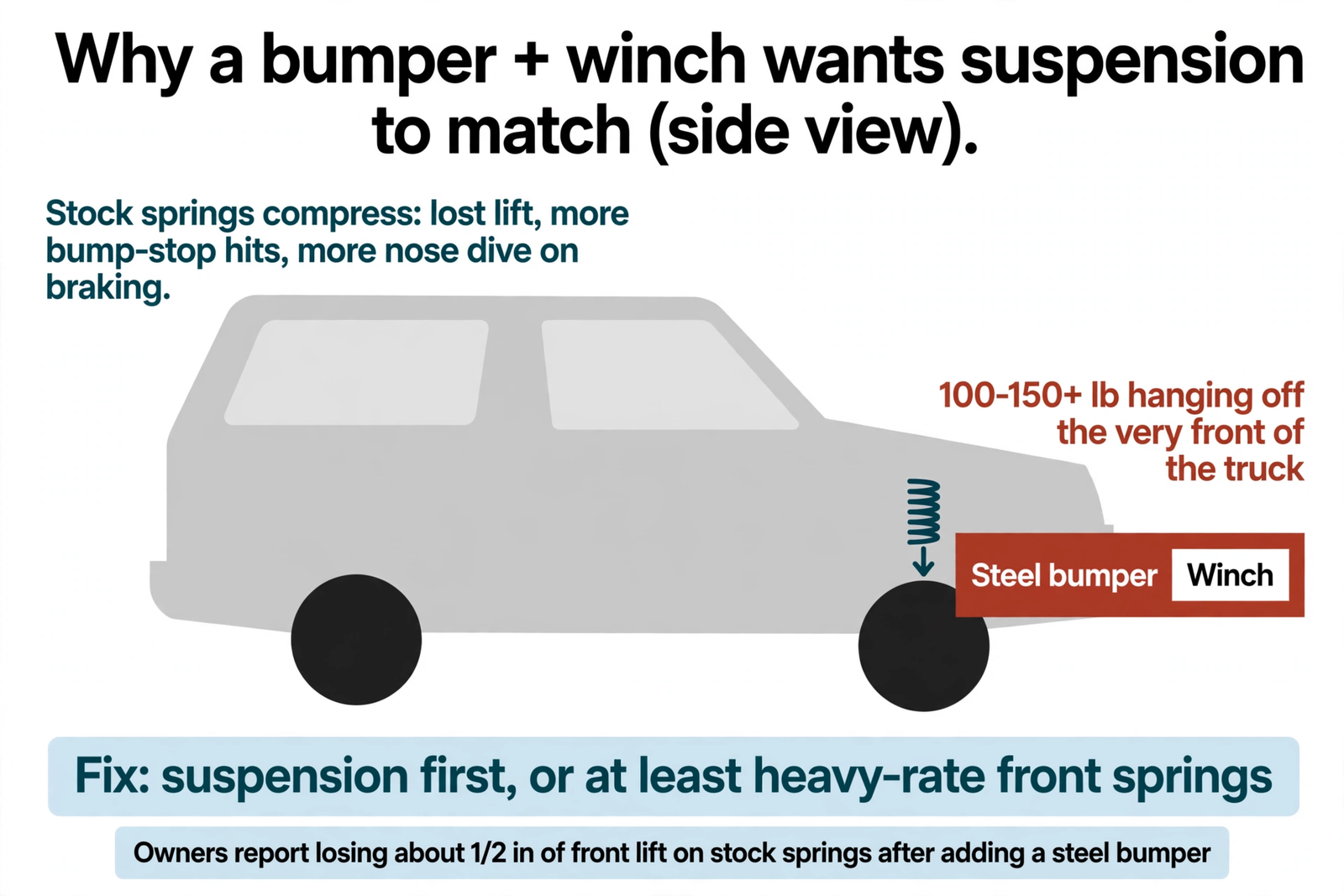
A front bumper does two real jobs: it improves approach angle and it gives the winch a home. Everything else is looks. The weight is the problem. A steel bumper plus a winch hangs far ahead of the front axle, where every pound counts most.
Suspension before bumper
The forum advice is consistent. One GX460 owner with a steel bumper on stock suspension reported losing about half an inch of measured front lift. The moderator-level summary: no physical rule prevents adding a bumper without upgrading suspension, but expect more bump-stop hits, more nose dive on braking, and a stink-bug stance. The recommendation is suspension before bumper if you can only do one.[15] A budget-friendly middle path some owners use: heavy-rate front springs or Bilstein 6112s with 650 to 700 lb front springs spec’d for the extra 150 to 200 lb up front, leaving the rear stock until funds allow.[15]
Steel vs aluminum vs hybrid
Steel is the traditional choice and slides best over rocks. It is also the heaviest. Aluminum saves weight where it counts most, ahead of the axle, and resists corrosion. One owner measured an aluminum bumper with tube at about 135 lb, still heavy enough to cost half an inch of front lift on stock springs.[16] Hybrid designs, like a plate steel center with a tube top and sides, split the difference: steel where the winch mounts and where rocks hit, tube where they do not.[17]
| Factor | Steel | Aluminum | Hybrid |
|---|---|---|---|
| Build | Solid plate, the traditional choice | Plate aluminum, sometimes with tube | Plate steel center with a tube top and sides |
| Weight | Heaviest of the three | The weight saver, though one owner’s aluminum bumper with tube still measured about 135 lb | Splits the difference |
| Where it wins | Slides best over rocks | Ahead of the axle, where every pound counts most, and it resists corrosion | Steel where the winch mounts and where rocks hit, tube where they do not |
| Pick it if | You crawl rocks | You daily-drive an overland rig in the salt belt | You want steel at the winch and contact points without full steel weight |
Match the material to your terrain and your climate. Rock crawlers pick steel. Daily-driven overland rigs in the salt belt get real value from aluminum. Mild trail trucks can stay honest with a winch cradle or hidden winch mount behind the stock bumper, which keeps the factory look and most of the factory weight.
Winch sizing and selection
The rule of thumb from WARN’s winching guide and the recovery threads: winch capacity of at least 1.5 times the vehicle’s gross vehicle weight rating (GVWR). A GX470’s GVWR is 6,200 lb, so roughly 9,300 lb is the floor. For a loaded expedition rig with armor and camping gear, owners recommend 10,000 to 12,000 lb.[18] The benchmark pick is the WARN VR EVO 12-S: 12,000 lb, synthetic rope, IP68 sealing, and a hawse fairlead in the box.
Practical owner guidance from the same threads:
- Buy synthetic rope, not steel cable. Lighter, safer if it snaps, easier to handle.
- Use a hawse fairlead with synthetic rope. Never a roller fairlead.
- A waterproof rating is a real plus for a winch that lives behind the bumper for years.
- Check hundreds or thousands of reviews before trusting a brand. A five-star rating with three reviews means nothing.
- A 9.5k winch with a snatch block and a winch extension rope covers most GX owners.[19] The block effectively doubles your pull and the extension gets you closer to the drum, where the winch pulls hardest. Keep a snatch block, a tree saver strap, and a pair of soft shackles in the same recovery kit.
- Wire it well and feed it with a healthy battery. A hard pull on a weak electrical system underperforms no matter what the rating says.
The winch adds about 50 lb plus the bumper weight ahead of the axle,[15] which loops back to the suspension point above. If you only wheel with a group that carries winches, a winch can wait. For solo travel, it moves up the list, paired with training and a maintained battery.
GX550 (2024+): CBI and NYTOP make GX550 front bumpers.[3] The Lexus/JAOS concept used a lightweight ABS bumper guard over an aluminum skid plate, which tells you the factory front is not armor to begin with.[14] Buy kits listed for the GX550.
Shadetree note: when the winch arrives, cycle it under light load in the driveway before the first trip. Winches die from sitting, not from working. Spool out, clean the rope, respool under tension, and confirm the remote works.
Parts and tools
Armor installs are bolt-on work. No special Lexus tools are needed, but a few items separate a clean install from a frustrating one.
| Item | Why |
|---|---|
| Torque wrench, 1/2 in drive | Bumper and slider bolts carry real loads; tighten to the kit’s spec, not by feel |
| Loctite 243 threadlocker, blue, medium strength | Off-road vibration backs out unprotected bolts; use on bumper and slider bolts |
| Penetrating oil | Frame bolt holes and factory rail points on a 15+ year old GX are rusty; soak overnight |
| Touch-up paint, satin black | Bare spots on steel skids and sliders rust fast; spot paint after install |
| Dielectric grease | Electrical connections for the winch solenoid and bumper lighting |
| Floor jack and tall jack stands | Sliders and skids are long and awkward solo; support them while you start bolts |
| Ratchet straps | Hold a long skid or bumper in position while you thread the first bolts alone |
| Anti-seize | Skid hardware you drop at every oil change; never combine with threadlocker on the same bolt |
No factory part numbers apply to aftermarket armor; buy by generation and vendor fitment chart. UNCERTAIN: aftermarket bolt torque values. Use the torque values printed in the kit’s instructions.
Installation notes
Plan a full day for skids and sliders, and another for a bumper and winch. Read the kit instructions before the hardware arrives so missing bolts do not strand the truck on jack stands.
Soak every factory bolt hole with penetrating oil the night before. Pull the factory splash shields and running boards first, and look at the frame where the new hardware mounts. If you find rust, treat it now. It is much easier with the armor off than under it. The GX frame rust guide covers inspection points and the Woolwax treatment owners use.
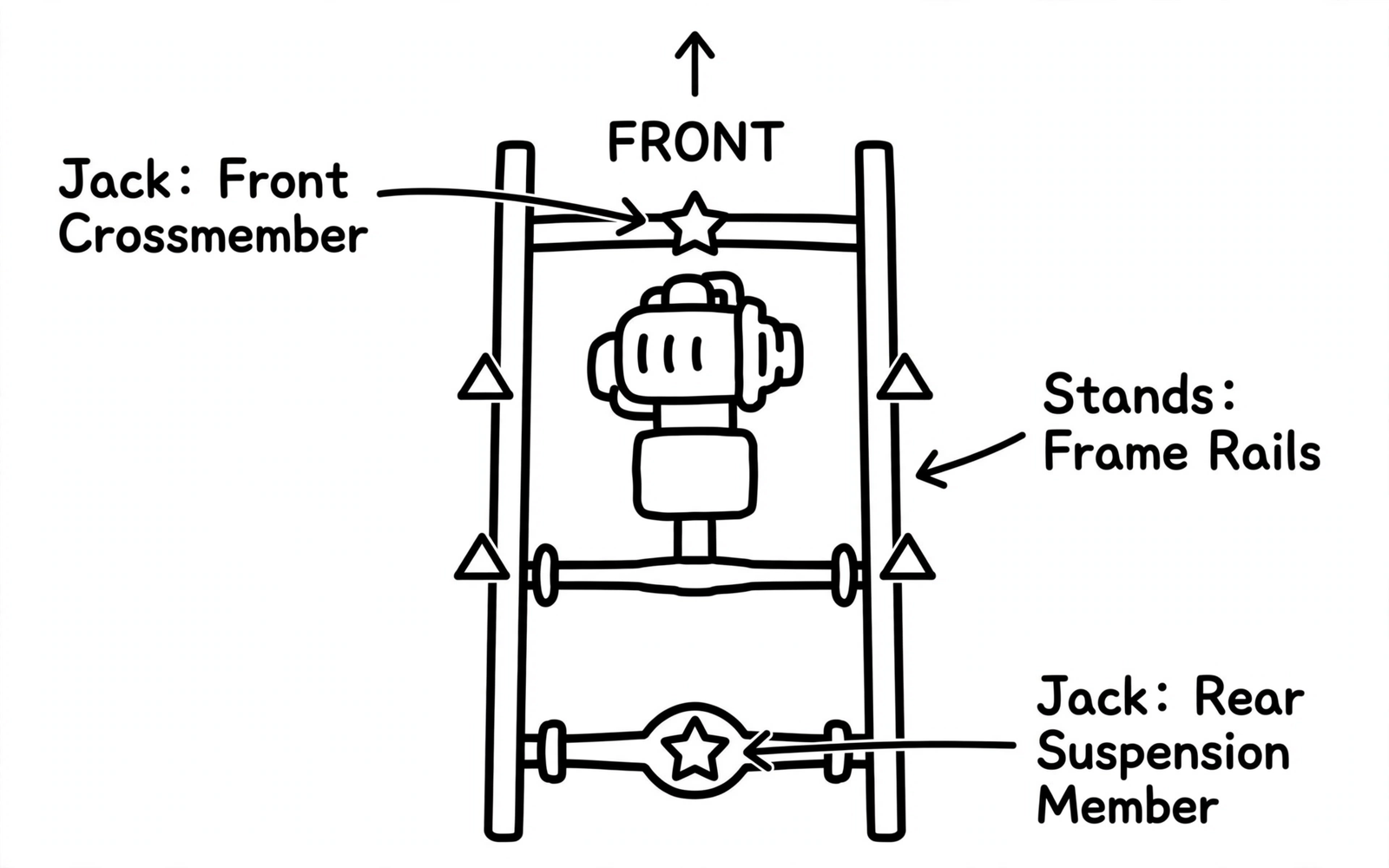
Test-fit before final torque. Skid sets from different brands slot together by design, but tolerances stack, and one owner found a different-brand skid needed persuasion to sit flush with his bumper. Start every bolt finger-tight, get the whole set aligned, then torque in the kit’s sequence.
After the first 100 miles and the first trail trip, recheck every armor bolt. Vibration settles hardware. This is also when you discover which bolts need thread locker and which access panels actually line up for oil changes.
FAQ
Do I need sliders or skids first? Sliders. They protect the rocker panels on every trip, and the owner consensus is tires, then sliders, skids later. Buy frame-mounted sliders, not body-mounted steps.
Steel or aluminum skids? Steel for rocks. It slides better and takes repeated hits that gouge aluminum. Aluminum saves weight and resists corrosion for long-distance travel. Match the material to where you actually drive.
Do I need to upgrade suspension before a steel bumper? Yes, plan on it. A bumper plus a winch hangs 100 to 150+ lb ahead of the front axle. Owners report losing about half an inch of front lift on stock springs, with more bump-stop hits and nose dive. Suspension first, or at least heavy-rate front springs, keeps the truck driving right.
What size winch does a GX need? At least 1.5 times the truck’s GVWR, which puts any GX at roughly a 9,300 lb floor. Most loaded overland builds run 10,000 to 12,000 lb with synthetic rope. A snatch block and an extension rope stretch a 9.5k further than a bigger winch without them.
Will a roof rack kill my MPG? A bare platform rack costs a little. One GX460 owner measured about 1 mpg. Loaded roof cargo costs a lot more: one owner measured about 3 mpg lost with cargo boxes and sold the rack over the noise. Run the wind fairing with a rubber gasket strip to control noise.
Can I put a rooftop tent on the factory crossbars? Check your owner’s manual first. The factory roof carrier ratings are 130 lb on the GX470, 176 lb on the GX460, and 165 lb on the GX550. A full-length platform rack spreads a tent across five or more crossbars and is the better home for a tent. The factory crossbars are the weakest link on any generation.
Do GX460 sliders fit a GX470, and do GX460 bumpers fit a GX550? Do not assume any cross-generation fit. The GX470 and GX460 share the J120/J150 family but hardware differs by year. The GX550 is a new TNGA-F platform. Buy kits listed for your exact generation and year range.
Is a rear bumper worth it? It improves departure angle and can carry a swing-out spare, which matters once a 33-inch spare stops fitting underneath. It is also the last piece of armor most owners buy. Front protection and recovery come first.
Footnotes
Sources
- IH8MUD GX 120/150 forums (research only): https://forum.ih8mud.com/
- “Do I Need Suspension Upgrade for GX460 Front Bumper?” https://forum.ih8mud.com/threads/do-i-need-suspension-upgrade-for-gx460-front-bumper.1182961/
- “2010-2013 GX front bumper options?” https://forum.ih8mud.com/threads/2010-2013-gx-front-bumper-options.1155498/
- “GX460 Skid Plates” https://forum.ih8mud.com/threads/gx460-skid-plates.1242388/page-2
- “Skid plate questions” https://forum.ih8mud.com/threads/skid-plate-questions.1297836/
- “What first… bigger tires, sliders, or skid plates” https://forum.ih8mud.com/threads/what-first-bigger-tires-sliders-or-skid-plates.990482/
- “GX 460 Blitz rock sliders” https://forum.ih8mud.com/threads/gx-460-blitz-rock-sliders.1181598/
- “5th gen 4runner sliders on ’19 GX460” https://forum.ih8mud.com/threads/5th-gen-4runner-sliders-on-19-gx460.1225041/page-2
- “2013 GX460 Build” https://forum.ih8mud.com/threads/2013-gx460-build.1219184/
- “GX470/Prado 120 – Show me your rack!” https://forum.ih8mud.com/threads/gx470-prado-120-show-me-your-rack.1198615/
- “GX460 Roof Rack Pics Needed” https://forum.ih8mud.com/threads/gx460-roof-rack-pics-needed.1146663/
- “Winch Size” https://forum.ih8mud.com/threads/winch-size.1295498/
- “Winch Recommendations” https://forum.ih8mud.com/threads/winch-recommendations.1344183/
- “Best winch for the money? Size?” https://forum.ih8mud.com/threads/best-winch-for-the-money-size.729932/
- TacomaWorld “Reviewing the PrinSu Roof Racks” https://www.tacomaworld.com/threads/blog-post-reviewing-the-prinsu-roof-racks.686847/
- TacomaWorld “roof rack – worth it?” https://www.tacomaworld.com/threads/roof-rack-worth-it.764109/
- TacomaWorld “Prinsu rack storage boxes question and wind noise” https://www.tacomaworld.com/threads/prinsu-rack-storage-boxes-question-and-wind-noise.756050/
- OzK Customs “Lexus GX As An Overland Platform” https://www.ozkcustoms.com/overland-rigs/gx-off-road
- Jalopnik on the GX550 Overtrail JAOS concept https://www.jalopnik.com/new-lexus-gx-overtrail-looks-really-good-with-jaos-off-1851164232/
- Engear on the GX550 Overtrail JAOS https://en.engear.tv/tag/gx-550-overtrail-jaos/?amp=1
- CBI Off-Road GX550 rock sliders via RoofTop Overland https://rooftopoverland.com/products/cbi-off-road-lexus-gx550-standard-overland-rock-sliders
- 2024 Lexus GX550 owner’s manual (manual on file; used for the roof luggage carrier weight limit)
- Lexus GX470 and GX460 owner’s manuals (roof luggage carrier load limits: 130 lb and 176 lb)
- BudBuilt GX460 skid plate specifications: https://budbuilt.com/FRONT-SKID-PLATE-2010-UP-GX460_p_803.html
- WARN winching techniques guide and VR EVO specifications: https://www.warn.com
Footnotes
[1] Owner consensus in the “What first… bigger tires, sliders, or skid plates” thread: tires then sliders, skids much lower on the list. https://forum.ih8mud.com/threads/what-first-bigger-tires-sliders-or-skid-plates.990482/
[2] One GX460 owner’s experience with Victory Blitz sliders blocking the factory KDSS line skid plate, requiring modification. https://forum.ih8mud.com/threads/gx-460-blitz-rock-sliders.1181598/
[3] CBI Off-Road GX550 rock sliders: bolt-on installation, support the weight of the vehicle, no welding or cutting. https://rooftopoverland.com/products/cbi-off-road-lexus-gx550-standard-overland-rock-sliders
[4] Owner report of OEM 5th-gen 4Runner sliders bolting onto a 2019 GX460. https://forum.ih8mud.com/threads/5th-gen-4runner-sliders-on-19-gx460.1225041/page-2
[5] GX460 skid plate thread: RCI 3/16-inch steel vs BudBuilt 4 mm, steel sliding better over rocks, skids weighing about as much as another adult passenger, BudBuilt GX-specific oil access. https://forum.ih8mud.com/threads/gx460-skid-plates.1242388/page-2
[6] Skid plate questions thread: 1/4-inch aluminum called a splash guard, aluminum gouging vs steel, drilling vs factory-hole fitment varying by brand. https://forum.ih8mud.com/threads/skid-plate-questions.1297836/
[7] Owner running an Ironman bumper with BudBuilt skids: lines up close enough, not exact. https://forum.ih8mud.com/threads/skid-plate-questions.1297836/
[8] GX470 rack thread: Prinsu chosen for full-length-to-rear fit; fairing reduces noise but a rubber gasket strip was what fully fixed it. https://forum.ih8mud.com/threads/gx470-prado-120-show-me-your-rack.1198615/
[9] GX460 roof rack thread: ~1 mpg penalty, quiet at highway speeds with a Prinsu. https://forum.ih8mud.com/threads/gx460-roof-rack-pics-needed.1146663/
[10] TacomaWorld comparison of Prinsu vs Front Runner: similar noise with trim, better Front Runner powder coat, Prinsu easier for lights and wiring. https://www.tacomaworld.com/threads/blog-post-reviewing-the-prinsu-roof-racks.686847/
[11] TacomaWorld: Sherpa’s founder bought a Prinsu, found it weaker than he wanted, and built a stronger rack with built-in handles. https://www.tacomaworld.com/threads/roof-rack-worth-it.764109/
[12] TacomaWorld: owner sold a Prinsu over wind noise with about a 3 mpg loss carrying roof cargo. https://www.tacomaworld.com/threads/prinsu-rack-storage-boxes-question-and-wind-noise.756050/
[13] Factory roof luggage carrier limits from the owner’s manuals: GX470 130 lb (58 kg), GX460 176 lb (80 kg), GX550 165 lb (75 kg). The GX550 figure is verified from the 2024 owner’s manual on file.
[14] Lexus GX550 Overtrail JAOS concept coverage: aluminum skid plate, ABS bumper guard, steel tube side steps, aluminum flat roof rack (1,250 x 1,400 mm). https://www.jalopnik.com/new-lexus-gx-overtrail-looks-really-good-with-jaos-off-1851164232/
[15] GX460 front bumper thread: winch adds ~50 lb ahead of the axle; suspension before bumper recommended; Bilstein 6112 front option for +150 to 200 lb; no physical rule prevents bumper without suspension. https://forum.ih8mud.com/threads/do-i-need-suspension-upgrade-for-gx460-front-bumper.1182961/
[16] Owner report: aluminum bumper with tube weighed about 135 lb and cost about 1/2 in of front lift on stock suspension. https://forum.ih8mud.com/threads/2010-2013-gx-front-bumper-options.1155498/
[17] Relentless Fabrication GX470 hybrid bumper: 3/16-in steel center with 1.75-in x 0.120 wall DOM tube top and sides. Cited in the 2004-2014 Tacoma bumper thread. https://forum.ih8mud.com/threads/2004-2014-tacoma-aftermarket-bumper-for-gx.1212182/
[18] WARN’s winching guide (1.5x GVWR sizing) and winch threads: about a 9,300 lb floor for a GX470, 10,000 to 12,000 lb for an expedition rig. https://forum.ih8mud.com/threads/best-winch-for-the-money-size.729932/ and https://forum.ih8mud.com/threads/winch-size.1295498/
[19] Winch recommendations thread: synthetic rope only, hawse fairlead (never roller) with synthetic, waterproof a plus, 10,000 lb fine for most. https://forum.ih8mud.com/threads/winch-recommendations.1344183/
Leave a Reply