Meta description: Can you sleep in a Lexus GX? This guide covers third-row seat removal for the GX470, GX460, and GX550, DIY sleeping platform dimensions from real owner builds, and the reversible delete options owners actually use.
Every GX generation can work as a camper. The difference is how much work it takes. Some owners sleep on the folded seats with an air mattress the first weekend. Others pull the third row entirely and build a drawer system. This guide walks through both paths, in model order, using what the factory manuals say and what owners have actually measured.
How each generation handles the third row
| GX470 (2003-2009) | GX460 (2010-2023) | GX550 (2024+) | |
|---|---|---|---|
| Third row layout | 50/50 split jump seats: fold flat forward, or fold up sideways against the windows | 50/50 split, folds flat and flush with the cargo floor | 50/50 split, stows into the floor |
| Fold style | Manual | Power fold on many trims, manual fold on others | Power stow on upper trims, manual lever fold on others |
| How it comes out | No bolts. Pop the leg covers, release the seat lock, lift the seat out | Four bolts per seat (two front, two rear) plus one wiring connector on power-fold trims | No verified removal procedure. The owner’s manual covers folding and stowing only |
| Reinstall | Latch it back in by hand, no tools, no torque spec | Same four bolts, torque to 27 ft·lbf (37 N·m) | Not applicable |
| Flat floor with seats out or stowed | Yes, once the seats are lifted out | Yes, once the seats are unbolted | Yes, the stowed seat leaves a flat floor |
GX470 (2003-2009)
The GX470 third row is the easy one. The seats do not bolt in at all. Per the GX470 factory service manual, removal is three moves: disengage the claws and take off the seat leg covers, release the rear seat lock, and lift the seat out. Pull the headrests if you want the seat lighter and easier to carry. There is no wiring and no torque spec on reinstall, because there is nothing to torque. The seat latches back onto its floor strikers by hand.
The GX470 third row also gives you two sleep setups with no removal at all. Fold the second row flat and the third row flat, and sleep on top of the folded seats like a bed. Or tumble the second row forward, fold the third row up sideways against the windows, and sleep on the cargo floor.
The tradeoff is that a latched seat is also your platform anchor situation. GX470 drawer builds and kits tie into the seat striker bars and the factory cargo tie-down points instead of threaded floor anchors. The Front Runner drawer kit for the GX470 installs exactly this way, with hooks and turnbuckles on the existing mounting points.
The GX470 folds its second and third rows flat enough that owners have slept on top of them. One owner at 6 foot 1 and 250 lbs reported sleeping comfortably with the front seats moved forward, on a queen air mattress draped over the folded rows. A queen is 60 in wide, so it rides up over the wheel wells rather than lying flat between them. The surface under it is not perfectly level, and an air mattress can pick up punctures from anything sharp nearby.
GX460 (2010-2023)
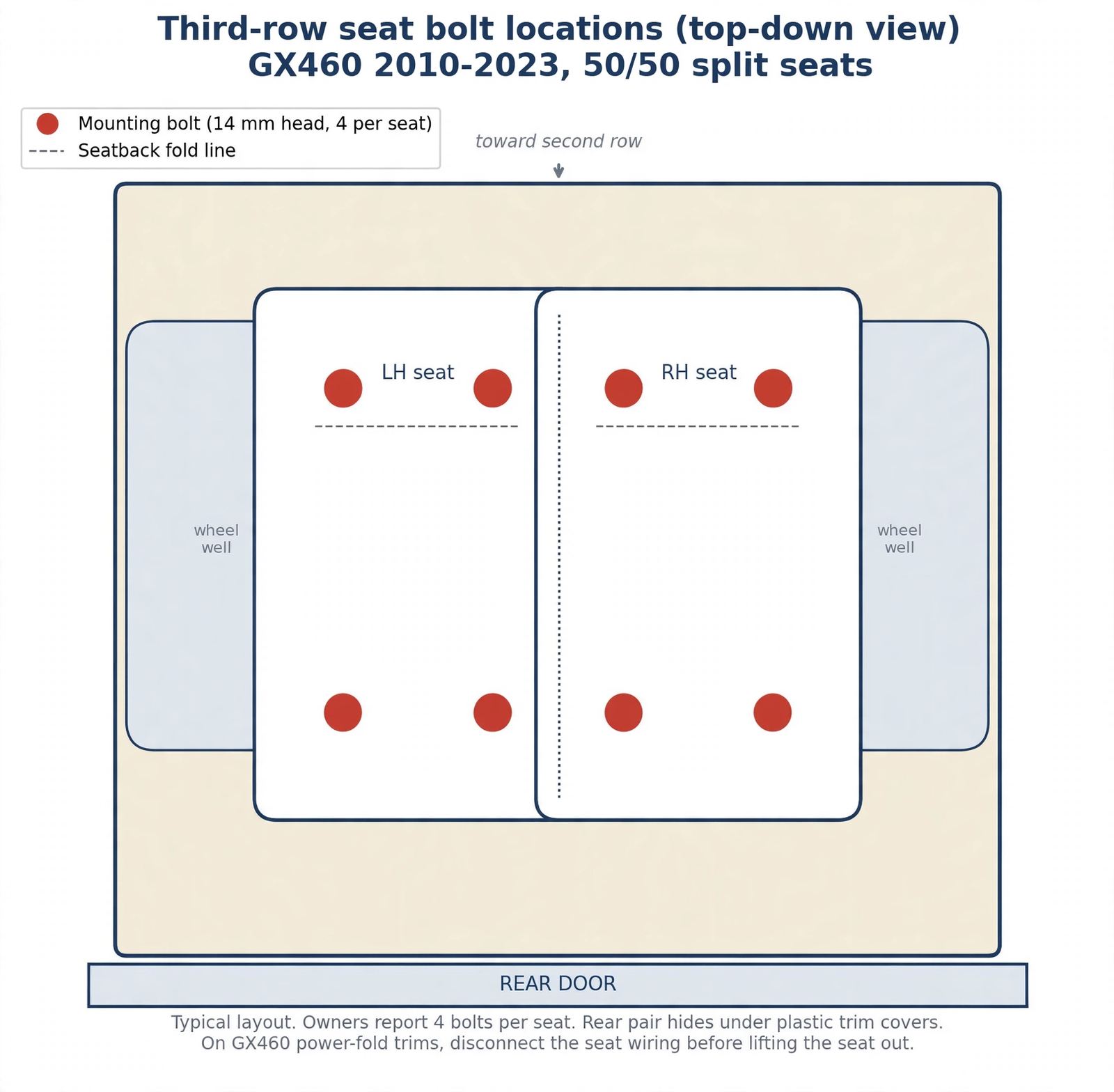
The third row is a 50/50 split that folds flat and flush with the cargo floor. Many trims have power-folding third-row seats run by a fold seat switch and control ECU; the rest fold manually. Either way, the seats are bolted in, and the GX460 factory service manual removal procedure is explicit: fold the seatbacks down, remove the deck boards and floor boards that cover the hardware, disconnect the seat wiring connector on power-fold trims, then remove four bolts per seat, two at the front bracket and two at the rear. Owners report 14 mm bolt heads. On reinstall there is no guesswork: the manual’s torque table lists the rear No. 2 seat assembly to vehicle body at 27 ft·lbf (37 N·m)[1].
Those four bolt holes per side are threaded M10 anchors, the same anchors a platform can bolt to. A builder in the GXOR in-floor storage thread measured the four M10 mounting points per side and designed a replacement storage box around them, noting the floor under the seats is not flat. Seat weight is owner-reported at 47 to 48 lbs per third-row seat, or about 60 lbs for the power-fold version. Removing both seats and the associated trim typically frees 120 to 130 lbs before the second row is touched. One owner who pulled both second and third rows weighed everything: about 60 lbs per second-row seat, 47 and 48 lbs for the third-row pair, 30 lbs of trim and brackets, 245 lbs total.
The GX460’s published cargo figures: 46.7 cubic feet behind the second row with the third row folded, 91.9 cubic feet behind the front seats with both rows folded, and 11.6 cubic feet behind the third row[2].
GX550 (2024+)
The third row stows into the floor. On power trims you hold the stow switch and the head restraint folds, the seatback folds down, and the cushion drops into the floor. On manual trims the owner’s manual procedure is a strap and lever: pull the strap to fold the head restraint, pull the seatback lever, and the cushion stows into the floor as the seatback folds. Five-passenger GX550s ship without a third row at all, which is the configuration most overland builders would pick if buying new.
Because the seat stows into the floor, the cargo floor is already flat, and commercial systems for the GX550 are built around that. No GX550 service manual is on file, so removal bolt specs and torque are not verified for this generation. The owner’s manual covers folding and stowing only. GX550 sleeping length and platform dimensions are likewise unverified here. Measure your own truck before building anything for one.
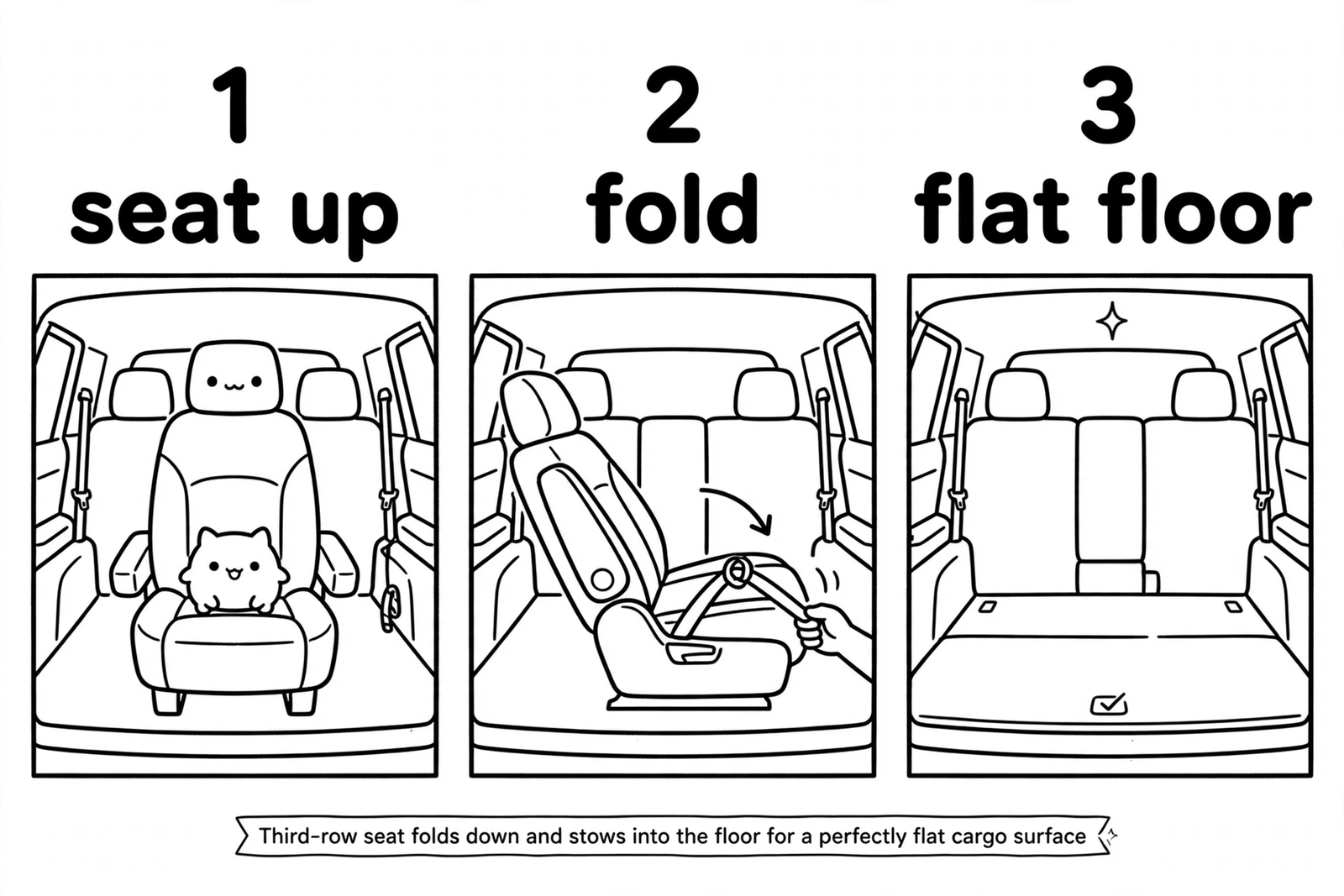
Should you remove the third row, or keep it?
Removal is reversible on the GX470 and GX460. The GX470 seats latch back in by hand. The GX460 seats bolt back in with the same four bolts per seat. Owners routinely store the seats in the garage and reinstall them later. One owner in the GXOR camping thread kept the seats for two years, then removed them and never looked back, while another kept one seat in and deleted only the other side.
Reasons to keep the seats in place:
- You still carry passengers. Seven seats is the whole point of the truck for some families.
- You can sleep on the folded rows with an air mattress and be camping tonight, with zero modification.
- Resale. A GX with all seats present sells easier than one with a garage full of hardware.
Reasons to remove them:
- A folded seat is not a flat floor. Drawers, fridges, and platforms all want a flat base.
- You gain roughly 120 to 130 lbs of payload budget on the GX460 and several inches of vertical storage on both trucks.
- The GX460 mounting anchors become hard points for a platform that will not shift in a panic stop. On the GX470, the striker bars and tie-downs do the same job.
A middle path works well on both older generations: remove one half of the 50/50 third row and keep the other. On the GX470 that is a two-minute latch job. On the GX460 it is four bolts. You get most of the cargo room and keep five-passenger seating.
Parts and tools
| Part or tool | Notes |
|---|---|
| Socket set with 14 mm socket | For the GX460 third-row bolts (owner-reported head size). The GX470 third row needs no socket at all |
| Torque wrench | GX460 reinstall spec is 27 ft·lbf (37 N·m)[1]. The GX470 seats latch back in by hand, nothing to torque |
| Plastic trim pry tools | The GX470 leg covers and the GX460 bolt covers and deck boards pop off; a trim tool avoids gouging them |
| 1/2 in or 3/4 in plywood | Deck material for a DIY platform; 3/4 in needs fewer supports. Full sheets come from the home store. Baltic birch panels suit drawer boxes and small pieces |
| 1×4 lumber or aluminum extrusion | Battens to level the uneven floor under the deck |
| M10 x 1.25 flange bolts with large washers | GX460 platform mounting into the third-row seat anchors. Length depends on your bracket and deck stack; measure before ordering |
| Trunk carpet and spray adhesive | Deck covering so gear does not slide |
| Full-extension ball-bearing drawer slides | The upgrade owners recommend over basic slides, which waste drawer depth. Locking slides keep drawers shut on grades |
Shadetree alternative: if you do not want to remove seats yet, a $23 sheet of 1/2 in plywood from the home store, cut to roughly follow the interior contour and laid over the folded rows, plus a foam pad, is a legitimate first camping setup. Several owners ran exactly this before committing to a full build.
Removing the third row, step by step
The two older generations come apart differently. The GX470 unlatches. The GX460 unbolts.
GX470: unlatch and lift
- Fold the third-row seat flat.
- Pop off the seat leg covers. They are held by claws and pull off by hand.
- Release the rear seat lock with the release lever and lift the back of the seat up out of the latch, then pull the seat back and out of the front latch.
- Lift the seat out through the rear door. Remove the headrests first if you want it lighter.
- If a seat fights you, check the lock release cable under the seat. Owners report the cable stretches with age and stops unlocking one side; pulling the cable directly with needle-nose pliers releases it.
- Reinstall is the reverse, by hand. Push the seat down until both latches click.

GX460: unbolt and lift
- Fold the third-row seats flat. On power trims, use the fold switch so the mechanism is parked.
- Remove the deck board and floor boards over the seat hardware, and pop off the plastic bolt covers. They pull off by hand or with a trim tool. Expect some resistance; they feel like they will break before they release.
- On power-fold trims, find the wiring connector at the seat and unplug it, the way the factory procedure does before the bolts come out. Check the dash afterward. Owners report the seat-ajar alarm simply stops with the seat gone, but treat any new warning light as a stop-and-check.
- Remove the four bolts per seat, two at the front bracket and two at the rear, and lift the seat straight out through the rear door. They are lighter than they look.
- Keep every bolt, cover, and clip in a labeled bag with the seat. Reinstall is the reverse. Torque the four bolts to 27 ft·lbf (37 N·m)[1].
On the GX550, there is no verified removal procedure in the materials on file. The owner’s manual describes folding and power stowing only. If you are considering removal on a GX550, that is a job to research from a service manual before touching anything.
Sleeping platform options, cheapest first
| Option | Cost | Floor you sleep on | Storage gained | Effort |
|---|---|---|---|---|
| 1. Sleep on the folded seats | Free | Folded seatbacks, not perfectly level | None | None |
| 2. Flat plywood deck, no drawers | One sheet of plywood and battens | Flat deck over the third-row area | Open space under the deck edges | An afternoon |
| 3. Drawer box plus bed extension | Plywood, slides, and hardware | Flat deck plus extension over the folded second row, about 72 in total | Two drawers, roughly 36 in deep | A weekend or two |
| 4. Commercial delete kit or drawer system | Real money, roughly four figures and up | Flat, finished deck, some with a fold-out sleeper | Locking drawers, fitted wings | Bolt-in install, no build time |
Option 1: sleep on the folded seats. Fold the second and third rows flat, fill the gaps with rolled gear or foam, and put an air mattress or thick foam pad on top. Free. Owners have done multi-night trips this way. Watch for sharp seat hardware under a thin air mattress, and remember a wide mattress drapes over the wheel wells instead of fitting between them.
Option 2: flat plywood deck, no drawers. One sheet of 1/2 in plywood, 1×4 battens to level it, carpet on top. An owner build on a GX460 used a 43 in wide by 37.5 in deep deck over the third-row area and left a gap to the second row for soft bags. Cost is a sheet of plywood and an afternoon.
Option 3: drawer box plus removable bed extension. This is the standard overland setup. A box roughly 41 to 43 in wide, 36 in deep, and 11 to 12 in tall sits where the third row was, with drawers for gear. A separate extension panel on removable legs spans the folded second row for sleeping. One GX470 owner build measured 72.5 in of total platform length with the extension, enough for a 6 footer with the driver seat still usable. Anchor the box so it cannot shift: GX460 builders bolt it to the third-row seat anchors with M10 x 1.25 hardware, and GX470 builders tie into the striker bars and factory tie-down points. Owners who used 1/2 in Baltic birch with UHMW strips for drawer slides report the drawers slide well if cut slightly undersize.
Option 4: third-row delete kits and drawer systems. Goose Gear sells a rear plate system for the GX460 that uses the seat mounting points with no cutting or drilling. Air Down Gear Up sells the SS1 storage and sleeper system for the GX470 and the GX550, with an integrated fold-out sleeper and full-extension locking drawer slides. Dobinsons, Front Runner, and ARB all sell drawer systems that fit the GX cargo area; the Front Runner kit is built for the GX470 and Dobinsons lists a dual roller drawer for both the GX460 and GX470. These cost real money, but one owner estimated 30 to 40 hours of build time plus tooling and materials to equal a commercial system.


Platform sizing notes
Measure your own truck before cutting. Owner-reported typicals, presented as starting points:
- Box width between the wheel wells: about 41 to 43 in.
- Box depth over the third-row area: about 36 in.
- Box height: 11 to 12 in. Taller boxes give deeper drawers but steal headroom. A fridge on a slide needs roughly the box height plus the fridge height to clear, so check before you commit.
- Total sleeping length with a bed extension over the folded second row: about 72 in, owner-reported on a GX470. That fits a 6 footer. A 5 ft 11 owner reported fitting with the passenger seat pushed forward and no platform at all.
- One useful detail from a GX470 build: the builder deliberately kept the platform 1 to 2 in shorter than maximum so the bed extension would clear a fold-down table mounted on the rear door.
Shadetree tip: make a cardboard template of the cargo floor first. The floor is not flat and the wheel wells intrude. Cardboard is cheap and plywood is not.
The second row: fold it or pull it?
Folding the second row flat is enough for most sleeping setups when paired with a bed extension. Removing the second row gains sleeping length and a flat floor all the way to the front seats, at the cost of losing passenger seating and adding a heavier, more awkward removal job. The GX460 second row is usually a 40/20/40 split bench with a walk-in function. The exception is captain’s chairs: Lexus made them standard on the 2017 Luxury and an option on the Premium and Luxury from 2017 through 2023, and those trucks seat six instead of seven. Either way the second row comes out in sections, and the owner who weighed a full seat delete put the second-row seats at about 60 lbs each. Expect more trim and brackets than the third row.
One practical compromise from the owner threads: remove the third row permanently for the platform, and fold the second row only on trip nights. The truck stays a five-seater for daily life and becomes a two-person camper in minutes.
Weight, payload, and safety
Removing seats gives back payload. A full second- and third-row removal measured 245 lbs on a 2018 GX460 build, against a 6,600 lb GVWR and roughly 1,315 lb of rated payload on the GX460[2]. A plywood drawer system with 3/4 in stock and 2×4 framing gets heavy fast; one builder called his own build overbuilt and regretted the weight. Baltic birch at 1/2 in with more supports is the lighter path.
Secure the platform to the floor. On the GX460, use the third-row seat anchors. On the GX470, use the striker bars and factory tie-downs. A loose 100 lb box becomes a projectile in a hard stop or a rollover, and several owners raised exactly this concern when discussing J-bolts and brackets. If you carry a fridge, strap it to the platform or the factory tie-downs, not just wedged in.
Sleeping inside the truck with the windows closed raises the ventilation question. Crack a window or the rear vent glass. Running the engine for heat is a carbon monoxide risk; owners who winter camp either run the HVAC before bedding down or use a 12V heated blanket off a portable power station.

FAQ
Does the GX third row fold flat? Yes on all three generations. The GX470 and GX460 third rows fold flat forward, and the GX460 folds flush with the cargo floor. The GX550 third row stows into the floor on power trims and folds flat on manual trims.
Can I remove the third row seats and put them back later? Yes on the GX470 and GX460. On the GX470 the seats unlatch and lift out by hand, and latch back in the same way. On the GX460 it is four bolts per seat, no cutting, fully reversible. GX550 removal is unverified in the materials on file.
What size sleeping platform fits a GX? Owner-reported typicals: a drawer box about 41 to 43 in wide, 36 in deep, and 11 to 12 in tall, plus a removable bed extension over the folded second row for about 72 in of total sleeping length. Measure your own truck. GX550 dimensions are unverified.
Can a 6 foot person sleep in the back of a GX? Yes, with the third row removed or folded and a platform or extension over the folded second row. Multiple owners at 6 ft and above report fitting. Without any platform, a 5 ft 11 owner fit with the passenger seat pushed forward.
Is a third-row delete kit worth it versus DIY? It depends on your time. A DIY plywood platform costs a sheet of plywood and a weekend. Commercial systems from Goose Gear, Air Down Gear Up, Dobinsons, Front Runner, and ARB cost far more but save an estimated 30 to 40 hours of build time and come with full-extension locking slides and a finished look. If you rarely use the third row, the DIY route is the value play.
Do I need to remove the second row too? Usually not. Fold it flat and span it with a bed extension. Removing it buys more length and a fully flat floor but costs you passenger seating and a heavier job.
Sources
- Lexus GX470 factory service manual, seat section (third-row components and removal procedure)
- Lexus GX460 factory service manual, seat section (rear No. 2 seat removal, installation, and torque specifications)
- 2024 Lexus GX550 owner’s manual (third-row power stow and manual fold procedures): https://www.lexus.com
- Lexus GX460 product information sheets, 2011, 2012, and 2016 editions (cargo volumes, fold-flat third-row specification, 40/20/40 second-row specification)
- Lexus USA Newsroom, 2017 Lexus GX 460 (second-row captain’s chairs standard on Luxury, available for Premium) https://pressroom.lexus.com/2017-lexus-gs-460-suv/
- Front Runner Toyota Prado 120 / Lexus GX470 Drawer Kit, dealer listing: https://ruggedoutlander.com/collections/cargo-carriers/products/front-runner-toyota-prado-120-lexus-gx470-drawer-kit
- Dobinsons Dual Roller Rear Drawer System for GX460/470, dealer listing: https://overlandgarage.ca/collections/lexus/products/dobinsons-dual-roller-rear-drawer-system-for-gx460-470-4runner-prado-120-150-with-fridge-slide-rd80-1001
- IH8MUD thread: GX 460 DIY Third Row Delete / Modular Platform Build: https://forum.ih8mud.com/threads/gx-460-diy-third-row-delete-modular-platform-build.1347227/
- IH8MUD thread: GX470 Drawer and Sleeping Platform Build: https://forum.ih8mud.com/threads/gx470-drawer-and-sleeping-platform-build.1349666/
- IH8MUD thread: GX470 Storage Box/Sleeping Platform Complete!: https://forum.ih8mud.com/threads/gx470-storage-box-sleeping-platform-complete.1229972/page-2
- IH8MUD thread: Sleeping in the back of a gx: https://forum.ih8mud.com/threads/sleeping-in-the-back-of-a-gx.900627/
- IH8MUD thread: GX460 3rd Row In-floor Storage Solution: https://forum.ih8mud.com/threads/gx460-3rd-row-in-floor-storage-solution.1357428/
- IH8MUD thread: GX460 Goose Gear Rear Plate Underside: https://forum.ih8mud.com/threads/gx460-goose-gear-rear-plate-underside.1275345/
- IH8MUD thread: Build – 2018 Premium 460 build: https://forum.ih8mud.com/threads/2018-premium-460-build.1194757/
- IH8MUD thread: AirDownGearUp SS1: Storage, Sleeper and Drawer System for GX470: https://forum.ih8mud.com/threads/airdowngearup-ss1-storage-sleeper-and-drawer-system-for-gx470.1286793/
- IH8MUD thread: AirDownGearUp SS1: Drawer, Kitchen, Storage and Sleeping Platform Systems for GX550: https://forum.ih8mud.com/threads/airdowngearup-ss1-drawer-kitchen-storage-and-sleeping-platform-systems-for-gx550.1347512/
- IH8MUD thread: 3rd row seat removal/storage area, 2013 GX: https://forum.ih8mud.com/threads/3rd-row-seat-removal-storage-area-2013-gx.1229766/
- IH8MUD thread: 3rd row seat is stuck (GX470 latch release cable): https://forum.ih8mud.com/threads/3rd-row-seat-is-stuck.1129225/
- IH8MUD thread: GX470 vs 4G 4Runner Cargo Space for Sleeping Platform?: https://forum.ih8mud.com/threads/gx470-vs-4g-4runner-cargo-space-for-sleeping-platform.1220744/
- 4Runners.com thread: Rear Seat Delete and Cheap Sleeping Platform/Storage: https://www.4runners.com/threads/rear-seat-delete-and-cheap-sleeping-platform-storage.39006/
- WheelsFeels: Advanced Storage and Camping System for Lexus GX550: https://wheelsfeels.com/shop/car-kitchens/storage-camping-system-lexus-gx550
- Related guides: Tire fitment guide, Lift kit guide, Rear air suspension guide, Ultimate GX buying guide, Transmission cooling guide, Frame rust guide
Footnotes
[1] Lexus GX460 factory service manual, torque specification table: Rear No. 2 seat assembly x vehicle body, 37 N·m (377 kgf·cm, 27 ft·lbf).
[2] Lexus GX460 product information (2011/2012 editions): cargo volume behind 1st row with 2nd and 3rd rows folded 91.9 cu ft; behind 2nd row with 3rd row folded 46.7 cu ft; behind 3rd row 11.6 cu ft. GVWR 6,600 lbs; rated payload approximately 1,315 lbs per dealer spec listings.
Leave a Reply