This guide is for owners of lifted trucks who have found a skid plate bolt rattling in the dirt, a slider mount nut gone missing, or a bumper bolt that keeps backing out no matter how many times it gets tightened. It covers why off-road vibration loosens fasteners, which threadlocker to use and where, where never to use it, and the low cost alternatives that work when there is no threadlocker in the toolbox.
Why Vibration Backs Bolts Out
A bolted joint holds because the tightened nut stretches the bolt slightly, and that stretch clamps the parts together. The clamping force creates friction between the threads, and friction is what keeps the nut from turning.
Off-road driving attacks that friction. Washboard, rocks, and potholes shake the clamped parts sideways in tiny movements, hundreds of times per minute. Each tiny sideways slip lets the nut rotate a fraction of a degree. One slip is nothing. Ten thousand slips and the nut has walked itself loose. Engineers call the sideways slip mechanism the reason fasteners self loosen, and a lifted truck with stiff suspension and big tires feeds it more vibration than a stock daily driver.
This is why the same bolt that never loosened on the street starts backing out after a desert weekend. Vibration walks it loose a fraction of a degree at a time, over hours. The fix is to take friction out of the equation and lock the threads in place.
The Three Colors and What They Mean
Threadlocker is an anaerobic adhesive. It stays liquid in the bottle and cures only when it is squeezed between metal threads with no air. That is why it works inside a threaded joint and not on your fingers.
Blue is the default. Red is for things you never want to touch again. Green is for bolts you cannot take apart to treat. The cheat sheet below summarizes them, then each gets its own section.
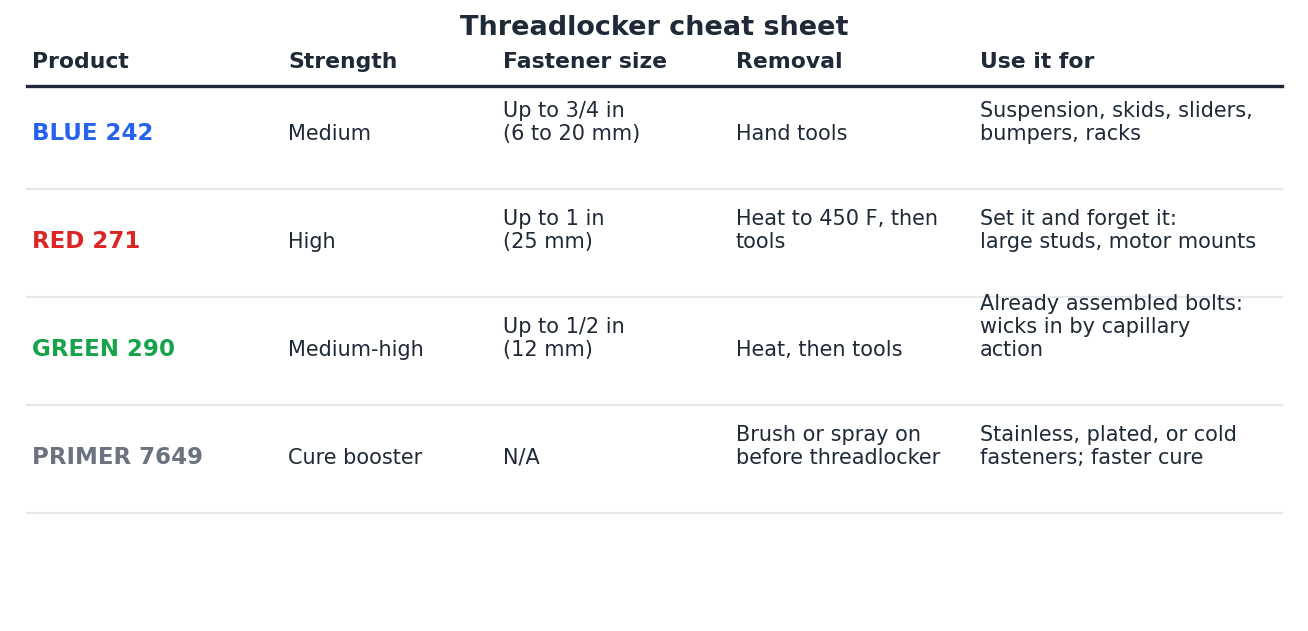
Blue 242: medium strength, the one to buy first. Made for fasteners from 6 to 20 mm (about 1/4 to 3/4 inch), which covers nearly every bolt on a truck you would ever service. It locks the threads against vibration and seals them against rust, and it comes back apart with normal hand tools. Full strength in 24 hours, handling strength in 10 to 20 minutes. Good from minus 65 F to 300 F (minus 54 C to 150 C).[1] If you buy one tube, buy this one.
Red 271: high strength, the commitment. Made for fasteners up to 1 inch (25 mm) that you want permanently locked: big studs, motor mounts, anything structural you do not plan to service. Once cured, it only comes apart with localized heat to 450 F (232 C), then hand tools while the part is still hot.[2] Sets in about 10 minutes, full cure in 24 hours, same minus 65 F to 300 F temperature range as blue.[2] Red is a marriage, not a first date. Most owners propose too soon and regret it at the next service.
Green 290: wicking, for bolts already together. The low viscosity formula creeps into engaged threads by capillary action, so you can lock a fastener without taking it apart first. Made for preassembled fasteners up to 1/2 inch (12 mm), with medium to high strength once cured. Breakaway torque of 90 in-lb (7.5 ft lb) and prevail torque of 260 in-lb (21.7 ft lb) on M10 steel test hardware. Fixture in 20 minutes, full cure in 24 hours, and it needs heat for disassembly like red.[3] The classic use is a set screw or an already torqued bolt you discover is walking loose on the trail.
Primer 7649: the cure booster. A brush or spray on primer for inactive metals like stainless steel and plated fasteners, and it shortens cure time in cold conditions. It is listed as the compatible primer for 242.[4] Most owners never need it. If you are working with stainless hardware or the garage is near freezing, primer is the difference between a bond that cures and one that does not.
Colors Are Not Standardized Across Brands
Blue means medium and red means high strength at Loctite, Permatex, and J-B Weld, but that is convention, not law. Read the strength on the label, not just the color. Permatex sells an orange threadlocker that is high strength yet comes apart with hand tools, a combination Permatex describes as unique to its brand.[7]
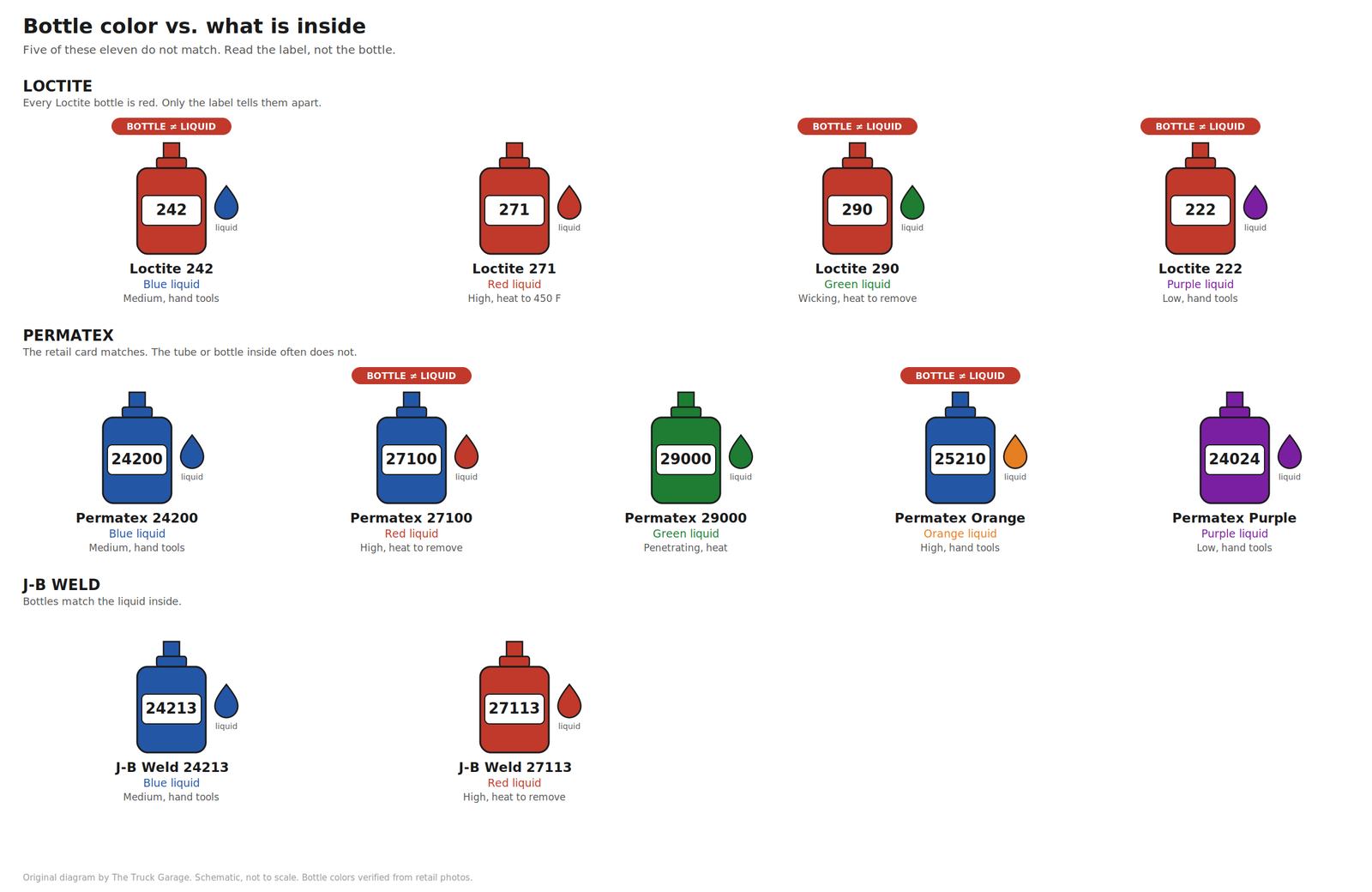
The bottle color does not always match the liquid inside. Every Loctite bottle is red, including the blue 242, the green 290, and the purple 222. Only the label band tells them apart. Permatex is sneakier: the retail card matches the strength color, but the tube inside often does not. The red 27100 comes in a blue tube, and the orange 25210 comes in a blue bottle. Grab “the blue one” off the shelf and you might walk out with red or orange. J-B Weld is the honest one: blue bottle with blue liquid, red bottle with red liquid.[8]
Where To Use It on a Lifted Truck
Rule of thumb: if a fastener takes vibration, you do not adjust it often, and losing it would ruin your day, it gets blue.
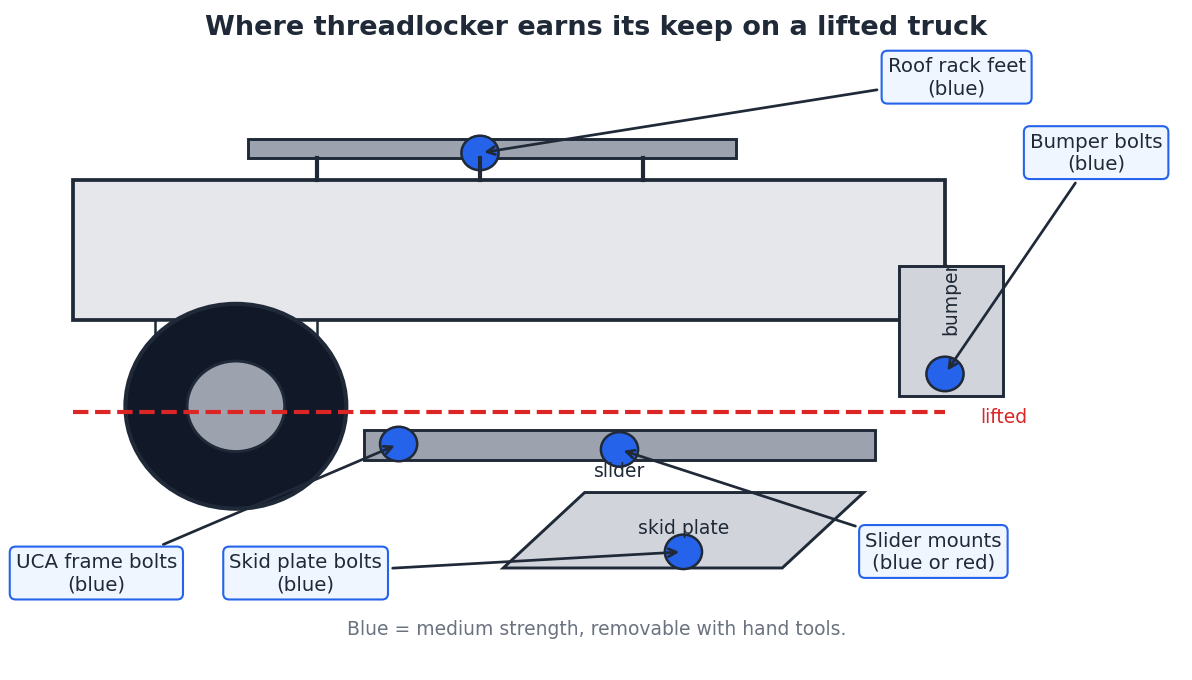
Upper control arm frame bolts. These are the bolts your alignment shop loosens and tightens. Aftermarket UCAs on a lifted truck see constant cycling. Blue on the threads, torqued to spec, and they stay put between alignments.
Skid plate bolts. Small bolts, constant rock strikes and vibration, and losing one means the plate starts flapping. Blue. This is the single most common threadlocker application on a trail truck.
Slider and bumper mounting bolts. Big hardware that rarely gets touched after install. Blue is the safe choice so a future removal is still possible. Red only if the hardware will genuinely never come off again and you are certain of the torque.
Roof rack feet and accessory mounts. Constant wind vibration plus washboard. Blue. Racks are the classic “mystery rattle” that turns out to be a loose foot.
Suspension link and stabilizer hardware. End links, track bar bolts, and sway bar brackets on a lifted truck cycle through more travel than stock. Blue, torqued to spec. For KDSS equipped trucks, the stabilizer hardware is covered in the KDSS guide.
Where Never To Use It
Lug nuts. The factory lug torque of 83 ft lb (112 N·m) assumes dry threads, and threadlocker changes thread friction unpredictably. You also need wheels off fast on the trail for a flat. The correct answer for lugs is a torque wrench and a re-torque after 50 miles, not adhesive.
Torque to yield bolts. Single use stretch bolts, like many engine internal fasteners. Threadlocker does not belong here. Replace the bolt.
Exhaust manifold studs and anything near exhaust heat. Blue and red are rated to 300 F. Exhaust hardware runs far hotter and will cook the bond into useless crust. Use the factory specified hardware and anti-seize where the manual calls for it.
Anything you adjust regularly. Coilover preload collars, adjustable track bars, alignment cams you touch every season. Threadlocker turns a ten minute adjustment into a fight. Use witness marks (covered below) so you can see if they move.
Plastic or composite fasteners. Threadlocker is for metal threads only. The red 271 data sheet specifically warns against use on plastic parts where stress cracking can result.[2]
Prep and Application: The Part Everyone Skips
Threadlocker bonds to clean, dry metal. It does not bond to oil, rust dust, or old threadlocker. The five minute prep is the difference between a joint that holds for years and one that fails on the first dirt road.
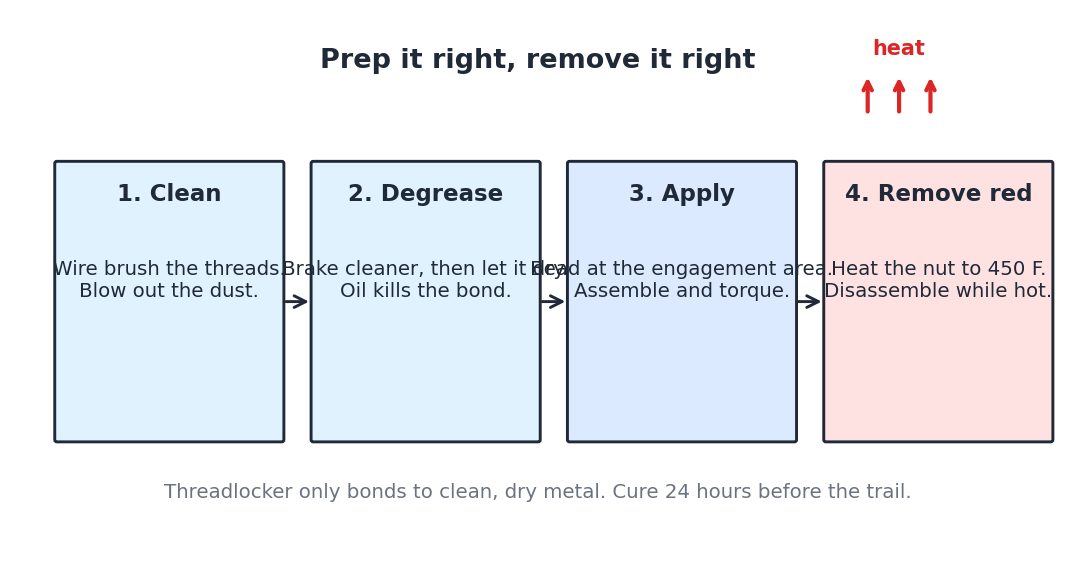
1. Clean. Run a wire brush over the male threads and blow out the female threads. Remove rust dust and any old threadlocker residue.
2. Degrease. Spray brake cleaner on both thread surfaces and let it dry completely. Oil contamination is the number one cause of threadlocker failure.
3. Apply. Put a 360-degree bead on the threads at the nut engagement area, leaving the first thread free so the bolt starts straight. For blind holes, put the drops down the internal threads to the bottom of the hole.[2] Assemble and torque to spec while the product is still wet. A little goes a long way. Drowning the threads does not make a stronger joint.
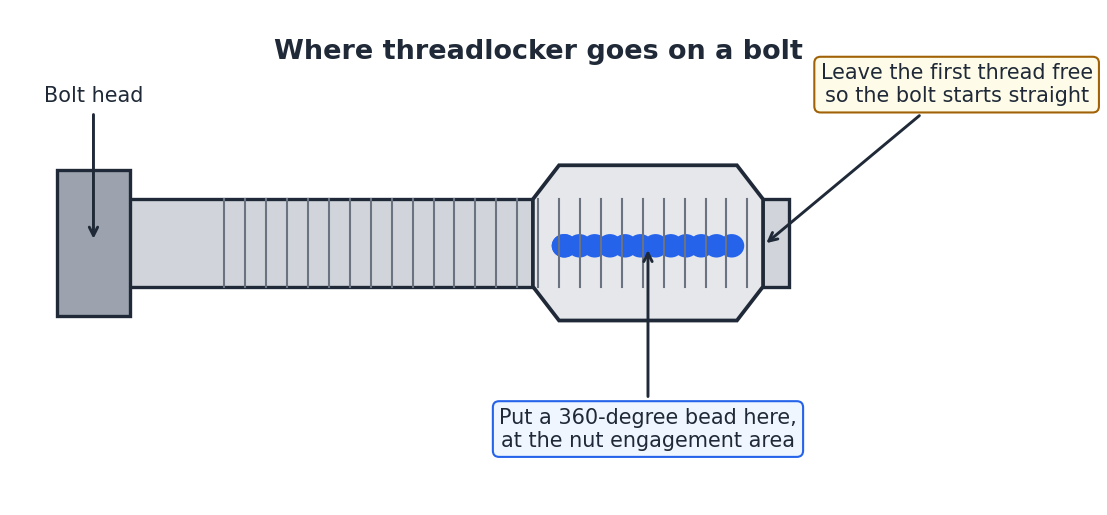
4. Wait. Handling strength in 10 to 20 minutes, full cure in 24 hours for blue, red, and green.[1][2][3] Do not wheel on it the same afternoon. Apply the night before a trail run at the latest.
One note from the factory: the 2005 GX470 factory manual itself specifies “LOCTITE 242 or equivalent” for the transfer case plugs, torqued to 14 ft lb (19 N·m).[5] If blue 242 is good enough for the factory inside the transfer case, it is good enough for your skid plates.
Re-Torque After the Trail
Threadlocker is not a substitute for checking your work. After any suspension install, and after every hard trail run, re-torque the critical fasteners. The GX470 column is verified from the 2005 GX470 factory manual and the GX460 column from the 2013 and 2016-2021 GX460 factory manuals. Every GX460 suspension value below is the same for 2010 through 2021. Only the lug nut torque changed between the early and late trucks. GX550 owners should confirm their values in their own manual.
| Fastener | GX470 | GX460 |
|---|---|---|
| Lug nuts | 83 ft lb (112 N·m) | 82 ft lb (112 N·m) 2010-2015; 76 ft lb (103 N·m) 2016-2021 |
| Lower ball joint attachment nut | 103 ft lb (140 N·m) | 103 ft lb (140 N·m) |
| Lower ball joint attachment bolts (2) | 166 ft lb (225 N·m) | 118 ft lb (160 N·m) |
| Lower arm cam bolt and nut | 100 ft lb (135 N·m) | 129 ft lb (175 N·m) |
| Front shock absorber lower nut | 100 ft lb (135 N·m) | 70 ft lb (95 N·m) |
| Upper ball joint nut | 81 ft lb (110 N·m) | 82 ft lb (110 N·m) |
| Upper arm frame bracket nut | 85 ft lb (115 N·m) | 85 ft lb (115 N·m) |
GX470 values from the 2005 GX470 factory manual front suspension procedures; GX460 values from the 2013 and 2016-2021 GX460 factory manual front suspension procedures and torque specification tables.[6] The GX460 lower ball joint nut gets a new cotter pin at install, and its lower arm cam bolt and nut get their final torque with the suspension settled at ride height. Torque with the suspension at ride height where the procedure calls for it, and use new cotter pins and non-reusable nuts wherever the manual specifies them.
Threadlocker Changes the Torque Reading
Yes, this needs saying: almost every torque spec in the factory manual assumes clean, dry threads, including the table above. Wet threadlocker is a liquid, and liquid on threads changes friction. Henkel’s engineering data notes some threadlocker grades lubricate as well as oils and greases, which means the same wrench reading can produce more clamp load than the dry spec intended.[9] Permatex’s technical data says the opposite for its own products: assemble and tighten as usual, no torque compensation required.[10]
So there is no universal correction factor. The practical rule is to use the torque value the way the manual gives it. When the manual names the threadlocker alongside the torque value, like the GX470 transfer case plugs at 14 ft lb with Loctite 242 called out, that value already accounts for the wet threads. Use it as stated.[5] When you add threadlocker to a fastener whose spec assumes dry threads, check the threadlocker maker’s technical data for that product and follow what it says. Do not invent your own percentage reduction. On standard suspension and chassis hardware the extra clamp load sits inside the bolt’s safety margin. The exception is torque to yield bolts and steel bolts threading into aluminum: use threadlocker sparingly there and follow the manual exactly.
Shadetree Alternatives
No threadlocker in the toolbox does not mean riding on hope.
Nyloc nuts. The nylon insert grips the threads and resists vibration. Good for moderate duty like rack mounts and light brackets. Treat them as one use: once removed, the nylon has lost its grip and the nut is a plain nut.
Double nutting. Run a second nut down against the first and tighten them against each other. The jam nut locks the pair. Ugly, heavy, and it works on large exposed studs.
Safety wire. Drill the bolt heads, run stainless wire so each bolt holds its neighbor from turning. The motorsport standard for critical fasteners. Overkill for a skid plate, exactly right for anything whose failure ends the trip.
Torque seal and witness marks. A stripe of paint or marker across the nut and the bolt after torquing. It does not prevent loosening, but a broken stripe tells you at a glance that something moved. Cheap, fast, and the best early warning system on the truck. Pair it with the re-torque schedule above.
The re-torque schedule itself. Check critical fasteners 50 miles after any install and after every trail run. No product replaces this habit. For the full post-lift checklist, see the lift kits guide.
Parts and Tools
- Blue threadlocker 242, medium strength. The one tube to own.
- Red threadlocker 271, high strength. Only for fasteners you mean to keep forever.
- Green threadlocker 290, wicking. For bolts that are already assembled.
- Primer 7649. Only needed for stainless or plated hardware, or cold weather work.
- Wire brush and brake cleaner for thread prep.
- Torque wrench covering 10 to 170 ft lb for the re-torque table.
- Heat gun or propane torch for red threadlocker removal.
- Torque seal marker or paint pen for witness marks.
- Nyloc nuts in common sizes as the shadetree backup.
Frequently Asked Questions
Can I use red threadlocker on everything to be safe?
No. Red needs 450 F of heat to remove, and most suspension and armor fasteners get serviced eventually. Blue holds against vibration and still comes apart with hand tools. Save red for fasteners you genuinely never want to touch again.
Will threadlocker fix a bolt that keeps loosening because it was never torqued right?
No. Threadlocker locks in whatever clamp load you assembled. If the bolt was under torqued, the joint is still loose and will still flex and fatigue. Torque to spec first, then let the threadlocker keep it there.
How long before I can drive on a threadlocked bolt?
Handling strength in 10 to 20 minutes, full strength in 24 hours. Apply it the night before, not in the trailhead parking lot.
Does threadlocker expire?
Unopened tubes last about two years stored cool and dry. A tube that has gone thick or stringy belongs in the trash. A fresh six dollar tube beats a lost skid plate.
Can I use threadlocker on lug nuts to stop them loosening?
Do not. The factory lug torque assumes dry threads, and you need wheels off quickly for trailside flats. Torque them properly and re-torque after 50 miles.
Sources
- Henkel Loctite 271 technical data sheet: https://datasheets.tdx.henkel.com/LOCTITE-Threadlocker-Red-271—Repair-Liquid-en_US.pdf
- Chempoint Loctite 242 product data: https://www.chempoint.com/en-emea/products/henkel/loctite-adhesives/loctite/loctite-242
- Loctite blue 242 and red 271 manufacturer comparison: https://www.amazon.com/dp/B01EZTPX8A/ref=cm_sw_r_as_gl_api_gl_i_Y9YWQXVY649CZPBCS6AD
- Loctite 290 green wicking threadlocker technical information: https://dfh.fm/products/loctite-290-threadlocker-medium-strength-high-temp-6-ml-tube
- Loctite 290 green wicking threadlocker product data: https://collinstools.com.au/product/loctite-290-green-wicking-grade-medium-strength-threadlocker-industrial-threadlockers-brisbane-qld/
- Zoro Loctite 242 product listing, primer 7649 compatibility: https://www.zoro.com/loctite-threadlocker-loctite-242-blue-medium-strength-liquid-05-ml-capsule-230718/i/G2762706/
- Permatex threadlocker color and strength guide (blue, orange, red, green, purple): https://www.permatex.com/the-right-stuff-threadlocker/
- J-B Weld 24213 blue medium strength threadlocker specifications: https://shop.rplumber.com/c/paint/adhesives-accessories/specialty-adhesives/p/j-b-weld-perma-lock-24213-threadlocker-liquid-mild-organic-red-13-ml-bottle-red
- J-B Weld 27113 red high strength threadlocker specifications: https://shop.rplumber.com/c/paint/adhesives-accessories/specialty-adhesives/p/j-b-weld-perma-lock-27113-threadlocker-liquid-mild-organic-red-13-ml-bottle-red
- Thread-locking compound color and strength table: https://en.wikipedia.org/wiki/Thread-locking_compound
- Henkel Loctite threadlocker engineering manual (lubrication and torque tension): https://dm.henkel-dam.com/is/content/henkel/LOCTITE-Threadlocker-Manual
- Permatex Medium Strength Threadlocker Blue technical documentation (no torque compensation required): https://pdf.directindustry.com/pdf/permatex/medium-strength-threadlocker-blue/25365-563255.html
- 2005 Lexus GX470 factory manual, transfer case plug sealant specification and front suspension torque procedures (on file)
- 2013 and 2016-2021 Lexus GX460 factory manuals, front suspension torque specification tables and installation procedures (on file)
Footnotes
[1] Loctite 242: medium strength, for 6 to 20 mm fasteners, removable with hand tools, full cure 24 hours, fixture 5 to 20 minutes, service temperature minus 65 F to 300 F. Break and prevail torque 110 and 43 in-lb per the manufacturer comparison table. Sources: Chempoint product data and the manufacturer comparison table.
[2] Loctite 271: high strength, for fasteners up to 1 inch, removable only by heating to 450 F (232 C), sets in about 10 minutes, full cure 24 hours, minus 65 F to 300 F. Break and prevail torque 250 and 275 in-lb per the manufacturer comparison table. Not for use on plastic parts. Sources: Henkel technical data sheet and the manufacturer comparison table.
[3] Loctite 290: green wicking grade, medium to high strength, for preassembled fasteners up to 1/2 inch (12 mm), penetrates by capillary action, breakaway 90 in-lb and prevail 260 in-lb on M10 steel hardware, fixture 20 minutes, full cure 24 hours, disassembly with heat. Sources: DFH and Collins Tools product technical information.
[4] Loctite 7649 listed as the compatible primer series for 242. Source: Zoro product listing.
[5] 2005 GX470 factory manual, transfer case assembly procedure: sealant specified as part 08833-00080, THREE BOND 1344, LOCTITE 242 or equivalent, torqued to 19 N·m (14 ft·lbf).
[6] GX470, 2005 GX470 factory manual, front suspension procedures: lower ball joint attachment nut 140 N·m (103 ft·lbf), attachment bolts 225 N·m (166 ft·lbf), lower arm cam bolt and nut 135 N·m (100 ft·lbf), front shock absorber lower nut 135 N·m (100 ft·lbf), upper ball joint nut 110 N·m (81 ft·lbf), upper arm frame bracket nut 115 N·m (85 ft·lbf), front disc wheel 112 N·m (83 ft·lbf). GX460, 2013 GX460 factory manual, front suspension torque specification table and installation procedures: lower ball joint attachment nut 140 N·m (103 ft·lbf) with new nut and cotter pin, attachment bolts (2) to front axle 160 N·m (118 ft·lbf), lower arm bolt and nut 175 N·m (129 ft·lbf) tightened at ride height, front shock absorber lower nut 95 N·m (70 ft·lbf), upper arm to steering knuckle 110 N·m (82 ft·lbf), upper arm to chassis frame 115 N·m (85 ft·lbf), front wheel 112 N·m (82 ft·lbf). All GX460 suspension values confirmed identical in the 2016-2021 GX460 factory manual torque specification table; 2016-2021 front wheel torque is 103 N·m (76 ft·lbf).
[7] Brand color mapping: Permatex official threadlocker page (blue medium, orange high strength removable and unique to Permatex, red high strength almost permanent, green low viscosity penetrating grade, purple low strength). J-B Weld 24213 blue medium strength with hand tool disassembly, 27113 red high strength requiring heat and hand tools. Loctite purple 222 low strength per the general threadlocker color table. Sources: Permatex, R&R Products J-B Weld spec sheets, Wikipedia thread-locking compound.
[8] Bottle colors verified by inspecting retail product photos in September 2026 for all eleven products. Loctite bottles are red across 242, 271, 290, and 222 (10 ml and 50 ml). Permatex 27100 ships in a blue 6 ml tube and Orange 25210 in a blue 10 ml bottle; the retail cards are color matched but the containers are not. J-B Weld 24213 is a blue bottle and 27113 a red bottle. Liquid colors per manufacturer specification and packaging illustrations. Sources: GCM Store (Loctite 242), Power Oil Center (Loctite 271), Ellsworth Adhesives (Loctite 222), Torque King (Permatex 24200), Bills Performance (Permatex 27100), Capital Auto Parts (Permatex 29000), SupremeDIY (Permatex Orange 25210), Mathias Power Parts (Permatex Purple 24024), JB Tools (J-B Weld 24213), Beach Audio (J-B Weld 27113).
[9] Henkel Loctite threadlocker engineering manual: some threadlocker grades provide equal levels of lubrication to oil and greases, narrowing torque tension scatter; friction absorbs 80 to 90 percent of tightening torque. Source: Henkel LOCTITE threadlocker manual.
[10] Permatex Medium Strength Threadlocker Blue technical documentation: “No torque compensation required during assembly”; “Assemble and tighten as usual. When tightening to established torque values, torque compensation is not required.” Source: Permatex technical documentation.
Leave a Reply