You lifted your GX two and a half to three inches, got the alignment checked, and the shop tells you the caster is maxed out and the truck still wanders. Or you are planning the lift and wondering whether the upper control arms on your shopping list are actually necessary. This guide answers that question directly for the GX470 (2003-2009) and GX460 (2010-2023), and the advice carries over to the shared-platform 4Runner, Tacoma, and FJ Cruiser where verified.
The short answer
At 2.5 inches, you can usually get away with the stock upper control arms. At 3 inches, you usually cannot, and at anything past 3 inches the answer is yes without qualification. The stock arms are fine until the alignment shop runs out of adjustment. Once the lower control arm cams are maxed out and the caster is still short of where it needs to be, the stock arms are the limiting part, not the lift [1][2].
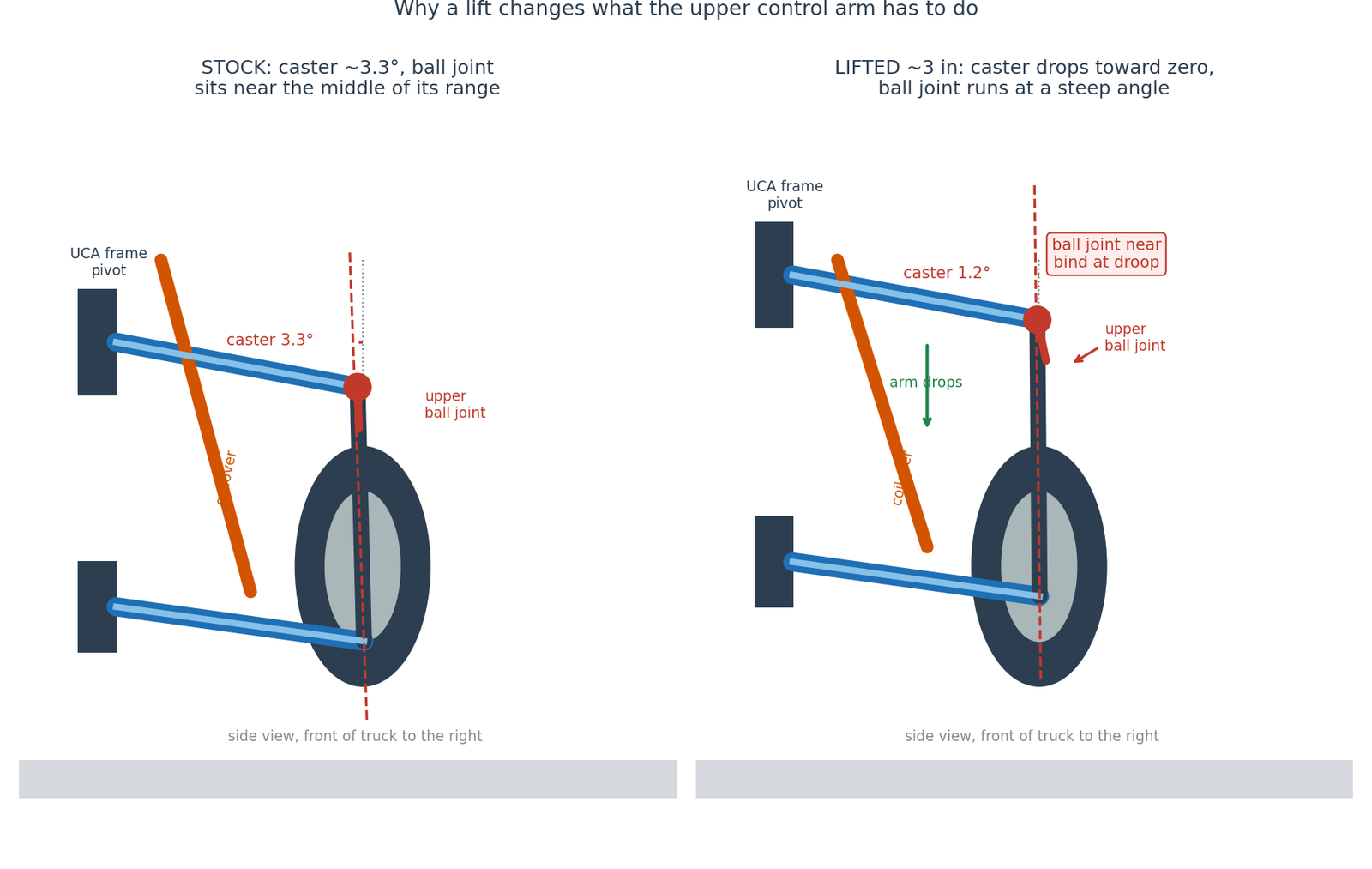
Why the 2.5 to 3 inch range is the crossover: lifting drops the whole front suspension further into its travel, which swings the arms down and pulls the upper ball joint toward the end of its range. As a rule of thumb, owners report losing roughly a degree of caster adjustment per inch of lift, so a 3 inch lift eats about 3 degrees of what the factory cams can provide [3]. No factory source quantifies this; treat it as an owner-reported guideline rather than a formula. The stock cams only have a few degrees to give. Past about 3 inches there is simply not enough left to land the alignment, and the ball joint itself starts running at angles it was never meant to hold [2].
Why the stock UCA becomes a problem
Three things happen when you lift, and all three point at the upper arm.
Caster loss. Caster is the backward tilt of the steering axis, and it is what makes the truck track straight and the wheel return to center. The factory spec is about 3.3 degrees positive on the GX470 (3.28 deg +/- 0.75 deg) and 3.3 to 3.5 degrees on the GX460 depending on seating capacity [4][5]. As the arms droop with a lift, the top of the knuckle moves forward and caster drops toward zero. On stock UCAs with a 3 inch lift, owners commonly report the shop can only recover 1 to 1.5 degrees of caster before the lower control arm cams hit their stops [6]. That is less than half of factory spec, and it is the main reason lifted trucks feel vague and wander at highway speed.
Ball joint bind at full droop. The upper ball joint on the stock arm is a sealed, greased-for-life joint sized for stock geometry. With the arm hanging lower after a lift, the joint runs near the end of its angular range, and at full droop it can bind or bottom out. Aftermarket arms fix this two ways: they reshape the arm so it clears the coilover at droop, and they use a joint with more angular range. That joint is either a high-articulation ball joint (JBA’s Max 90, for example) or a uniball (the 1 in uniball with high-misalignment spacers in Total Chaos arms, for example) [7][13]. The cutaway comparison below shows how the two joint designs differ.
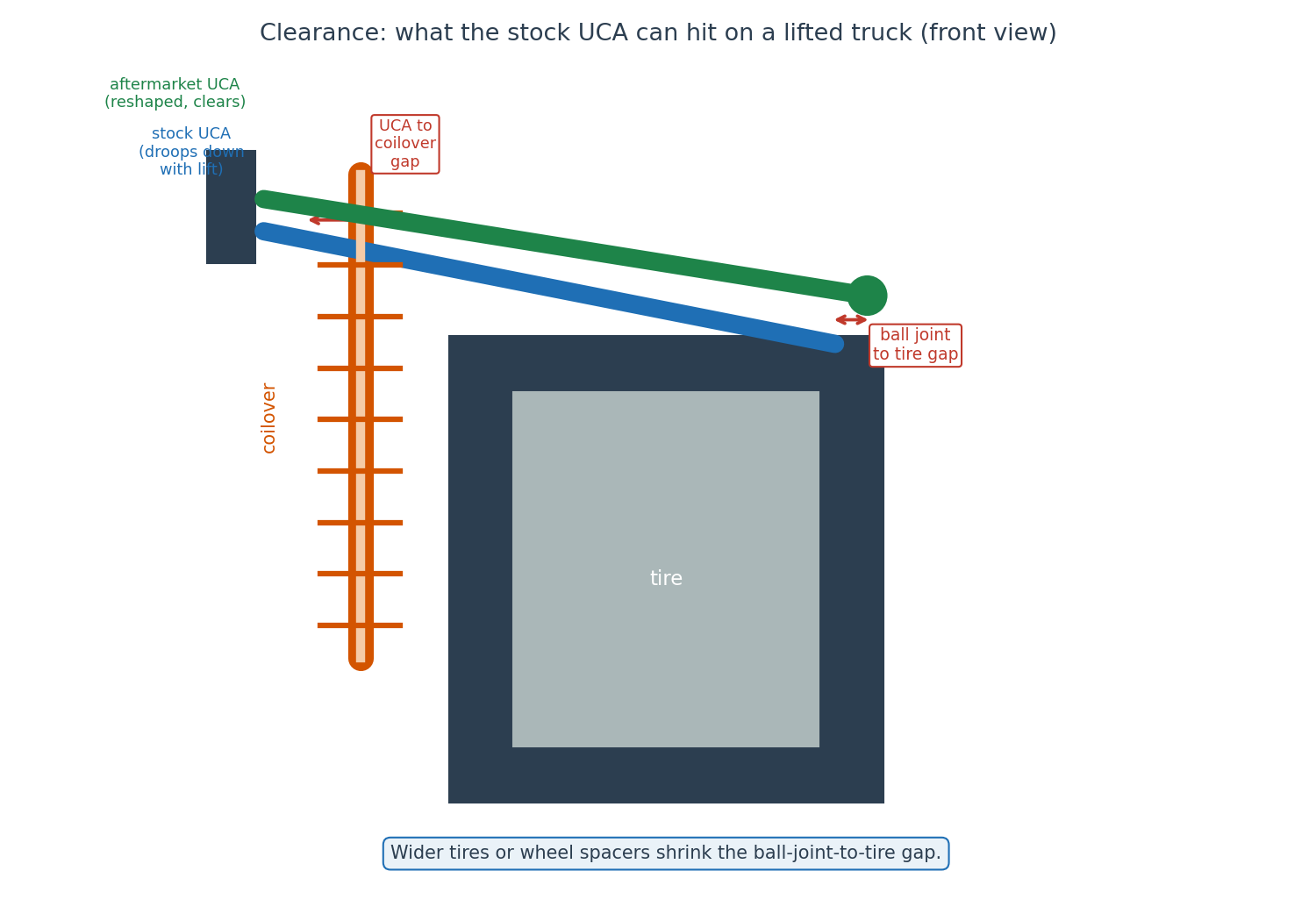
Clearance. A drooping stock arm gets closer to the coilover, and the ball joint and arm sit closer to the tire. Wide tires, low-offset wheels, or wheel spacers make this worse [8]. Aftermarket arms are built with a different shape that opens up clearance to the coil spring at full articulation, which SuperPro calls out explicitly in its design claims [9].
How to tell you need them
The alignment printout is the definitive test. If the lower control arm cams are at or near their maximum and caster is still below about 2 degrees on a 3 inch lift, the stock arms are the problem. Owners report this exact scenario constantly: the shop maxes the cams, the truck still will not hold caster, and the only fix left is arms with more correction built in [1][6].
The other signs:
- The truck wanders at highway speed or the steering feels dead on center after the lift, even with toe set correctly. Low caster is the usual cause.
- You can see the upper ball joint sitting at a steep angle at ride height, or the arm is visibly close to the coilover.
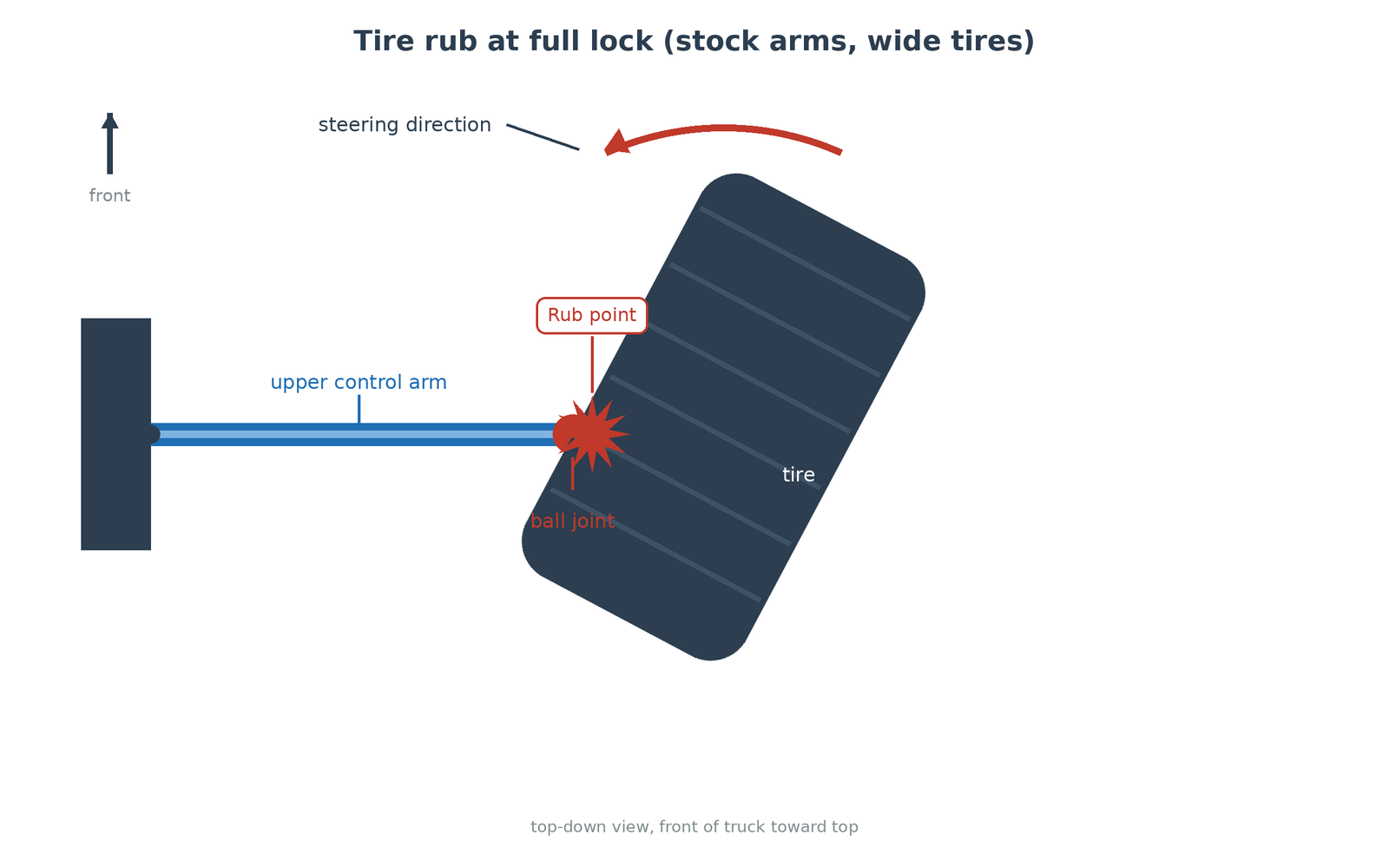
- The tire rubs the stock arm or ball joint at full lock, especially with wider tires or spacers [8].
- The shop tells you the cams are frozen. This is worth separating from the lift question. Seized lower control arm cams on a high-mileage truck will make any alignment impossible, lifted or not, and some owners fix it with new cams and fresh lower arms before blaming the uppers. Adjustable UCAs like SPC’s can compensate for frozen cams by setting camber at the arm, but freeing or replacing the cams is the better repair: seized cams limit every alignment correction, no matter which arms are installed [10].

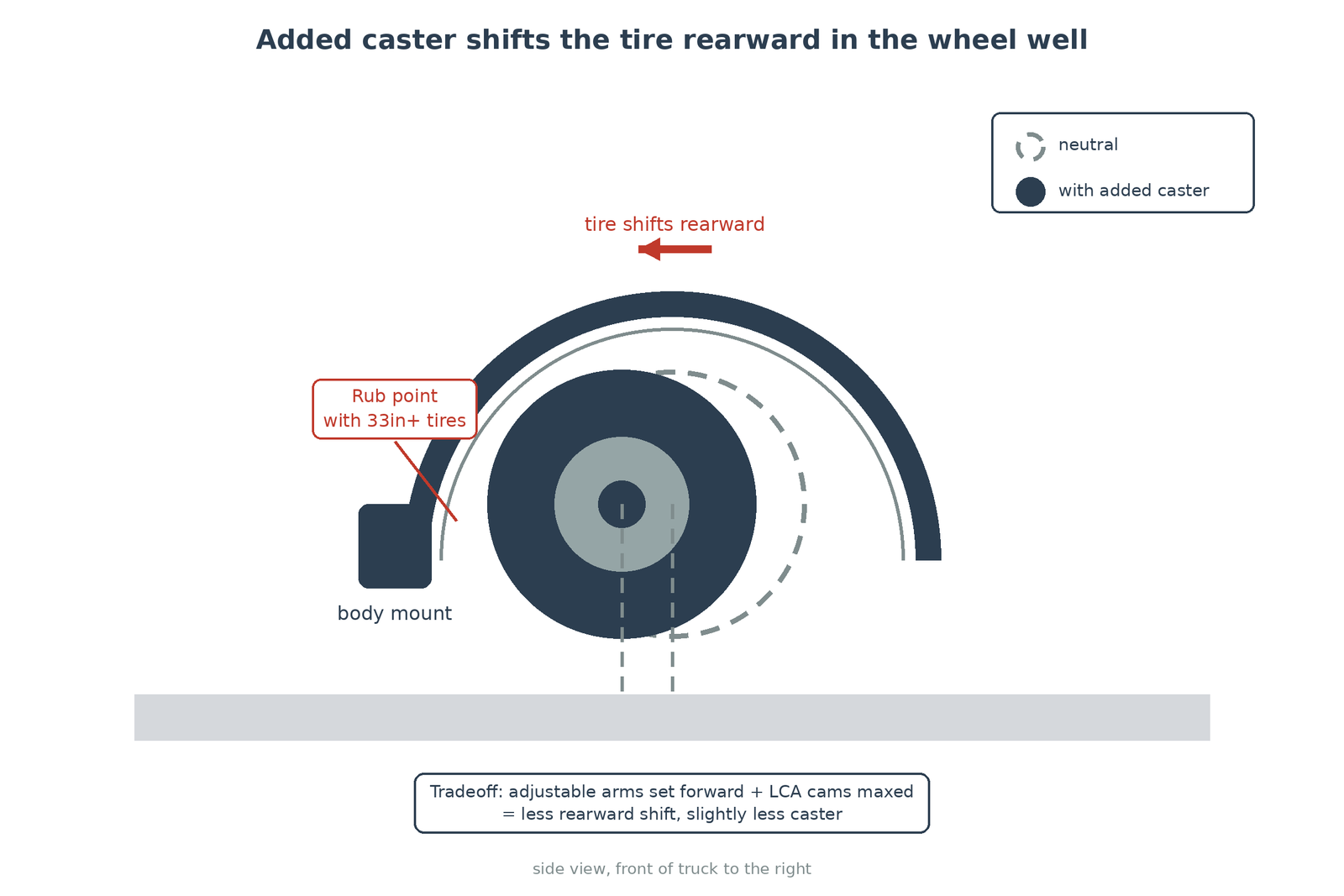
One more wrinkle: adding caster with aftermarket arms moves the tire slightly rearward in the wheel well. Total Chaos says this outright in its own instructions. That extra rearward shift is why high-caster arms can create or worsen body mount rub with 33 inch and larger tires, and why some owners choose to run their adjustable arms set forward with the LCA cams maxed instead, trading a little caster for firewall clearance [11][6]. If you are running 285/70R17 or bigger, read the body mount section of the tire fitment guide before choosing your alignment targets.
The aftermarket options
Every arm below has real owner evidence behind it. All of them correct caster for a lifted truck. They differ in how they correct it, what joint they use, and how much the alignment shop can do with them.
| Brand | Joint type | Caster correction | Notable |
|---|---|---|---|
| SPC | Adjustable ball joint | Up to 4 deg total (+3 to -1), plus adjustable camber | The pick when LCA cams are frozen or the shop needs maximum room: the only common arm that sets both caster and camber at the arm [10][12] |
| Total Chaos | 1 in uniball | About 2 deg fixed | Tubular 4130 chromoly, PTFE-lined uniball, greasable urethane bushings; the pick for hard wheeling, with the maintenance tradeoff covered below [7] |
| JBA | High-articulation ball joint | High caster built in | Bolt-in replaceable ball joints, greasable bushings, sells direct only; the daily-driver pick, with a 365-day return policy several owners cite as the reason they tried them [13][14][17] |
| Camburg | Ball joint or uniball | Fixed correction | Both joint styles offered; ball joint version is the daily-driver favorite, uniball version for hard use [15] |
| Icon | Varies (tubular or billet) | Fixed correction, some billet arms adjustable at the frame | Check the fine print: some Icon arms instruct cutting 1/4 in off the inner tie rod for toe adjustment [16] |
| SuperPro | Fixed offset ball joint | 2 to 3.5 deg (vendor claim) | Bolt-on fixed geometry for 50 to 75 mm lifts, no adjustment to fiddle with [9] |
Shopping for a joint you can grease yourself? See the Notable column: JBA’s ball joints are greasable.
Shadetree note on budget: cheap no-name tube arms exist at a fraction of these prices. Nothing in the owner record vouches for their weld quality or joint longevity, and the UCA is not the part to gamble on. It holds the top of your steering knuckle.
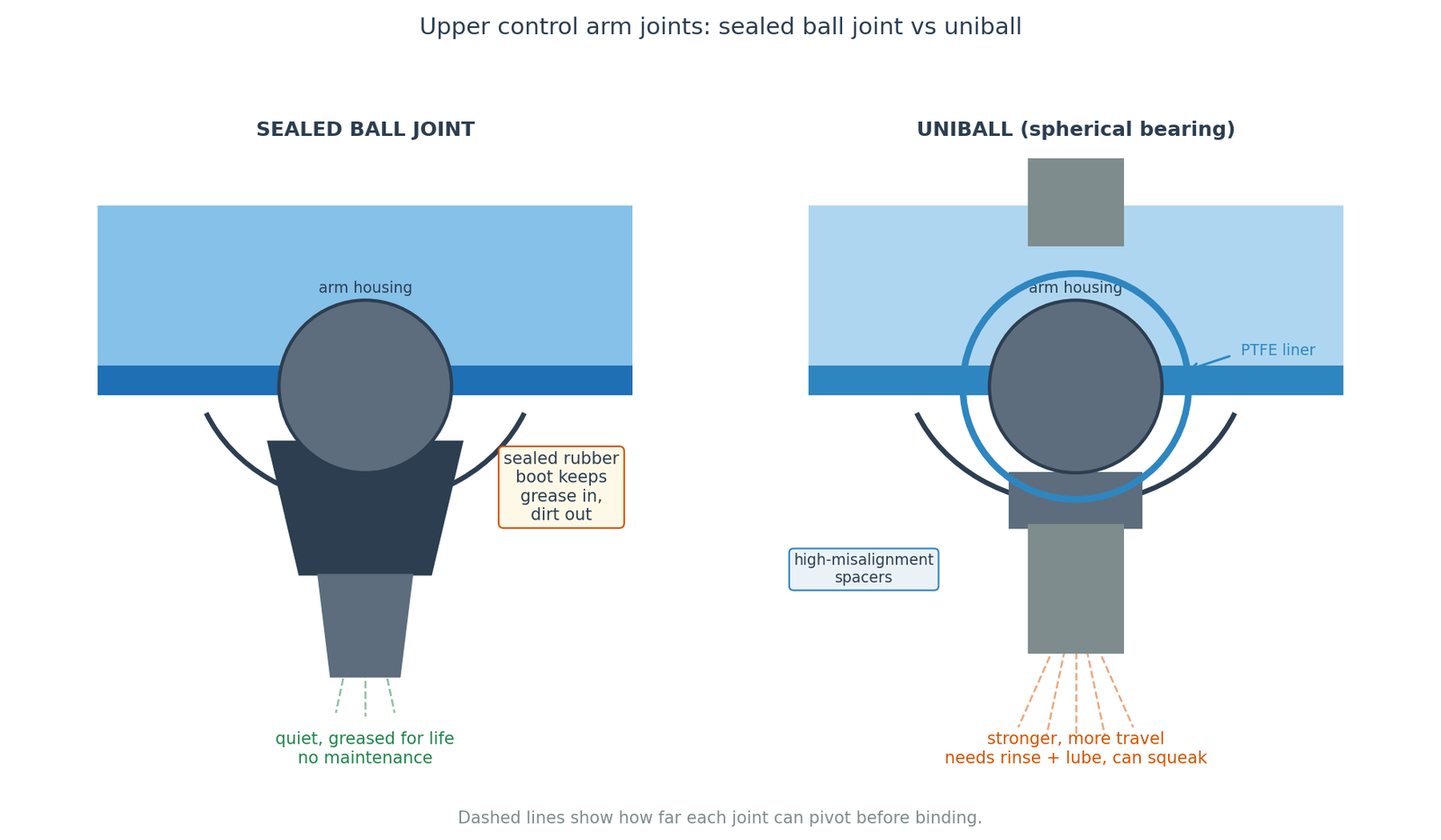
Uniball vs sealed ball joint
This is the key tradeoff inside the UCA purchase, and owners split along use lines.
Sealed ball joints are the quiet, zero-maintenance option. The joint is greased at the factory, sealed under a rubber boot, and you never touch it. For a daily driver that sees fire roads, snow, and moderate trails, they are plenty strong. One frequently quoted summary: the uniball is a racing design where strength was the goal and longevity was not a factor, while the ball joint’s whole point is longevity with no maintenance [18].
Uniballs are stronger and pivot further before binding, which matters when the suspension is cycling hard. The Total Chaos design uses a heat treated stainless ball and race with a military grade PTFE liner, plus high-misalignment spacers that add droop travel [7]. The cost is maintenance: uniballs squeak when they dry out, need an occasional rinse and lube, and in salt climates owners report them needing replacement after about two years even with lubrication [19]. A can of silicone spray in the truck quiets them on a trip, but it is a recurring chore the ball joint owner never does [18].
| Your use | Pick |
|---|---|
| High-speed desert running or hard wheeling, where extra travel and strength matter | Uniball [15] |
| Daily driver with a lift for clearance and looks | Sealed ball joint: same alignment job, no noise, no maintenance [15][18] |
Note that even with uniball uppers, the lower ball joint is still an OE-style joint, so it still needs attention on its own schedule [18].
What it costs
Arm prices move, so treat these as order of magnitude. JBA listed its GX470 kit at $853 at research time [13]. SPC and Total Chaos pairs land in the same general neighborhood. Budget tube arms run a few hundred dollars less but carry the quality caveat above.
Shop install is typically a few hours of labor per the owner record, plus an alignment afterward, and the alignment is not optional. Get the alignment done by a shop that understands lifted trucks: the target is not the factory caster number, it is as much positive caster as the combination of arms and cams will give while keeping camber near zero and toe in spec. Owners regularly land at 3.5 to 4.5 degrees of caster on lifted trucks and report the steering feels better than stock [20][21]. If the shop insists on forcing caster back inside the factory window, find another shop [2].
Shadetree math: doing it yourself saves the labor and costs you a Saturday, a ball joint separator, and a torque wrench. You still pay for the alignment.
Parts and tools
No part numbers are listed here because arm part numbers vary by brand, model year, and joint choice, and the factory UCA is sold as a complete assembly. Verify fitment for your exact year on the vendor’s page before ordering.
| Item | Notes |
|---|---|
| Aftermarket UCA pair | SPC, Total Chaos, JBA, Camburg, Icon, or SuperPro; match to your lift height (most cover 1 to 3.5 in or 2 to 4 in) |
| New cotter pins or clips | The factory ball joint nut gets a new cotter pin (GX470) or clip (GX460) on install; the NEIKO 555-piece assortment covers every size you will touch up front |
| Penetrating oil | PB Blaster on the UCA frame pivot bolt and ball joint taper; soak the night before on rust belt trucks |
| Ball joint separator | Scissor-type separator (OEMTOOLS 25112); kinder to the boot than a pickle fork, works with a 3/4 in socket or wrench |
| Torque wrench, 1/2 in drive | TEKTON 24335, 10 to 150 ft lb range; suspension hardware here runs 70 to 118 ft lb |
| Grease gun and grease | Lumax LX-1152 pistol gun with 18 in flex hose; for arms with greasable bushings or uniballs |
Install overview
This is a driveway job on both trucks. The factory procedure is nearly identical between the GX470 and GX460, which is no surprise since the front suspension architecture carried over. Work one side at a time so the knuckle never hangs by the brake hose.
- Truck on jack stands, wheel off. Soak the UCA frame pivot bolt and the ball joint nut with penetrating oil.
- Separate the upper ball joint from the steering knuckle: remove the cotter pin or clip and the nut, then break the taper with a separator. Do not hammer the stud threads directly.
- Remove the long bolt through the frame pivot and pull the arm out. Note the washer positions.
- Install the new arm. Leave the frame pivot bolt snug but not torqued.
- Seat the ball joint stud in the knuckle, install the nut, and torque it. GX470: 81 ft lb (110 N.m), then a new cotter pin. GX460: 81 ft lb (110 N.m), then a new clip [22][23].
- Reinstall the wheel, lower the truck to the ground, and bounce the suspension a few times to settle it. The factory manuals are explicit about this step: rubber-bushed pivots must be torqued at ride height, not hanging in the air [22][23].
- With the full weight on the tires, torque the UCA frame pivot nut. GX470: 85 ft lb (115 N.m). GX460: 85 ft lb (115 N.m) [22][23].
- Drive straight to the alignment shop. Do not put serious miles on it first.
Shadetree notes: the ball joint taper is the fight on high-mileage trucks. A scissor separator plus a sharp hammer hit on the knuckle ear (never the stud) breaks most of them. If the frame pivot bolt is seized in the bushing sleeve, cut it out with a reciprocating saw and replace the bolt; this is common enough on rust belt trucks that having a spare bolt on hand before you start is cheap insurance. Aftermarket arms with greasable bushings: grease them after the pivot is torqued at ride height, not before, so you do not deform the bushings. Some arms ship with the bushings pre-greased; follow the maker’s instructions rather than adding more.
Torque reference (factory, verified from the manuals on file):
| Fastener | GX470 | GX460 |
|---|---|---|
| UCA ball joint nut | 81 ft lb (110 N.m), new cotter pin | 81 ft lb (110 N.m), new clip |
| UCA frame pivot nut | 85 ft lb (115 N.m), at ride height | 85 ft lb (115 N.m), at ride height |
| Shock lower bolt/nut | 100 ft lb (135 N.m), at ride height | 70 ft lb (95 N.m) |
| Shock upper 3 nuts | 47 ft lb (64 N.m) | 47 ft lb (64 N.m) |
| Wheel nuts | 83 ft lb (112 N.m) | 83 ft lb (112 N.m) |
A note on the GX550
The GX550 is a different platform generation with its own front suspension design, so GX470/GX460 arms and geometry do not carry over. The same principles apply (lift eats caster, the UCA is the fix), but arm choices and fitment for the 250 series need their own research. This guide does not cover them.
Related guides
- Lift Kits & Suspension for the Lexus GX: A Practical Guide (companion: choosing the lift itself)
- GX Tire Size & Fitment Guide (companion: what tire sizes fit, body mount chop, wheel offset)
FAQ
Do I need UCAs with a 2 inch lift? Usually not. At 2 inches the factory cams still have enough range to land the alignment on most trucks. Spend the money on the lift and the alignment first.
Do I need UCAs with a 2.5 inch lift? Maybe. This is the gray zone. If the alignment comes back with good caster numbers, you are fine. If the cams are maxed and caster is short, you need them. Many owners install them at 2.5 inches preemptively to give the shop room to work.
Do I need UCAs with a 3 inch lift? Plan on it. The owner record is consistent: at 3 inches the stock arms leave the shop with 1 to 1.5 degrees of caster at best, the truck wanders, and the ball joints are running at angles they were not designed for [6][2].
Will aftermarket UCAs fix my wandering steering? If the wandering is from low caster after a lift, yes, that is exactly what they fix. If the truck wandered before the lift, check tie rod ends, lower ball joints, and bushings first.
Can I install UCAs and skip the alignment? No. New arms change every angle up front. The install is not done until the alignment is done.
Uniball or ball joint for a daily driver? Ball joint. Quieter, no maintenance, and strong enough for everything short of hard high-speed off-road use [15][18].
Do UCAs give me more tire clearance? Slightly, and in the wrong direction for some trucks. Aftermarket arms reshape the arm for more coilover and ball joint clearance, but the added caster moves the tire rearward in the wheel well, which can increase body mount rub with big tires [11]. For tire fitment questions, see the GX Tire Size & Fitment Guide.
Do I need a diff drop or extended brake lines with UCAs? UCAs do not change those answers. A diff drop addresses CV angles on lifted trucks and brake line length depends on your shock travel. Both are covered in the lift kit guide.
Sources
- 2005 Lexus GX470 factory repair manual, front suspension and wheel alignment sections (on file)
- 2013 Lexus GX460 factory repair manual, front shock absorber and front upper suspension arm sections (on file)
- Total Chaos, body mount clearance instructions: https://lexusgxor.com/_media/general:chaos_fab_96504.pdf
- Tundras.com, Everything you need to know about Upper Control Arms (UCA): https://www.tundras.com/threads/everything-you-need-to-know-about-upper-control-arms-uca.4497/page-10
- IH8MUD, Upper control arm issues: https://forum.ih8mud.com/threads/upper-control-arm-issues.1267225/
- IH8MUD, New member intro and recommendations needed for UCA vs BMC: https://forum.ih8mud.com/threads/new-member-intro-and-recommendations-needed-for-uca-vs-bmc.1327953/
- IH8MUD, SPC UCA owners… GET IN HERE!!! (caster settings): https://forum.ih8mud.com/threads/spc-uca-owners-get-in-here-caster-settings.843495/page-3
- Tacomaworld, Alignment Issues / Caster Adjustment: https://www.tacomaworld.com/threads/alignment-issues-caster-adjustment.506028/
- Tundras.com, Alignment after lift seems off: https://www.tundras.com/threads/alignment-after-lift-seems-off.80880/
- Tundras.com, Alignment issues with Icon UCA and ICON coilovers: https://www.tundras.com/threads/alingment-issues-with-icon-uca-and-icon-coilovers-tie-rods-bottomed-out.10423/page-2
- Tacomaworld, The truth about Uniball’s: https://www.tacomaworld.com/threads/the-truth-about-uniballs.90685/
- Tacomaworld, Uniball vs standard ball joints: https://www.tacomaworld.com/threads/uniball-vs-standard-ball-joints.324265/
- 4runners.com, Balljoint UCAs or Uniballs with King Coilovers?: https://www.4runners.com/threads/balljoint-ucas-or-uniballs-with-king-coilovers.18417/
- 4runners.com, Advice on Balljoint UCA: https://www.4runners.com/threads/advice-on-balljoint-uca.29844/
- JBA Offroad, Lexus GX470 upper control arms: https://jbaoffroad.com/upper-control-arms/lexus-upper-control-arms/gx470-2003-2009
- Speedzone Performance, SuperPro fixed offset front upper control arm set (GX460/4Runner): https://speedzone-web.com/en-mx/products/superpro-03-23-toyota-4runner-10-23-lexus-gx460-fixed-offset-front-upper-control-arm-set
- 4x4works, SuperPro fixed front upper control arms (GX470): https://www.4x4works.co.uk/product/superpro-fixed-front-upper-control-arms-lexus-gx470-2002-09-offset-pair/
- IH8MUD, Most mild GX470 lifts don’t permit additional tire clearance/size correct?: https://forum.ih8mud.com/threads/most-mild-gx470-lifts-dont-permit-additional-tire-clearance-size-correct.1242291/
- IH8MUD, Analysis paralysis with GX460 lift, wheels, and tires decisions: https://forum.ih8mud.com/threads/analysis-paralysis-with-gx460-lift-wheels-and-tires-decisions.1269106/page-2
- Tacomaworld, Tires are rubbing on upper control arm.: https://www.tacomaworld.com/threads/tires-are-rubbing-on-upper-control-arm.485287/
- Irate4x4, Caster: IFS 4Runner Questions: https://irate4x4.com/threads/caster-ifs-4runner-questions.379502/
Footnotes
[1] Tundras.com, Alignment after lift seems off: stock UCAs usually OK up to 2.5 to 3 inches; beyond that new UCAs are needed to get alignment back to acceptable levels. https://www.tundras.com/threads/alignment-after-lift-seems-off.80880/
[2] Tundras.com, Alignment issues with Icon UCA and ICON coilovers: with lifted trucks caster should be positive and above factory spec; most alignment shops do not know that. https://www.tundras.com/threads/alingment-issues-with-icon-uca-and-icon-coilovers-tie-rods-bottomed-out.10423/page-2
[3] 4x4works, SuperPro fixed front upper control arms: for every inch of lift you lose a degree of adjustment; offset arms restore the lost degrees. https://www.4x4works.co.uk/product/superpro-fixed-front-upper-control-arms-lexus-gx470-2002-09-offset-pair/
[4] 2005 Lexus GX470 factory repair manual, front wheel alignment: caster 3.28 deg +/- 0.75 deg, camber 0.02 deg +/- 0.75 deg, steering axis inclination 12.48 deg +/- 0.75 deg. On file.
[5] 2013 Lexus GX460 factory repair manual, front wheel alignment: caster 3.32 deg +/- 0.50 deg (5-seater), 3.53 deg +/- 0.50 deg (7-seater). On file.
[6] Tacomaworld, Alignment Issues / Caster Adjustment: on stock UCAs with a 3 inch lift expect 1 to 1.5 deg caster max; Total Chaos arms add about 2 deg; SPC allows much higher caster. https://www.tacomaworld.com/threads/alignment-issues-caster-adjustment.506028/
[7] Tundras.com, Everything you need to know about Upper Control Arms (UCA): Total Chaos arms add caster for 2.5 to 3 inch lifts; 1 in uniball with heat treated stainless ball and race, PTFE liner, high-misalignment spacers, urethane bushings with zerk fittings. https://www.tundras.com/threads/everything-you-need-to-know-about-upper-control-arms-uca.4497/page-10
[8] Tacomaworld, Tires are rubbing on upper control arm: 3 inch dealer lift, tire rubbing the UCA at full lock; aftermarket UCAs plus correct wheels or spacers are the fix. https://www.tacomaworld.com/threads/tires-are-rubbing-on-upper-control-arm.485287/
[9] Speedzone Performance, SuperPro fixed offset UCA: increased clearance between spring and control arm at full articulation; 2.5 to 3.5 deg caster increase at 50 mm lift. https://www.speedzone-web.com/en-mx/products/superpro-03-23-toyota-4runner-10-23-lexus-gx460-fixed-offset-front-upper-control-arm-set
[10] IH8MUD, Upper control arm issues: SPC offers 4 degrees total caster correction (+3 to -1 deg); most other UCAs have fixed correction of 1 to 1.5 deg; SPC can also set camber, helpful with frozen LCA cams. https://forum.ih8mud.com/threads/upper-control-arm-issues.1267225/
[11] Total Chaos, body mount clearance instructions: TC A-arms add caster which moves the tire back slightly in the wheel well; may require cutting back body mounts with larger tires. https://lexusgxor.com/_media/general:chaos_fab_96504.pdf
[12] IH8MUD, SPC UCA owners caster settings: position D gives +1 deg caster correction; owner achieved caster 2.7/3.1 after SPC install. https://forum.ih8mud.com/threads/spc-uca-owners-get-in-here-caster-settings.843495/page-3
[13] JBA Offroad, Lexus GX470 upper control arms: designed for 1 to 3.5 inch lifts, Max 90 ball joints, EZ Lube bushings, lifetime structural warranty, 365-day return policy, listed at $853.00. https://jbaoffroad.com/upper-control-arms/lexus-upper-control-arms/gx470-2003-2009
[14] 4runners.com, Advice on Balljoint UCA: JBA sells direct only; ball joints bolt in and cross to AC Delco 45D0062 / Raybestos 500-1062 / Moog K6292 in an emergency. https://www.4runners.com/threads/advice-on-balljoint-uca.29844/
[15] 4runners.com, Balljoint UCAs or Uniballs with King Coilovers?: ball joints recommended for daily drivers; no travel benefit from uniballs at stock travel. https://www.tacomaworld.com/threads/balljoint-ucas-or-uniballs-with-king-coilovers.18417/
[16] Tundras.com, Alignment issues with Icon UCA: some Icon arms instruct cutting 1/4 in off the inner tie rod for toe adjustment. https://www.tacomaworld.com/threads/alingment-issues-with-icon-uca-and-icon-coilovers-tie-rods-bottomed-out.10423/page-2
[17] IH8MUD, New member intro and recommendations needed for UCA vs BMC: owner on JBA UCAs with Dobinsons 2.5 lift achieved about +3.5 deg caster; JBA 12-month return policy. https://forum.ih8mud.com/threads/new-member-intro-and-recommendations-needed-for-uca-vs-bmc.1327953/
[18] Tacomaworld, The truth about Uniball’s and Uniball vs standard ball joints: uniball is a racing design, strength is the goal, longevity and no maintenance were not design factors; ball joint UCAs need no maintenance and make no noise. https://www.tacomaworld.com/threads/the-truth-about-uniballs.90685/
[19] IH8MUD, Analysis paralysis with GX460 lift, wheels, and tires decisions: owner reports Total Chaos uniball joints squeaked after 1.5 years and needed replacement after 2 years in a salt climate despite lubrication. https://www.ih8mud.com/threads/analysis-paralysis-with-gx460-lift-wheels-and-tires-decisions.1269106/page-2
[20] Tundras.com, alignment thread: owner with Total Chaos arms maxed caster at L4.0 / R4.5 and was happy with the result. https://www.tundras.com/threads/alingment-issues-with-icon-uca-and-icon-coilovers-tie-rods-bottomed-out.10423/page-2
[21] 4runners.com, Advice on Balljoint UCA: owner achieved 4.5+ deg caster with JBA arms and the rest of the alignment exactly where it should be. https://www.4runners.com/threads/advice-on-balljoint-uca.29844/
[22] 2005 Lexus GX470 factory repair manual, front suspension upper arm: ball joint nut 81 ft lb (110 N.m) with new cotter pin; frame pivot nut 85 ft lb (115 N.m) tightened at ride height after stabilizing the suspension. On file.
[23] 2013 Lexus GX460 factory repair manual, front upper suspension arm: ball joint nut 81 ft lb (110 N.m) with new clip; pivot nut 85 ft lb (115 N.m) tightened after stabilizing the suspension. On file.
Leave a Reply