Applies to: Lexus GX470 2003-2009 (2UZ-FE 4.7L V8). GX460 and GX550 notes included at the end.
Who This Guide Is For
You own a GX470 with 150,000 miles or more and you have either found dried pink crust on the top of the radiator, watched the coolant level drop with no puddle under the truck, or read enough forum threads to be scared of the pink milkshake. This guide answers the three questions owners ask most: should I replace the radiator before it fails, is the top-seam leak repairable, and which radiator should I buy.
Why GX470 Radiators Fail
Every GX470 left the factory with the same radiator architecture: an aluminum cooling core with glass-filled plastic side tanks, held on by a metal crimp (the factory calls it a lock plate) over a rubber gasket. This is the standard OE design across the industry. It works fine for a long time. Then it does not.
The aluminum core rarely fails. Fifteen to twenty years of heat cycles shrink and embrittle the plastic tanks and harden the gasket underneath the crimp tabs. The crimp loses its squeeze. Coolant starts weeping at the seam, almost always along the top first, because that is where the hottest coolant enters the radiator and where the tank sees the most flex. Owner reports cluster this failure roughly in the 150,000 to 220,000 mile window, though hot climates and skipped coolant changes move it earlier. No manufacturer publishes a service life for these radiators. That mileage window comes from owner reports.

The factory manual itself treats the crimp seam as a serviceable joint, with a whole disassembly procedure for removing the tanks, fitting a new O-ring, and re-caulking the lock plate. But it states a hard limit: the radiator can only be re-caulked twice, after which the core must be replaced. That procedure needs a dealer-only overhaul handle tool and new tank gaskets. Toyota no longer sells the tank and gasket service parts for this radiator, per owner reports. In practice, this means the crimp seam is not a field repair. Keep reading for what is.
The Top-Seam Leak: What It Means
The signature symptom is dried pink crust along the top edge of the radiator, right where the plastic tank meets the aluminum core. Toyota Super Long Life Coolant is pink, and when it weeps and dries it leaves a pink or white-pink residue that is easy to spot once you know to look. Other owners first notice the coolant level dropping in the reservoir with no puddle, because a seam weep evaporates on the hot tank before it drips. The classic spot is the driver-side upper area.
Before you condemn the radiator, check two things that mimic a dead radiator:
The drain petcock. The plastic drain plug at the bottom of the radiator has an O-ring that collapses with age and produces a slow phantom drip. If your leak is low and central, look here first.
The hoses and clamps. Squeeze the upper and lower hoses. Mushy, swollen, or cracked hoses near the clamps weep the same pink crust. Hoses are cheap. Do not buy a radiator for a hose problem.
The factory leak check is a pressure test: fill the system, attach a radiator cap tester, warm the engine, and pump to 17.1 psi (118 kPa). If the pressure drops, you have a leak. If the drop leads you to the crimp seam, the answer to “replace or repair” is replace. Bending the crimp tabs tighter with pliers is described in owner threads, and it can slow a weep, but it is a delay tactic, not a fix. The plastic keeps shrinking. Plan the replacement.
Should You Replace the Radiator Before It Fails?
This is the honest cost-benefit question, and the honest answer depends on when your timing belt is due.
The radiator on a GX470 fails in one of two ways. The common way is the seam weep, which gives you weeks or months of warning: pink crust, slow reservoir drop, no drama. The rare way is the one that strands people, and it is almost never the seam. More on that in the milkshake section below.
The reason owner threads bundle the radiator with the timing belt job is access, not coincidence. The 2UZ-FE timing belt service is due every 90,000 miles or 108 months, and our timing belt and water pump guide covers it in full. With the front of the truck apart for the belt, the water pump, the thermostat, and the radiator are all within reach. Adding a radiator to a timing belt job costs one part and a small amount of extra labor instead of a full second teardown. If your GX470 is at or past 150,000 miles on the original radiator and the front of the engine is coming apart anyway, replacing it preventatively is sensible. If your truck is at 200,000 miles with a clean seam and no crust, many owners keep driving and just check the seam at every oil change. A 200,000-mile teardown of a transmission cooler in the sister 4Runner platform found the cooler nowhere near failure, and the author concluded the catastrophic risk was overstated for trucks with fresh coolant and ATF. That is one data point, not a guarantee, but it is a real one.
A middle path exists: replace the radiator cap and the coolant on schedule, and inspect the seam and the ATF cooler fittings every time you change the oil. The radiator cap is a wear item. One owner thread calls it a 90,000-mile maintenance item alongside the timing belt, and overpressure from a sticking cap stresses the seam. A new cap costs very little.
The Pink Milkshake: What It Is and How Worried to Be
Here is the short version, because the full treatment lives in our transmission fluid service guide.
Your GX470 routes automatic transmission fluid through a heat exchanger built into one of the radiator end tanks. Engine coolant warms the ATF on cold starts and cools it once everything is hot. If the walls of that internal cooler fail, ATF and coolant mix into a pink, milky sludge. Coolant in the transmission destroys clutch material fast. ATF in the cooling system turns to brown sludge that coats everything. Either direction is bad, and a confirmed milkshake means a new radiator plus a full transmission fluid exchange, and often a wounded transmission.
Now, how likely is it on a GX470 specifically. The community teardown referenced above cut open a 200,000-mile cooler from the shared Toyota truck platform and found the internals nowhere near failure. The conclusion: with regular coolant changes (which keep the coolant from going acidic) and regular ATF service, the cooler walls are not a wear item that silently rots. Reported failures were attributed to salt corrosion at the external fittings, acidic neglected coolant, or manufacturing defects. The failure point to watch is the ATF line fittings where they enter the tank, where dissimilar metals can corrode, not the cooler walls themselves.
So do not let the milkshake alone push you into a preventative radiator replacement. Inspect the ATF cooler fittings for corrosion and crust at every timing belt interval. If the fittings look clean, the cooler looks clean, and your coolant and ATF are serviced on schedule, the risk is low. If you see crusty green or white corrosion blooming around the fittings, that is your warning sign, and that is the case for replacing the radiator before it fails.
Repair vs Replace
Repairing a plastic-tank radiator seam is not a real fix for a daily driver.
Epoxy and stop-leak products cannot bond to heat-cycled plastic under 16 psi of system pressure for long. Bending the crimp tabs tighter works only until the next heat cycle. The factory’s own re-caulking procedure exists but caps out at two re-caulks, requires a dealer-only tool, and the service parts are no longer sold by Toyota. A radiator shop might re-tank the core if you find one that still does it, but a new OE-style radiator costs little more than the labor.
Replace the radiator. The one exception: if the leak is confirmed at the drain petcock O-ring or a hose, fix that part and keep the radiator.
OEM vs Denso vs All-Aluminum
There are three real options for a GX470, and the right one depends on how you use the truck.
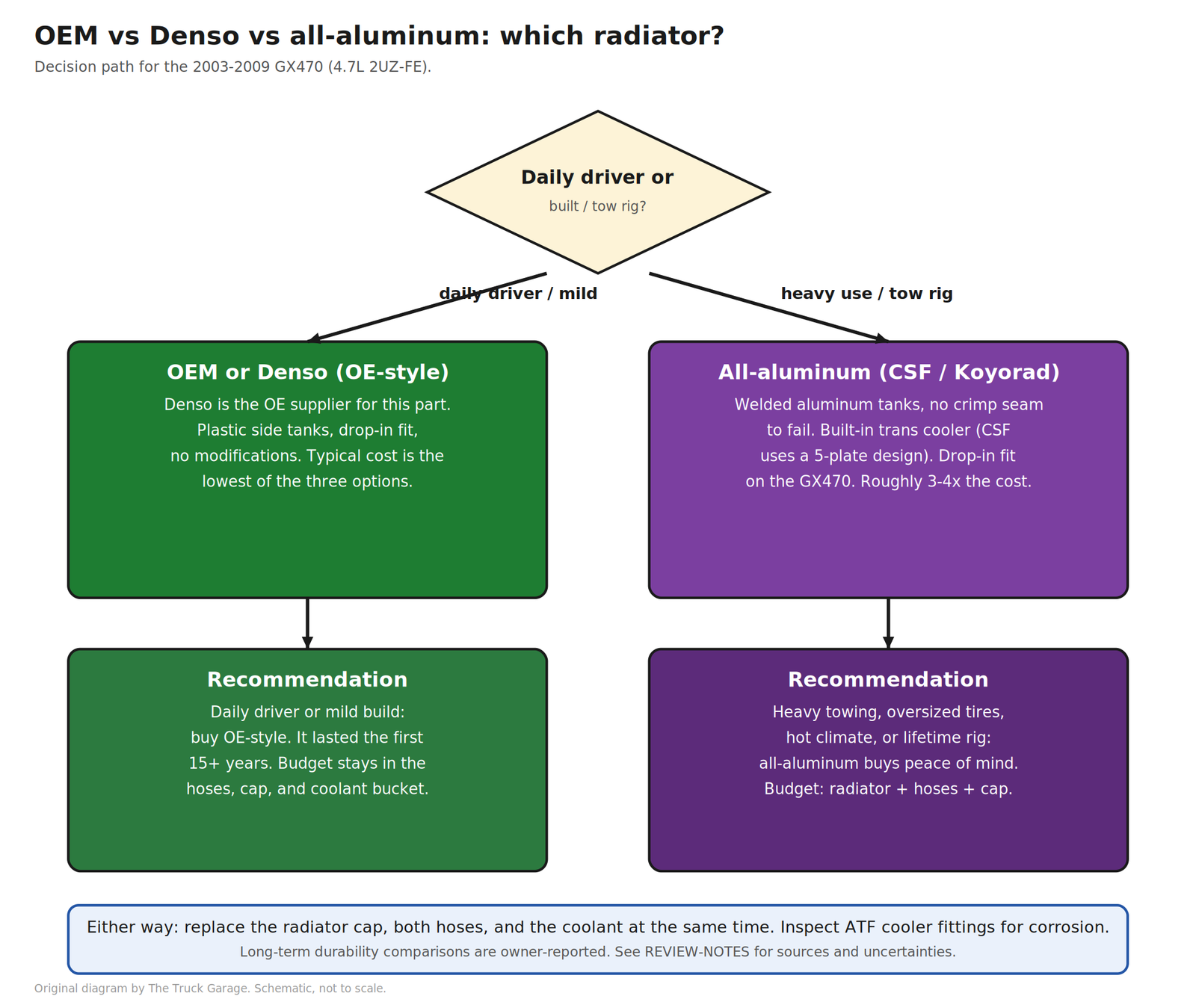
OEM Toyota/Lexus. The dealer part. Same plastic-tank construction as what failed, with the same expected lifespan. Most expensive option, best for a truck you are keeping stock or reselling soon where receipts matter. Confirm fitment by VIN at parts.lexus.com or toyodiy.com.
Denso aftermarket (221-3125). Denso is Toyota’s primary tier-1 supplier for cooling components and the OE manufacturer of this radiator. The Denso 221-3125 is the confirmed correct aftermarket fitment for the 2003-2009 GX470, and it is typically the cheapest option of the three. It is the same plastic-tank design as OEM. One owner reported the top strap on a RockAuto Denso unit was thinner than the original and eventually cracked, though cooling was unaffected. Verify the part number against your VIN before ordering, since catalog mixups happen.
All-aluminum (CSF, Koyorad). TIG-welded aluminum end tanks replace the crimped plastic entirely, which removes the seam as a failure point. CSF makes a drop-in all-metal radiator specifically for the 2003-2009 GX470 and V8 4Runner, with a 2-row 42 mm aluminum core and a built-in 5-plate transmission cooler, plus foam strips to seal the fan shroud. CSF claims its B-Tube core design improves heat transfer about 15 percent over standard oval tubes, which is a manufacturer claim worth footnoting rather than accepting blindly. Koyorad sells a racing-spec all-aluminum unit for the same trucks. The trade-off is cost: all-aluminum runs roughly three to four times the price of the Denso. One install note for the all-aluminum units: TIG-welded tanks are rigid, so they pass chassis flex straight to the core seams. Inspect the lower rubber mount bushings and replace them if they are rotted. Worn isolators plus a rigid radiator is how core seams crack on trucks that see off-road articulation.
| Option | Construction | Typical cost | Best for |
|---|---|---|---|
| OEM Toyota/Lexus | Plastic tanks, crimped | Highest | Stock truck, resale receipts |
| Denso 221-3125 | Plastic tanks, crimped (OE-style) | Lowest | Daily driver, mild build |
| CSF all-aluminum | Welded aluminum tanks | ~3-4x Denso | Towing, oversized tires, hot climate, lifetime rig |
| Koyorad all-aluminum | Welded aluminum tanks | ~3-4x Denso | Same as CSF, brand preference |
Durability claims for the all-aluminum units beyond “the seam cannot fail” are owner-reported. An OE-style radiator that lasted 15 plus years is not a bad part. Do not buy all-aluminum for a truck that will see grocery runs. Buy it for the truck that tows, crawls, or lives in the desert.
GX460 and GX550 Notes
The same plastic-tank, crimped-seam construction concept carries forward. The GX460 (2010-2023, 4.6L 1UR-FE) shares the same plastic-tank, crimped-seam design with an internal transmission oil cooler, and owner threads describe the same side-tank leak pattern at high mileage. The GX460 radiator (16400-38252), cap (16405-50051), hoses (16571-38101 upper, 16572-38151 lower), and thermostat (90916-03110) are listed in the parts table below. Torque figures for the GX460 are verified against the factory manual: radiator bolts 13 ft lb (18 N.m), fan shroud bolts 44 in lb (5.0 N.m), fluid coupling nuts 15 ft lb (21 N.m). Coolant capacity is 14.5 US qt (13.7 L) without the rear heater, 16.3 US qt (15.4 L) with it. Confirm against the GX460 factory manual for your year before wrenching.
The GX550 (2024+, 3.4L twin-turbo V35A-FTS) uses a complex multi-stage thermal management network with external liquid-to-liquid heat exchangers, and community long-term failure data is thin. Procedures and capacities do not carry over. Inspect the same way, verify everything against the factory manual, and do not assume GX470 parts or procedures carry over.
Parts and tools
Parts. Part numbers by model. Confirm against your VIN at parts.lexus.com before ordering. Links go to eBay search results for the part number unless noted.
| Part | GX470 (2003-2009, 2UZ-FE) | GX460 (2010-2023, 1UR-FE) | GX550 (2024+, V35A-FTS) |
|---|---|---|---|
| Radiator, OEM | 16400-50313 (Lexus) / 16400-50300 (Toyota) | 16400-38252 | Verify by VIN |
| Radiator, aftermarket | Denso 221-3125 | CSF 7214 all-aluminum | Verify by VIN |
| Radiator cap | 16401-31650 | 16405-50051 | Verify by VIN |
| Upper radiator hose | 16571-50200 | 16571-38101 | Verify by VIN |
| Lower radiator hose | 16572-50190 | 16572-38151 | Verify by VIN |
| Thermostat | 90916-03100 (Amazon) | 90916-03110 | Verify by VIN |
| Coolant | Toyota Super Long Life pink premix, 00272-SLLC2 | Toyota Super Long Life pink premix, 00272-SLLC2 | Toyota Super Long Life pink premix, 00272-SLLC2 |
A radiator swap drains about 6 to 8 quarts. The rest stays in the engine block unless you pull the block drain plugs, so two gallons of premix covers the refill. Full dry system capacity is 13.6 US qt (12.9 L) on the GX470 2UZ-FE and 14.5 US qt (13.7 L) on the GX460 1UR-FE without the rear heater, 16.3 US qt (15.4 L) with it.
New thermostat is the common add-on since the system is open; owners doing the timing belt bundle do it then. New drain petcock if yours weeps. Inspect the lower radiator mount bushings. They are frequently rotted by 150,000 miles. Replace them if they are cracked or collapsed. The two heater hoses are worth replacing if they are original, but they vary enough by year that a VIN lookup beats a printed part number here.
Tools. Basic socket set, drain pan that holds at least 3 gallons, funnel. Hose clamp pliers or a flat screwdriver, depending on your clamp style. A cooling system pressure tester is the shadetree luxury that pays for itself here: it finds the seam weep cold, before you tear anything apart. Shadetree alternative to the pressure tester: clean the seam with brake cleaner, drive it hot for a day, and re-inspect with a flashlight for fresh pink crust. It works, it just takes longer.
Replacement Overview
This is an overview of the job, not a reproduction of the factory procedure. The full step-by-step with every fastener lives in the factory manual. The GX470 radiator is a beginner-to-intermediate job. Plan half a day the first time.
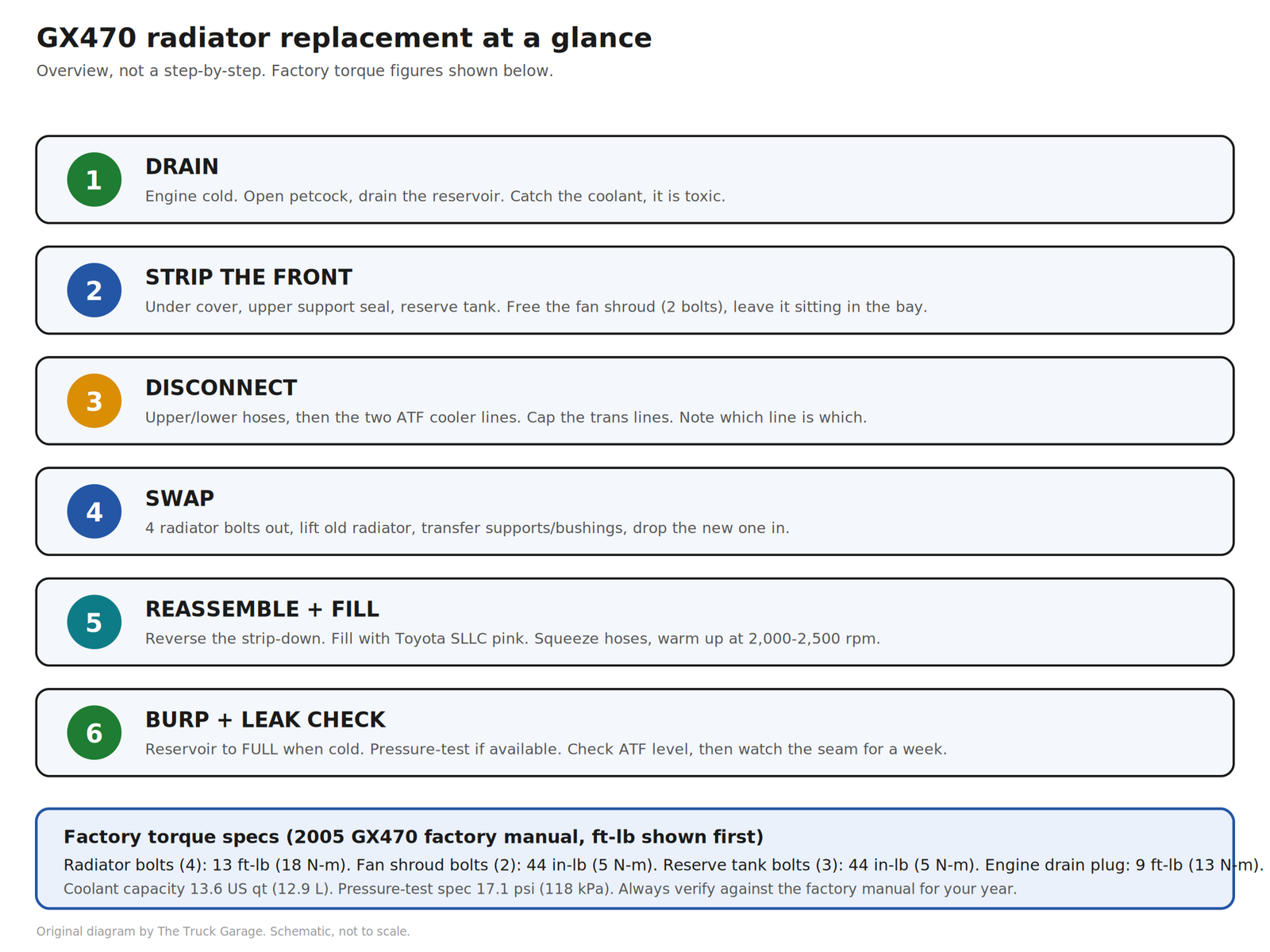
1. Drain. Engine cold. Remove the radiator cap, attach a hose to the radiator drain, open the petcock, and drain the reservoir too. Coolant is toxic to pets and kids. Catch all of it.
2. Strip the front. Remove the engine under cover, the upper radiator support seal, and the reserve tank. Disconnect both radiator hoses and the two ATF cooler lines from the radiator, and cap the transmission lines so they do not drip ATF into your drain pan or driveway. Separate the fan shroud with its two bolts and set it aside in the engine bay. Shadetree note: mark which ATF line is inlet and outlet with tape before you pull them.
3. Swap. Four bolts hold the radiator. Lift it straight up and out. Transfer the rubber supports, bushings, and brackets to the new radiator. The factory manual lists 13 ft lb (18 N·m) for these four bolts. Fan shroud bolts go to 44 in lb (5 N·m), and the reserve tank bolts to 44 in lb (5 N·m).
4. Reassemble and fill. Reverse the strip-down. Fill slowly with Toyota Super Long Life Coolant. A radiator swap takes about 6 to 8 quarts, roughly what you drained. Full dry system capacity is 13.6 US qt (12.9 L), but you will not need that much unless the block was drained too.
5. Burp. The factory fill procedure: install the cap, start the engine with the heater on, hold 2,000 to 2,500 rpm until warm, shut down, let it cool, then top the reservoir to the FULL line. Squeeze the upper and lower hoses by hand a few times to work air out. The 2UZ-FE traps air at the thermostat, so do not skip this. Shadetree alternative: a spill-free funnel on the filler neck makes the burp nearly foolproof.
6. Check for leaks. Factory spec is a 17.1 psi (118 kPa) pressure test with the engine warm. The factory bench-tests the radiator alone at 26 psi (177 kPa). Then check the ATF level using the overflow-plug procedure in our transmission fluid service guide, because you opened the cooler lines. Watch the top seam for a week after the job.
GX460 replacement overview
Same concept as the GX470, with more front-end teardown and nearly identical torque figures. Verified against the 2013 GX460 factory manual.
1. Drain. Engine cold. Drain the radiator and the reservoir. The GX460 holds more coolant than the GX470: 14.5 US qt (13.7 L) without the rear heater, 16.3 US qt (15.4 L) with it.
2. Strip the front. Remove the V-bank cover, the lower front bumper cover, and the front bumper cover. Move both radiator side deflectors aside. Remove the radiator reservoir (3 bolts) and disconnect its hose. Disconnect the No. 1 radiator hose.
3. Fan shroud. Loosen the 4 fluid coupling nuts, remove the fan and generator V belt, then remove the 2 fan shroud bolts. Lift the shroud out together with the fluid coupling, and pull the fan pulley off the water pump. Do not damage the radiator core on the way out.
4. Swap. Disconnect the No. 2 radiator hose and the 2 oil cooler hoses from the radiator. Remove the 4 radiator bolts and lift the radiator straight up and out. Transfer the No. 1 and No. 2 supports, the 4 support bushes, and the seals to the new radiator. The 4 radiator bolts torque to 13 ft lb (18 N.m), same as the GX470.
5. Reassemble and fill. Reverse the strip-down. Fan shroud bolts go to 44 in lb (5.0 N.m). Fluid coupling nuts go to 15 ft lb (21 N.m). Reservoir bolts go to 44 in lb (5.0 N.m). Fill with Toyota Super Long Life Coolant and burp the system the same way: heater on, hold rpm until warm, cool down, top the reservoir to FULL.
6. Check for leaks. Pressure-test, check the ATF level through the overflow plug since you opened the cooler lines, and watch the seam for a week.
The GX550 has no verified replacement procedure in this guide. Its cooling package is a multi-stage design with external heat exchangers, so do not apply the GX470 or GX460 steps to it.
Common Mistakes
- Diagnosing a hose or petcock as a radiator. Pink crust near a clamp is a hose. Low central drip is the petcock O-ring. Pressure-test cold before buying parts.
- Reusing the radiator cap. The cap is a wear item that regulates system pressure. Replace it with the radiator.
- Skipping the burp. The 2UZ-FE traps air. An incomplete burp overheats the truck on the first drive and looks like a bad job.
- Forgetting the ATF level. You disconnected the cooler lines. Set the level through the overflow plug afterward.
- Using the wrong coolant. Toyota Super Long Life Coolant, pink, premixed. Not green universal. Not plain water.
- Replacing the radiator without inspecting the ATF fittings. If the old fittings were corroded, that corrosion was your milkshake warning. Look at the lines, not just the radiator.
FAQ
Should I replace my GX470 radiator preventatively at 200,000 miles?
If the front of the engine is coming apart for a timing belt service, yes, bundle it. The extra cost is one part. If the seam is clean and the coolant and ATF are serviced on schedule, inspecting the seam and the ATF fittings at every oil change is a defensible alternative. There is no factory-published replacement interval.
My radiator is leaking at the top seam. Can it be repaired?
Replace it. The factory’s own re-caulking procedure caps out at two re-caulks, needs a dealer-only tool, and Toyota no longer sells the tank service parts. Epoxy and crimp-tab bending are delay tactics.
Is the Denso radiator as good as OEM?
Denso is the OE supplier for this radiator, and the Denso 221-3125 is the confirmed aftermarket fitment. It is the same plastic-tank design as OEM, at the lowest price. Confirm the part number against your VIN before ordering.
Which all-aluminum radiator fits the GX470?
CSF makes a drop-in all-metal radiator for the 2003-2009 GX470 and V8 4Runner with a built-in 5-plate transmission cooler. Koyorad sells a racing-spec all-aluminum unit for the same trucks. Both cost roughly three to four times the Denso.
What does the pink milkshake look like, and how do I check?
Pink, milky sludge in the coolant overflow bottle or on the 2003’s transmission dipstick. On sealed transmissions, pull the level-check plug briefly and look at what comes out. A confirmed milkshake means a new radiator and a full transmission service. Full detail is in our transmission fluid service guide.
What else should I replace with the radiator?
Radiator cap, upper and lower hoses, the coolant, and usually the thermostat. If your truck is due for the timing belt, bundle the belt, water pump, and radiator in one job. See our GX fluids guide.
Sources
- Factory manual: 2005 GX470 repair manual, Cooling system (2UZ-FE), coolant replacement, pressure test, and radiator removal/installation procedures
- ih8mud, Replacing radiator 07gx470, Denso 221-3125 fitment and OE-supplier discussion: https://forum.ih8mud.com/threads/replacing-radiator-07gx470.887405/
- ih8mud, I’m guessing it’ll need a new radiator: Leaks at the bottom?, crimp-tab repair discussion and radiator cap maintenance: https://forum.ih8mud.com/threads/im-guessing-itll-need-a-new-radiator-leaks-at-the-bottom.1331819/
- ih8mud, GX470 Coolant loss with no visible leaks, driver-side upper seam leak and bundled thermostat/radiator/hose job: https://forum.ih8mud.com/threads/gx470-coolant-loss-with-no-visible-leaks.1331819/
- ih8mud, New CSF Lexus GX470 Radiator, CSF manufacturer design and engineering details: https://forum.ih8mud.com/threads/new-csf-lexus-gx470-radiator.1314664/
- 4Runners.com, The Pink Milkshake: How worried should you be? 200k Radiator Teardown: https://www.4runners.com/threads/the-pink-milkshake-how-worried-should-you-be-200k-radiator-teardown.22783/
- tundras.com, More Pink Milkshake, ATF fitting corrosion discussion: https://www.tundras.com/threads/more-pink-milkshake.37875/page-3
- TrailBuilt Off-Road, Koyorad VH011703N racing radiator product page: https://www.trailbuiltoffroad.com/store/performance/116653/koyorad-racing-radiator-03-09-toyta-4runner
- HPS Performance via Figs Engineering, GX460 silicone radiator hose kit, OEM interchange 16571-38101 / 16572-38151: https://shopfigs.com/v5/2010-2023-Lexus-GX460-Radiator-Coolant-Hose-57-2127-BLUE
- FinditParts, AISIN THT-005 thermostat, GX460 2010-2023 fitment (OEM cross-reference Toyota 90916-03110): https://www.finditparts.com/products/8064765/aisin-tht-005
- Standard part number references: parts.lexus.com and toyodiy.com
- Related Truck Garage guides: Transmission Fluid Service, GX Fluids Guide
Leave a Reply